Solutions to Moral Hazard
18 May 2016 Leave a comment
in economics of information, industrial organisation Tags: moral hazard
What % of each occupation needs a license or certificate in the USA?
23 Apr 2016 1 Comment
in applied price theory, applied welfare economics, economics of regulation, labour economics, labour supply, occupational choice, occupational regulation, Public Choice, rentseeking Tags: adverse selection, barriers to entry, moral hazard, occupational licensing, occupational regulation
The 2015 Current Population Survey in the USA added a question about whether you needed a licence or a certificate to practice your occupation. One in 4 Americans say they need a licence or certificate. 22.4% need a license and 3.1% need a certificate among employed over the age of 16 in the USA.
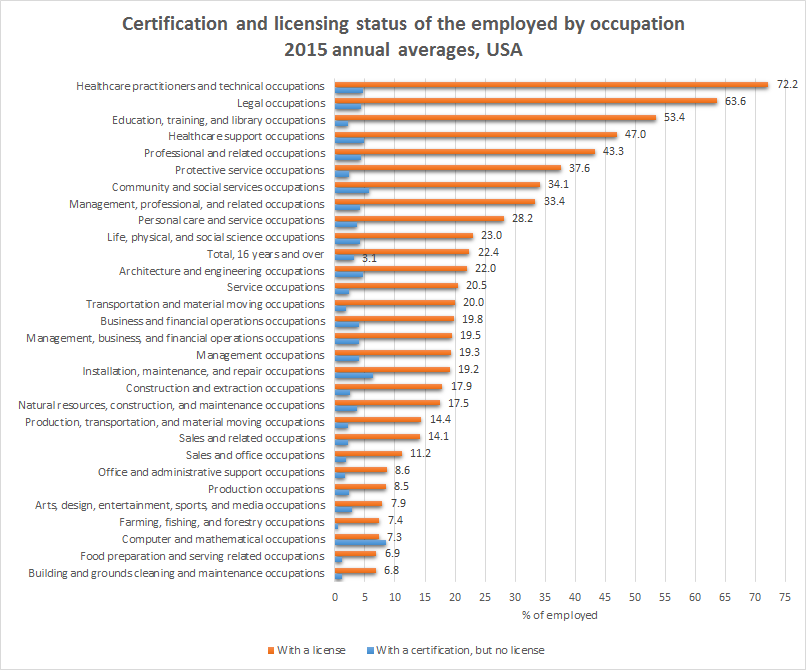
Source: Bureau of Labour Statistics, Labor Force Statistics from the Current Population Survey (2015), Certification and licensing status of the employed by occupation Table 5.
This estimate of 25% is less than the 30% estimated by Kleiner and Vorotnikov (2015) using a Harris Poll. Kleiner and Vorotnikov (2015) also found that some American states regulate twice as many occupations as others. This diversity in federalism strains any public interest explanation of occupational regulation.
Occupational regulation is more likely to be an issue for those who finished further education. It would have been better if the estimate by the Bureau of Labour Statistics was for adults and not have included teenagers.
The purpose of occupational regulation is to protect buyers from quacks and lemons – to overcome asymmetric information about the quality of the provider of the service.
The main issue with quacks in the labour market is whether there is a large cost of less than average quality service, and is there a sub-market who will buy less than average quality products in the presence of competing sellers competing on the basis of quality assurance. This demand for assurance creates opportunities for entrepreneurs to profit by providing assurance of quality.
Mostly disciplinary investigations and deregistrations under the auspices of occupational regulation are for gross misconduct and criminal convictions rather than the shading of quality.
Interesting critique of the Big Short (moral hazard)
15 Apr 2016 Leave a comment
in applied price theory, business cycles, economics of media and culture, global financial crisis (GFC), law and economics, macroeconomics Tags: moral hazard, The Big Short
Are CEOs denied their labour surplus?
11 Dec 2015 Leave a comment
in applied price theory, entrepreneurship, fisheries economics, human capital, industrial organisation, labour economics, labour supply, managerial economics, occupational choice, organisational economics, personnel economics, survivor principle Tags: CEO pay, moral hazard, promotion tournaments, superstar, superstar wages
Bang Dang Nguyen and Kasper Meisner Nielsen looked at how share prices reacted to 149 cases of the chief executive or another prominent manager dying suddenly in American companies between 1991 and 2008.
If the shares rise on an executive’s death, he was overpaid; if they fall, he was not. Only 42% of the bosses studied were overpaid. Those with the bigger pay packages gave the best value for money as measured by the share-price slump when they passed away unexpectedly.
Share prices do speak to the value of the company and the contribution of its CEO. The share price of Apple went up and down by billions on the back of rumours about the health of Steve Jobs.
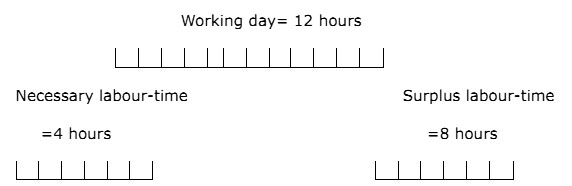
In terms of splitting of what some call the labour surplus increase from a firm hiring an executive, these employees retain on average about 71% and their employer keeps 29%. Others call this rent sharing.

71% going to the CEO might initially sound high, “but it’s not like he’s taking home more than he produced for the company,” says Nguyen.

The exploitation of CEOs gets worse when you consider the extensive use of promotion tournaments by their employers when setting their wages. They are thrust into rat races. Promotion tournaments are an integral and often invisible part of their workplaces.
Executive level employees are often ranked by their employers relative to each other and promoted not for being good at their jobs but for being better than their rivals. These promotion tournaments sent one employee against another – one worker against another – to the profit of the owners of the firm.
The rat race set up by the owners of the firm are so cutthroat that in competitions to determine promotions the capitalists who own the firm may find that their employees discover that the most efficient way of winning a promotion is by sabotaging the efforts of their rivals.
Lazear and Rozen’s tournament theory of executive pay has stood the test of time. The key to this rat race is the larger is your boss’s pay, the bigger the motivation for you as an underling to work for a promotion. As Lazear wrote in his book, Personnel Economics for Managers
The salary of the vice president acts not so much as motivation for the vice president as it does as motivation for the assistant vice presidents.
The modern macroeconomics of the Global Financial Crisis
02 Dec 2015 Leave a comment
in applied price theory, budget deficits, business cycles, economic growth, economic history, economics of regulation, Euro crisis, fiscal policy, global financial crisis (GFC), great depression, great recession, macroeconomics, monetary economics Tags: adverse selection, bank panics, bank runs, banking crises, deposit insurance, economics central banks, financial crises, moral hazard, sovereign defaults
The most dangerous monopoly: When caution kills
13 Sep 2015 Leave a comment
in applied price theory, applied welfare economics, economics of bureaucracy, economics of regulation Tags: adverse selection, Competition as a discovery, drug lags, moral hazard, The meaning of competition
There is an economic literature on feuds and duelling
07 Aug 2015 Leave a comment
in applied price theory, comparative institutional analysis, economic history, economics of media and culture Tags: adverse selection, asymmetric information, competition as a discovery procedure, duals, feuds, game theory, moral hazard, screening, signalling
How they resolved spats before Twitter existed
thepoke.co.uk/2015/07/26/res… http://t.co/a04CTYT2aX—
The Poke (@ThePoke) July 27, 2015
I thought America’s poor never had health insurance cover!? I’ve watched too much American TV?
26 Jul 2015 1 Comment
in applied welfare economics, economic history, economics of media and culture, health economics, industrial organisation, politics - USA, Public Choice, rentseeking, survivor principle Tags: adverse selection, expressive voting, health insurance, Leftover Left, media bias, medicaid, Medicare, moral hazard, Obamacare, rational ignorance, rational irrationality
#Medicaid expands access to health coverage and supports work: bit.ly/1RKHQ2x #Medicaidat50 http://t.co/mydZMggcXg—
Center on Budget (@CenterOnBudget) July 20, 2015
6.4 million seniors get the vital support & care they need thanks to Medicaid: bit.ly/1HqYvNG #Medicaidat50 http://t.co/onWMiYj301—
Center on Budget (@CenterOnBudget) July 23, 2015
Reminder: #Medicaid helps millions of babies: bit.ly/1RS7ME5 #Medicaidat50 http://t.co/SeJ7MFPGWE—
Center on Budget (@CenterOnBudget) July 20, 2015
#Medicaid help millions of children across the country live healthier lives. #Medicaidat50: bit.ly/1RS7ME5 http://t.co/LT6rXhNzUg—
Center on Budget (@CenterOnBudget) July 16, 2015
50 years of coverage that every American deserves. #Medicare http://t.co/uRtERV2k9K—
American Progress (@amprog) July 30, 2015
Mann: Celebrating historic gains in coverage for kids CCF#2015 http://t.co/g7CYQ7DuwN—
Georgetown CCF (@GeorgetownCCF) July 22, 2015
#Medicare has been keeping seniors insured and healthy for 50 years. http://t.co/mXW4x12Rhi—
American Progress (@amprog) July 30, 2015
The majority of Americans of all ages don't recognize that gov subsidizes their health care: vox.com/2015/3/1/81257… http://t.co/ivq5eLThsi—
(@SocImages) April 22, 2015
The Effect of Police Body-Worn Cameras on Use of Force and Citizens’ Complaints Against the Police
26 Feb 2015 Leave a comment
in economics of crime, law and economics, managerial economics, organisational economics, personnel economics Tags: camera surveillance, crime and punishment, moral hazard, police
The results are no surprise. There is a 50% drop in the use of force by police when they are required to wear body cameras.
We conducted a randomized controlled trial, where nearly 1,000 officer shifts were randomized over a 12-month period to treatment and control conditions.
During ‘‘treatment shifts’’ officers were required to wear and use body-worn-cameras when interacting with members of the public, while during ‘‘control shifts’’ officers were instructed not to carry or use the devices in any way.
We observed the number of complaints, incidents of use-of-force, and the number of contacts between police officers and the public, in the years and months preceding the trial (in order to establish a baseline) and during the 12 months of the
experiment.
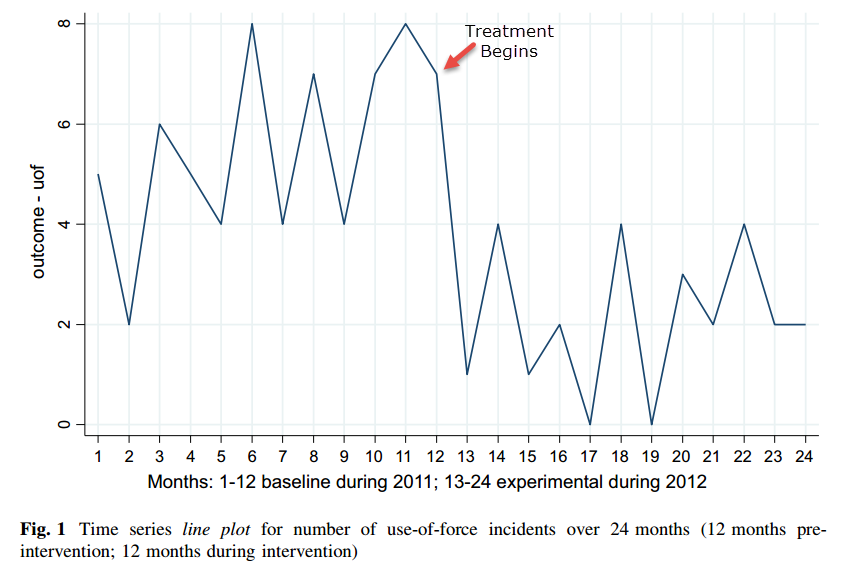
Police use of force reports halved on shifts when police wore cameras. It is not known whether this reduction in the use of force is because members of the public were now aware that any misbehaviour by them to be caught on camera and used as evidence against them or police were aware that any excessive force by them would be caught on camera as well.
The personnel economics of putting up election billboards
04 Sep 2014 Leave a comment
in applied price theory, labour economics, managerial economics, organisational economics, personnel economics, politics - New Zealand, theory of the firm Tags: 2014 New Zealand election, agent principal problems, labour economics, moral hazard, New Zealand politics, paid versus unpaid labour, personnel economics
I’ve been out of late, helping put up election billboards. Maybe I should get a life, but I noticed that the quality of effort by volunteers was much better than that by the contractors hired by the Internet – Mana party. Everybody in that party appears to be paid including the leader for $140K year. She is not yet in Parliament.

The Internet-Mana party election billboards are very heavy, solid wooden signs and obviously pre-manufactured and must be driven around in a truck. They are certainly too heavy to be put on the back of a trailer behind a private car.
Our signs are constructed on site from a dozen pieces of wood of various sizes. The only pre-prepared part is the billboard itself with fits on the back of a trailer.
What first took my interest is the contractors hired by the Internet – Mana party signs seem to pay not all that much regard to the traffic flow. Some of their signs are parallel with the traffic so hardly anybody can see them. They are all one sided signs.
When we are putting up a election billboard, we squabble like a bunch of old women over the exact angle each sign should face the traffic to capture the most number of passing cars and buses. Everybody has an opinion including those doing it for the first time.

We then squabble about whether the sign should be one-sided or two sided depending upon how well it can be viewed from the other side by traffic coming the other way.
We also squabble about its positioning and height to maximise the number of views by the passing traffic relative to the positioning all the other signs.
There is also a lot of vandalism of these signs by rather naive people who don’t understand that the passing motorist looks at the vandalised signs first.

It takes a whole lot of hatred to vandalised a sign in this way. Photos of the above sign immediately went viral. For some reason, the National party has repaired that sign. I don’t know why.
Managerial Econ: Fee-for-service vs. capitation: 10 fewer amputations per capita
31 Jul 2014 Leave a comment
in health economics Tags: agent principal problems, asymmetric information, moral hazard

- Single-year mortality rates fell from 6.8 per cent in the traditional fee-for-service sample to 1.8 per cent
- Patients in the Medicare Advantage plans had shorter average stays in the hospital (about 19 per cent shorter.)
- Patients in the managed plans were more likely to receive preventive care …For example, diabetic patients in the fee-for-service sample had an average of 11.5 amputations per 1,000 patients; those in HMO plans with global capitation had only 0.3.

via Managerial Econ: Fee-for-service vs. capitation: 10 fewer amputations per capita.
Managerial Econ: Physician Induced Demand
31 Jul 2014 Leave a comment
in applied welfare economics, health economics Tags: agent principal problems, asymmetric information, moral hazard, Physician Induced Demand

Rehavi and Johnson compare obstetricians’ choice of C-section during childbirth when the expectant mother is herself a medical doctor to when she is not. From their abstract:
… Consistent with PID [Physician Induced Demand], physicians are almost 10 per cent less likely to receive a C-section, with only a quarter of this effect attributable to differential sorting of patients to hospitals or obstetricians.

To those who still doubt moral hazard
15 Jul 2014 Leave a comment
in applied price theory Tags: moral hazard

I’ve had arguments with people until I’m blue in the face trying to persuade them that the risk of accidents is influenced by incentives.
 Utopia, you are standing in it!
Recent Comments