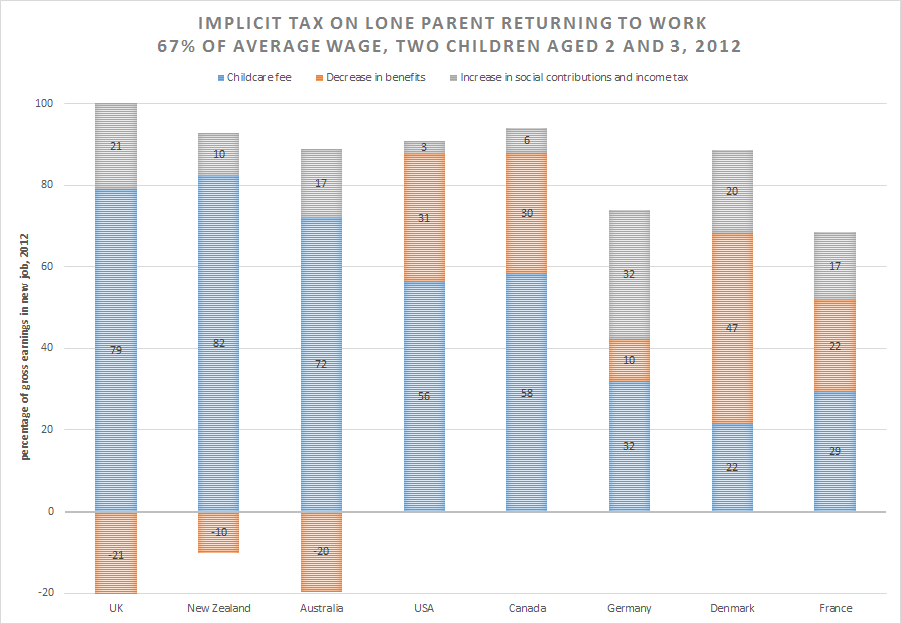
Implicit tax on a lone parent returning to a low-paid job in the USA, UK, Denmark, France, Germany, Canada, Australia and New Zealand
28 Feb 2016 Leave a comment
in applied price theory, fiscal policy, labour economics, labour supply, politics - Australia, politics - New Zealand, politics - USA, poverty and inequality, public economics, welfare reform Tags: poverty traps, single mothers, single parents, social insurance, taxation and labour supply, welfare state
Ratio of unemployment and single parents benefit to the New Zealand net average wage since 1970
27 Feb 2016 Leave a comment
in economic history, labour economics, labour supply, politics - New Zealand, welfare reform Tags: domestic purposes benefit, single mothers, single parents, social insurance, unemployment benefit, welfare state
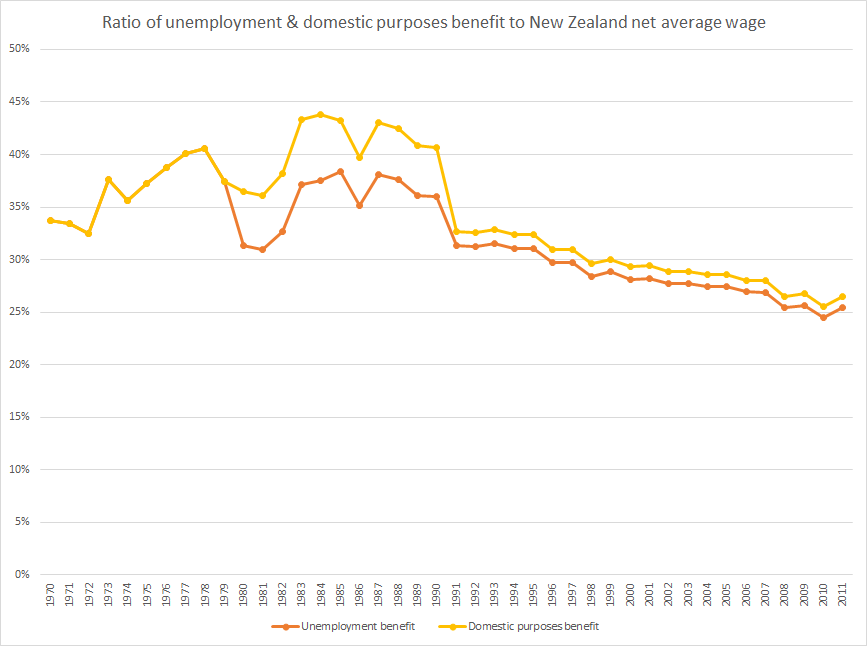
Source: OECD Economic Survey New Zealand 2015.
Public, mandatory private and private social expenditure as % of US GDP, selected years since 1980
20 Feb 2016 Leave a comment
in economic history, fiscal policy, labour economics, macroeconomics, politics - USA, welfare reform Tags: social insurance, welfare state
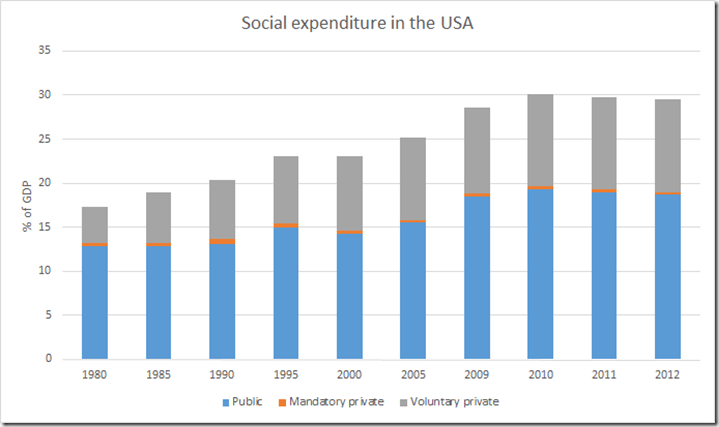
Source: OECD Income Distribution database.
Public, mandatory & voluntary private social expenditure, G7, Nordics, Australia & New Zealand
20 Feb 2016 Leave a comment
in applied welfare economics, economics of regulation, fiscal policy, labour economics, politics - Australia, politics - New Zealand, politics - USA, welfare reform Tags: British economy, Canada, Denmark, Finland, France, Germany, Italy, Japan, Norway, social insurance, Sweden, welfare state
Mandatory and voluntary private social expenditure makes a big difference to the degree of social insurance in some countries but not others. The calculation of these numbers in purchasing power parity would be much more interesting.
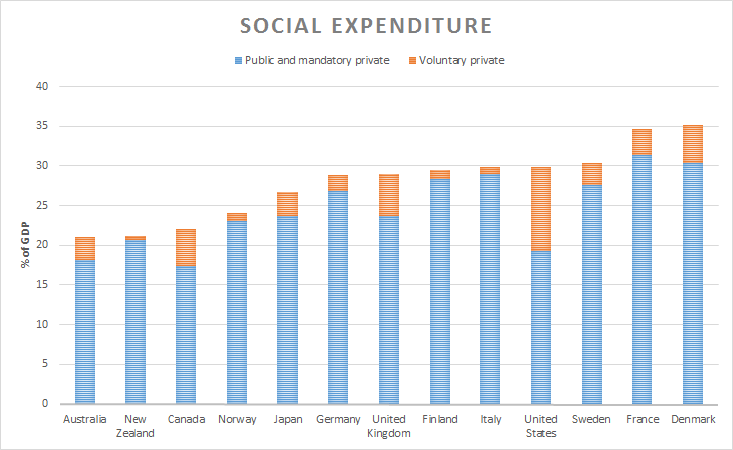
Source: OECD Income Distribution database.
% social benefits in cash by income quintile, G7, Nordics, Australia and New Zealand
20 Feb 2016 Leave a comment
in fiscal policy, income redistribution, labour economics, politics - Australia, politics - New Zealand, politics - USA, Public Choice, welfare reform Tags: British economy, Denmark, Finland, France, Germany, Italy, Japan, Norway, social insurance, Sweden, welfare state
Some welfare states are much more targeted. Australia has the most targeted welfare state in terms of public social benefits paid in cash to the bottom quintile (Q1) of income earners.

Source: OECD Income Distribution database.
Effective labour market exit age by gender in the G7 countries, Australia and New Zealand
19 Feb 2016 Leave a comment
in labour economics, labour supply, politics - Australia, politics - New Zealand, politics - USA, population economics Tags: ageing society, gender gap, old age pensions, older workers, social insurance, welfare state
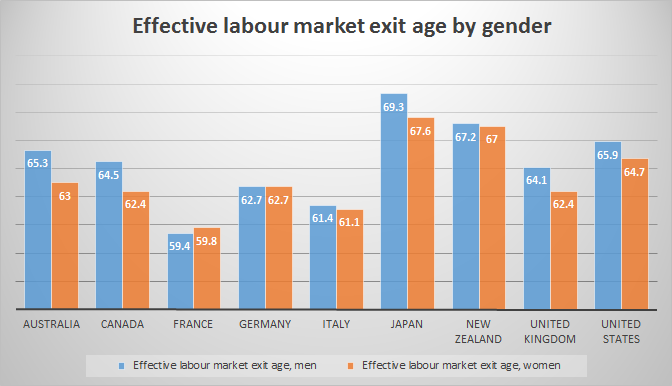
Source: OECD Pensions at a Glance 2015.
.
New Zealand male labour force participation, ages 50 to 74, 5 year age bands, 1986 – 2014
08 Feb 2016 Leave a comment
in labour economics, labour supply, politics - New Zealand, public economics Tags: old-age pension, older workers, social insurance
Older workers in the past was defined by a drop-off in labour force participation at the age of 55 such as there was in the 1990s. Not only that is no more, New Zealand workers aged 60 to 64 participate in the labour force to the same extent as workers in their 50s, more or less.
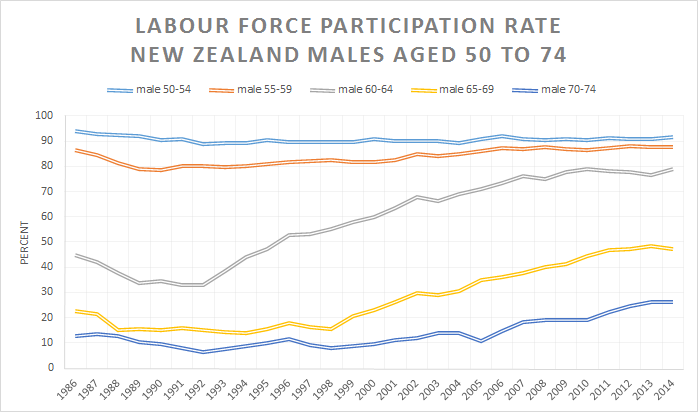
Source: OECD Stat.
Workers aged 65 to 69 and aged 70 to 74 also rapidly increased their labour force participation. Nonetheless, in New Zealand they still get an old age pension in these age brackets without an income test or an asset test.
Female labour force participation rate, workers aged 65 to 69, US, UK, Australia and New Zealand since 1960
06 Feb 2016 Leave a comment
in gender, labour economics, labour supply, politics - New Zealand, public economics Tags: ageing society, labour demographics, old age pensions, older workers, social insurance
The phased increase in the eligibility age for the New Zealand old pension from 60 to 65 from the mid-1990s obviously carried through to the labour force participation of women over 65 as well.
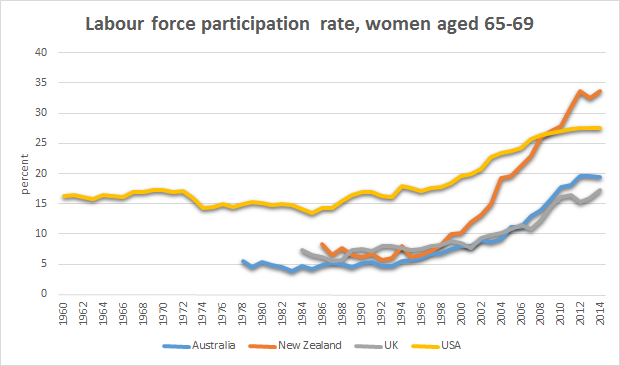
Data extracted on 05 Feb 2016 05:13 UTC (GMT) from OECD.Stat.
Female labour force participation rate, workers aged 60 to 64, USA, UK, Australia and New Zealand since 1960
06 Feb 2016 Leave a comment
in economic history, labour economics, labour supply, politics - New Zealand, public economics Tags: ageing society, labour demographics, old-age pension, older workers, social insurance, welfare state
The increase in the eligibility age from the age of 60 to the age of 65 for the old age pension in New Zealand clearly sparked an explosion in female labour force participation between these ages.
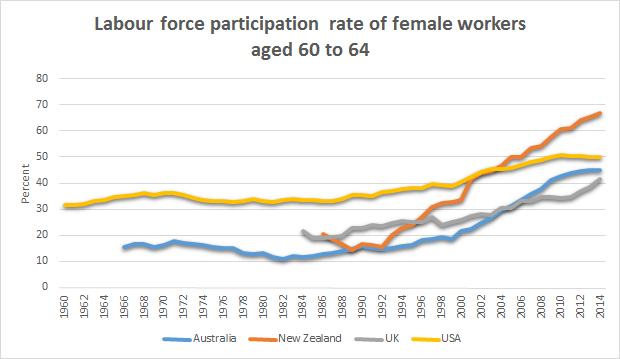
Data extracted on 05 Feb 2016 04:49 UTC (GMT) from OECD.Stat.
@BernieSanders MRI rationing – US v. Single-payer UK, Canada and Denmark
05 Feb 2016 Leave a comment
in health economics, politics - USA Tags: 2016 presidential election, British economy, Canada, Denmark, health insurance, medical rationing, NHS, single-payer, social insurance, universal health insurance
Single payer health insurance systems may have their advantages but one of which is not ready access to an MRI scan in the UK, Denmark or Canada.
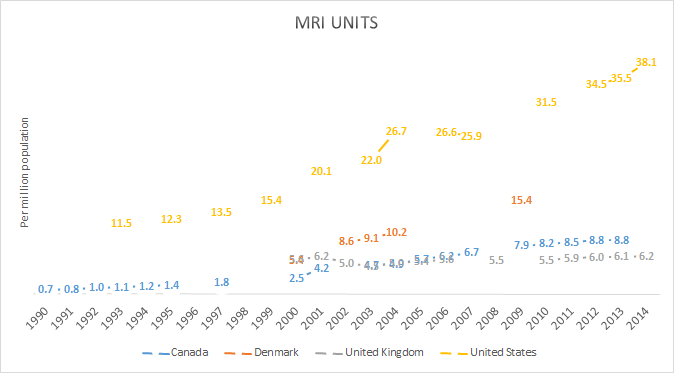
Source: OECD Health Statistics.
Remember that those aged over 65 in the USA are covered by Medicare; the poor and welfare beneficiaries are covered by Medicaid; and children of the working poor are covered by CHIPS.
I am told that dogs to get an MRI scan in Canada far quicker than humans. This is because dog owners can pay for the MRI scan. Private health insurance is unlawful in 9 of the 10 Canadian provinces.
There is considerable medical tourism from Canada to the USA, including by politicians who passionately support the single-payer system.
G7, Danish, Australian and New Zealand marginal income tax and social security contribution rates
31 Jan 2016 Leave a comment
in politics - Australia, politics - New Zealand, politics - USA, public economics Tags: Australia, British economy, Canada, Denmark, France, Germany, Italy, Japan, New Zealand, social insurance, Social Security taxes, taxation and labour supply
Ordinary French, Germans, Italians and Danish pay much higher marginal tax rates and that is before their high rates of GST.
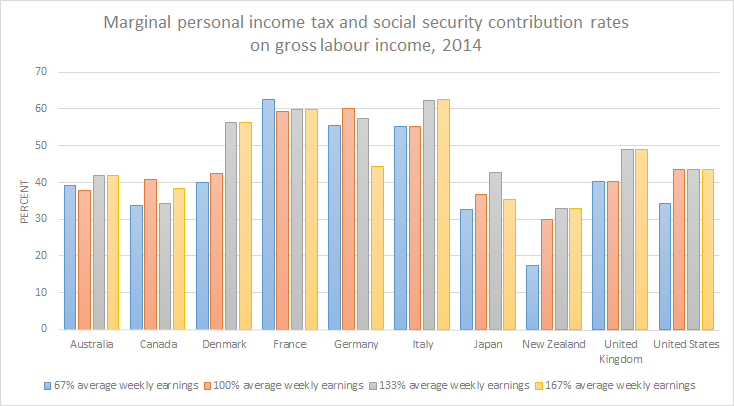
Data extracted on 30 Jan 2016 03:08 UTC (GMT) from OECD.Stat.
 Utopia, you are standing in it!
Recent Comments