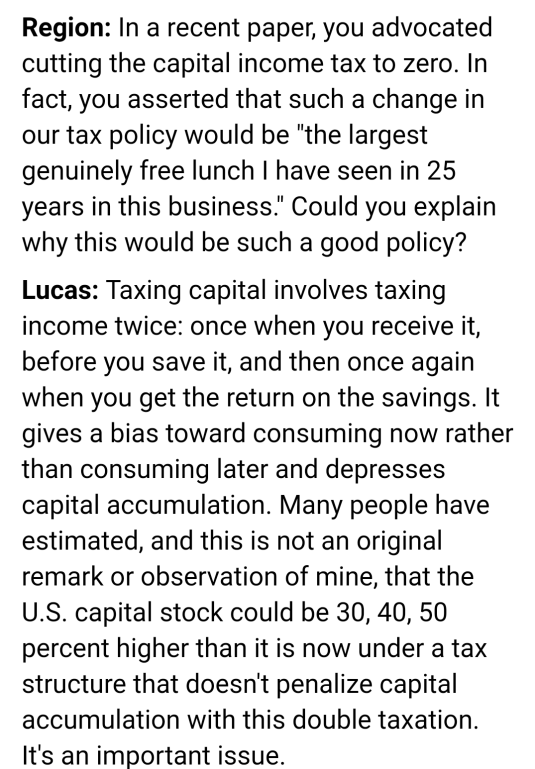
Speaking of capital gains taxes
02 Sep 2018 Leave a comment
in applied price theory, economic growth, macroeconomics, public economics, Robert E. Lucas Tags: capital gains tax, taxation and investment
“You’re all a bunch of socialists” Mises on Friedman
08 Aug 2018 Leave a comment
in applied price theory, applied welfare economics, Austrian economics, comparative institutional analysis, F.A. Hayek, income redistribution, Ludwig von Mises, Milton Friedman, Public Choice, public economics Tags: taxation and investment, taxation and labour supply
Piketty is a supply-side economists?
12 Jul 2018 Leave a comment
in applied price theory, entrepreneurship, human capital, labour economics, labour supply, occupational choice, poverty and inequality, public economics Tags: taxation and investment, taxation and labour supply, top 1%
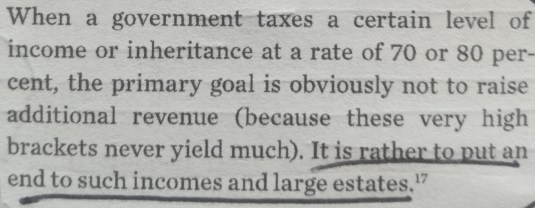
Maximum Wages: An absolutely terrible idea
11 Jan 2017 Leave a comment
in applied price theory, fiscal policy, labour economics, labour supply, macroeconomics Tags: British politics, envy, maximum wage, taxation and investment, taxation and labour supply
Do the Rich Pay Their Fair Share?
13 Jul 2016 Leave a comment
in politics - USA, public economics Tags: envy, superstars, taxation and entrepreneurship, taxation and investment, top 1%, top 10%
The effects of cutting the Australian company tax by one percentage point
02 Jun 2016 Leave a comment
in applied price theory, politics - Australia, politics - New Zealand, public economics Tags: Australia, company tax, international tax competition, tax incidents, taxation and entrepreneurship, taxation and investment
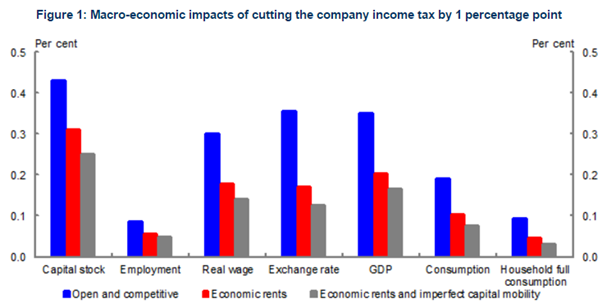
@PikettyLeMonde pension fund socialism has finished taking over #capitalism #Piketty
28 May 2016 Leave a comment
in economic history, financial economics, politics - USA, public economics Tags: company tax, Leftover Left, pension fund socialism, Peter Drucker, tax havens, taxation and entrepreneurship, taxation and investment, Twitter left
Peter Drucker first pointed out in the 70s that the retirement savings of ordinary workers will end up opening the majority of public listed companies. That day has come much to the disappointment of the Leftover Left ranging from Thomas Piketty to Max Rashbrooke.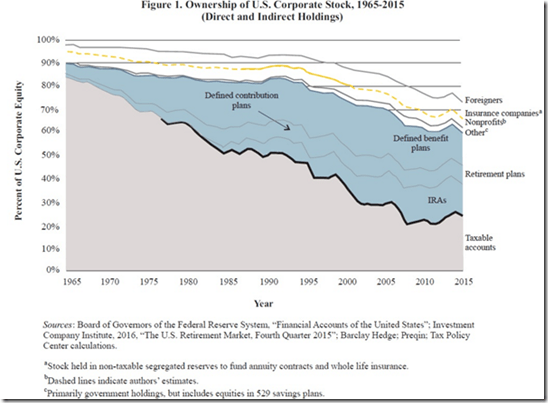
Source: CONVERSABLE ECONOMIST: US Corporate Stock: The Transition in Who Owns It.
Any call for higher taxes on investment incomes and capital and even tax havens is an attack on the retirement savings of ordinary workers.
#NeverTrump but why no #neverBernie, only #feelthebern?
28 May 2016 Leave a comment
in constitutional political economy, politics - USA Tags: 2016 presidential election, Leftover Left, reactionary left, taxation and entrepreneurship, taxation and investment, taxation and labour supply, Twitter left
Why have no Democrats formed the equivalent of #NeverTrump?
Bernie Sanders is not even a member of their party. Have they no principles?
Many of their republican opponents do in rejecting Trump and planning to vote for either Clinton or Gary Johnson.
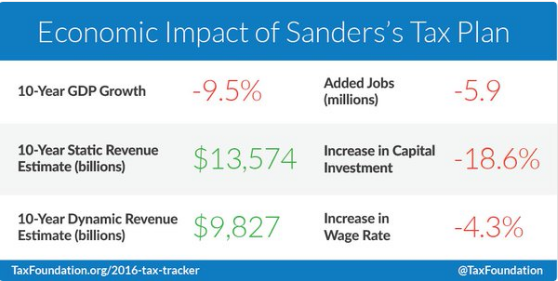
Sanders is an old socialist throwback whose economic policies would plunge the American economy into a deep recession harming most of all those that Democrats claim to represent.
Sander’s mind is just as inflexible as that of Trump as is his unwillingness to learn from events.
Money makes people right-wing and inegalitarian
21 May 2016 Leave a comment
in applied price theory, applied welfare economics, public economics Tags: taxation and investment, taxation and labour supply
Figure 1. Evidence on switchers: The percentage of people who switched right (conservative), and previously did not vote conservative, after a lottery win

Source: Money makes people right-wing and inegalitarian | VOX, CEPR’s Policy Portal.
@TheAusInstitute has not heard of Ireland’s 12.5% company tax and European tax harmonisation
19 May 2016 Leave a comment
in politics - Australia, politics - New Zealand, politics - USA, public economics Tags: company tax rate, Ireland, race to the bottom, tax competition, tax harmonisation, taxation and investment
The Australia Institute has been running the line that cutting the Australian company tax rate just means more tax revenue for offshore tax departments. They will tax the larger after-tax Australian dividends in the home country of the foreign investor if Australia were to cut its company tax rate.
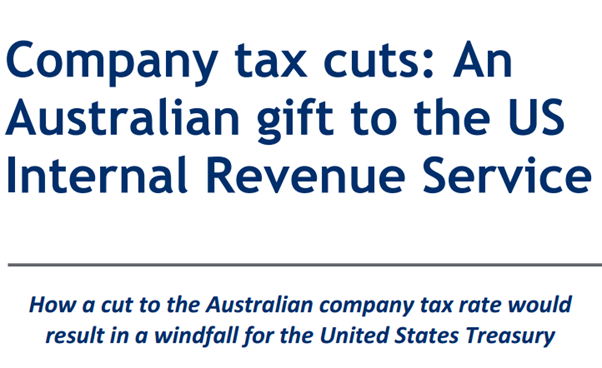
Source: David Richardson, Company tax cuts: An Australian gift to the US Internal Revenue Service How a cut to the Australian company tax rate would result in a windfall for the United States Treasury. Australia Institute (May 2015).
The Australia Institute obviously has not picked up on the relentless bullying that Ireland was subject to by the rest of the European Union over its 12.5% company tax.
The Irish company tax rate of 12.5% was initially on export profits. To finesse European Union member state complaints about that 12.5% company tax rate on discrimination grounds, the Irish government extended that low rate to all companies in 1995.
I am yet to see a minister of finance welcoming a company tax cut in a competing jurisdiction, rubbing his hands in anticipation of greater tax revenues on the foreign profits of companies headquartered in his country.
If there is no race to the bottom in company tax rates, you must wonder why there is substantial efforts within the European Union on tax harmonisation regarding company tax?
France and Germany are pushing plans to introduce a minimum corporation tax rate across the continent, it was reported today, in a move that could result in higher taxes on British companies.
European officials will debate plans to set a EU-wide floor on corporation tax in order to crack down on tax havens such as Ireland and Luxembourg, it emerged.
If there is an ounce of sense in what the Australia Institute said about foreign taxmen benefiting from low company taxes in Australia, high corporate tax rate countries such as Germany, France and the USA should welcome low company tax rates in destination countries for foreign investment originating in those countries but they do not. Rather than seek tax harmonisation, high tax country should welcome low company taxes in competing investment destinations but they do not.
About $2 trillion in profits is held offshore by American businesses because they do not pay company tax in the USA until they actually repatriate the profits to the USA. This is common. You wonder what the purpose of tax havens is if a company tax rate cut in Australia is so easily captured by the IRS?
Studies of the company tax in the USA suggest that a cut in that company tax would lead to large inflows of foreign investment into the USA boosting wages significantly.
Why is GST but not company tax incidence so easy to understand
28 Apr 2016 Leave a comment
in public economics Tags: company tax, rational irrationality, tax incidence, taxation and entrepreneurship, taxation and investment
 The tax incidence of sales taxes is understood by everybody but who pays company tax is stubbornly misunderstood. The seller is sending the tax cheque to the taxman does not fool anyone regarding who ultimately pays sales taxes.
Everyone expects that sales tax increases such as of the GST or VAT will be passed on to buyers but sometimes a little bit is absorbed in terms of lower profits by sellers if it is more than the market can bear.
When it comes to company taxes, this intuitive understanding of the economics of the incidence of taxes completely disappears. There is a strong belief that only investors pay the company tax in the form of dividends.
The notion that investors may reduce their investment and therefore the amount of capital with which workers can work is stoutly denied as is the implications for lower than otherwise wages because of this.
The possibility that the entire company tax may show up as lower wages when capital is internationally mobile is just not even contemplated. This is despite foreign direct investment being welcomed on the grounds that more capital means higher wages for local workers.

Likewise, when a factory is re-located offshore, it is understood that that will harm wages. That understanding does not carry through to company tax incidence when the factory relocates offshore because of low company taxes rather than import competition.
@garethmorgannz is getting a little techie about debating optimal tax theory
17 Apr 2016 1 Comment
in politics - New Zealand, public economics Tags: optimal tax theory, taxation and entrepreneurship, taxation and investment, taxation and labour supply, taxation of capital
All I said was “optimal tax theory including that pioneered by Stiglitz and Merrlees, economists of impeccable left-wing credentials, show that taxes on the income from capital should be low because the deadweight social costs of taxes on capital are very high”.

@garethmorgannz gives optimal tax theory a pass once again @JordNZ
17 Apr 2016 Leave a comment
in applied price theory, entrepreneurship, fiscal policy, macroeconomics, politics - New Zealand, public economics Tags: company tax, Gareth Morgan, rational irrationality, taxation and entrepreneurship, taxation and investment, taxation and labour supply, taxation of capital income
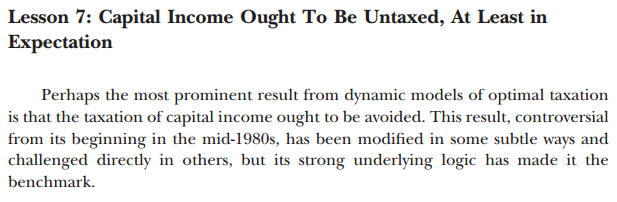
The Morgan Foundation gave optimal tax theory a pass in yesterday’s publication about taxes on land and capital. Gareth Morgan is keen on a comprehensive capital tax.
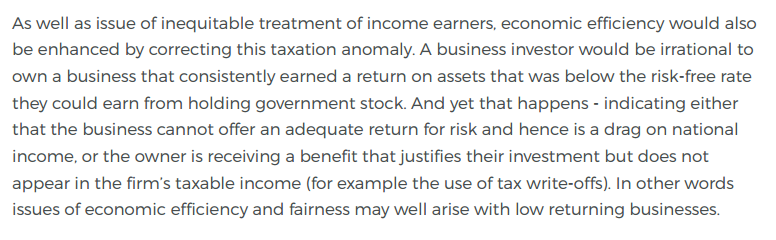
Source: Taxing Wealth & Property – What Works? A Morgan Foundation Report.
This failure to refer to optimal tax theory is despite the Foundation’s strong commitment to evidence-based policy. Any discussion of tax policy that is evidence-based must refer optimal tax theory.
Source: Morgan Foundation, Public Policy Education.
<p>
Taxpayers Alliance mistaken about tax revenues as a stable % of GDP @the_tpa
12 Apr 2016 Leave a comment
in applied price theory, economic history, public economics Tags: British economy, British taxes, growth of government, Margaret Thatcher, size of government, taxation and entrepreneurship, taxation and investment, taxation and labour supply, Taxpayers Alliance
The British Taxpayers Alliance got carried away a bit when it said taxes as a share of British GDP have not varied much over the last 50 years or so. Margaret Thatcher would be turning in her grave.
A stable tax take is more the case in the USA. Federal tax receipts stay within the range of 18-20% of U.S. GDP as shown in the charts below and above.
There were large cuts in the top tax rates in the USA without any fall in tax revenues as a percentage of GDP because of base broadening.
Margaret Thatcher really did make a dent in taxes as a share of GDP in the 1980s. They fell by 5% of GDP but then went back up again in the 1990s as is shown in the Centre for Policy Studies chart below.
That 5% drop was a big variation as a share of GDP which is also shown in the Taxpayers Alliance chart if you look closely at the 1980s. That sharp drop in taxes as a share of British GDP is clearer in the Centre for Policy Studies chart because it magnifies the data.
There are also big changes in the British tax mix in the 1970s and 1980s. The large rise in tax in personal income in the 1970s as a percentage of GDP, also shown in both British charts above as well is the one below, coincided with the rise of the British disease and British economy becoming widely known as the sick man of Europe.
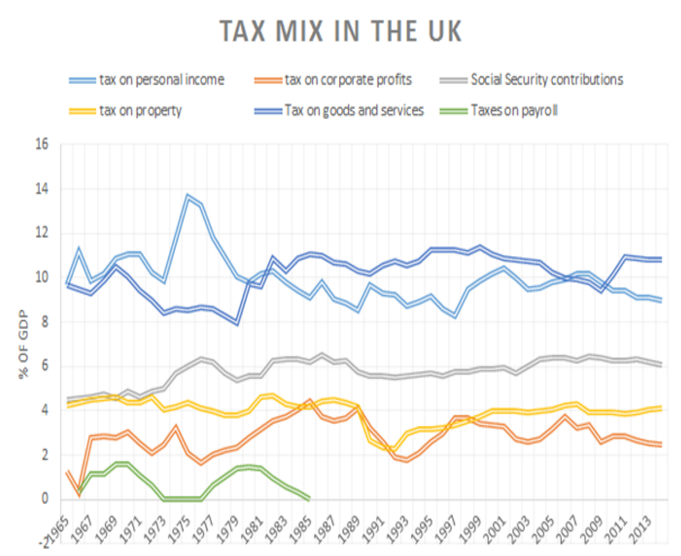
Source: OECD Stat.
The large decline in taxation in personal income under Thatchernomics was followed by an economic boom. The UK grew at above the trend annual real GDP growth to 1.9% for most of the period from the early 1980s to 2007 as shown in the detrended data in the chart below.
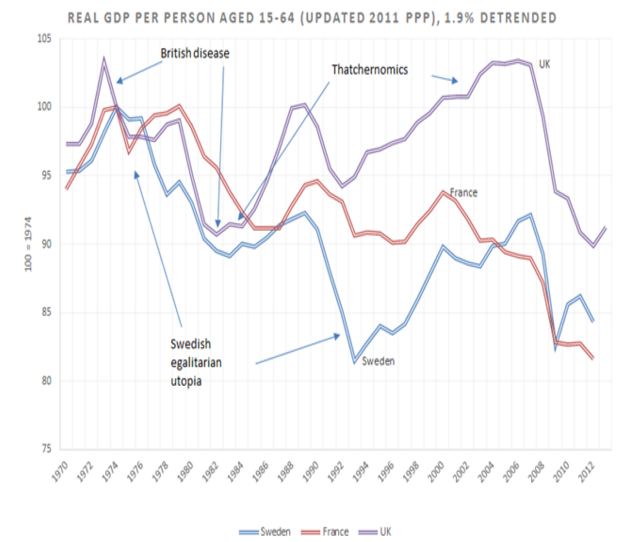
Source: Computed from OECD Stat Extract and The Conference Board. 2015. The Conference Board Total Economy Database™, May 2015,http://www.conference-board.org/data/economydatabase/.
In the above chart, a flat line is growth at the same rate as the USA for the 20th century, which was 1.9% for GDP per working age person on a purchasing power parity basis. The USA’s trend growth rate in the 20th century is taken as the trend rate of growth of the global technological frontier.
A falling line in the above chart is growth in real GDP per working age person, PPP at less than the trend rate of 1.9% per annum while a rising line is real growth in GDP per working age person in excess of the trend rate.


Recent Comments