
A challenge for @GarethMorgannz on disagreement in public policy making
21 Apr 2016 Leave a comment
in applied price theory, comparative institutional analysis, constitutional political economy, politics - New Zealand, Public Choice, rentseeking Tags: action bias, conjecture refutation, motivated reasoning, The fatal conceit, The pretense to knowledge

What a $15 Minimum Wage Would Do
20 Apr 2016 Leave a comment
in applied price theory, economics of media and culture, entrepreneurship, job search and matching, labour economics, managerial economics, minimum wage, organisational economics, personnel economics, theory of the firm Tags: living wage, offsetting behavior, The fatal conceit
P.T. Bauer on @BernieSanders extending #fightfor15 to entire Third World!
19 Apr 2016 Leave a comment
in applied welfare economics, behavioural economics, constitutional political economy, development economics, economic history, growth disasters, growth miracles, P.T. Bauer, politics - USA, Public Choice Tags: 2016 presidential election, antiforeign buyers, George Orwell, living wage, rational irrationality, The fatal conceit, The pretense to knowledge
India tried that in the 1950s as part of its five-year plans. It did not work that well. Bauer said that in development economics there is a “need to restate the obvious.”

Source: Ending the Race to the Bottom – Bernie Sanders.
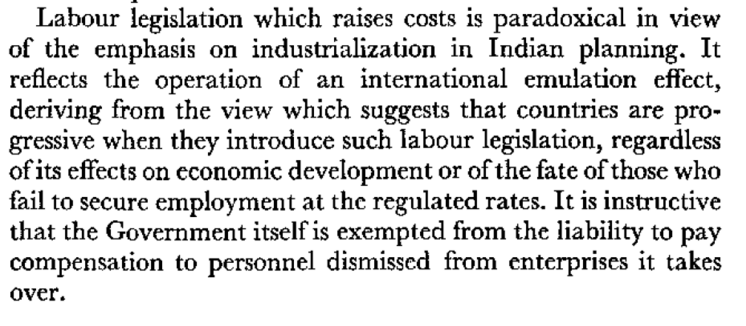
Source: Indian Economic Policy and Development – P. T. Bauer (1959) – Google Books
<p><img src="http://quotes.lifehack.org/media/quotes/quote-George-Orwell-we-have-now-sunk-to-a-depth-39424.png" /></p> <p>
McDonald’s Workers Just Lovin’ Their #ZeroHoursContracts @suemoroney @IainLG @FairnessNZ
19 Apr 2016 Leave a comment
in labour economics, labour supply, managerial economics, market efficiency, organisational economics, personnel economics, politics - New Zealand Tags: British economy, British politics, employment law, employment regulation, fixed costs of working, part-time work, The fatal conceit, The pretense to knowledge, zero hours contracts
Revealed preference rules. Not only do about half of unemployed turned down offers of zero hour contract jobs, those that switch from a zero hours contract to minimum hours are not much different from the number of people in these type of jobs who would be quitting to another job anyway.

Source: McDonald’s Workers Are Just Lovin’ Their Zero Hours Contracts – Forbes and McDonald’s offer staff the chance to get off zero-hours contracts | UK news | The Guardian.
Do minimum wages stimulate productivity? @BernieSanders @livingwageNZ
06 Apr 2016 Leave a comment
in econometerics, labour economics, labour supply, minimum wage, politics - New Zealand, politics - USA, poverty and inequality Tags: living wage, The fatal conceit, The pretence the knowledge

Will @JulieAnneGenter’s KiwiBank plan bankrupt KiwiPost? @JordNZ
03 Apr 2016 Leave a comment
in financial economics, industrial organisation, politics - New Zealand, privatisation, survivor principle Tags: economics of banking, government ownership, KiwiBank, New Zealand Greens, offsetting behaviour, rational irrationality, state owned enterprises, The fatal conceit
The Greens are followed up on an earlier suggestion by Julie Anne Genter, the Green’s Shadow Minister of Finance, that KiwiBank should be refocused to keeping interest rates low. To that end, it would not be required to pay dividends to the government to help fund the effort. KiwiBank has only just started paying dividends to its parent, KiwiPost.
If that were to be the case, that KiwiBank was no longer be required to pay dividends, that would blow quite a hole in the balance sheet of its parent company KiwiPost.
KiwiPost owns the share capital of KiwiBank, which must be valued on a commercial basis to pass auditing as a state owned enterprise which is commercially orientated.

Source: Historic $21 million dividend paid by state owned bank Kiwibank | interest.co.nz.
That share capital owned by KiwiPost in KiwiBank would be have to be written off if KiwiBank were to pay no further dividends because it is no longer commercially orientated entity. Such a write-off of its investment in KiwiBank would write off most of Kiwi Post’s equity capital.

The reason why state owned enterprises are required to be valued on commercial principles is to ensure that any subsidies or other favours sought by politicians show up in the profit and loss statement or the balance sheet through asset write-offs. Section 7 of the State-Owned Enterprises Act 1986 non-commercial activities states that:
Where the Crown wishes a State enterprise to provide goods or services to any persons, the Crown and the State enterprise shall enter into an agreement under which the State enterprise will provide the goods or services in return for the payment by the Crown of the whole or part of the price thereof.
This statutory safeguard ensures that the cost of any policies proposed by ministers, and the Greens are very keen on transparency and independent costing of political promises, are plain to all.
@NZGreens expand KiwiBank into wrong market to cut mortgage rates @JulieAnneGenter
03 Apr 2016 1 Comment
in industrial organisation, monetary economics, politics - New Zealand, survivor principle Tags: economics of banking, government ownership, KiwiBank, New Zealand Greens, offsetting behaviour, privatisation, rational irrationality, state owned enterprises, The fatal conceit
The Greens want to cut mortgage rates by having KiwiBank expand in business lending. Wrong market.
This expansion into a market that is not the mortgage market is to be underwritten by a capital injection as the Greens explain:
- Inject a further $100 million of capital in KiwiBank to speed its expansion into commercial banking;
- Allow KiwiBank to keep more of its profits to help it grow faster; and,
- Give KiwiBank a clear public purpose to lead the market in passing on interest rate cuts.
Note well that the $100 million capital injection is to expand in to commercial banking. More aggressive passing on of interest rate cuts may jeopardise credit ratings if this lowers the profitability of KiwiBank. KiwiBank has an A- rating
The bigger hole in the policy is the more aggressive mortgage rate setting by KiwiBank will be done by keeping more of its profits and paying fewer dividends to its parent company Kiwi Post and through that to the taxpayer. There are next to no dividends currently to stop distributing to fund a more aggressive mortgage rate setting policy.
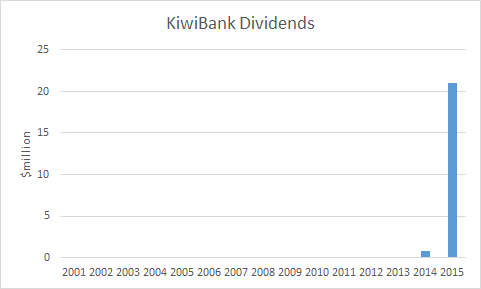
Source: KiwiBank pays its first dividend of $21 million to Government | Stuff.co.nz.
KiwiBank paid its first dividend last year. Prior to that, the bank kept all profits to allow it to expand its lending base. $20 million in foregone dividends does not go far given the actual size of all lending markets in New Zealand.

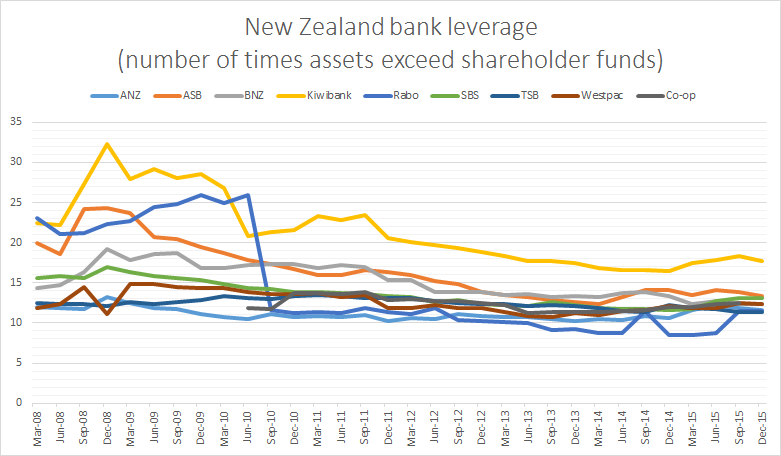
Source: G1 Summary information for locally incorporated banks – Reserve Bank of New Zealand.
KiwiBank is minnow in the mortgage market and a pimple in commercial lending. Rapid business expansion is risky in any market, much less in banking.
The government has declined further capital injections so profits were retained to meet capital adequacy ratios. The government in 2010 earmarked NZ$300 million for an uncalled capital facility for NZ Post to help maintain its credit rating and KiwiBank’s growth.
Saving the best for last, KiwiBank last year announced plans to borrow up to $150 million through an issue of BB- perpetual capital notes to be used to bolster the bank’s regulatory capital position.
The Margin for the Perpetual Capital Notes has been set at 3.65% per annum and the interest rate will be 7.25% per annum for the first five years until the first reset date of 27 May 2020. Kiwi Capital Funding Limited is not guaranteed by KiwiBank, New Zealand Post nor the New Zealand Government.
The Perpetual Capital Notes have a BB- credit rating compared to KiwiBank which has an A- rating. These capital notes were issued in addition to prior subordinate debt in the form of CHF175 million (about NZ$233 million) worth of 5-year bonds.
I doubt that KiwiBank can raise capital through subordinated debt under normal commercial conditions if it does not plan to seek profits in the same way as other commercial banks do. The current issue of Perpetual Capital Notes are already rated as junk bonds:
An issue of $150 million of perpetual capital notes from KiwiBank with a speculative, or "junk", credit rating have been priced at the bottom of their indicative margin range.
The closest the prospectus for these Perpetual Capital Notes got to complementing KiwiBank changing from a normal business to being a public good is the following risk statement:
Kiwibank’s banking activities are subject to extensive regulation, mainly relating to capital, liquidity levels, solvency and provisioning.
Its business and earnings are also affected by the fiscal or other policies that are adopted by various regulatory authorities of the New Zealand Government.
The interest rate on this subordinate debt will go up to offset the additional risk of aggressive lending and aggressive expansion, which will cancel out many of the advantages of not having to pay for dividends and the capital injection.
That discipline is one of the purposes of subordinate debt in the regulatory capital of banks. This is to provide another pair of eyes and ears to watch the performance of the bank and through rising costs of lending and risk ratings, signal trouble of imprudent lending and lack of cost control.
The proposal to use KiwiBank to lower mortgage rates does not add up. KiwiBank does not pay much in the way of dividends to fund such a foray. KiwiBank is already far more leveraged than any other New Zealand major bank.
George Orwell had it right 80 years ago on the #sugartax
21 Mar 2016 Leave a comment
in health economics, liberalism Tags: George Orwell, meddlesome preferences, nanny state, sugar tax, The fatal conceit
The 1st @PaulKrugman on @GrantRobertson1’s #futureofwork?
21 Mar 2016 Leave a comment
in economics of regulation, labour economics, minimum wage, politics - USA, poverty and inequality, unemployment Tags: employment law, employment protection laws, France, labour market regulation, New Zealand Labour Party, rent control, social insurance, The fatal conceit, unintended consequences
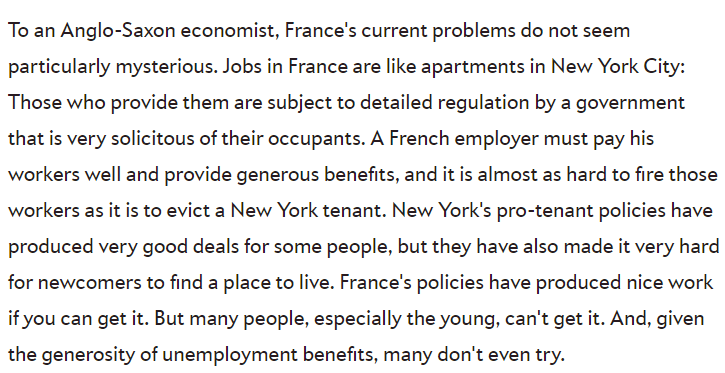
Source: Paul Krugman (1997) Unmitigated Gauls.
% of New Zealand mortgages that were fixed and floating since 2004
16 Mar 2016 Leave a comment
in economic history, economics of information, economics of regulation, monetary economics, politics - USA Tags: antimarket bias, libertarian paternalism, monetary policy, mortgage interest rates, New Zealand Labour Party, Other people are stupid fallacy, rational irrationality, The fatal conceit, The pretence to knowledge
Despite the best efforts of the libertarian paternalists to sell the other people are stupid fallacy, ordinary New Zealanders are quite nimble at moving between fixed and floating rates depending upon their forecasts of the future of interest rates. Price controls on floating rate mortgages, as suggested by the New Zealand Labour Party, would make this more difficult, not easier.

Source: S8 Banks: Mortgage lending ($m) – Reserve Bank of New Zealand.
@TBillTheProf unintentionally destroys the case for a #livingwage @Mark_J_Perry @arindube
13 Mar 2016 Leave a comment
in applied price theory, labour economics, managerial economics, minimum wage, organisational economics, personnel economics, politics - New Zealand, politics - USA Tags: living wage, rational irrationality, The fatal conceit, The pretense to knowledge
Living wage advocate William Lester published a briefing for the Washington Centre for Equitable Growth that destroys the case for a living wage. He did not intend this but he documented in detail the exclusion of inexperienced workers from the restaurant industry in San Francisco after a living wage was imposed. He compared San Francisco’s minimum wage of $12 per hour with North Carolina which only pays the federal minimum of $7.25 per hour.
What Lester found was a systematic increase in hiring standards. The living wage in San Francisco of $12 all but ended the hiring of inexperienced workers as shown in the chart below. This is exactly what basic price theory predicts. I put the two pie charts in his paper into a single bar chart so this powerful effect of the living wage on hiring standards is not lost.
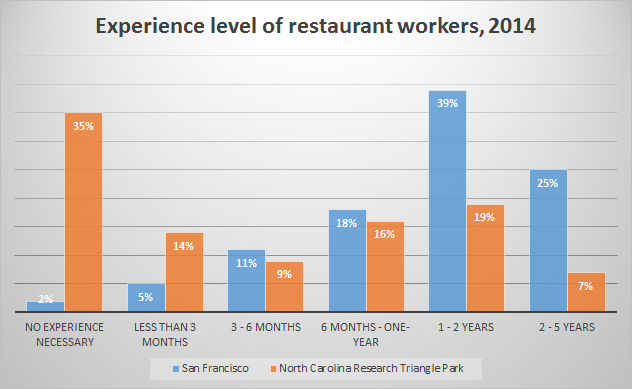
Source: The consequences of higher labor standards in full service restaurants – Equitable Growth.
The most fundamental criticism of living wage and minimum wage increases is they exclude workers who do not meet the new labour productivity level required to make it profitable for employers to hire them. UK research found the same thing – an increase in hiring standards and tougher shortlisting. Lester welcomes this transition of the restaurant industry in San Francisco into a career for professionals. As he says in his briefing paper:
Concurrent with this wage compression was a rise in professional standards as employers sought to hire and keep already well-trained workers at higher wages and with expanded benefits. Both developments reduced turnover and attracted more professional employees who maintain a high level of customer service.
As with all minimum wage and living wage advocates, he is incurious as to what happens to those low skilled, inexperienced workers and new workforce entrants who no longer meet the hiring standards of San Francisco restaurants because of the large minimum wage increase.
Best 2 Minimum Wage Cartoons Ever, from Henry Payne, Updated for Seattle's $15 "Economic Death Wish" @HenryEPayne http://t.co/vatUzkHMss—
Mark J. Perry (@Mark_J_Perry) August 18, 2015
As Lester concedes in his conclusions about what will happen if the San Francisco minimum wage of $12 an hour, the highest in the country, is extended to other cities and states:
Higher professional standards may limit entry-level opportunities within the industry, while lower standards may result in more employer-provided training for new workers.
Employer funded on-the-job training is often a major part of a job package. It is well-known in the labour economics literature since the time of Adam Smith that any job is a package of wages and other attributes including learning opportunities.

Workers sell their services and buy learning opportunities; firms buy labour services and sell jobs with varying learning possibilities (Rosen 1972, 1975, 1976). The rational allocation of time results in most careers starting with large investments in full-time schooling and then mostly investments in on-the-job training (Becker 1975; Ben-Porath 1967, 1970; Weiss 1987).
As the training provided by restaurant employers is useful to other employers, the trainee must fund it through trading off wages for this training. Once trained, the employee can command a higher pay because other employers are willing to pay them more now that they are trained. Again, this is a standard result in the human capital literature.
Where the human capital is more specialised to one firm or job, the employer and the trainee share the cost. A classic example of this is an apprenticeship.

Source: IZA World of Labor – Do firms benefit from apprenticeship investments?
In San Francisco, employers expect recruits to be fully trained and experienced. They provide little in the way of on-the-job training. Their recruits must have been able to afford to fund this in their previous jobs by trading off wages for training as Lester notes in his working paper:
…San Francisco employers were less likely to report lengthy formal training periods for either front-of-house or back-of-house workers. Instead, there is an overall higher level of skill expectation and—as is the case for many professions—workers are expected to acquire and exhibit industry specific knowledge on their own.
In North Carolina, as Lester notes, the restaurant industry hires younger workers with less formal education and offers them intensive on-the-job training:
The restaurant industry in the Research Triangle region tends to hire younger workers with a lower level of formal education. Specifically, 49.5 percent of workers in there are under age 24 or have less than a high school education, compared to 38.9 percent in San Francisco. Conversely, 40.6 percent of workers in San Francisco have some college or a bachelor’s degree or higher, compared to 29.7 percent in the Research Triangle Region.
North Carolina restaurants sought to hire unskilled workers who were friendly and reliable as Lester notes:
One manager of a neighbourhood bistro in Raleigh explained what he looks for in a new front-of-house worker: “Basically, we require [that a server] can work a four-shift minimum per week and go an entire shift, an entire eight-hour shift without smoking a cigarette and [without] any facial piercings or anything. Beyond that, just come in with a smile on your face.”
The restaurant industry in North Carolina is willing to give people low skilled, poorly educated and inexperienced a chance to work if they are willing to work. Lester reports this when quoting an upscale bar-and-grill manager on his hiring standards:
We look for at least one year’s experience, but the biggest thing we look for is we look for the person. We don’t look for the skill. I could teach anybody how [to] wait tables [and] pour drinks. I can teach anybody how to cook steaks. What I can’t teach is how to be a good person.
Lester then discusses with some degree of approval the hiring standards in the San Francisco where restaurants are professional careers:
Rather than viewing servers as essentially interchangeable labourers who can be trained quickly and easily if they possess a modicum of personal hygiene and a friendly personality, employers in San Francisco exhibited a clear description of what a “professional server” was.
One mid-scale restaurant employer said of her front-of-house staff: “We have a lot of people who have made it a career and they’re investing in the knowledge of the product and learning their trade or already know their trade because they’ve done it for years.”
Much to the surprise of believers in the inherent inequality of bargaining power between employers and workers, employers invest heavily in low-skilled employees despite the fact this makes them employable elsewhere. Lester again:
“Training is a huge investment for us and it is constant,” [a manager] said. “Training days depend on the position. Bartending training is ten days and servers require eight days. In the kitchen it’s probably about ten days. Every day they write note cards on all their recipes. But they’ll take a final. When they take their final, their test in the kitchen, they have to know every ingredient, every ounce, and every item, for the entire station. That’s why we require them to write note cards.
Even at higher-end restaurants, employers in the region have built a human resource system that accepts a high rate of turnover. “We try to stay ahead of the game so that we’re always hiring, we’re always interviewing, but hopefully it’s not desperation hires,” says another manager. “And we try to have a mix of needs like people who need fulltime, who can work lunches and brunches and all of that, to servers who really want very part time so that you can kind of over staff on busy shifts and then there’s always someone that wants to go home. There’s always a student that would like a Saturday night off.”
Lester paints a picture of a San Francisco restaurant industry that expects workers to fund their own industry specific human capital. In North Carolina, employers provide those training opportunities to minimum wage workers despite this making these up-skilled employees an attractive proposition for rivals to poach. By depriving low skilled workers of this opportunity of both wages and employer-funded training, a living wage would make them worse off.

I am at a loss here. How can the progressive left regard the exclusion of low paid, low skilled workers as a good thing? How do they put food on the table in San Francisco other than through a welfare check? How do they get their first job?
It's pretty simple: Minimum Wage = Compulsory Unemployment http://t.co/6xiX6YCp9Z—
Mark J. Perry (@Mark_J_Perry) July 25, 2015
% of workforce employed by large firms across the OECD
11 Mar 2016 Leave a comment
in industrial organisation, politics - New Zealand Tags: The fatal conceit, The pretense to knowledge
It is claimed that New Zealand lacks large firms, that “New Zealand has one very large firm – Fonterra – and a long tale of large to mid-sized firms”. The percentage of the workforce employed by large firms in New Zealand is in the middle of the pack. It is not in any way an outlier.

Source: Entrepreneurship at a Glance 2015 – OECD 2015.
A hurdle to cross-national comparisons of firm size distribution is the number of small firms will fall and the number of large firms will rise with increases in real wages (Lucas 1978; Poschke 2013; Gollin 2008; Eeckhout and Jovanovic 2012). Nations that are more productive than New Zealand have higher wages because they have accumulated more capital per worker. One consequence of more capital per worker is real wages increase at a faster rate than profits (Gollin 2008; Eeckhout and Jovanovic 2012). For example, the rate of return on capital was stable over the 20th century while real wages increased many fold (Jones and Romer 2010).
Higher wages reduces the supply of entrepreneurs and increases the average size of firms because entrepreneurship becomes a less attractive occupational choice (Lucas 1978; Gollin 2008; Eeckhout and Jovanovic 2012). For example, in the mid-20th century, many graduates who were not teachers were self-employed professionals. With an expanding division of labour because of economic growth, many well-paid jobs and new occupations emerged for talented people in white-collar employment.
OECD countries richer than New Zealand should have less self-employment and more firms that are large because paid employment is an increasingly better-rewarded career option for their high skilled workers. The U.S. had the second lowest share of self-employed workers (7 percent) in the OECD in 2010 – the latest data – which is less than half the rate of New Zealand self-employment (16.5 percent) in 2011 (OECD 2013). The Australian self-employment rate was 11.6 per cent in 2010 (OECD 2013).
A companion reason for larger average firm sizes in countries richer than New Zealand is more capital-intensive production can prosper in larger corporate hierarchies than can labour-intensive production (Lucas 1978; Becker and Murphy 1992; Poschke 2011; Eeckhout and Jovanovic 2012).
The more able entrepreneurs can run larger firms with bigger spans of control in richer countries because their employees can profitably use more capital per worker with less supervision. The diseconomies of scale to management and entrepreneurship should rise at a faster rate in less technological advanced countries such as New Zealand because they are more labour intensive economies (Lucas 1978; Becker and Murphy 1992; Poschke 2011; Eeckhout and Jovanovic 2012).
Importantly, the more able entrepreneurs benefit most from introducing frontier technologies because they can deal more easily with their increased complexity and more uncertain prospects (Poschke 2011; Lazear 2005; Shultz 1975; 1980). Growing technological complexity reduces the supply of entrepreneurs because it takes longer to acquire the necessary balance of skills and experience needed to lead a firm (Lazear 2005; Otani 1996).
The more marginal entrepreneurs will switch to be employees as technology advances so the average size of firms will increase. The entrepreneurs that remain in business will be the most able, more skilled and more experienced entrepreneurs and will be more capable of running larger firms that pioneer complex, frontier technologies (Poschke 2011; Lazear 2005, Otani 1996; Lucas 1978). Countries more technologically advanced than New Zealand will have both larger firms and less self-employment because of growing technological complexity.
The greater is the exposure to foreign competition, the smaller is the fraction of self-employed and small firms in a country (Melitz 2003; Díez and Ozdagli 2012). More foreign competition increases wages because of lower prices, which makes self-employment less lucrative. More exporting favours larger firms both because of the fixed costs of entering export markets and because the stiffer competition will weed-out the lower ability entrepreneurs who run the smaller firms (Melitz 2003; Díez and Ozdagli 2012). Countries that export more than New Zealand also will have larger firms.
Average firm sizes are often larger is richer countries because of their high labour productivity and higher wages rather than labour productivity is low in New Zealand because average firm sizes are smaller. Other factors can countermand the effects that occupational choice, frontier technologies, exporting and capital intensity have to increase the average size of firms as real wages rise. This makes comparisons of firm size distributions are even more fraught with institutional complexities.
Tax and regulatory policies appear to reduce the average size of firms in many EU member states to levels that are similar to New Zealand. A nuance in international comparisons of firm size distributions is the EU is less likely to have large firms in its labour intensive sectors. Employment protection laws, product market and land use regulation and in particular, high taxes stifled the growth of labour intensive services sectors in the continental EU (Bertrand and Kramatz 2002; Bassanini, Nunziata and Venn 2009; Rogerson 2008).
EU firms are a biased sample. Their firms are more capital intensive with fewer employees than otherwise because labour is so expensive to hire in the EU. Small and medium sized firms can struggle to grow in much of the EU because of regulatory burdens that phase in with firm size (Garicano, Lelarge and Van Reenen 2012; Hobijn and Sahin 2013; Rubini, Desmet, Piguillem and Crespo 2012). Average firm sizes are 40 percent smaller in Spain and Italy than in Germany. Obstacles to firm growth originate in product, labour, technology and financial and the binding constraints differ from one EU member state to another (Rubini, Desmet, Piguillem and Crespo 2012).
Bartelsman, Haltiwanger, and Scarpetta (2009) found that the USA had a very high proportion of above-average sized firms. Western Europe had smaller firms in most industries with one of the exceptions in low-tech UK industries. Apart from the USA, they could not map differences in firm size against the overall size of the country, the technology levels of an industry, or its degree of maturity.
Another confounding factor is the average number of employees in firms with 500 or more employees in France and New Zealand is similar: 1667 and 1593 respectively (Mills and Timmins 2004; Hobijn and Sahin forthcoming). Preferring the UK over France as the benchmark for very large firms calls for a detailed analysis of Anglo-French institutional differences. This defeats the very purpose of the simple statistical comparisons undertaken to date. These simple cross-national statistical comparisons presuppose relatively common economic drivers and institutional backgrounds. If that is not so, a detailed institutional analysis is required before cross-national comparisons are possible. Bartelsman, Haltiwanger, and Scarpetta (2009) suggest that cross-national comparisons of firm dynamics and firm size distribution are subject to substantial definitional and measurement problems and no one measure will capture properly the many institutional and regulatory differences.
Average firm sizes in the USA and UK may be larger because of fewer tax and regulatory policies that limit business growth. Bartelsman, Scarpetta and Schivardi (2005) found that new entrants in the U.S. started on a smaller scale than in Europe but grew at a much higher rate. This willingness to experiment on a smaller scale was worth the risk because the payoff was much larger in terms of growth in the more flexible U.S. markets.
Happy birthday – you’re fired! #livingwage and youth job losses
04 Feb 2016 Leave a comment
in labour economics, labour supply, minimum wage, unemployment Tags: living wage, rational irrationality, teenage unemployment, The fatal conceit
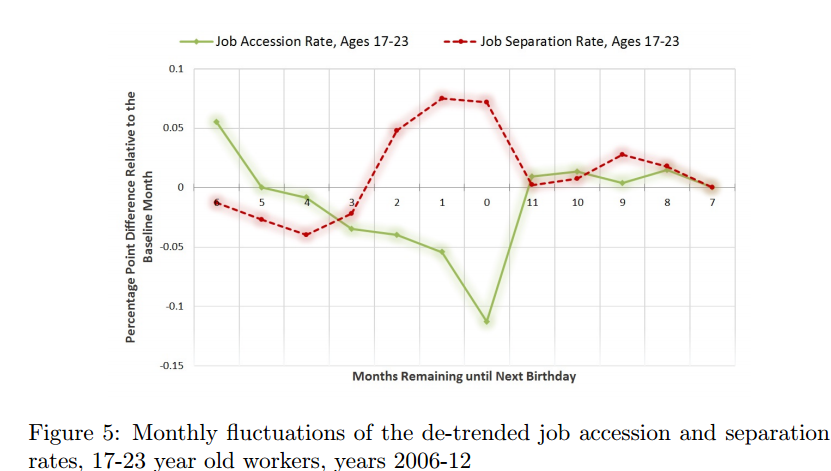
The Dutch minimum wage increases with every birthday until the age of 23. Not surprisingly, there is a surge in job losses and a recession in hiring around birthdays. What is even worse is employment opportunities are redistributed from a group with a high rate of unemployment, teenagers and young people, towards prime age adults who have a much lower rate of unemployment.
Diogenes on what should governments do
26 Dec 2015 Leave a comment
in applied price theory, applied welfare economics, comparative institutional analysis, constitutional political economy, liberalism Tags: ancient Greeks, Diogenes, growth of government, philosophy of economics, size of government, The fatal conceit, The pretence to knowledge
@donal_curtin @smalltorquer Does competition law in high-tech markets help consumers?
14 Dec 2015 2 Comments
in applied price theory, economics of regulation, Gary Becker, industrial organisation, politics - New Zealand, politics - USA, Sam Peltzman Tags: Aaron Director, anti-trust law, cartels, competition law, creative destruction, entrepreneurial alertness, merger law enforcement, offsetting the, The fatal conceit, unintended consequences
New Zealand has decriminalised cartels. Price fixers cannot be sent to prison but can still be fined. Some agree, some disagree with the wisdom of this move.
Those that agreed with the wisdom of this move were christened cartel apologists by one of those that disagree with the removal of criminal penalties for cartels.
There is an infallible rule in competition law enforcement. It arises mostly crisply in merger law enforcement. If competitors oppose a merger, the merger must be pro-consumer. If the merger is anti-competitive, that merger will increase prices. The competing firms can follow those prices up and profit from the weakening of competition.
Under the collusion hypothesis, rivals of the merging firm benefit since there is a higher probability of successful collusion limits output and raises product prices. The share prices of these rival firms should increase in anticipation of enhanced cartel profits. As Eckbo explains:
Using Stigler (1964) theory of oligopoly, a horizontal merger can reduce the monitoring costs by reducing the number of independent producers in the industry. The fewer the members of the industry the more “visible” are each producers actions, and the higher is the probability of detecting members who try to cheat on the cartel by increasing output.
When was the last time an entrepreneur complained about his rivals putting their prices up? The entrepreneur can either match that price increase or undercut it to win more business. The real reason competitors oppose a merger is the merged firm will have lower costs, making it a fiercer competitor.

If the share prices of competitors fall on news of the merger, they are worse off as a result because they face a fiercer competitor. If their share prices rise, that suggests either that others in the industry are to benefit from higher prices or rival firms will soon replicate the cost savings discovered in the course of the merger. The latter is the information effect of mergers:
…since the production technologies of close competitors are (by definition) closely related, the news of a proposed efficient merger can also signal opportunities for the rivals to increase their productivity
Mergers are a high-risk way of securing higher prices unless there are offsetting cost saving of combining the two firms. Mergers disturb previously efficient firm sizes and risk diseconomies of scale and a burgeoning corporate hierarchy. A cartel is a safer way to raise prices by jointly agreeing to restrict output.

Cartels have few redeeming features. Cartels are inherently unstable because the history of cartels is the history of double-crossing. The best place in a cartel is to be on the outside undercutting it slightly to sell as you can at inflated cartel price.
The complication with cartels is competitors must sometimes coordinate their activities with their rivals in various ways such as agreeing product standards, undertaking joint ventures or licensing technologies to them.
Criminalisation of cartels may deter these business practices that promote consumer welfare. The process of innovation in new industries in particular often involves successful firms taking over the unsuccessful firms.
Serial competition is common in rapidly innovating industries with one dominant firm making hay for a while then quickly swept away. Merger law enforcement agencies do not handle the wake of creative destruction well.

There is no more cutthroat market than Hollywood. Yet the movie industry is riddled with collusion and joint ventures. Actors and producers can be collaborating on one film and also be making another film that will be its rival in the box office when released.
The movie industry would not work without this incestuous mix of competition and collaboration. Joint ventures are aplenty between otherwise direct competitors in the film industry. When do these joint ventures become cartels threatened with criminal penalties?
What should be another working rule in competition law enforcement is when there is reasons to stay your hand, that is usually a good idea even if you do not have the reasons worked out yet. When in doubt, stay your hand.
It goes back to that extremely famous 1984 essay by Frank Easterbrook on the limits of anti-trust law. The essay was about errors in competition policy and law enforcement:
- When a competition law enforcer makes a mistake and closes off an efficiency enhancing practice or stops a pro-consumer merger, there are few mechanisms to correct this mistake; and
- If a competition law enforcer inadvertently does not stop a anti-competitive merger or lets a collusive or inefficient practice get through, at least there is market processes that will slowly chip away at his mistake.
Easterbrook argued that courts and enforcers should craft liability and procedural rules to minimise the sum of competition law’s error and decision costs:
The legal system should be designed to minimize the total costs of (1) anticompetitive practices that escape condemnation; (2) competitive practices that are condemned or deterred; and (3) the system itself
Competition law enforcers and policymakers made plenty of errors in the past. Chastened by their follies aplenty in the past, competition law policymakers should not approach any issue with overconfidence. They have had a dismal track record in aligning competition law with applied price theory and the basics of the economics of industrial organisation.
That is at best only a good start for the competition law enforcement agencies. This is because the economics of industrial organisation spent a lot of time condemning practices that neither restricted output or increased prices.
It took many decades for consumer welfare to be the exclusive goal of competition. Time and again protecting competitors from competition was the priority of competition law enforcement agencies.

The ICT revolution coincided with a revolution in competition law economics and policy. That revolution consisted of basing competition law on applied price theory and not condemning every novel or as yet unexplained practice.
In the high-tech industries, competition law runs a high risk of chilling innovation. As Joshua Wright said:
Innovation is critical to economic growth. Incentives to innovate are at the heart of the antitrust enterprise in dynamically competitive industries, and, thus, getting antitrust policy right in high-tech markets is an increasingly important component of regulatory policy in the modern economy. While antitrust enforcement activity in high-tech markets in the United States and the rest of the world is ever-increasing, there remain significant disputes as to how to assess intervention in dynamically competitive markets.
The relentless pursuit of Microsoft by the US Department of Justice at the behest of its competitors such as Netscape is notorious example of the chilling of innovation.
You are showing your age if you even remember who Netscape was. Its complaint was that Microsoft by giving away its browser was engaging in predatory competition.

Netscape want to protect consumers from the scourge of lower prices – from not having to pay $49 for the Netscape browser. You are showing your age if you have ever paid to install a browser.
Netscape had the advantage of a senior US senator representing the state where it was based. He happened to sit on the committee overseeing the budget of the US Anti-trust enforcement agencies.

We are still waiting for the day when Microsoft finishes giving away its browser, excludes competition from the market for browsers, jacks up its price to make up for a good 20 years of giving away its browser and is not immediately threatened by new entry.
Facebook is now worth more than Walmart
buff.ly/1fuvV7V h/t @DKThomp
$FB $WMT buff.ly/1fuvSZB http://t.co/FtIIJP3EGN—
Ninja Economics (@NinjaEconomics) June 22, 2015
The intrepid competition law enforcers of the 1990s did not anticipate a business model where competitors profitably give their product away.
Thankfully, Facebook did not face competitors who charged for their social media. If Facebook had faced such competition, what would the US Department of Justice thought of this anti-competitive practice of giving social media away. The scourge of lower prices again. That great bugbear of competition law enforcement agencies.
10 years ago today Facebook was founded by Mark Zuckerberg and his college friends http://t.co/IVFDFvu2VM—
History Pics (@HistoryPixs) February 04, 2014
Facebook is doing the exact same thing that Microsoft did when it gave away the Internet Explorer browser. To this day, competition law enforcement agencies including the New Zealand Commerce Commission do not accept lower prices to be lawful in all cases without exception.

A test of how imbibed you are with the fatal conceit about competition law is to cast your mind back as to what your attitude was to the Department of Justice anti-trust lawsuit against Microsoft.
If you thought the anti-trust lawsuit against Microsoft was well-founded, you are an optimist about the efficient scope of competition law. To quote McKenzie and Shughart:
Microsoft’s critics come far closer to the mark when they complain that Microsoft has been “brutally competitive” than when they claim Microsoft is a “monopoly.” From our perspective, it appears that once again the Justice Department is using the antitrust laws to thwart competition by a highly successful American firm. To protect unsuccessful competitors, it is squelching competition.
A long time has passed since that suit. People can reflect upon the extent to which Microsoft have successfully monopolised browsing the Internet. It hasn’t. As Gary Becker said:
Anti trust policy should recognize that dynamic competition is often a powerful force when static competition is weak. The big policy question then is whether it is worthwhile to bring expensive and time consuming anti trust cases against still innovating firms that have considerable profits and monopoly power, given the significant probability that new competitors will before long greatly erode this power through different products? I believe the answer to that is no, and that policy should often rely on dynamic competition, even when that allows dominant firms only temporarily to enjoy economic power.
The law and economics of competition has been a bit of a glass house for the last 50 years. People should be careful about criticising new idea and attempts to be more modest about the positive contribution the competition law makes to society.
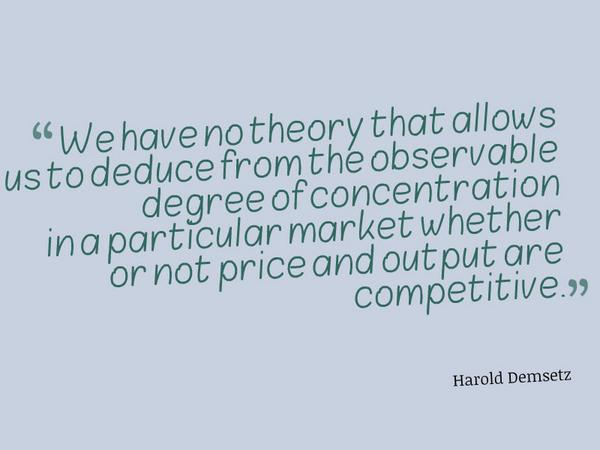
Competition law can subvert competition by stymieing the introduction of new goods and the temporary monopoly often necessary to recoup their invention costs and induce innovation. Sam Peltzman, when reflecting on the contributions of Aaron Director to the law and economics of competition said:
There are the myriad of ways in which real world business practices behave differently from the caricaturing in textbooks. Those differences sometimes arouses suspicious responses from economists. Visions of market power and deadweight loss triangles dance their heads, and some of the suspect practices have been constrained by anti-trust policy. Director rejected this kind of intellectual laziness, and he sought, sometimes successfully, to inoculate those around him against it.
Director approached all business practices with the methodology that entailed asking very basic questions and answering them in a rigorous logic that it appealed ultimately to facts. The style was verbal – some combination of Socratic dialogue and Adam Smith. This style had the disadvantage of producing few closed-form solutions. But it had the advantage of permitting analysis of the kind of problems that eluded simple solutions.
Indeed I believe that one reason for Director’s lasting influence he was able to show that simple judgements about business practices often cannot withstand rigorous scrutiny.
Economic theory and empirical evidence are full of examples of business conduct that reduce choice but increase consumer welfare through lower prices, more innovation, or higher quality products and services. Manne and Wright noted in the paper, Innovation and the Limits of Antitrust that:
Both product and business innovations involve novel practices, and such practices generally result in monopoly explanations from the economics profession followed by hostility from the courts (though sometimes in reverse order) and then a subsequent, more nuanced economic understanding of the business practice usually recognizing its pro-competitive virtues.
Competition law enforcement agencies are suing Google because it is anti-competitive. The dead hands of the competitors to Google are buried somewhere in those suits. Is there no learning. There is certainly no modesty about past mistakes about the proper scope of competition law.

 Utopia, you are standing in it!
Recent Comments