American workers toiled for 37 days more than their French counterparts in 2013 econ.st/1M645uQ http://t.co/faN8XtmLAW—
The World If (@EconWorldIf) August 10, 2015
The Battle Over Global Warming Is All in Your Head
16 Aug 2015 Leave a comment
in applied price theory, applied welfare economics, economics of information, economics of media and culture, energy economics, environmental economics, global warming Tags: climate alarmism, doomsday prophecies, global warming, political psychology
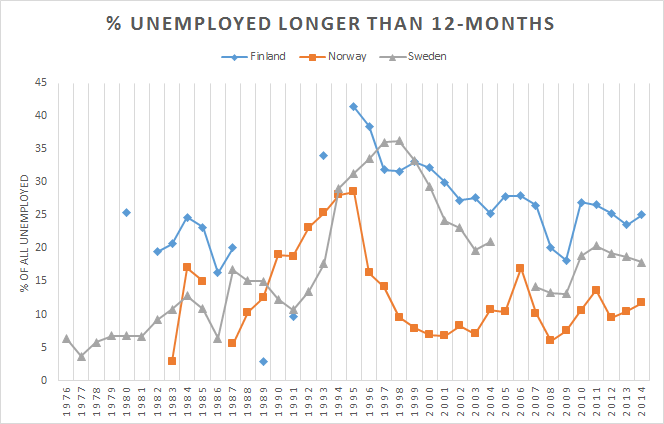
% of unemployment lasting longer than 12 months in Scandinavia since 1976
16 Aug 2015 Leave a comment
in applied welfare economics, business cycles, constitutional political economy, economic history, job search and matching, labour economics, labour supply, macroeconomics, Public Choice, unemployment Tags: borders, deployment subsidies, economics of borders, equilibrium unemployment rate, Finland, labour market programs, long-term unemployment, maps, natural unemployment rate, Norway, Scandinavia, search and matching, Sweden, unemployment durations
As I recall, most unemployed have been unemployed longer than 12 months in Sweden have to go on a labour market program. When they returned to unemployment after the program, the clock starts again. They are deemed to be freshly unemployed rather than adding to the previous spell with an interlude on a make work program. This makes Swedish long-term unemployment data rather unintelligible.
Source: OECD StatExtract.
Finland was recovering from its worst depression since the 1930s and the early 1990s when its data on long-term unemployment started to be continuous. This makes Finnish unemployment data rather difficult to interpret. Norway’s data for the long-term unemployed goes up and down a bit too much to be trustworthy without a background policy narrative.
Why we shouldn’t rely too much on GDP and Human development index to tell us how we are doing
15 Aug 2015 Leave a comment
in applied price theory, applied welfare economics, development economics, economic history, economics of media and culture Tags: measurement error, The Great Enrichment, The Great Escape, The Great Fact

Up to now, I personally think we are yet to come up with a more accurate and adequate way of measuring our welfare, our quality or standard of living, that is, how happy we feel in our lives or how enjoyable and satisfying our lives are. If this is what we are measuring GDP (output) is in so many ways an inadequate measure of welfare because it is concentrating on output, it focuses more on commodities therefore GDP does not capture the happiness and joy got from family and social networks. So some economists have tried to come up with new ways to better measure GDP as a measure of our welfare, and they have broken down welfare into three things that they believe constitute welfare. Firstly, welfare has something to do with consumption of goods and services giving us utility, pleasure, or happiness. Secondly, it also has something to…
View original post 722 more words
Pope Francis Needs a Better Role Model for Economic Policy
15 Aug 2015 Leave a comment
in applied price theory, applied welfare economics, comparative institutional analysis, constitutional political economy, economics of bureaucracy, Public Choice Tags: Catholic Church, The fatal conceit, The pretense to knowledge

What’s the greatest economic tragedy in modern history?
The obvious answer is communism, which produced tens of millions of needless deaths and untold misery for ordinary people.  Just compare living standards in North Korea and South Korea, or Chile and Cuba.
But if there was a second-place prize for the world’s biggest economic failure, Argentina would be a strong contender.
Here’s one fact that tells you everything you need to know. In 1946, when Juan Perón came to power, Argentina was one of the 10-richest nations in the world. Economic policy certainly wasn’t perfect, but government wasn’t overly large are markets generally were allowed to function. Combined with an abundance of natural resources, that enabled considerable prosperity.
But Perón decided to conduct an experiment in statism.
Here’s how Wikipedia describes his economic policy.
Campaigning among workers with promises of land, higher wages, and social security, he won…
View original post 630 more words
More on the rise and the rise of the working super rich
15 Aug 2015 Leave a comment
in applied price theory, applied welfare economics, economic history, entrepreneurship, industrial organisation, survivor principle Tags: antimarket bias, entrepreneurial alertness, superstar wages, superstars, top 0.1%, top 1%, top wage earners
How many of the richest Americans inherited their fortune? Find out. buff.ly/1DNM3g2 http://t.co/QlarE5yAdT—
HumanProgress.org (@humanprogress) August 14, 2015
John Stuart Mill on who loses from trade barriers
15 Aug 2015 Leave a comment
in applied price theory, applied welfare economics, international economics, liberalism Tags: antiforeign bias, expressive voting, John Stuart Mill, protectionism, rational ignorance, rational irrationality, tariffs and quotas
@metiria @NZGreens 20,000 drop in children in hardship in 2014
13 Aug 2015 Leave a comment
in applied welfare economics, economic history, income redistribution, labour economics, politics - New Zealand, poverty and inequality, Public Choice, welfare reform Tags: child poverty, family poverty, family tax credits, Leftover Left, New Zealand Greens, Twitter left
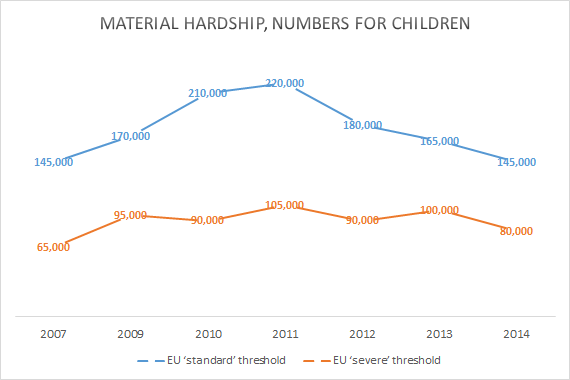
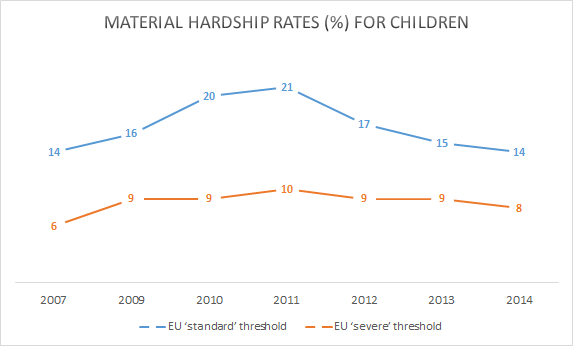
The material hardship measure shows a falling child material hardship rate using a threshold equivalent to the ‘standard’ EU level, down from a peak of 21% immediately after the GFC to 14% in 2014.
Using the more severe threshold, there was a slight rise through the GFC to 10% and a small fall to 8%, the level it was at before the GFC.
Source: Bryan Perry, Household Incomes in New Zealand: trends in indicators of inequality and hardship 1982 to 2014 – Ministry of Social Development, Wellington (August 2015), p. 133.
Source: Bryan Perry, Household Incomes in New Zealand: trends in indicators of inequality and hardship 1982 to 2014 – Ministry of Social Development, Wellington (August 2015), p. 133.
Maori and Pasifika economic progress since 1988
13 Aug 2015 Leave a comment
in applied welfare economics, discrimination, economic history, labour economics, politics - New Zealand, poverty and inequality Tags: Maori economic development
From a longer-term perspective, all groups showed a strong rise from the low point in the mid 1990s through to 2010. In real terms, overall median household income rose 47% from 1994 to 2010: for Maori, the rise was even stronger at 68%, and for Pacific, 77%.
These findings for longer- term trends are robust, even though some year on year changes may be less certain. For 2004 to 2010, the respective growth figures were 21%, 31% and 14%.

Source: Bryan Perry, Household Incomes in New Zealand: trends in indicators of inequality and hardship 1982 to 2014 – Ministry of Social Development, Wellington (August 2015), Table D6.
@WJRosenbergCTU A brief history of rising equality in New Zealand
13 Aug 2015 Leave a comment
in applied price theory, applied welfare economics, economic history, economics of media and culture, income redistribution, labour economics, politics - New Zealand, poverty and inequality, Public Choice Tags: capitalism and freedom, Leftover Left, The Great Enrichment, The Great Fact, top 1%, Twitter left
Bill Rosenberg at the Council of Trade Unions was good enough to tweet a Treasury chart that shows next to no increases in inequality in New Zealand for at least 20 years.
A brief history of inequality-from Treasury paper Fig4. Note Employment Contracts Act,GST,income tax,benefit cuts,WFF http://t.co/y4w3cUsgjD—
Bill Rosenberg (@WJRosenbergCTU) June 27, 2015
Inequality in both market and disposable incomes has been stable for a good 20 years, as the above tweet shows, while inequality in consumption has been falling. To back this interpretation of mine up, coincidentally today Bryan Perry published his annual report on income and inequality under the banner of the Ministry of Social Development.
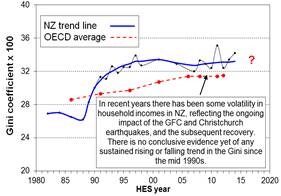
His report showed that there be no significant increase in New Zealand in at least 20 years.
@metiria @NZGreens child poverty is driven by housing unaffordability – by Green opposition to RMA reform
13 Aug 2015 1 Comment
in applied welfare economics, economic history, economics of regulation, labour economics, politics - New Zealand, poverty and inequality, urban economics Tags: antimarket bias, child poverty, expressive voting, family poverty, green rent seeking, housing affordability, land use planning, Leftover Left, New Zealand Greens, NIMBYs, rational ignorance, rational irrationality, RMA, zoning
#moreinclusivenz @povertymonitor Killer graphs & #infographics by NZ Children's Commissioner. Shameful content, NZ http://t.co/mG987C5kh0—
Isabella Cawthorn (@fixiebelle) July 26, 2015
Nothing much has happening to child poverty before housing costs in New Zealand since the early 1980s. It is after housing costs poverty that is crucifying the children in New Zealand.
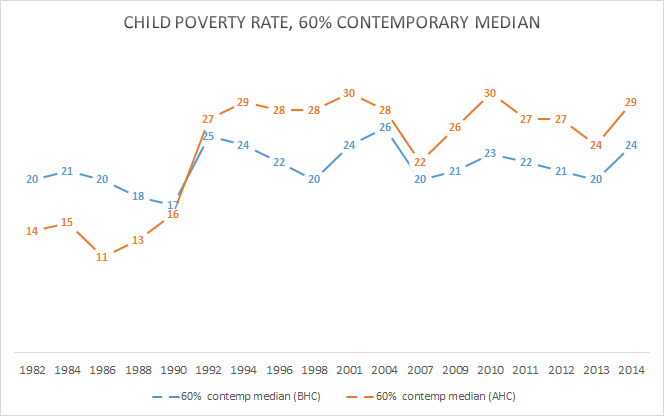
Source: Bryan Perry, Household Incomes in New Zealand: trends in indicators of inequality and hardship 1982 to 2014 – Ministry of Social Development, Wellington (August 2015), Table F6 and table F7.
An economy that is not working for all of us, is simply not working. http://t.co/zZu0LOy7ED—
Green Party NZ (@NZGreens) August 13, 2015
From HES 2013 to HES 2014 median household income rose 5% in real terms (5% above the CPI inflation rate)…
On the AHC moving line measures, child poverty rates in HES 2014 are around the same as their peak after the GFC. A good amount of the rise from HES 2013 to HES 2014 is due to the large rise in the BHC median, as noted above, rather than a change in the numbers in low income per se.
The parties that oppose measures to increase the supply of land and reduce the cost of housing through reform of the Resource Management Act and its many restraints on the supply of land are the New Zealand Labour Party and New Zealand Greens.
Children's views on poverty #childpovertynz occ.org.nz/assets/Uploads… http://t.co/wZHJ19QcpN—
Child Poverty NZ (@povertymonitor) September 08, 2015
Has NZ child poverty doubled as @MaxRashbrooke said?
13 Aug 2015 Leave a comment
in applied welfare economics, economic history, politics - New Zealand Tags: child poverty, family poverty, Leftover Left
An economy that is not working for all of us, is simply not working. http://t.co/zZu0LOy7ED—
Green Party NZ (@NZGreens) August 13, 2015https://twitter.com/JimRose69872629/status/631634249737605120
https://twitter.com/JimRose69872629/status/631635425271001088

Lindsay Mitchell put me onto a quote by veteran grumbler Max Rashbrooke that the child poverty rate doubled in New Zealand:
In a system where income goes disproportionately to the already well-off, ordinary workers are missing out on the rewards of their efforts, to the tune of billions of dollars a year. Welfare benefits, cut by a quarter in 1991 and increased just 8 per cent in the last budget, are far too low to meet people’s basic needs.
The result is a doubling of child poverty and the return of childhood diseases unknown in most developed countries – a national embarrassment, as one researcher described it.
Poverty, income and inequality data is collected in loving detail by Brian Perry every year for the Ministry of Social Development.
Figure 1: % child poverty in New Zealand (before and after housing costs), 60% 1998 median constant value, 1982 – 2013
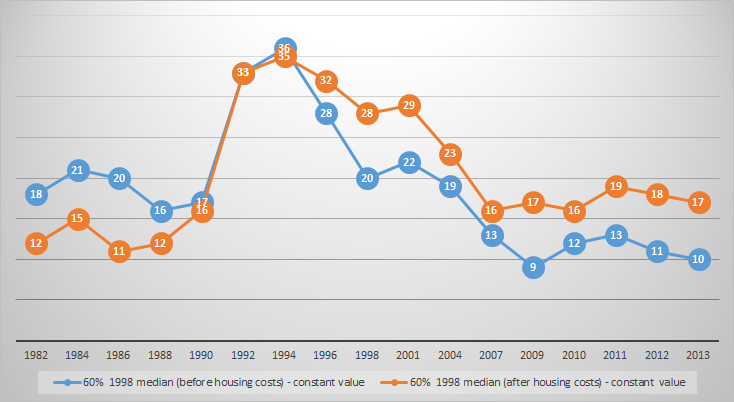
Source:
View original post 509 more words
Prices — what do they do?
13 Aug 2015 Leave a comment
in applied price theory, applied welfare economics, Austrian economics Tags: competition is a discovery procedure, market process, The meaning of competition
Creative destruction in family spending in the USA
12 Aug 2015 Leave a comment
in applied welfare economics, economic history, politics - USA Tags: creative destruction, living standards
https://twitter.com/VisualEcon/status/508957190129188864/photo/1
Family spending across a different income groups bit.ly/195NbKb http://t.co/mSbc0DRICY—
Catherine Mulbrandon (@VisualEcon) September 01, 2014
Australia announces its futile carbon emissions target
12 Aug 2015 Leave a comment
in applied price theory, applied welfare economics, environmental economics, global warming, politics - Australia, politics - New Zealand, politics - USA, Public Choice, rentseeking Tags: Australia, China, climate alarmism, climate change treaties, free-riders, game theory, global warming, international free riders, international public goods, public goods


Recent Comments