Does fair trade help the poor? Economist Don Boudreaux's answer may surprise you: https://t.co/FU9iUzwZrw
— Mercatus Center (@mercatus) July 29, 2015
Does fair trade help the poor?
11 Aug 2015 Leave a comment
in applied price theory, applied welfare economics, comparative institutional analysis, development economics, growth disasters, growth miracles, health and safety, human capital, industrial organisation, international economics, labour economics, survivor principle Tags: agricultural economics, expressive voting, fair trade, rational irrationality
How @equitablegrowth showed inequality helps growth when arguing inequality harms growth
10 Aug 2015 1 Comment
in applied price theory, applied welfare economics, comparative institutional analysis, currency unions, economic growth, economic history, economics of regulation, entrepreneurship, Euro crisis, fiscal policy, global financial crisis (GFC), income redistribution, labour economics, labour supply, macroeconomics, Marxist economics, poverty and inequality, Public Choice, public economics, rentseeking Tags: British disease, entrepreneurial alertness, Eurosclerosis, France, German unification, Germany, growth of government, sick man of Europe, social insurance, Sweden, taxation and entrepreneurship, taxation and investment, taxation and labour supply, welfare state
The Washington Centre for Equitable Growth recently tweeted that inequality harms growth in the USA as compared to Sweden, France, Germany and the UK. It was relying on some dodgy OECD research.
.@OECD sees continued rise in growth-harming inequality, reports @PaulHannon29 on.wsj.com/1EZpq1S http://t.co/xt4heZysXT—
Equitable Growth (@equitablegrowth) May 21, 2015
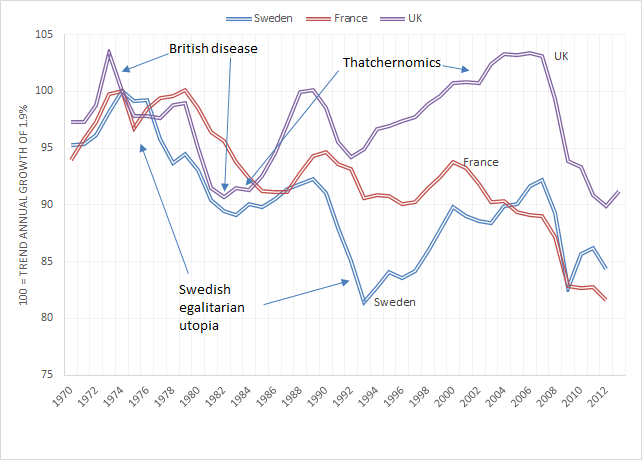
The Washington Centre for Equitable Growth did not check their inequality ratios they tweeted against trends in economic growth and economic policy since 1970, which I have reproduced in figure 1. Germany is not included in figure 1 because German data on growth is thrown askew by German unification.
Figure 1: Real GDP per British, French and Swede aged 15-64, 2014 US$ (converted to 2014 price level with updated 2011 PPPs), 1.9 per cent detrended, 1970-2013
Source: Computed from OECD Stat Extract and The Conference Board. 2015. The Conference Board Total Economy Database™, May 2015, http://www.conference-board.org/data/economydatabase/
Figure 1 shows that France has been in a long-term decline since the late 1970s despite the blessings of a more equal society than the USA as championed by the Washington Centre for Equitable Growth. In figure 1, a flat line is growth in real GDP per working age person, PPP, at the same rate as the USA for the 20th century, which was 1.9% per year. A falling line in figure 1 indicates growth of less than 1.9% while a rising line indicates growth in real GDP per working age person, PPP, in excess of 1.9%. In figure 1, France hardly ever grew at the trend rate of growth for the USA of 1.9% per year and was frequently well below that rate.

Sweden tells a slightly different story in figure 1 because of regime change in the early 1990s when Sweden adopted more liberal economic policies where taxes and government spending were reduced:
The rapid growth of the state in the late 1960s and 1970s led to a large decline in Sweden’s relative economic performance. In 1975, Sweden was the 4th richest industrialised country in terms of GDP per head. By 1993, it had fallen to 14th.
@alexvoronov använda smygfinansiering av Generell Välfärd är alltid av ondo. @NimaSanandaji: bit.ly/1Nar2eV http://t.co/wD0YEgncIE—
Old Whig (@aClassicLiberal) August 05, 2015
That regime change reversed a long economic decline since 1970 under the egalitarian policies of the Swedish Social Democratic Party. Under the Swedish Social Democratic Party, Sweden was almost always growing at less than the trend rate of growth of the USA, which was 1.9%. That position reversed only when there was a turn away from big government and high taxes.

Figure 1 tells a similar story for the British economy: a long economic decline in the 1970s when Britain was the sick man of Europe. Under Thatchernomics, Europe had a long economic boom for 20 years or more – see figure 1.
In the 1970s, under the high taxes of the Heath, Callaghan and Wilson administrations, as figure 1 shows, Britain was the sick man of Europe. With the election of the Thatcher Government, Britain soon grew at better than the US trend growth rate for nearly 20 years through few exceptions.
Graph of the Day: The UK has among the lowest total tax rates on businesses in the G7 http://t.co/l6mMhN9yLD—
CPS Think Tank (@CPSThinkTank) August 04, 2015
Swedosclerosis and Eurosclerosis compared
10 Aug 2015 Leave a comment
in applied welfare economics, comparative institutional analysis, economic growth, economic history, economics of regulation, industrial organisation, labour economics, labour supply, macroeconomics, survivor principle Tags: Eurosclerosis, Sweden, taxation and entrepreneurship, taxation and investment, taxation and labour supply, welfare state
Analysing environmental benefits from driving electric vehicles
09 Aug 2015 Leave a comment
in applied welfare economics, energy economics, environmental economics, global warming, politics - USA, Public Choice, rentseeking Tags: coal power, electric cars, green rent seeking, hydroelectric power, nuclear energy, nuclear power, offsetting behaviour, The fatal conceit, The pretense to knowledge, unintended consequences
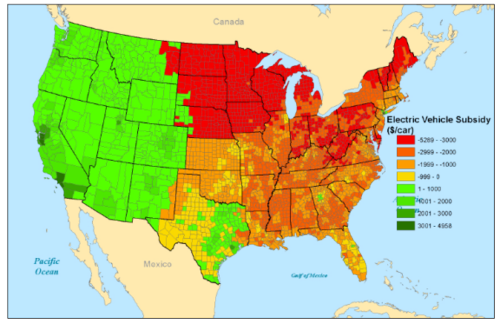
- The benefit is large and positive in many places in the west because the western electricity grid is relatively clean – primarily a mix of hydro, nuclear, and natural gas.
- The benefit is large and negative in many places in the east because the eastern electricity grid primarily relies more heavily on coal and natural gas.
via Economist’s View.
The Great Enrichment by household type in the 20th century
09 Aug 2015 2 Comments
in applied welfare economics, economic history Tags: creative destruction, entrepreneurial alertness, living standards, The Great Enrichment
https://twitter.com/VisualEcon/status/501347052878823425/photo/1
Share of Income Before & After Federal Taxes "An Illustrated Guide to Income" bit.ly/1tfXrse #inequality http://t.co/DnkSWZ6Yov—
Catherine Mulbrandon (@VisualEcon) April 24, 2014
The impact of welfare states on life expectancy
07 Aug 2015 Leave a comment
in applied welfare economics, fiscal policy, labour economics, politics - Australia, politics - New Zealand, politics - USA, poverty and inequality, welfare reform Tags: Denmark, Finland, life expectancies, Norway, Sweden, welfare state
New from @iealondon: Scandinavian success is not due to high taxes and welfare spending. iea.org.uk/in-the-media/p… http://t.co/QVH566KNtV—
IEA (@iealondon) July 07, 2015
I’m worried! I’m sympathising with organic farmers over a land use conflict!
06 Aug 2015 1 Comment
in applied price theory, applied welfare economics, economics of regulation, industrial organisation, law and economics, politics - New Zealand, property rights, Public Choice, rentseeking, Richard Epstein, survivor principle Tags: common law, economics of agriculture, food snobs, green rent seeking, land use conflicts, land use planning, law of nuisance, noise pollution, nuisance, old common law, organic farming, Richard Epstein, William Blackstone, zoning
Writing this blog of sound mind and sober disposition, I still have considerable sympathy with two organic farmers over a land use conflict they have with the neighbouring gun range.

Local land use regulations allows a gun club to set up 600 m away with competitive shooting days all day for 88 days a year. That is a voluntary self restraint. They could hold shooting competitions every day of the year. The local land use regulations allow the use of guns on rural land. The gun club used this absence of a prohibition on the use of guns in the frequency of use to set up a gun range to fire guns all day long on rural land.

Now here is the rub. There something wrong with the concept of quiet enjoyment of your land if a neighbour can fire off a large amount of noises continuously. The occasional noise, the occasional gunshot yes, but all day? I live near the airport, but I knew it was there when we bought the property and the lands was a little cheaper because of that.
The organic farmers are unusually pristine and prissy about what they want by neighbours to protect the sacredness of their more expensive snob food. I’m not too sure whether they would want to grant their neighbours an equal right to unusual land uses such as opening a gun range. That said, the organic farmers do have a point about a very noisy neighbouring land use that can be heard some distance away.
The organic farmers, of course, could have negotiated with their neighbours for covenants to restrict land use that undermine there are unusually pristine requirements for quiet enjoyment of their land and their neighbours land too. Easy to do when the land is first unused, but once economic activity accumulates, not so easy in terms of transaction costs and hold-outs.

The Great Escape in infant mortality
06 Aug 2015 Leave a comment
in applied welfare economics, economic history, health economics, population economics Tags: infant mortality, life expectancies, The Great Escape, The Great Fact
Child mortality declined dramatically – and #India and #Ghana are catching up fast.
From: OurWorldInData.org http://t.co/uReMfGyoPd—
Max Roser (@MaxCRoser) November 11, 2014
The Left opposed airline deregulation
05 Aug 2015 Leave a comment
in applied price theory, applied welfare economics, comparative institutional analysis, economic history, economics of regulation, entrepreneurship, income redistribution, industrial organisation, politics - Australia, politics - New Zealand, politics - USA, Public Choice, rentseeking, survivor principle Tags: airline deregulation, antimarket bias, bootleggers and baptists, expressive voting, Leftover Left, rational ignorance, rational irrationality
CHART: US average airfares 1979 to 2014 measured in number of hours work at the average wage. @chartoftheday http://t.co/q7Phz3VkU0—
Mark J. Perry (@Mark_J_Perry) August 02, 2015
Do vaccines work?
04 Aug 2015 Leave a comment
in applied welfare economics, economic history, environmental economics, health economics Tags: anti-vaccination movement, antiscience left, conjecture and refutation, vaccinations, vaccines
Beautiful charts by WSJ on history of vaccines and diseases:
graphics.wsj.com/infectious-dis… http://t.co/MWXr8nPWie—
Neil Halloran (@neilhalloran) February 24, 2015
The tax rates of the top 1%
04 Aug 2015 Leave a comment
in applied welfare economics, entrepreneurship, fisheries economics, income redistribution, politics - USA, rentseeking Tags: entrepreneurial alertness, envy, taxation and entrepreneurship, taxation and investment, taxation and the labour supply, top 1%
Historical Tax Rates of Top 0.01% (15,000 returns reporting more than $8 million in 2010) visualizingeconomics.com/blog/2013/8/14… http://t.co/XygW0t0npu—
Catherine Mulbrandon (@VisualEcon) August 15, 2013
Must we always tread on eggshells?
03 Aug 2015 Leave a comment
in applied welfare economics, comparative institutional analysis, economics of media and culture, liberalism Tags: free speech, meddlesome preferences, moral panic, nanny state, political correctness, trigger warnings
Trigger Warning: Those easily offended could be offended by this message. http://t.co/69NRjjeK7y—
Mark J. Perry (@Mark_J_Perry) July 28, 2015
North and South Korea in the 20th century
03 Aug 2015 Leave a comment
in applied price theory, applied welfare economics, comparative institutional analysis, constitutional political economy, development economics, economic history, economics of bureaucracy, growth disasters, growth miracles, income redistribution, Marxist economics, Public Choice, rentseeking Tags: central planning, North Korea, South Korea
Deirdre McCloskey’s speech on ‘Bourgeois Dignity’
03 Aug 2015 Leave a comment
in applied price theory, applied welfare economics, comparative institutional analysis, constitutional political economy, economic history, entrepreneurship, industrial organisation, law and economics, property rights, survivor principle Tags: Deirdre McCloskey, entrepreneurial alertness, industrial revolution, The Great Enrichment, The Great Fact


Recent Comments