The Great Escape – vaccine preventable deaths
02 Aug 2015 Leave a comment
in applied welfare economics, economic history, health economics, politics - USA Tags: anti-vaccination movement, The Great Escape, vaccinations, vaccines
The Great Fact in India
02 Aug 2015 Leave a comment
in applied welfare economics, development economics, economic history, growth disasters, growth miracles Tags: India, The Great Fact
In #India poverty is falling very, very rapidly – while inequality is rising.
More at: bit.ly/1KLT8Lh http://t.co/xTxlW1i06o—
Max Roser (@MaxCRoser) June 29, 2015
The fates of two islands under constant threat from a neighbouring military colossus
01 Aug 2015 Leave a comment
in applied price theory, applied welfare economics, Austrian economics, comparative institutional analysis, constitutional political economy, development economics, economics of media and culture, economics of regulation, growth disasters, growth miracles, income redistribution, industrial organisation, law and economics, liberalism, Marxist economics, property rights, Public Choice, rentseeking, survivor principle Tags: anticapitalist mentality, antimarket bias, capitalism and freedom, China, Cuba, expressive voting, Hong Kong, Leftover Left, public intellectuals, rational ignorance, rational irrationality, Twitter left
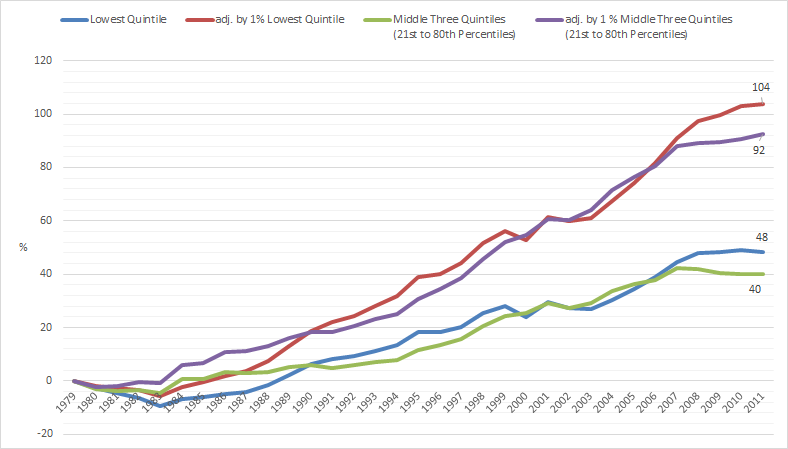
Cumulative Growth in Average Inflation-Adjusted After-Tax Income by Before-Tax Income Group, 1979 to 2011 with 1% annual adjustment for inflation measurement bias
01 Aug 2015 Leave a comment
in applied price theory, applied welfare economics, economic history, politics - USA Tags: CPI bias, living standards, measurement errors, The Great Enrichment
The Congressional Budget Office did its best to adjust after-tax incomes for inflation between 1979 in 2011. In figure 1, I added an extra 1% inflation adjustment in every year from 1979. 1% per annum is a common estimate of the inflation bias introduced by the inability of most measures of inflation to account for new goods and upgrades in the quality of existing goods to name but a few bias is in the measurement of consumer price inflation.
Figure 1: Cumulative Growth in Average Inflation-Adjusted After-Tax Income, by Before-Tax Income Group, USA, 1979 to 2011, 1% upward annual adjustment for inflation bias for new goods and quality upgrades
Source: derived from Congressional Budget Office, The Distribution of Household Income and Federal Taxes, 2011.
As can be seen from figure 1, with a 1% up left for measurement bias, instead of increases of 48% and 40% in the incomes of the lowest quartile in the middle three quartiles respectively, their after-tax, after inflation incomes about doubled since 1979.
"The rich got richer, true. But…" —@DeirdreMcClosk buff.ly/1Imdv4o http://t.co/M3ERx3JTIn—
HumanProgress.org (@humanprogress) June 28, 2015
Well done, capitalism. Everyone was on a working class income in the 1970s is now on a middle-class income. Such are the joys of compounding 1% per year over more than 30 years.
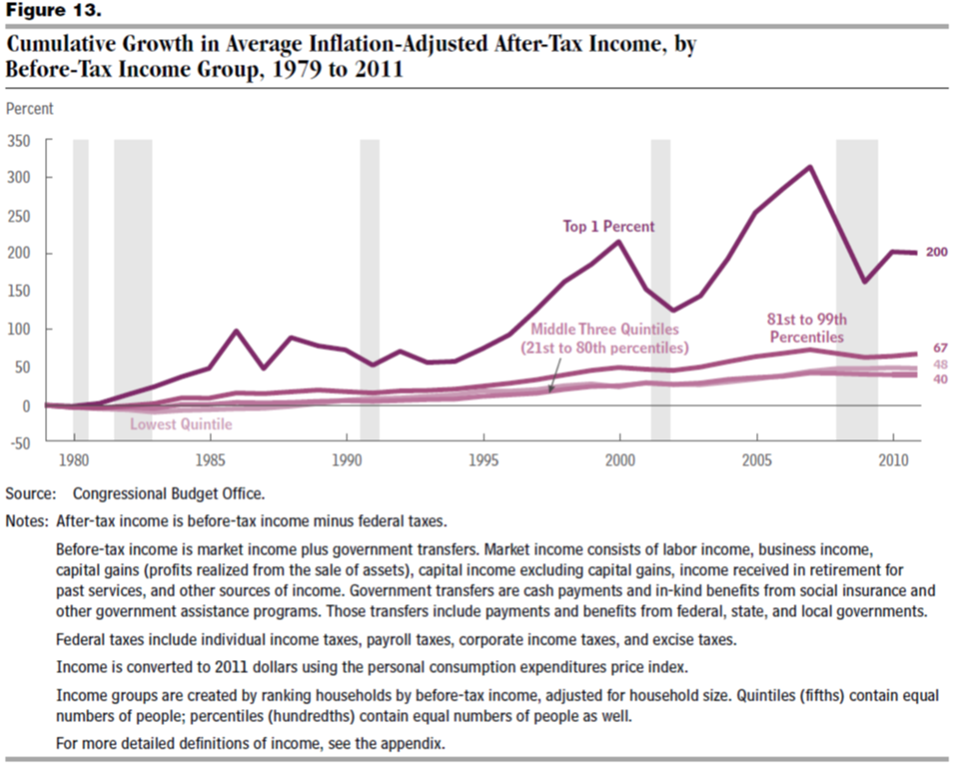
Source: Congressional Budget Office, The Distribution of Household Income and Federal Taxes, 2011.
The original Congressional Budget Office diagram above with the higher income quartiles is presented for comparison. I didn’t present the top quartiles in figure 1 because it made it unreadable because of the dominant influence of the top 1%’s increase in income.
The lesson for the day is small inaccuracies in the measurement of prosperity can over several decades through compounding lead to massive misunderstandings of the increases in prosperity.
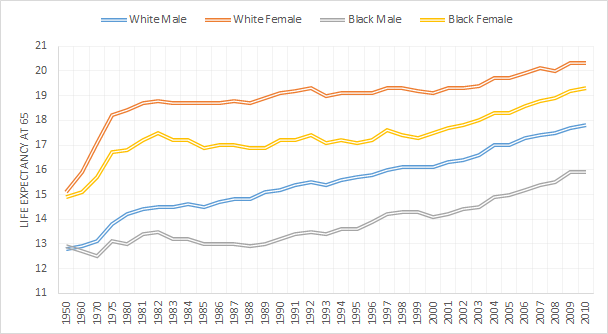
Life expectancies at age 65 by sex and race, USA, 1950 – 2010
31 Jul 2015 1 Comment
in applied welfare economics, economic history, health economics, politics - USA Tags: life expectancies, The Great Escape
There was quite a jump in life expectancy in the decades of the 1950s and 1960s, followed by slow progress for white females and black females. In the case of men of both races, the situation appears to be steady progress in post retirement life expectancy since 1950. Black male life expectancy actually fell in the 1960s for those aged 65.
Figure 1: life expectancies at age 65 by sex and race, USA, 1950 – 2010
Source: Centres for Disease Control and Prevention.
Trigger warning for the Twitter Left
31 Jul 2015 Leave a comment
in applied price theory, applied welfare economics, constitutional political economy, income redistribution, politics - Australia, politics - New Zealand, politics - USA, Public Choice, public economics, rentseeking Tags: antimarket bias, endogenous growth theory, expressive voting, laffer curve, Leftover Left, taxation and entrepreneurship, taxation and human capital, taxation and investment, taxation and the labour supply, top 1%, Twitter left
Deirdre McCloskey on the Samaritan’s dilemma
30 Jul 2015 Leave a comment
in applied price theory, applied welfare economics, comparative institutional analysis, constitutional political economy, development economics, economic history, economics of regulation, entrepreneurship, growth disasters, growth miracles, history of economic thought, income redistribution, industrial organisation, liberalism, Public Choice, rentseeking, survivor principle Tags: Age of Innovation, bourgeoisie deal, capitalism and freedom, Deirdre McCloskey, The Great Enrichment, The Great Escape, The Great Fact

Jane Kelsey opposes handcuffs on the democratic choices of future governments! Does she oppose labour and environmental standards in trade agreements too?
30 Jul 2015 6 Comments
in applied price theory, applied welfare economics, comparative institutional analysis, constitutional political economy, economics of regulation, environmental economics, health economics, industrial organisation, international economic law, international economics, International law, law and economics, property rights, Public Choice Tags: climate treaties, copyrights, customs unions, environmental standards, free trade agreements, free trade zones, intellectual property law, ISDS, Jane Kelsey, Labour standards, Left-wing hypocrisy, neocolonialism, patents, preferential trading agreeents, regional trade agreements, regulatory harmonisation, TPA, TPPA, WTO
Jane Kelsey in a television interview said she opposes the reductions in sovereignty in trade agreements that result from investor-state dispute settlement (ISDS) provisions because they limit the democratic choices of future governments.
If so, she must oppose environmental and labour standards in trade agreements and, more importantly, binding the hands of future governments with climate treaties. All international treaties are about restrictions on sovereignty.
Environmental and labour clauses in trade agreements and climate treaties all limit the powers of governments to legislate on environmental and employment law in accordance with the will of the people as expressed in the most recent election and change of government. Power to the people.
https://twitter.com/rorymccourt/status/625540621457960960
Jane Kelsey would do better focusing on those parts of the TPPA deal that lowers the net value of the deal such as those extending the term of patents over the drugs. All international treaties are about trade-offs.

The most important reason for focusing on intellectual property law in trade agreements is Kelsey is likely to actually win people over that are not on the far left, including many on the right of politics over to her cause. Kelsey is too busy rounding up the usual suspects.

Ranting about big corporate conspiracies and the investor state dispute settlement clauses puts people off.
As copyright duration's at play in #TPPA, a reminder of the costs when copyright's too long.
offsettingbehaviour.blogspot.co.nz/2014/03/orphan… http://t.co/tOtihpDmSU—
Eric Crampton (@EricCrampton) July 29, 2015
These gusts of paranoia lose support on issues where there is common ground to be suspicious about the growing scope of trade agreements and their reach behind borders.

Regulatory harmonisation is advisable only when there are compelling reasons such as the prevention of hazards or technical compatibility of products – do the plugs fit into each other? As Sykes argues:
as a normative matter, harmonization is inferior to a legal system that tolerates regulatory differences subject to legal constraints, and that relies on mutual recognition where appropriate (the exception to this claim being matters of technical compatibility between products).
Related, as a positive manner, harmonization will often lack any political constituency and thus instances of true harmonization will be rare.
Urban agglomeration and rent capitalisation explained
30 Jul 2015 Leave a comment
in applied price theory, applied welfare economics, transport economics, urban economics Tags: agglomeration economics, compensating differentials, equalising differences, land supply, rent capitalisation
What are the costs of prioritizing driving over transit? #infographic #cities #transit http://t.co/bOGG2kKwjX—
YouthfulCities (@youthfulcities) July 21, 2015
The first Paul Krugman (1997) on what trade negotiators negotiate about
29 Jul 2015 Leave a comment
in applied price theory, applied welfare economics, comparative institutional analysis, constitutional political economy, international economics, Public Choice, rentseeking Tags: customs unions, free trade agreements, free trade zones, game theory, Paul Krugman, preferential trading agreements, regional trade agreements, WTO

#TPPA The first Paul Krugman on trade agreements that level the playing field behind the border
29 Jul 2015 2 Comments

Measles cases and measles deaths in the USA
29 Jul 2015 Leave a comment
in applied welfare economics, health economics, politics - USA Tags: measles commonly anti-vaccination movement, The Grade Escape, The Great Fact, vaccines
The occupations of the top 1% and the top 0.1%
29 Jul 2015 Leave a comment
in applied price theory, applied welfare economics, entrepreneurship, financial economics, human capital, labour economics, occupational choice Tags: CEO pay, compensating differentials, entrepreneurial alertness, top 0.1%, top 1%, top income earners, top wage earners
Page 41 from "An Illustrated Guide to Income" more economic #dataviz at: bit.ly/11v2e9k http://t.co/7Hlgk4AjZn—
Catherine Mulbrandon (@VisualEcon) May 22, 2013


Recent Comments