#TPPANoWay @oxfamNZ @GreenpeaceUSA The Effects of Globalization
07 Feb 2016 Leave a comment
in applied price theory, applied welfare economics, development economics, economic history, growth disasters, growth miracles, international economics, Marxist economics Tags: customs unions, expressive voting, free trade, Leftover Left, ODA, preferential trading agreements, rational ignorance, rational irrationality, The Great Escape, The Great Fact, TPA, TPPA, Twitter left, Tyler Cowen
Why Does 1% of History Have 99% of the Wealth? @Oxfam #TPPANoWay
06 Feb 2016 Leave a comment
in development economics, economic history, growth disasters, growth miracles, history of economic thought, international economics Tags: capitalism and freedom, free trade, global poverty, globalisation, industrial revolution, international technology diffusion, technology diffusion, The Great Enrichment, The Great Fact, TPPA
@HillaryClinton @BernieSanders is it Republicans who are too extreme?
06 Feb 2016 Leave a comment
in economic history, politics - USA
…as Lynn Vavreck and John Sides show in The Gamble, their excellent book on the 2012 campaign, voters saw themselves as ideologically between Obama and Mitt Romney but closer to Romney.
Source: Bernie Sanders’s strong campaign is solving Hillary Clinton’s biggest problem – Vox

Source: Bernie Sanders’s strong campaign is solving Hillary Clinton’s biggest problem – Vox.
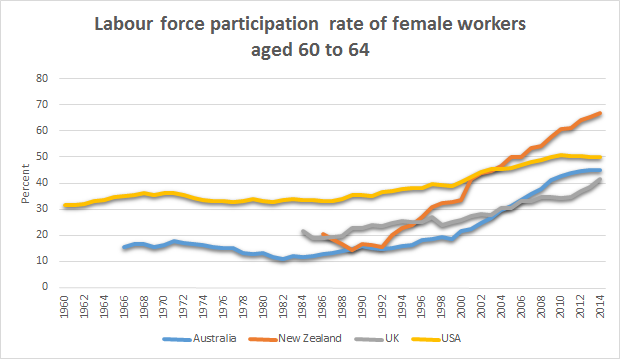
Female labour force participation rate, workers aged 60 to 64, USA, UK, Australia and New Zealand since 1960
06 Feb 2016 Leave a comment
in economic history, labour economics, labour supply, politics - New Zealand, public economics Tags: ageing society, labour demographics, old-age pension, older workers, social insurance, welfare state
The increase in the eligibility age from the age of 60 to the age of 65 for the old age pension in New Zealand clearly sparked an explosion in female labour force participation between these ages.
Data extracted on 05 Feb 2016 04:49 UTC (GMT) from OECD.Stat.
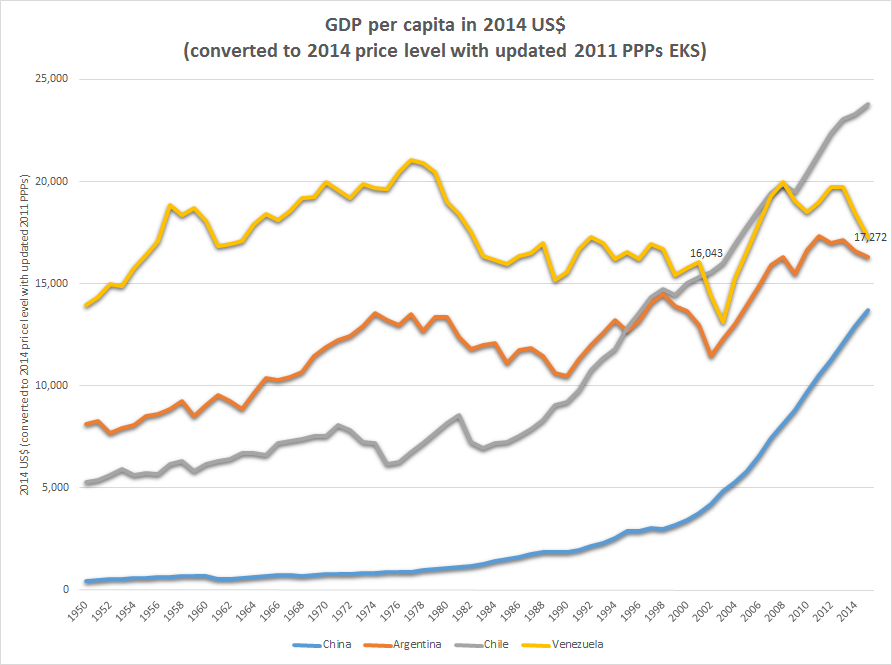
@OwenJones84 @K_Niemietz GDP per capita has not more than doubled @chavezcandanga
05 Feb 2016 Leave a comment
in development economics, economic history, growth disasters, growth miracles, Marxist economics Tags: Argentina, Chile, China, left-wing populism, Leftover Left, Oil prices, The Great Fact, Twitter left, Venezuela
Source: The Conference Board. 2015. The Conference Board Total Economy Database™, May 2015, http://www.conference-board.org/data/economydatabase/
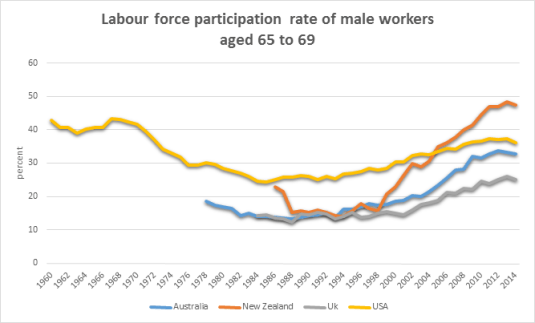
Labour force participation rates of US, UK, Australian and New Zealand male workers aged 65 to 69 since 1960
05 Feb 2016 Leave a comment
in economic history, labour economics, labour supply, politics - New Zealand, public economics
Up until the early 1990s, New Zealand had a universal old age pension that was paid from the age of 60. There was no means test or assets test. The eligibility age for this old age pension was increased to age 65 over the course of the 1990s and early 2000s. It obviously showed up in the labour supply of workers aged 66 and over in New Zealand after the change in the eligibility age.
Data extracted on 05 Feb 2016 04:49 UTC (GMT) from OECD.Stat.
Labour force participation rates of US, UK, Australian and New Zealand workers aged 60 to 64 since 1960
05 Feb 2016 Leave a comment
in applied price theory, economic history, labour economics, labour supply, politics - New Zealand, public economics
Up until the early 1990s, New Zealand had a universal old age pension that was paid from the age of 60. There was no means test or assets test. The eligibility age for this old age pension was increased to age 65 over the course of the 1990s and early 2000s. It obviously showed up in the labour supply of workers aged 60 to 64 in New Zealand both before and after the change in the eligibility age.

Data extracted on 05 Feb 2016 04:49 UTC (GMT) from OECD.Stat.
Poverty’s development 1800-2015
05 Feb 2016 Leave a comment
in development economics, economic history, growth disasters, growth miracles, technological progress Tags: global poverty, industrial revolution, The Great Enrichment, The Great Escape, The Great Fact
@TransportBlog forgets the car ownership data it published
04 Feb 2016 Leave a comment
in economic history, politics - New Zealand, transport economics, urban economics
Transport Blog was making much of some data about how a lot of people used public transport and New Zealand in the 1950s:
Take Auckland as an example. According to Paul Mees [Transport for Suburbia, p. 21], in 1954 Auckland’s public transport network “accounted for 58 per cent of trips by motorized modes, private transport only 42 per cent. When walking and cycling, which were not surveyed, are taken into account, it is likely that fewer than a third of daily trips were by car.”
… public spending to enable car travel did not respond to existing demand – it was intended to shape future demand. (And in doing so, change the shape of the city).
…
“roads first” transport policies seem less like an exercise in meeting demands, and more of a component of a large social engineering programme.
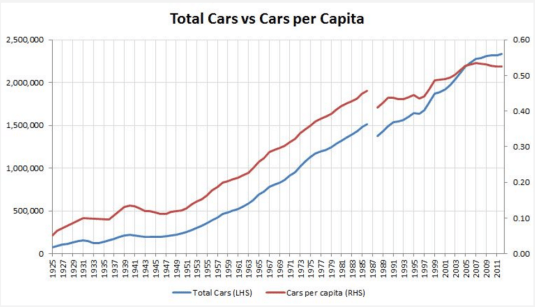
Transport Blog forgot previous data it dugout on trends in car ownership per capita in New Zealand since 1925. There is an explosive growth in car ownership from the 1950s onwards with the post-war economic boom. The roadbuilding that followed responded to this growing wealth of the New Zealand people rather than the other way round.
Source: The Infernal Combustion Engine « transportblog.co.nz.
People like owing and driving cars. Transport Blog begrudgingly admits in its post today that cars have some advantages.
Young people save up to buy a car not because they are duped by the enemies of public transport, they save because a car is a good way to get around.
Privately owned cars are more comfortable, faster, more private, more convenient in trip timing, and more flexible for multiple tasks on one trip than any form of public transit. What cannot be avoided as Anthony Downs explains is:
As household incomes rise around the world, more and more people shift from slower, less expensive modes of movement to privately owned cars and trucks.
Downs argues that it is time to settle down and accept what cities are:
…peak-hour traffic congestion is inescapable in large modern metropolitan areas the world over. Business firms want most people on the job during the same hours so that workers can interact efficiently. Many firms also want to locate in low-density establishments scattered across the landscape.
Households want a range of choices of where to live and work, and most want to live in low-density settlements that are separate from poorer households, use private vehicles for most travel and be able to carry out multiple errands on a single trip.
Despite population growth, see how the total number of people in extreme poverty has fallen
04 Feb 2016 Leave a comment
in development economics, economic history, growth miracles Tags: extreme poverty, global poverty, The Great Escape, The Great Fact
@RusselNorman @JulieAnneGenter a hedge fund specialises in shorting renewable energy shares @Greenpeace
03 Feb 2016 Leave a comment
in defence economics, economic history, economics of regulation, energy economics, entrepreneurship, environmental economics, financial economics, global warming Tags: active investing, disinvestment, entrepreneurial alertness, ethical investing, Fossil Fuels, green rentseeking, hedge funds, passive investing, renewable energy, solar power, Vice Fund, wind power

Just as the Vice Fund specialises in investing in tobacco, alcohol, gaming and defence shares, Cool Futures Funds Management is starting-up to specialise in betting against global warming by shorting green stocks:
…instead of renewables being our energy future, they’re betting on the subsidies drying up and the whole industry collapsing; instead of fossil fuels being left in the ground as “stranded assets”.
An example of the nice little earners this hedge fund can come across is anticipating when particular investors will want to disinvest from fossil fuels.
When institutional investors ranging from universities to sovereign investment funds such as the New Zealand Superannuation Fund seek to disinvest from fossil fuels, that will be a good time to buy cheap shares.The
Agricultural subsidies as a % of gross farm receipts in USA, Canada, Japan, Australia and New Zealand since 1986
02 Feb 2016 1 Comment
in economic history, politics - Australia, politics - New Zealand, politics - USA, Public Choice, rentseeking Tags: agricultural subsidies, Australia, Canada, cultural economics, Japan
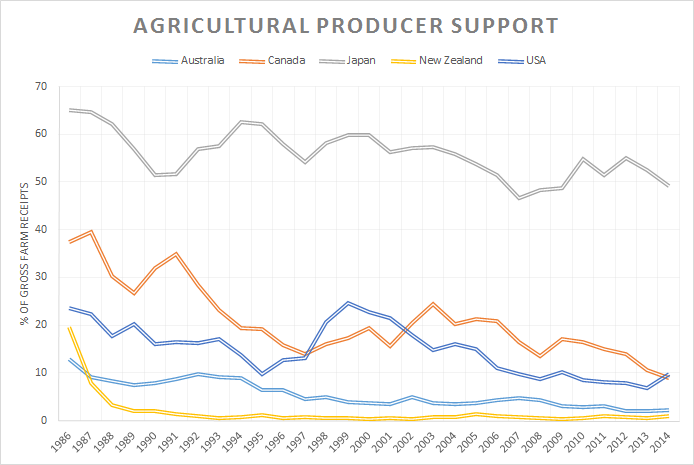
Source: Agricultural policy – Agricultural support – OECD Data.
Agricultural support is defined as the annual monetary value of gross transfers to agriculture from consumers and taxpayers arising from government policies that support agriculture, regardless of their objectives and economic impacts.


Recent Comments