Mises on the task of the historian
13 Aug 2015 Leave a comment
in economic history, Ludwig von Mises Tags: political correctness
Italian unemployment incidence by duration since 1983
12 Aug 2015 Leave a comment
in business cycles, economic history, Euro crisis, job search and matching, labour economics, macroeconomics, unemployment Tags: employment law, equilibrium unemployment rate, Eurosclerosis, Italy, labour market regulation, natural unemployment rate, unemployment duration
Unemployment of more than a year was slowly tapering down in Italy before the global financial crisis, but ever so slowly.
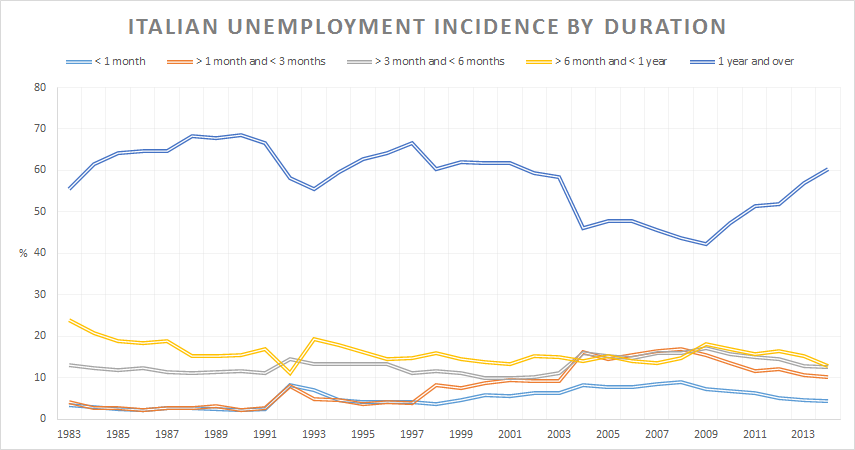
Source: OECD StatExtract.
Creative destruction in family spending in the USA
12 Aug 2015 Leave a comment
in applied welfare economics, economic history, politics - USA Tags: creative destruction, living standards
https://twitter.com/VisualEcon/status/508957190129188864/photo/1
Family spending across a different income groups bit.ly/195NbKb http://t.co/mSbc0DRICY—
Catherine Mulbrandon (@VisualEcon) September 01, 2014
How to See All Six Apollo Moon Landing Sites
12 Aug 2015 Leave a comment
in economic history, health economics Tags: antiscience left, conspiracy theories, conspiracy theorists, moon landing, Quacks

12 Aug 2015 Leave a comment
in economic history, economics of media and culture, entrepreneurship, financial economics, industrial organisation, survivor principle Tags: creative destruction, entreprenurial alertness, Google
Creative destruction in cell phones
12 Aug 2015 Leave a comment
in economic history, technological progress Tags: cell phones, creative destruction, smart phones
30 Years Of Cell Phones http://t.co/dmCB77ThXa—
History In Pictures (@HistoryInPix) August 05, 2015
German unemployment incidence by duration since 1983
11 Aug 2015 Leave a comment
in economic history, Euro crisis, fiscal policy, job search and matching, labour economics, labour supply, macroeconomics, unemployment, welfare reform Tags: equilibrium unemployment rate, Eurosclerosis, German unification, Germany, natural unemployment rate, poverty traps, unemployment duration, unemployment insurance, welfare state
German long term unemployment has been pretty stable albeit with an up-and-down after German unification. There is also a fall in long-term unemployment after some labour market reforms around 2005.

Source: OECD StatExtract.
A Beatlemania theory of share market fluctuations
11 Aug 2015 Leave a comment
in economic history, financial economics, Music Tags: efficient markets hypothesis, The Beatles
#TBT Remember when Bob Prechter explained the entire stock market simply by using The Beatles? http://t.co/u1UHW8lv1L—
Joseph Weisenthal (@TheStalwart) July 22, 2015
DMZ in 1953
11 Aug 2015 Leave a comment
in economic history, politics - USA, war and peace Tags: Korean war
Singapore at 50
10 Aug 2015 Leave a comment
in constitutional political economy, development economics, economic history, economics of bureaucracy, growth miracles, Public Choice Tags: Singapore
How @equitablegrowth showed inequality helps growth when arguing inequality harms growth
10 Aug 2015 1 Comment
in applied price theory, applied welfare economics, comparative institutional analysis, currency unions, economic growth, economic history, economics of regulation, entrepreneurship, Euro crisis, fiscal policy, global financial crisis (GFC), income redistribution, labour economics, labour supply, macroeconomics, Marxist economics, poverty and inequality, Public Choice, public economics, rentseeking Tags: British disease, entrepreneurial alertness, Eurosclerosis, France, German unification, Germany, growth of government, sick man of Europe, social insurance, Sweden, taxation and entrepreneurship, taxation and investment, taxation and labour supply, welfare state
The Washington Centre for Equitable Growth recently tweeted that inequality harms growth in the USA as compared to Sweden, France, Germany and the UK. It was relying on some dodgy OECD research.
.@OECD sees continued rise in growth-harming inequality, reports @PaulHannon29 on.wsj.com/1EZpq1S http://t.co/xt4heZysXT—
Equitable Growth (@equitablegrowth) May 21, 2015
The Washington Centre for Equitable Growth did not check their inequality ratios they tweeted against trends in economic growth and economic policy since 1970, which I have reproduced in figure 1. Germany is not included in figure 1 because German data on growth is thrown askew by German unification.
Figure 1: Real GDP per British, French and Swede aged 15-64, 2014 US$ (converted to 2014 price level with updated 2011 PPPs), 1.9 per cent detrended, 1970-2013
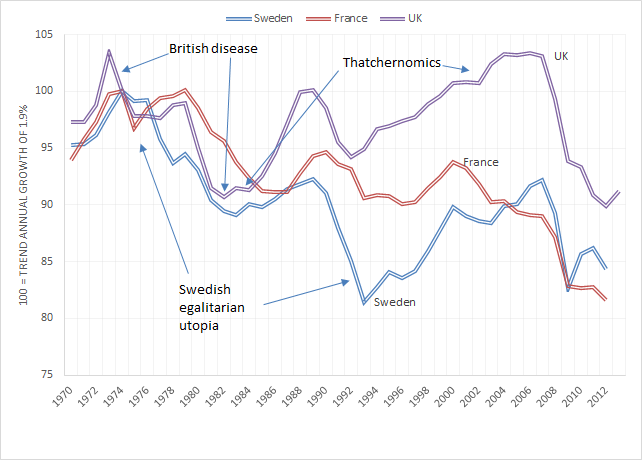
Source: Computed from OECD Stat Extract and The Conference Board. 2015. The Conference Board Total Economy Database™, May 2015, http://www.conference-board.org/data/economydatabase/
Figure 1 shows that France has been in a long-term decline since the late 1970s despite the blessings of a more equal society than the USA as championed by the Washington Centre for Equitable Growth. In figure 1, a flat line is growth in real GDP per working age person, PPP, at the same rate as the USA for the 20th century, which was 1.9% per year. A falling line in figure 1 indicates growth of less than 1.9% while a rising line indicates growth in real GDP per working age person, PPP, in excess of 1.9%. In figure 1, France hardly ever grew at the trend rate of growth for the USA of 1.9% per year and was frequently well below that rate.

Sweden tells a slightly different story in figure 1 because of regime change in the early 1990s when Sweden adopted more liberal economic policies where taxes and government spending were reduced:
The rapid growth of the state in the late 1960s and 1970s led to a large decline in Sweden’s relative economic performance. In 1975, Sweden was the 4th richest industrialised country in terms of GDP per head. By 1993, it had fallen to 14th.
@alexvoronov använda smygfinansiering av Generell Välfärd är alltid av ondo. @NimaSanandaji: bit.ly/1Nar2eV http://t.co/wD0YEgncIE—
Old Whig (@aClassicLiberal) August 05, 2015
That regime change reversed a long economic decline since 1970 under the egalitarian policies of the Swedish Social Democratic Party. Under the Swedish Social Democratic Party, Sweden was almost always growing at less than the trend rate of growth of the USA, which was 1.9%. That position reversed only when there was a turn away from big government and high taxes.

Figure 1 tells a similar story for the British economy: a long economic decline in the 1970s when Britain was the sick man of Europe. Under Thatchernomics, Europe had a long economic boom for 20 years or more – see figure 1.
In the 1970s, under the high taxes of the Heath, Callaghan and Wilson administrations, as figure 1 shows, Britain was the sick man of Europe. With the election of the Thatcher Government, Britain soon grew at better than the US trend growth rate for nearly 20 years through few exceptions.
Graph of the Day: The UK has among the lowest total tax rates on businesses in the G7 http://t.co/l6mMhN9yLD—
CPS Think Tank (@CPSThinkTank) August 04, 2015
Colonial Africa on the eve of World War I
10 Aug 2015 Leave a comment
in economic history, war and peace Tags: Africa, British empire, British imperialism, colonialism, imperialism, World War I
Colonial Africa On The Eve of World War I. Learn more here: brilliantmaps.com/africa-1914/ http://t.co/RAm2HXA3X6—
Brilliant Maps (@BrilliantMaps) April 30, 2015
Swedosclerosis and Eurosclerosis compared
10 Aug 2015 Leave a comment
in applied welfare economics, comparative institutional analysis, economic growth, economic history, economics of regulation, industrial organisation, labour economics, labour supply, macroeconomics, survivor principle Tags: Eurosclerosis, Sweden, taxation and entrepreneurship, taxation and investment, taxation and labour supply, welfare state
The raw numbers on The Great Fact
10 Aug 2015 Leave a comment
in development economics, economic history, growth disasters, growth miracles Tags: extreme poverty, global poverty, The Great Fact
1 billion ppl lived in extreme poverty 2 centuries ago – 1 billion ppl live in extreme poverty today. #dataviz http://t.co/xBMzrJB1N1—
Randy Olson (@randal_olson) August 01, 2015
Population projections for the rest of this century
10 Aug 2015 Leave a comment
in development economics, economic history, population economics Tags: ageing society, demographic crisis, economics of fertility
Daily chart: India will surpass China as the world's most populous country in 2022 econ.st/1MKsSFu http://t.co/EBeGKsMCtp—
The Economist (@ECONdailycharts) August 05, 2015


Recent Comments