Page 41 from "An Illustrated Guide to Income" more economic #dataviz at: bit.ly/11v2e9k http://t.co/7Hlgk4AjZn—
Catherine Mulbrandon (@VisualEcon) May 22, 2013
The occupations of the top 1% and the top 0.1%
29 Jul 2015 Leave a comment
in applied price theory, applied welfare economics, entrepreneurship, financial economics, human capital, labour economics, occupational choice Tags: CEO pay, compensating differentials, entrepreneurial alertness, top 0.1%, top 1%, top income earners, top wage earners
More evidence on the rise and rise of the working super rich – the top income earners are top wage earners now
28 Jul 2015 Leave a comment
in economic history, economics of education, entrepreneurship, financial economics, human capital, labour supply, occupational choice, politics - USA Tags: creative destruction, entrepreneurial alertness, top 1%, top income earners, top wage earners
Page 47 from "An Illustrated Guide to Income" more economic #dataviz at: bit.ly/10QWgyR http://t.co/d1dhSYKWDC—
Catherine Mulbrandon (@VisualEcon) June 03, 2013

The share market capitalisation of the top tech companies
23 Jul 2015 Leave a comment
in entrepreneurship, financial economics Tags: Amazon on, Apple, creative destruction, entrepreneurial alertness, Facebook, Google, Microsoft
PayPal is now worth more than Netflix, eBay, and Twitter by @eugenekim222 businessinsider.com/paypal-now-wor… @pmarca http://t.co/M3IbfNlTi0—
Evan Kirstel (@evankirstel) July 20, 2015
And the rich got richer, who cares
16 Jul 2015 Leave a comment
in applied price theory, applied welfare economics, Austrian economics, comparative institutional analysis, constitutional political economy, development economics, economic history, economics of bureaucracy, economics of education, economics of regulation, economics of religion, energy economics, entrepreneurship, environmental economics, financial economics, growth disasters, growth miracles, income redistribution, industrial organisation, international economics, labour economics, labour supply, liberalism, poverty and inequality, Public Choice, rentseeking, survivor principle, transport economics, urban economics Tags: Deirdre McCloskey, entrepreneurial alertness, The Great Enrichment, The Great Escape, The Great Fact, top 1%
"The rich got richer, true. But…" —@DeirdreMcClosk buff.ly/1Imdv4o http://t.co/M3ERx3JTIn—
HumanProgress.org (@humanprogress) June 28, 2015
Was the Chinese share market crash rational asset-price movements without news?
14 Jul 2015 1 Comment
in business cycles, entrepreneurship, financial economics, macroeconomics Tags: competition as a discovery procedure, dot.com bubble, entrepreneurial alertness, event studies, learning by doing, sharemarket bubbles, sharemarket crashes
Large share market crashes such as over the recent months in China and the 1987 Wall Street crash do not necessarily imply an economic slowdown.
As the stock market gets rocked, let's remember this one thing about the crash of 1987 businessinsider.com/lets-remember-… http://t.co/BDgy5h5UN0—
Elena Holodny (@elenaholodny) August 21, 2015
The majority of major share market movements occur without any particular news hitting the market. Studies of the 50 largest share market movements in the US stock market between 1946 and 1987 found that the majority of them could not be explained by news. That includes the 1987 share market crash. In October 1987, shares fell by 20% in one day for no obvious reason.
China's stock market selloff explained in 6 charts bloom.bg/1HStJSe http://t.co/0CpoU21RpY—
Bloomberg Business (@business) July 13, 2015
David Romer explained these booms and busts, including the 1987 share market crash in two ways: investor uncertainty about the quality of other investors’ information; and dispersion of information and small costs to trading:
Asset prices can change because initially the market does an imperfect job of revealing the relevant information possessed by different investors and because developments within the market can then somehow cause more of that information to be revealed…
The possibility of imperfect aggregation implies an alternative to external news and irrationality as a potential source of asset-price movements: some price changes may be caused by “internal” news.
That is, asset prices can change because initially the market does an imperfect job of revealing the relevant information possessed by different investors and because developments within the market can then somehow cause more of that information to be revealed.
Either of these models are perfectly plausible. Investors learn from each other through trading and improve their estimations of the value of various shares.
#China Reality Check: #Stocks Are Still Too Expensive for @MarkMobius bloom.bg/1Monzct via @business @frostyhk http://t.co/e3Lv3KwgTZ—
Fion Li (@fion_li) July 13, 2015
As such, through internal learning and discovery within the share market there can be booms and crashes despite no new information, no communication, and no coordination among the participants in trading. Underneath the surface, there is a gradual updating of information by the participants and at a certain point in time, this causes a sudden change of behaviour.
Dow and Gorton made similar points to David Romer about how share market learning is a process of learning, judgement and error correction rather than an instant adjustment:
Strategic interaction and the complexity of the information result in a protracted price response.
Indeed, equilibrium price paths of the model may display reversals in which the two traders rationally revise their beliefs, first in one direction, and then in the opposite direction, even though no new information has entered the system.
A piece of information which is initially thought to be bad news may be revealed, through trading, to be good news.
Bubbles and crashes are consistent with private information held by a few slowly dispersing among market participants until this knowledge was reflected in stock prices as in Hayek’s (1945) analysis of the price mechanism as a means of communicating information.
HT: The one thing you should remember about the stock market crash of 1987 | Business Insider.
The share market speaks on recent British elections
12 Jul 2015 Leave a comment
in financial economics Tags: British politics, efficient markets hypothesis, event studies
Do British general election results have a big impact on the stockmarket? Yes, sometimes econ.st/1PUBhEh http://t.co/Ye7ede34HA—
The Economist (@ECONdailycharts) May 19, 2015
Entrepreneurial alertness in index-linked passive investing front-running
11 Jul 2015 Leave a comment
in entrepreneurship, financial economics Tags: active investing, arbitrage, efficient markets hypothesis, entrepreneurial alertness, passive investing, Speculation
There's an easy way to game the stock market, and it's getting easier by the day bloom.bg/1NNmHPs http://t.co/GFtBhKH2fo—
Bloomberg Business (@business) July 08, 2015
The traders are simply buying stocks before they’re added to the indexes that, by definition, index funds must track.
As the popularity of index investing soars to new heights, the emergence of index front-running is raising fundamental questions about so-called passive investment strategies, as well as how indexes are compiled and the role the funds themselves play in elevating costs.
By one estimate, it gouges owners of funds tracking the Standard & Poor’s 500 Index to the tune of $4.3 billion a year, a sum that can double or even triple the cost of such investments…
Take American Airlines Group Inc., which joined the S&P 500 after markets closed on March 20. Because the addition of the carrier was announced four days earlier, nimble traders had plenty of time to get in front of the less fleet-footed. American jumped 11 percent over the span.
The cost was ultimately borne by index funds, which sparked an $8 billion buying frenzy in the two minutes right before the close — an amount equal to more than two weeks of the stock’s typical volume…
Financial crises surprisingly common, but few countries close their banks
10 Jul 2015 Leave a comment
in business cycles, currency unions, economic history, economics of regulation, Euro crisis, financial economics, global financial crisis (GFC), law and economics, macroeconomics, monetary economics, property rights Tags: bank runs, banking crises, banking panic, financial crises, Greece, sovereign default
Financial crises surprisingly common, but few countries close their banks pewrsr.ch/1NQyz2P #Greece http://t.co/pK0sfB49Ka—
PewResearch FactTank (@FactTank) July 09, 2015
Real and Pseudo-Financial Crises, the Chinese share market crash and Anna Schwartz
09 Jul 2015 Leave a comment
in economic history, financial economics, fiscal policy, international economics, macroeconomics, monetarism, monetary economics Tags: Anna Schwartz, bank runs, banking panics, China, contagion, evidence-based policy, financial crises, financial stability, inflation targeting, international systemic risk, Michael Bordo, monetary history, pseudo financial crises, pseudo international systemic risk
If we could take time out from the breathless journalism about the Chinese stock market, which some people may have heard of before this week, it’s crash should be seen through the lens that Anna Schwartz developed in 1987 of a pseudo financial crisis and a financial crisis.
This is why so many Chinese companies are suspended bloom.bg/1UA7TbA http://t.co/5awEt6B23u—
Bloomberg Business (@business) July 08, 2015
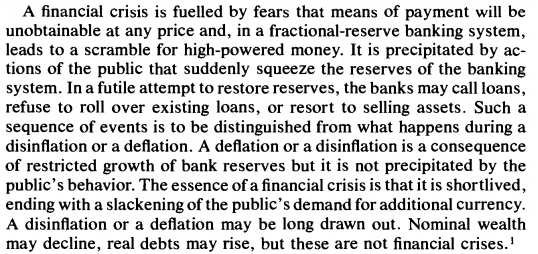
Her paper is written at the same time as the 1987 stock market crash. On financial crises, Anna Schwartz said:
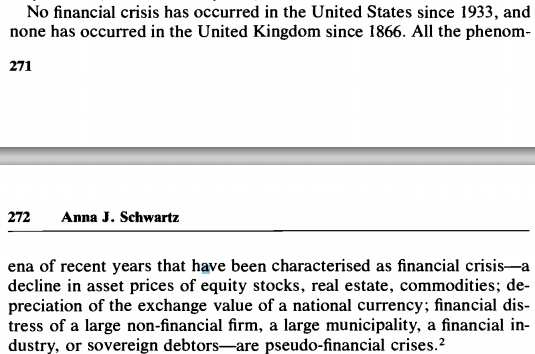
As for those pseudo financial crises, she said:
Schwartz’s principal concern with regard to pseudo financial crisis was:
proposals to deal with pseudo-financial crises is the perpetuation of policies that promote inflation and waste of economic resources
As we are talking about the Chinese stock market, Anna Schwartz also wrote about the concepts of real systemic international risk and and pseudo international systemic risk.
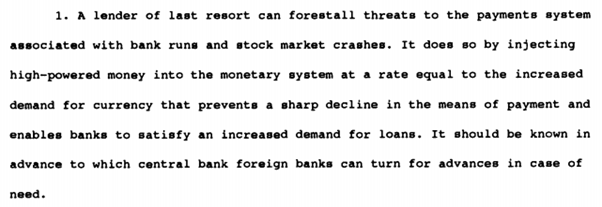
Once again, and as with pseudo financial crises and real financial crises, what distinguishes real systemic international risk and pseudo international systemic risk is a threat to the payment system. The threat of bank runs, which can easily be eliminated through lender of last resort facilities:
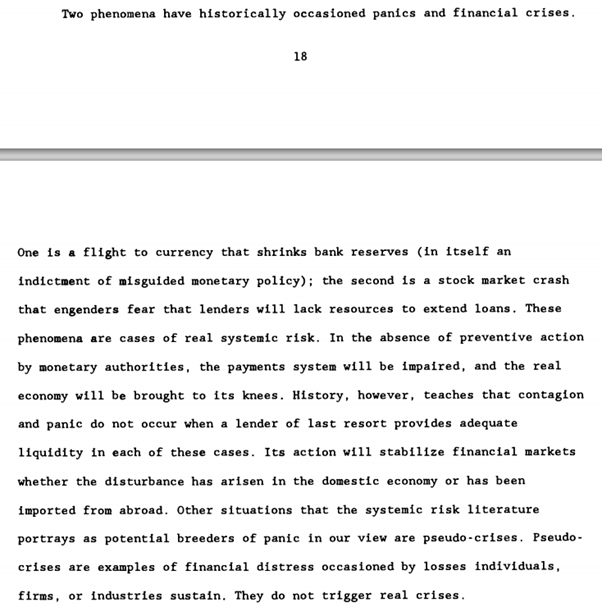
As always it is about the security of the payments system – of avoiding bank runs, not private losses:
The lesson for the day is that when people start panicking about the economy or the stock market or international markets, don’t go to a macroeconomist for advice, go to a monetary historian. They have seen it all before.

The reason why New Zealand should rule out helping Greece!
06 Jul 2015 Leave a comment
in budget deficits, business cycles, currency unions, economic growth, Euro crisis, financial economics, fiscal policy, global financial crisis (GFC), macroeconomics Tags: bank runs, banking panics, Eurosclerosis, Germany, Greece, sovereign defaults

Greece is a tiny part of the European economies so it doesn’t matter that much to the rest of the European Union what happens to Greece. The only people will notice the sovereign default of Greece once the breathless journalism has died down are Greeks themselves as they rebuild their banking and monetary system against a background of a government run by coffee shop Marxists.

Matt Ridley on the Pope and The Great Fact
06 Jul 2015 Leave a comment
in applied price theory, applied welfare economics, development economics, economic history, economics of regulation, energy economics, entrepreneurship, environmental economics, financial economics, growth disasters, growth miracles, health economics, history of economic thought, human capital, industrial organisation, labour economics, liberalism, survivor principle Tags: doomsday prophecies, Matt Ridley doomsday prophets, Papal economics, The Great Enrichment, The Great Escape, The Great Fact
See which way the data points for yourself, like @mattwridley. buff.ly/1HsZxgx #health #progress http://t.co/B3KbUJOn05—
HumanProgress.org (@humanprogress) June 30, 2015
Paul Samuelson on the acceptance of the efficient markets hypothesis by Wall Street
04 Jul 2015 Leave a comment

The share market speaks – Supreme Court’s Obamacare Decision Already Worth $3 Billion For Insurers
26 Jun 2015 Leave a comment
in financial economics, health economics, politics - USA Tags: events studies, Obamacare, share prices

via The Supreme Court’s Obamacare Decision Is Already Worth $3 Billion For Insurers | FiveThirtyEight.
Uber has grown faster in its first five years than Facebook
26 Jun 2015 Leave a comment
in economic history, economics of media and culture, financial economics, industrial organisation, survivor principle Tags: creative destruction, Facebook, Uber
Uber has grown faster in its first five years than Facebook did buff.ly/1eTxaNH http://t.co/dD1Gv1djkb—
Business Insider (@businessinsider) June 06, 2015
 Utopia, you are standing in it!
Recent Comments