Tariffs and the class war
10 Sep 2015 1 Comment
in applied welfare economics, income redistribution, international economics, Public Choice, rentseeking Tags: rentseeking, tariffs
Map of undersea cables around the world
25 Aug 2015 Leave a comment
in economic history, industrial organisation, international economics, technological progress Tags: map, undersea cables
The undersea cables wiring the Earth (2014).
(Explanation at: bit.ly/1yBFuEL) http://t.co/IWzrKL5pDl—
Max Roser (@MaxCRoser) June 25, 2015
Why @NZGreens @nzlabour @GreenpeaceNZ hate applied welfare economics
21 Aug 2015 Leave a comment
in applied welfare economics, economics of regulation, energy economics, environmental economics, health economics, international economics, labour economics, law and economics, politics - New Zealand, Public Choice Tags: antiforeign bias, antimarket bias, expressive voting, Greenpeace, Leftover Left, make-work bias, methodology of economics, New Zealand Greens, New Zealand Labour Party, rational ignorance, rational irrationality
Quotation of the Day from French Economist Frederic Bastiat in the 1850s http://t.co/2ECWtb6m9u—
Mark J. Perry (@Mark_J_Perry) August 14, 2015
John Stuart Mill on who loses from trade barriers
15 Aug 2015 Leave a comment
in applied price theory, applied welfare economics, international economics, liberalism Tags: antiforeign bias, expressive voting, John Stuart Mill, protectionism, rational ignorance, rational irrationality, tariffs and quotas
Creative destruction in car manufacturing
14 Aug 2015 Leave a comment
in development economics, economic history, entrepreneurship, growth miracles, industrial organisation, international economics, survivor principle Tags: automotive industry, car industry, comparative advantage, creative destruction, entrepreneurial alertness, manufacturing industry, market selection, The meaning of competition
Changing shares of car production since 1950
(source bit.ly/1hn1l0Y) http://t.co/VPhianlBBX—
Max Roser (@MaxCRoser) August 07, 2015
Explanation of the Greece Bailout in 90 Seconds
13 Aug 2015 Leave a comment
in budget deficits, business cycles, currency unions, economic growth, fiscal policy, international economic law, international economics, International law, macroeconomics Tags: credible commitments, Eurosclerosis, game theory, Greece, sovereign bailouts, sovereign defaults

Does fair trade help the poor?
11 Aug 2015 Leave a comment
in applied price theory, applied welfare economics, comparative institutional analysis, development economics, growth disasters, growth miracles, health and safety, human capital, industrial organisation, international economics, labour economics, survivor principle Tags: agricultural economics, expressive voting, fair trade, rational irrationality
Passports in Europe were abolished between 1861-1914
11 Aug 2015 Leave a comment
in international economic law, international economics, International law Tags: passports
@BrankoMilan Passports in Europe were abolished between 1861-1914 "History of Passports" bit.ly/1N5QSRo http://t.co/P97W2FCKJS—
Old Whig (@aClassicLiberal) August 04, 2015
TPP – Trojan Horse in a global race to the bottom
03 Aug 2015 Leave a comment
in international economics, International law, law and economics, politics - Australia, politics - New Zealand, politics - USA, property rights, Public Choice Tags: free trade agreements, ISDS, regional trade agreements, TPPA
I can’t think of a single fact that this crank got right in this clip on the Trans-Pacific partnership agreement (TPPA).
Robert Reich, a Democratic party hack, referred to the TPPA as the biggest trade deal ever. He ignored a large number of multinational trade deals under the World Trade Organisation and the GATT such as the Uruguay round and the current Doha round.
http://www.cuts-international.org/brf-97-1.gif
Reich claims the deal is negotiated in secret and later talks about its submission to the Congress for fast track.
Robert Reich claims that investor state dispute settlement allows challenges to any regulation and compensation for unfair reductions in profits. It is a far narrow criteria than that involving discrimination against foreigners.
http://images.slideplayer.com/5/1585527/slides/slide_6.jpg
Currently, about 3000 international treaties give the ability to sue governments. Some 2700 of these are Bilateral Investment Treaties. The rest are trade treaties, including NAFTA. These treaties have spread rapidly around the world since the 1990s.
The TPP draft chapter says that the point of investment protection has long been “to encourage and promote the flow of investment…as a means to promote economic growth.”
At the same time, the TPP draft chapter specifically highlights “the inherent right to regulate…to protect legitimate public welfare objectives, such as public health, safety, the environment, the conservation of living or non-living exhaustible natural resources, and public morals.”


Robert Reich talks about the Trans Pacific Partnership and its implications especially if it is signed. It would be the largest trade deal in history representing 792 million people and accounting for 40% of the world economy. Well worth a look.
A lot more Americans have a passport
02 Aug 2015 Leave a comment
in international economics, law and economics, politics - USA Tags: passports
From 3% to 38%, America Has Seen A Staggering Growth In Passport Holders: dadaviz.com/i/3323 #dataviz http://t.co/4IJweXJvK0—
Randy Olson (@randal_olson) February 20, 2015
Income from selling citizenships is now 16% of Malta government’s budget
01 Aug 2015 Leave a comment
in Economics of international refugee law, international economic law, international economics, law and economics Tags: Malta, passports, trading on sovereignty
Income from selling citizenships is now 16% of Malta government's budget bloom.bg/1GFbhJK @dslesperance http://t.co/C5HS8PjOb0—
Old Whig (@aClassicLiberal) March 22, 2015
Why do @NZGreens want NZ to lead the world by example on a carbon tax, but not unilateral free trade?
31 Jul 2015 Leave a comment
in David Friedman, environmental economics, global warming, international economics, Milton Friedman, Murray Rothbard, politics - New Zealand Tags: antiforeign bias, antimarket bias, carbon tax, carbon trading, climate treaties, expressive voting, free trade, global warming, left-wing double standards, Left-wing hypocrisy, New Zealand Greens, protectionism, rational ignorance, rational irrationality, unilateral free trade


NZ’s greenhouse gas emissions are high per person and unit of GDP but have fallen since 1990 oe.cd/10z http://t.co/f5BMLMvTjq—
OECD Publications (@OECD_Pubs) June 10, 2015
Are there net saving from a British pull-out of the EU?
31 Jul 2015 Leave a comment
in currency unions, economic growth, Euro crisis, international economics, macroeconomics Tags: British economy, customs unions, EU, EU membership, free trade areas, international economic integration, preferential trading agreements, regional integration
Ukip claims that there is a net saving from pulling out of EU are highly debatable: http://t.co/TemtNC9gnN—
C4 News FactCheck (@FactCheck) April 02, 2015
It’s Time to Name a Price on KiwiRail – how much more in losses before committing to shutting it down?
30 Jul 2015 Leave a comment
in industrial organisation, international economics, politics - New Zealand Tags: bailouts, corporate welfare, KiwRail, New Zealand Greens, TPPA
If a TPPA means no more bailouts for KiwiRail, that is a major benefit from the agreement not previously brought to public attention.
New Zealand shouldn’t be signing an agreement that ties future governments’ hands. #TPPANoWay http://t.co/dawreBzLia—
Green Party NZ (@NZGreens) July 30, 2015The KiwiRail bailouts add 1 to 2 percentage points to the company tax of every New Zealand business. Cutting the company tax by 1-2% by not bailing out KiwiRail would be a major public benefit. I now have one more reason to favour the TPPA.
For all the TPP's flaws, the biggest trade deal in years is good news for the world econ.st/1SjmwS3 http://t.co/UokBxoOXgf—
The Economist (@EconBizFin) July 30, 2015A trade agreement tying the hands of future governments preventing them from bailing out failing state-owned enterprises would be a major gain that could more than offset and indeed pay for the higher drug prices that may result from longer patent lives for new drugs.

In the finest public service traditions of free and frank advice, the New Zealand Treasury in its budget advice this year advised ministers to contemplate shutting down KiwiRail.
Treasury recommended the Government fund KiwiRail for one more year and undertake a comprehensive public study to look into closing the company. The study is public so that people were informed of the costs of running the rail network compared with any benefits it provided. The Government rejected the idea.
Figure 1: State-owned enterprise welfare, Vote Transport and Vote Finance (KiwiRail), Budgets 08/09 to 15/16
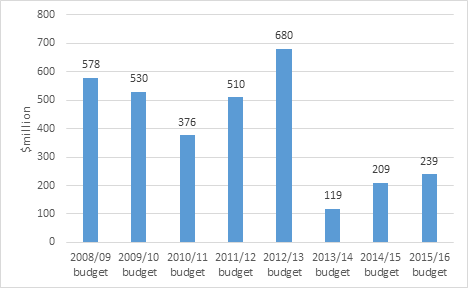
KiwiRail has been a constant thorn in the taxpayers’ side. Since this rail business was acquired in 2008 for $665 million as a commercial investment, Crown investments have totalled $3.4 billion – see Figure 1.
Fortunately in the 2015 budget, the Minister of Finance signalled that the government’s patience with the KiwiRail deficits is not unlimited. KiwiRail…
View original post 204 more words
 Utopia, you are standing in it!


Recent Comments