08 Aug 2015
by Jim Rose
in budget deficits, great recession, job search and matching, labour economics, labour supply, macroeconomics, politics - USA, unemployment, welfare reform
Tags: natural unemployment rate, taxation and labour supply, unemployment duration, unemployment insurance, unemployment rates, welfare state
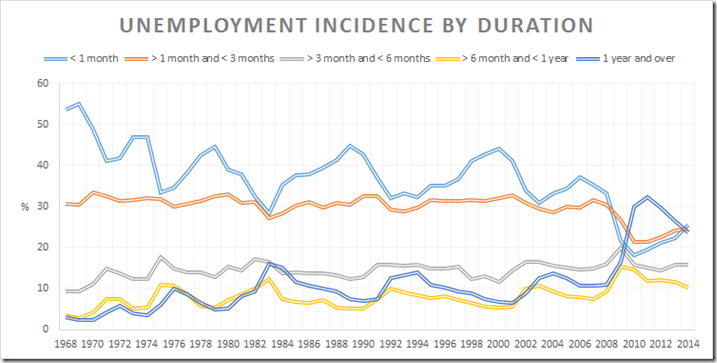
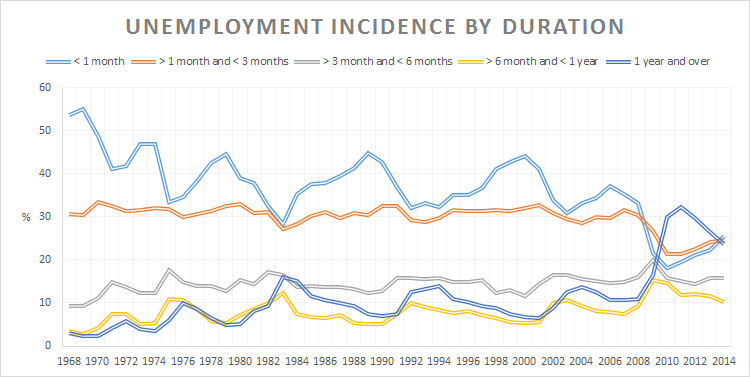
The Great Recession was the first recession in the USA in a good 40 to 50 years where the composition of employment changed by much. Even the big recession at the beginning of the 1980s did not do much to the composition of unemployment by duration in the USA.
Source: OECD StatExtract.
Those unemployed for more than a year moved from barely double digits even in a bad recession prior to 2008 to coming on one-third of all unemployed. Likewise, those unemployed for less than a month halved from 40% to 20%. Something changed in the US labour market with the Great Recession and the long extensions of unemployment insurance from 26 weeks to 52 weeks and then 99 weeks.
08 Aug 2015
by Jim Rose
in business cycles, economic history, global financial crisis (GFC), great recession, job search and matching, labour economics, labour supply, macroeconomics, unemployment
Tags: Australia, Canada, unemployment rates
Source: OECD StatExtract.
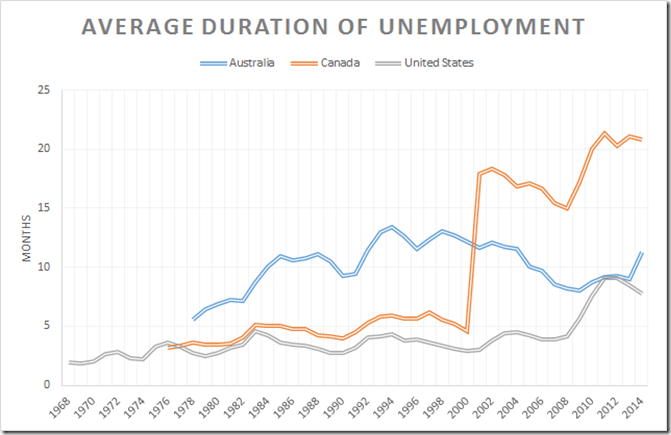
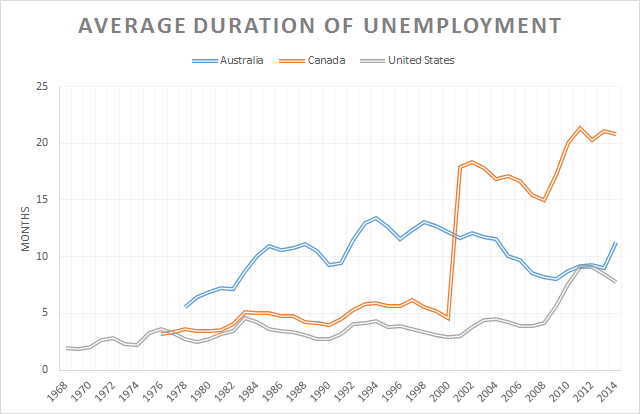
I have no information as to why there is a sudden surge in the Canadian unemployment duration rate in 2001.
07 Aug 2015
by Jim Rose
in economic history, global financial crisis (GFC), job search and matching, labour economics, labour supply, macroeconomics, politics - New Zealand, unemployment
Tags: Australia, equilibrium unemployment rate, natural unemployment rate, unemployment duration
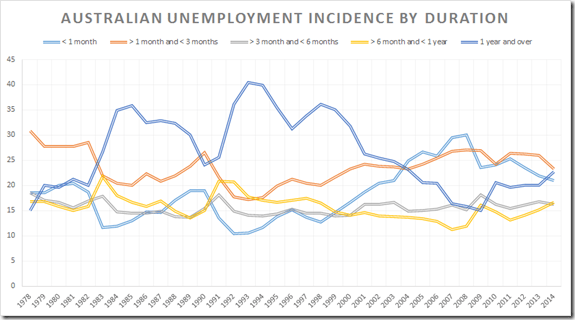
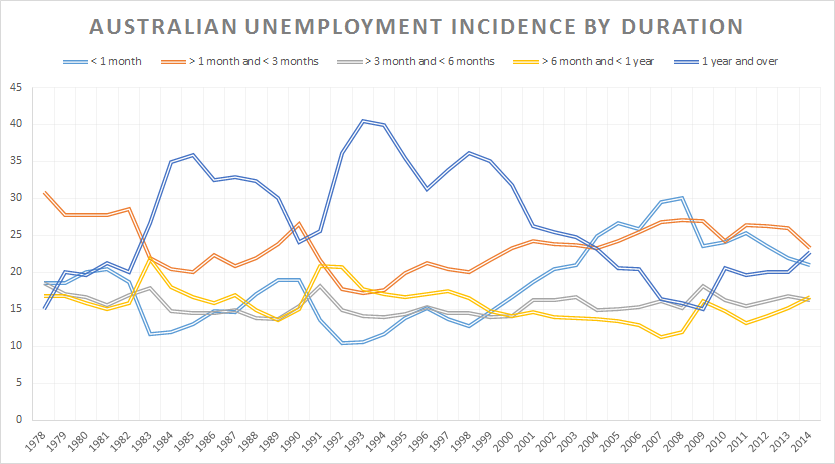
As with New Zealand, Australian long-term unemployment seems to go up and down quite a lot with recessions such as those in the early 1980s and early 1990s but not after the global financial crisis.
Source: OECD StatExtract.
05 Aug 2015
by Jim Rose
in economic history, Euro crisis, job search and matching, labour economics, labour supply, macroeconomics, unemployment
Tags: employment law, equilibrium unemployment rate, France, labour market regulation, natural unemployment rate, unemployment duration
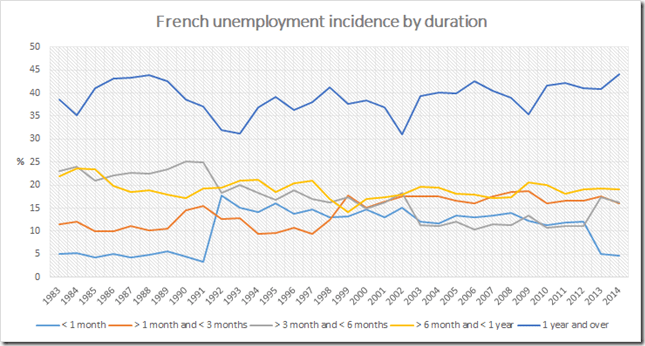
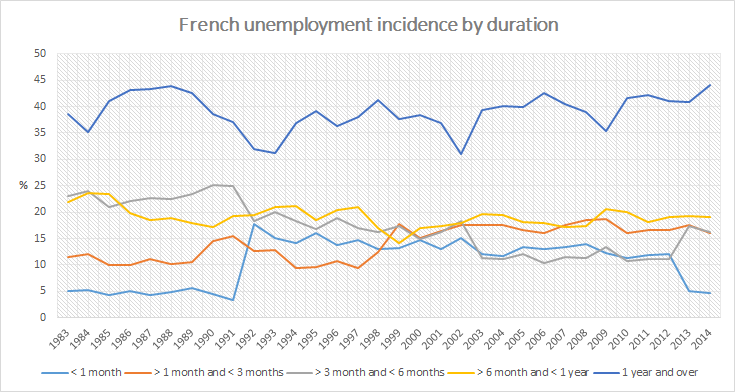
Nothing really changes in France recently unemployment duration. Italian labour market is notorious for having very low inflows and outflows from employment and unemployment.
Source: OECD StatExtract.
04 Aug 2015
by Jim Rose
in economics of education, entrepreneurship, human capital, labour economics, labour supply, sports economics
Tags: entrepreneurial alertness, on-the-job training, superstar wages, superstars
 Randall McElroy III
FiveThirtyEightSports has a great piece about how much college quarterbacks are really worth in terms of market value. I’m neutral-but-leaning-against on the issue of paying college athletes, but the piece begins with University of Iowa Athletic Director Gary Barta giving a very bad reason to oppose it: it’s too complicated to figure out how much they should be paid. He’s right given how he’s conceiving the issue, he’s just not conceiving the issue in the right way.
Wages are not determined by a person or group of people independently evaluating what a job is “really” worth. That’s what markets do, i.e. that’s what innumerable decisions over time by innumerable anonymous consumers operating within the price system do. The failure to understand how the price system works in allocating resources by preferences is not unique to Barta. Very few people understand it, and lamentably even people who do understand it often…
View original post 619 more words
03 Aug 2015
by Jim Rose
in labour economics, labour supply, occupational choice, politics - Australia, politics - New Zealand, politics - USA, poverty and inequality, unemployment, welfare reform
Tags: social insurance, taxation and labour supply, unemployment benefits, welfare reform
02 Aug 2015
by Jim Rose
in labour economics, labour supply, politics - Australia, politics - New Zealand, politics - USA, public economics
Tags: Australia, British economy, Canada, France, Germany, taxation and labour supply
31 Jul 2015
by Jim Rose
in labour economics, labour supply, poverty and inequality, unemployment, welfare reform
Tags: James Bartholomew, poverty traps, social insurance, Social Security, taxation and the labour supply, welfare reform, welfare state
30 Jul 2015
by Jim Rose
in business cycles, currency unions, economic growth, Euro crisis, job search and matching, labour economics, labour supply, macroeconomics, unemployment
Tags: employment law, employment regulation, EU, Euro sclerosis, Euroland, Eurosclerosis, Japan, labour market regulation
29 Jul 2015
by Jim Rose
in discrimination, gender, human capital, labour economics, labour supply, occupational choice, politics - New Zealand
Tags: employer discrimination, ethnic wage gap, gender wage gap, racial discrimination, racial wage gap
29 Jul 2015
by Jim Rose
in economic history, job search and matching, labour economics, labour supply, law and economics, minimum wage, politics - Australia, politics - New Zealand, politics - USA, unions
Tags: Australia, British economy, employment law, employment law regulation
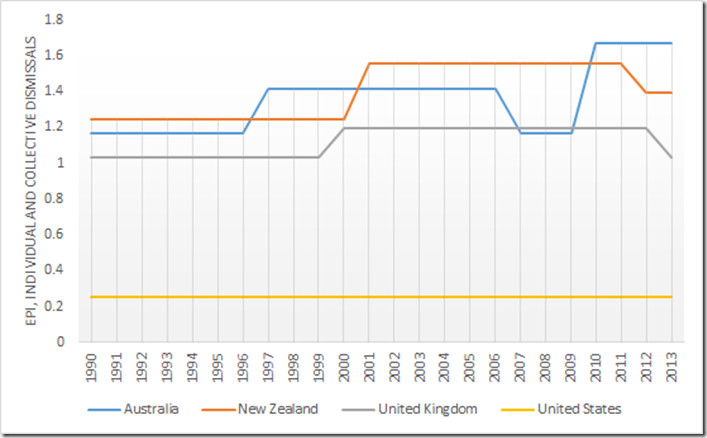
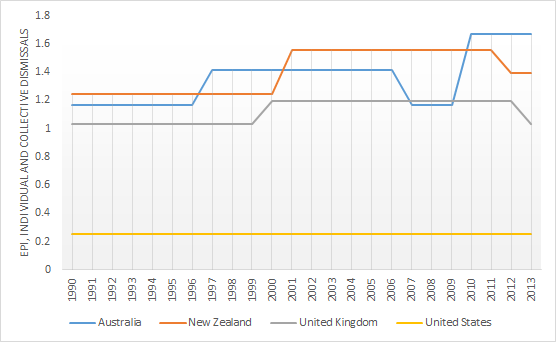
Major deregulations and re-regulations of the labour market in Australia and New Zealand did not move the employment protection inducts around that much in figure 1. All is been quiet on the labour market regulation front of the UK pretty much since the index was started.
Figure 1: OECD employment protection index (EPI), strictness of employment protection – individual and collective dismissals, USA, UK, Australia and New Zealand, 1990 – 2013
Source: OECD StatExtract.
The Work Choices legislation in Australia in 2006 was looked upon by the OECD as a somewhat minor deregulation not much more in scale than the deregulation introduced in 2008 with the election of the National Party led government.

Nobody told the unions that.
Previous Older Entries Next Newer Entries




Recent Comments