Declining fertility and population loss pose significant challenges for state and federal local governments responsible for providing a range of services to citizens, including education, health care, and infrastructure. Indeed, many areas are already experiencing outright population decline, with roughly half of U.S. counties losing population between 2010 and 2020. This paper examines how shrinking…
Does this have implications for higher ed in particular?
Does this have implications for higher ed in particular?
20 Apr 2026 Leave a comment
in economics of education, human capital, labour economics, labour supply, population economics
The Laffer Curve and Limits to Class Warfare Tax Policy, Part II
19 Apr 2026 Leave a comment
in applied price theory, econometerics, entrepreneurship, fiscal policy, human capital, income redistribution, labour economics, labour supply, macroeconomics, poverty and inequality, Public Choice, public economics Tags: taxation and entrepreneurship, taxation and investment, taxation and labour supply
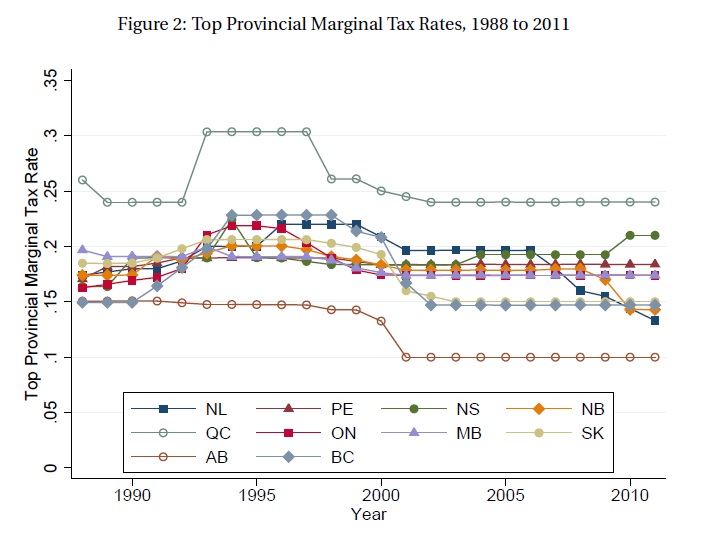
In Part I of this series back in 2014, we looked at some academic research from Canada showing that the revenue-maximizing tax rate on the richest taxpayers was 27.5 percent. A key insight from that research is that high-income taxpayers have considerable control over the timing, level, and composition of their income (just like in […]
The Laffer Curve and Limits to Class Warfare Tax Policy, Part II
The President(s) Fought the Law and the Law Won
18 Apr 2026 Leave a comment
in applied price theory, economic history, history of economic thought, income redistribution, industrial organisation, international economics, labour economics, labour supply, politics - USA, poverty and inequality, Public Choice, rentseeking, survivor principle Tags: creative destruction, free trade, tarrifs
In our textbook, Modern Principles, Tyler and I emphasize that Congress and the President are subject to a higher law, the law of supply and demand. In an excellent column, Jason Furman gives a clear example of how difficult it is to fight the law of inelastic demand: …Today a given number of autoworkers can…
The President(s) Fought the Law and the Law Won
Interview with Ellen McGrattan: Business Cycles and Intangible Capital
17 Apr 2026 Leave a comment
in business cycles, Edward Prescott, entrepreneurship, financial economics, global financial crisis (GFC), great recession, history of economic thought, human capital, labour economics, macroeconomics, monetary economics, occupational choice, Robert E. Lucas
Tim Sablik of the Richmond Fed interviews “Ellen McGrattan: On measuring what businesses do, developing effective tax policy, and searching for answers beyond the lamppost” (Econ Focus: Federal Reserve Bank of Richmond, First/Second Quarter 2026). Here are a few of the comments that caught my eye: How did McGrattan become interested in business cycles? In…
Interview with Ellen McGrattan: Business Cycles and Intangible Capital
Guest Post: IOC Restores Common Sense to Women’s Sport – Now It’s Time for New Zealand to Follow Suit
16 Apr 2026 Leave a comment
in discrimination, gender, politics - New Zealand, sports economics Tags: sex discrimination
A guest post by Ro Edge, New Zealand Spokesperson, Save Women’s Sport Australasia (SWSA): The decision by the International Olympic Committee to restore the core purpose of women’s sport: providing biological females with a fair and safe arena to compete, is long-overdue. For years, many sporting bodies adopted the IOC’s earlier open-door policy, leading to…
Guest Post: IOC Restores Common Sense to Women’s Sport – Now It’s Time for New Zealand to Follow Suit
Migrant Income and Long-Run Economic Development
13 Apr 2026 Leave a comment
in development economics, labour economics, labour supply Tags: economics of immigration
We study how international migrant income prospects affect long-run development in origin areas. We leverage the 1997 Asian Financial Crisis exchange rate shocks in a shift-share identification strategy across Philippine provinces. Initial migrant income shocks are magnified six-fold over time, increasing domestic income, education levels, migrant skills, and high-skilled migration. Remarkably, 74.9 percent of long-run…
Migrant Income and Long-Run Economic Development
Oil and monetary policy
10 Apr 2026 Leave a comment
in applied price theory, defence economics, economic history, economics of bureaucracy, energy economics, financial economics, history of economic thought, labour economics, macroeconomics, monetary economics, politics - New Zealand, Public Choice, unemployment, war and peace Tags: 1973 oil crisis, monetary policy, oil shocks

I didn’t have too much problem with either the Reserve Bank Governor’s speech a couple of weeks ago on a framework for how monetary policy might deal with the oil shock, or with this week’s OCR review release from the Monetary Policy Committee. It was really all very orthodox stuff, much as any of the […]
Oil and monetary policy
Why “Gini Coefficients” Are Meaningless
09 Apr 2026 Leave a comment
in economics of education, entrepreneurship, financial economics, history of economic thought, human capital, industrial organisation, labour economics, labour supply, occupational choice, poverty and inequality

I created the 8th Theorem of Government because it’s important to distinguish between people who want to help the poor and people who want to punish the rich. The former group has good motives while the latter group has ignoble motivations. Envy (common among the leftist intelligentsia) Public choice (common among leftist politicians) Zero-sum illiteracy […]
Why “Gini Coefficients” Are Meaningless
The CA Minimum Wage Increase: Summing Up
06 Apr 2026 1 Comment
in applied price theory, econometerics, economics of regulation, income redistribution, labour economics, labour supply, politics - USA, Public Choice, unemployment
Two recent joint-papers Did California’s Fast Food Minimum Wage Reduce Employment? by Clemens, Edwards and Meer and The Effects of California’s $20 Fast Food Minimum Wage on Prices by Clemens, Edwards, Meer and Nguyen give what I think is a plausible and consistent account of California’s $20 fast food minimum wage. California’s $20 fast food…
The CA Minimum Wage Increase: Summing Up
Does working from home raise lifetime fertility?
06 Apr 2026 Leave a comment
in applied price theory, economics of love and marriage, labour economics, labour supply, population economics Tags: economics of fertility, economics of pandemics
See Work from Home and Fertility by Steven J. Davis, Cevat Giray Aksoy, Jose Maria Barrero, Nicholas Bloom, Katelyn Cranney, Mathias Dolls & Pablo Zarate. Abstract”We investigate how fertility relates to work from home (WFH) in the post-pandemic era, drawing on original data from our Global Survey of Working Arrangements and U.S. Survey of Working Arrangements…
Does working from home raise lifetime fertility?
Quotation of the Day…
05 Apr 2026 Leave a comment
in applied price theory, economics of regulation, labour economics, labour supply, law and economics, Richard Epstein

Tweet… is from page 162 of Richard Epstein’s magnificent 1995 volume, Simple Rules for a Complex World: The entire regulatory process [of wrongful dismissal of workers] shows the constant preoccupation with the direct effects of decisions on named persons, without regard to the vastly greater indirect effects on other persons similarly situated. The effort to…
Quotation of the Day…
Bet On It Book Club: For a New Liberty, Chapter 8
04 Apr 2026 Leave a comment
in applied price theory, Austrian economics, economic history, history of economic thought, labour economics, labour supply, Murray Rothbard, welfare reform

SummaryThis chapter, on “Welfare and the Welfare State,” argues that the welfare state gives the poor perverse incentives. A superficial reader might say, “However original this was in 1973 when it was first written, it’s now old hat. Clinton made the same arguments for welfare reform.” However, on closer examination, Rothbard’s analysis remains distinctive both…
Bet On It Book Club: For a New Liberty, Chapter 8
Diversity has its limits: Georgina Beyer made it as a Mayor and MP but the Greens bar Bianca Beebe
03 Apr 2026 Leave a comment
in labour economics, labour supply, occupational choice, occupational regulation, politics - New Zealand Tags: nanny state
Bob Edlin writes – The Green Party has brought its promotion of diversity into question by deciding not to select a former sex worker as a candidate. It denies the decision has nothing to do with her background but has not explained why she did not pass muster with the party big-wigs who make these […]
Diversity has its limits: Georgina Beyer made it as a Mayor and MP but the Greens bar Bianca Beebe
On the Great Recession
02 Apr 2026 Leave a comment
in Austrian economics, budget deficits, business cycles, economic growth, fiscal policy, global financial crisis (GFC), great depression, great recession, history of economic thought, labour economics, macroeconomics, monetarism, unemployment
TweetPrager University’s new short video on the Great Recession was inspired by Chapter 5 of Phil Gramm’s and my 2025 book, The Triumph of Economic Freedom. The post On the Great Recession appeared first on Cafe Hayek.
On the Great Recession
Ohio Court Rejects View that Rejecting a Child’s Gender Change is Evidence of Parental Unfitness
02 Apr 2026 Leave a comment
in discrimination, gender, law and economics, liberalism, Marxist economics, politics - USA, property rights Tags: free speech, gender gap, political correctness, regressive left, sex discrimination

There was an interesting decision from the Ohio Court of Appeals last week on parental rights and transgender identity. In…
Ohio Court Rejects View that Rejecting a Child’s Gender Change is Evidence of Parental Unfitness


Recent Comments