24 Jul 2015
by Jim Rose
in business cycles, econometerics, economic growth, economic history, job search and matching, labour economics, labour supply, macroeconomics, politics - New Zealand, Public Choice, unemployment, unions, welfare reform
Tags: antimarket bias, Don Brash, economic reform, expressive voting, Homer Simpson, Leftover Left, lost decades, makework bias, neoliberalism, rational ignorance, rational irrationality, Sir Roger Douglas, Twitter left
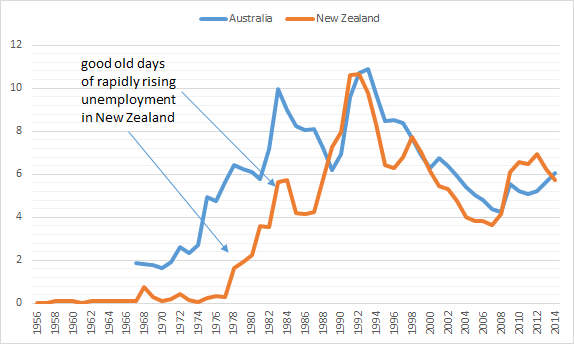
Today, Closing The Gap – The Income Inequality Project boldly claimed today that there was next to no unemployment in New Zealand prior to the onset of the curse of neoliberalism.

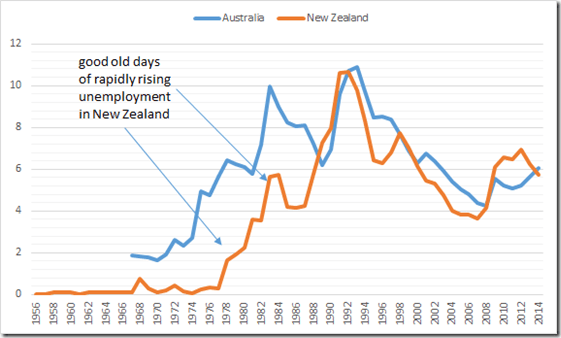
There is an Internet on computers now where it is easy to find data showing that the unemployment rate was rising rapidly in New Zealand in the 1970s and in double digits by the end of the 1980s – see figure 1.
Figure 1: harmonised unemployment rates, Australia and New Zealand, 1956-2014
Source: OECD StatExtract.
Figure 1 shows unemployment was rising rapidly in the 1970s and wasn’t much different by the end of the 1970s to the unemployment rates recorded after about 2000 in New Zealand.

One of the reasons that Sir Roger Douglas wrote There’s Got To Be A Better Way was the rapidly rising unemployment in New Zealand and the stagnant economic growth in the late 1970s and early 1980s.

New Zealand was one of the most regulated economies, so much so that Prime Minister David Lange said:
We ended up being run very similarly to a Polish shipyard.
As for those jobs on the railways, the then Reserve Bank Governor Don Brash said in 1996:
Railways cut its freight rates by 50 percent in real terms between 1983 and 1990, reduced its staff by 60 percent, and made an operating profit in 1989/90, the first for six years.
19 Jul 2015
by Jim Rose
in business cycles, economic growth, economic history, fiscal policy, job search and matching, labour economics, macroeconomics, unemployment
Tags: Celtic Tiger, equilibrium unemployment rate, Eurosclerosis, Germany, Ireland, Italy, natural unemployment rate, Rance, Spain
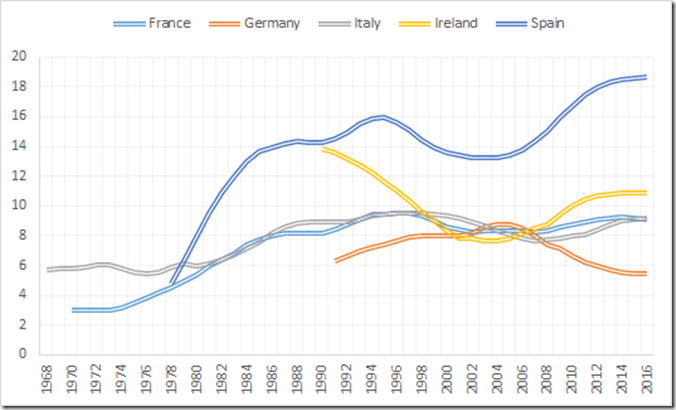
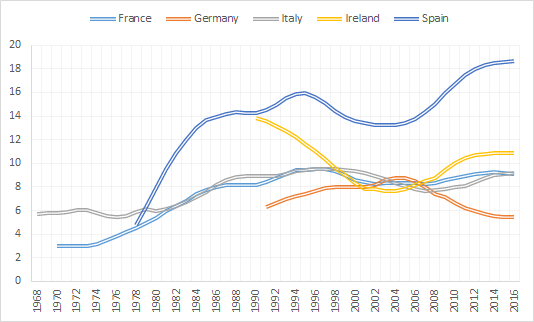
Figure 1 shows large contrasts in time path of equilibrium unemployment rates. For example, French and Italian equilibrium unemployment rates haven’t changed much since about 1986.
Figure 1: equilibrium unemployment rates, France, Germany, Italy, Ireland and Spain, 1968 – 2016
Source: OECD Economic Outlook June 2015 via OECD StatExtract..
Figure 1 also shows some fortuitous ups and downs in the German equilibrium unemployment rate. This estimate was available only from after German unification.
The equilibrium German unemployment rate rose from 6% to above 8% on the eve of the global financial crisis. Fortunately for Germany, major labour market reforms brought the equilibrium unemployment rate down as Germany moved into the global financial crisis.
The Spanish equilibrium unemployment rate had been terrible since about 1980, started to fall in the 1990s, then skyrocketed even before the onset of the global financial crisis – see figure 1.
There have been ups and downs in the Irish equilibrium unemployment rate – see figure 1. It was as high as 14% at the end of the Irish great depression of the 1970s and 1980s. The equilibrium Irish unemployment rate was 8% at the heyday of the Celtic tiger then slowly rose in the lead up to the global financial crisis.
17 Jul 2015
by Jim Rose
in applied welfare economics, budget deficits, comparative institutional analysis, constitutional political economy, currency unions, economic growth, economic history, economics of regulation, Euro crisis, fiscal policy, income redistribution, macroeconomics, Marxist economics, Public Choice, rentseeking
Tags: Greece, growth of government, Margaret Thatcher, size of government
17 Jul 2015
by Jim Rose
in economic growth, economic history, human capital, income redistribution, labour economics, labour supply, politics - New Zealand, poverty and inequality, Public Choice, rentseeking
Tags: Leftover Left, neoliberalism, top 1%
On 12 August last, Closer Together New Zealand posted a chart showing average hourly wages had been stagnant for 20 years and then started growing again in 1993. Closer Together New Zealand then rounded up the usual suspects of the Left over Left.
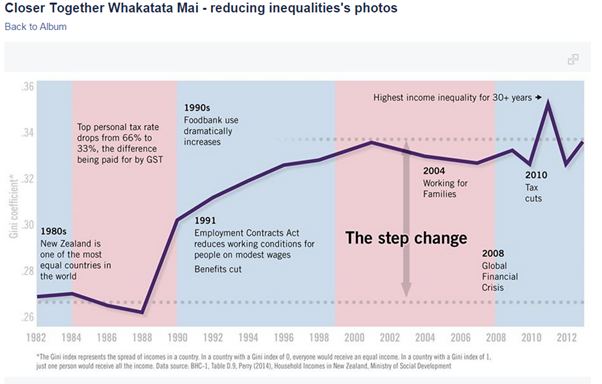
Later that month in a comment on that post, a chart was posted showing that inequality had been increasing quite rapidly in the late 1980s and early 1990s in New Zealand. There were a range of economic reforms Closer Together New Zealand didn’t like in the late 1980s and early 1990s.
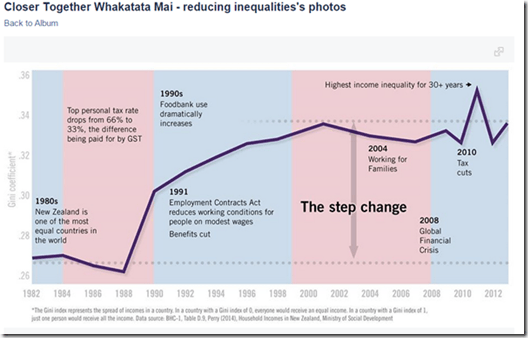
Closer Together New Zealand did not notice their second chart showed there had been a large increase in inequality, and their first chart showed that this was followed by the return of regular average hourly wages after 20 years of stagnation.
I am not so vulgar as to suggest correlation is causation, but it is amusing to watch that one day a chart is posted showing a resumption of wages growth after 20 years of wage stagnation and the next day a chart is posted showing that the major economic developments in the preceding years were a large increase in inequality and substantial economic liberalisation.
To add to my amusement, a companion site Inequality A New Zealand Conversation posted a chart showing the top 1% had not had much at all in income growth for the last 20 years while most everyone else had. This spike in the incomes of the top 1% prior to about 1994 was followed by the resumption in average wages growth after 1994.
16 Jul 2015
by Jim Rose
in economic growth, labour economics, labour supply, minimum wage, politics - New Zealand, poverty and inequality, unemployment, welfare reform
Tags: child poverty, family poverty, family tax credits, in-work tax credits, social insurance, welfare reform, welfare state

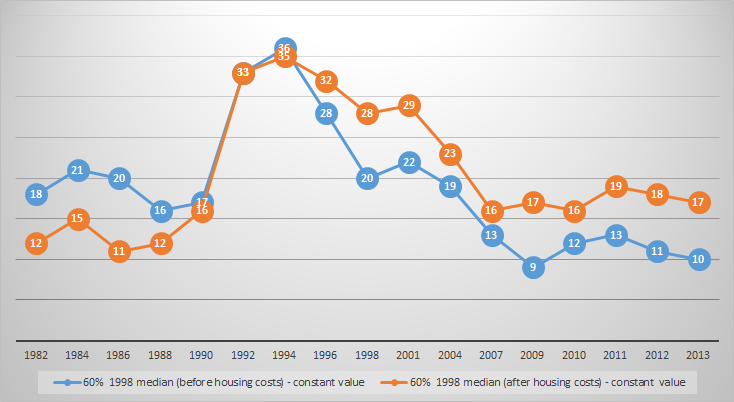
Figure 1: child poverty (%) in New Zealand (before and after housing costs), 1982 – 2013
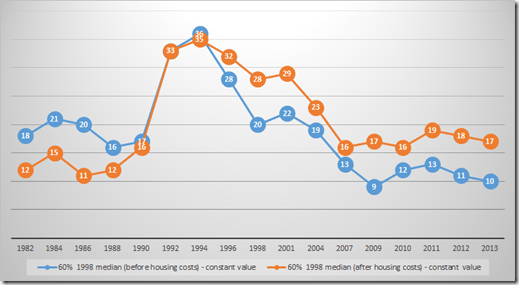
Source: Bryan Perry, Household incomes in New Zealand: Trends in indicators of inequality and hardship 1982 to 2013. Ministry of Social Development (July 2014), Tables F.6 and F.7.
15 Jul 2015
by Jim Rose
in business cycles, currency unions, economic growth, Euro crisis, fiscal policy, job search and matching, labour economics, macroeconomics, unemployment
Tags: ageing society, demographic crisis, economic reform, employment law, employment regulation, Greece, labour market deregulation, Margaret Thatcher, pension reform, privatisation, Roger Douglas, social insurance, sovereign bailouts, sovereign defaults, welfare state
14 Jul 2015
by Jim Rose
in business cycles, currency unions, economic growth, economic history, Euro crisis, global financial crisis (GFC), great depression, great recession, job search and matching, labour economics, macroeconomics, unemployment
Tags: Greece
07 Jul 2015
by Jim Rose
in applied price theory, applied welfare economics, development economics, economic growth, economic history, energy economics, environmental economics, growth disasters, growth miracles, health and safety, industrial organisation, international economics, labour economics, law and economics, liberalism, property rights, public economics
Tags: healthier is wealthier, Japan, Kuznets environmental curve, richer is greener, richer is safer
The Kuznets environmental curve describes an empirical regularity between environmental quality and economic growth. Outdoor water, air and other pollution first worse and then improves as a country first experiences economic growth and development.

While many pollutants exhibit this pattern in the Kuznets environmental curve, peak pollution levels occur at different income levels for different pollutants, countries and time periods. John Tierney explains:
In dozens of studies, researchers identified Kuznets curves for a variety of environmental problems.
There are exceptions to the trend, especially in countries with inept governments and poor systems of property rights, but in general, richer is eventually greener.
As incomes go up, people often focus first on cleaning up their drinking water, and then later on air pollutants like sulphur dioxide.
As their wealth grows, people consume more energy, but they move to more efficient and cleaner sources — from wood to coal and oil, and then to natural gas and nuclear power, progressively emitting less carbon per unit of energy.
When I was living in Japan in the mid 1990s, they just completed a period of rapid operation of the Kuznets environmental curve. I was told by my professors at Graduate School that in the 1960s, cities and prefectures welcomed polluting industries because of the better paid jobs they offered. At that time, shipping companies used like to go to Tokyo because the pollution in Tokyo Bay was so bad that it would clean all the barnacles off their ships. That made them sail faster.

Japanese incomes and wages doubled over the course of the 1960s. The Japanese voter was now prepared to support stricter pollution standards and environmental controls.
In the early 1970s, the ruling LDP stole the long-standing environmental policies of their opponents in a big crack down on pollution because the country could now afforded them.
Plenty of developing countries are democracies now. Their people could demand through the ballot box higher environmental standards and clean tap water but they don’t because of its cost to economic development.
The environmental movement lives in a state of denial regarding the relationship between economic growth and environmental quality.
06 Jul 2015
by Jim Rose
in applied price theory, applied welfare economics, budget deficits, business cycles, comparative institutional analysis, constitutional political economy, currency unions, economic growth, economic history, Euro crisis, fiscal policy, fisheries economics, global financial crisis (GFC), international economics, macroeconomics, Public Choice, rentseeking
Tags: Euro sclerosis, Greece, insurance attacks, sovereign defaults, speculative attacks
The roots of Greece’s crisis are simple. Before Greece joined the Eurozone, investors treated it as a middle-income country with poor governance — which is to say, a credit risk.
After Greece joined the Eurozone, investors thought that Greece was no longer a credit risk — they figured, if push came to shove, other Eurozone members like Germany would bail Greece out. They were wrong.

Michael Dooley put forward a theory of speculative attacks on currencies as insurance attacks on currencies for emerging markets after the East Asian financial crisis:
First generation models of speculative attacks show that apparently random speculative attacks on policy regimes can be fully consistent with rational and well-informed speculative behaviour.
Unfortunately, models driven by a conflict between exchange rate policy and other macroeconomic objectives do not seem consistent with important empirical regularities surrounding recent crises in emerging markets. This has generated considerable interest in models that associate crises with self-fulfilling shifts in private expectations.
In this paper we develop a first generation model based on an alternative policy conflict. Credit constrained governments accumulate reserve assets in order to self-insure against shocks to national consumption. Governments also insure poorly regulated domestic financial markets.
Given this policy regime, a variety of internal and external shocks generate capital inflows to emerging markets followed by successful and anticipated speculative attacks.
We argue that a common external shock generated capital inflows to emerging markets in Asia and Latin America after 1989. Country specific factors determined the timing of speculative attacks. Lending policies of industrial country governments and international organizations account for contagion, that is, a bunching of attacks over time.
His model was not within the context of a currency union but his basic theory is correct.
There are speculative attacks on a currency or a bank run after foreign markets revises their estimates of the available central bank reserves and international lines of credit to bail out the banking systems and/or foreign debt.
Michael Dooley was dealing with the emerging economies of Southeast Asia and their official lines of credit that insure their foreign exchange liabilities and domestic banking system. Greece is about lines of credit for similar purposes to other European union member states.
via 12 charts and maps that explain the Greek crisis – Vox and The Most Important Graphs of 2011 – The Atlantic.
06 Jul 2015
by Jim Rose
in budget deficits, business cycles, currency unions, economic growth, Euro crisis, financial economics, fiscal policy, global financial crisis (GFC), macroeconomics
Tags: bank runs, banking panics, Eurosclerosis, Germany, Greece, sovereign defaults
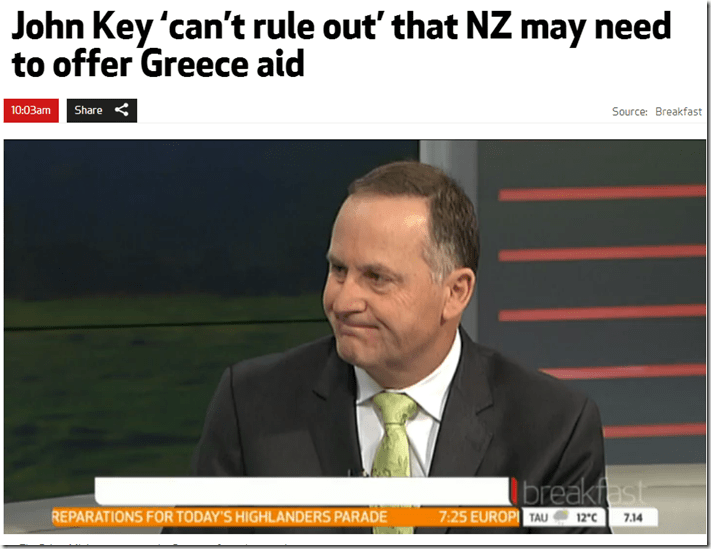
Greece is a tiny part of the European economies so it doesn’t matter that much to the rest of the European Union what happens to Greece. The only people will notice the sovereign default of Greece once the breathless journalism has died down are Greeks themselves as they rebuild their banking and monetary system against a background of a government run by coffee shop Marxists.

Previous Older Entries Next Newer Entries






 Utopia, you are standing in it!
Recent Comments