
Source: Bank closures like Greece’s are rare | Pew Research Center
Celebrating humanity's flourishing through the spread of capitalism and the rule of law
16 Nov 2015 Leave a comment
in currency unions, economic history, economics of regulation, Euro crisis, macroeconomics, monetary economics Tags: bank run, banking crises, banking panics, economics of banking, financial crises
15 Nov 2015 1 Comment
in applied welfare economics, economic growth, economic history, economics of regulation, fiscal policy, labour economics, politics - New Zealand Tags: Australia, John Quiggin, lost decades
Leading Australian academic economist John Quiggin has just published an article arguing that New Zealand should not be a policy role model for anything. To quote Quiggin:
For most of the twentieth century, the New Zealand and Australian economies performed almost identically. New Zealand took a somewhat larger hit when Britain entered the European Common Market in the 1970s, but that impact has long since washed out. The real divergence came in the 1980s. Since then, New Zealand’s income per person has fallen 35 per cent behind Australia’s
He used Reserve Bank of New Zealand data going back to 1990, which is common starting point for most Reserve Bank data.
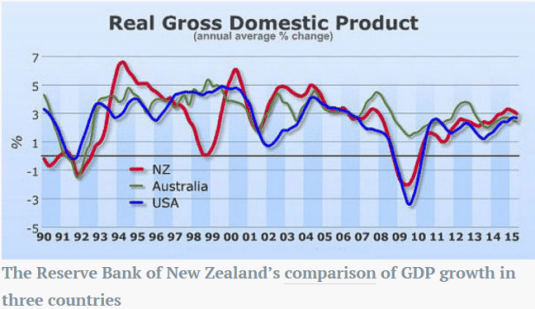
Source: John Quiggin “How New Zealand fell further behind”. Inside Story, 11 November 2015.
If he had taken that chart back to the 1970s and earlier using the Conference Board Total Database, Quiggin would have found that New Zealand economy diverged from Australia in the 1970s, not in the 1980s. His data from the Reserve Bank of New Zealand started at the low point in 1990 – at the end of that divergence that started in 1974. The New Zealand economy was depressed between 1974 and 1992. I label this Great Depression in New Zealand as New Zealand’s Lost Decades.
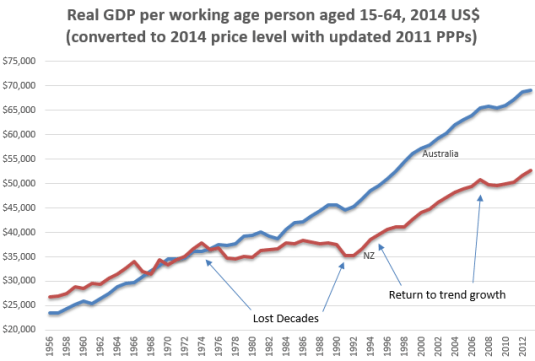
Source: Computed from OECD Stat Extract and The Conference Board. 2015. The Conference Board Total Economy Database™, May 2015, http://www.conference-board.org/data/economydatabase/
Real GDP PPP per working age New Zealander fell rapidly after 1974 (a 34% drop against trend) when that economy was a heavily regulated, highly taxed economy. This heavily regulated, highly taxed, economically stagnant New Zealand is the good old days in the eyes of the Twitter Left.
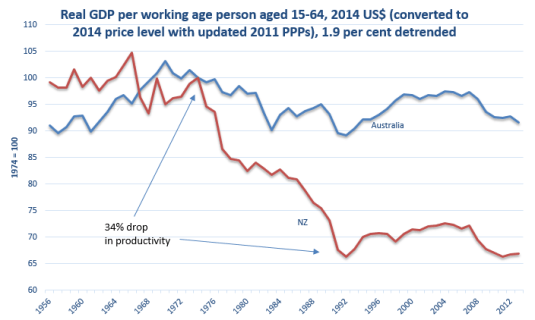
Source: Computed from OECD Stat Extract and The Conference Board. 2015. The Conference Board Total Economy Database™, May 2015, http://www.conference-board.org/data/economydatabase/
In the chart above, the base is 1974 which equals 100. A flat-line means annual growth equal to the trend rate of growth in the 20th century for the USA. A falling line means below trend growth; a rising line means above trend rate economic growth per working age Australian or New Zealander.
With the election of a National Party government in 1990 and a massive fiscal consolidation, New Zealand growth rate returned to the previous trend rate of 1.9% in 1992. Ruth Richardson’s horror budget of 1991 was so bad that the what became the Twitter Left called it the “Mother of All Budgets“.
What followed this massive fiscal consolidation where welfare benefits for cut severely was an economic boom that lasted until the GFC.
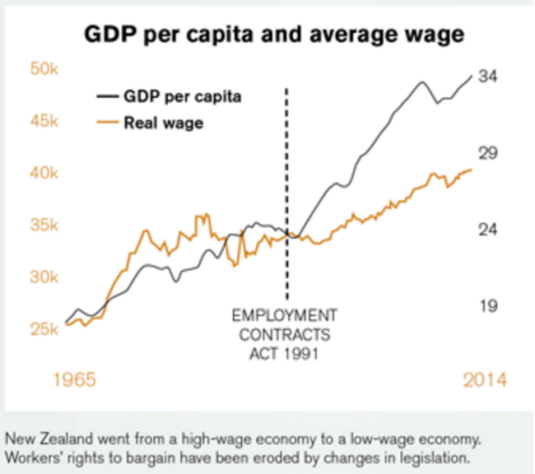
Source: Income Gap | New Zealand Council of Trade Unions – Te Kauae Kaimahi.
As shown in the chart conveniently compiled by the New Zealand Council of Trade Union, there was 20 years of real wage stagnation until the passage of the Employment Contracts Act in 1991.
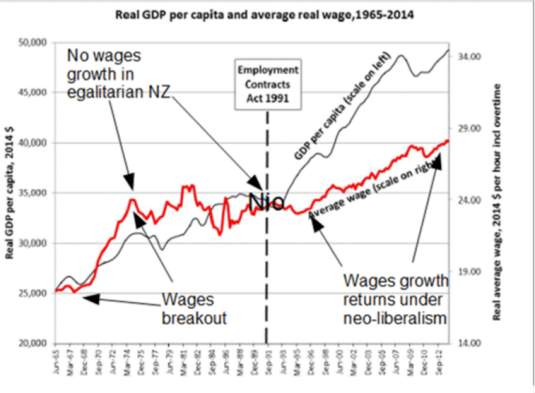
Source: Income Gap | New Zealand Council of Trade Unions – Te Kauae Kaimahi with annotations.
What followed the passage of that Act was sustained real wages growth for the first time in two decades and the end of growing inequality under the previously highly taxed, heavy regulated economy that was good old days New Zealand if the Twitter Left is to be believed.
To do this, to paint pre-1984 New Zealand, pre-neoliberal New Zealand as a fairly egalitarian paradise, Max Rashbrooke is an example of that is had to ignore two thirds of the population and the inequalities they suffered:
“New Zealand up until the 1980s was fairly egalitarian, apart from Maori and women, our increasing income gap started in the late 1980s and early 1990s,” says Rashbrooke. “These young club members are the first generation to grow up in a New Zealand really starkly divided by income.”
Racism and patriarchy can sit comfortably with a fairly egalitarian society if you are to believe the vision of the Twitter Left as to their good old days. John Quiggin refers to the period in Australia known as the Menzies Era as part of his golden age of the mixed economy. The Menzies Era was most of the 23 years of uninterrupted conservative party rule between 1949 and 1972. The actual Menzies Era was the period up to 1966 when Liberal Party Prime Minister Sir Robert Menzies retired
The reforms of the 1980s known as Rogernomics stopped the long-term stagnation in real wages that started in about 1974. The reforms of the early 1990s under a National Party government including a massive fiscal consolidation and the passing of the Employment Contracts Act was followed by the resumption of sustained growth in real wages with little interruption since.
New work by Chris Ball and John Creedy shows substantial *declines* in NZ inequality.
initiativeblog.com/2015/06/24/ine… http://t.co/f94fw4Bhae—
Eric Crampton (@EricCrampton) June 24, 2015
This boom after two decades of minimal real economic growth per working age New Zealander benefited everyone. The unemployment rate fell to a record low of 3.5% about 2005. Maori unemployment was at a 20-year low of 8% in 2008. Maori labour force participation rates increased from 45% in the late 1980s to about 62% by the eve of the Global Financial Crisis.
The increase in percentage terms of Maori and Pasifika real household income is much larger than for Pakeha since the economic reforms of the 1980s and 1990s. As Bryan Perry (2015, p. 67) explains when commenting on table D6 sourced by Closer Together Whakatata Mai:
From a longer-term perspective, all groups showed a strong rise from the low point in the mid 1990s through to 2010. In real terms, overall median household income rose 47% from 1994 to 2010: for Maori, the rise was even stronger at 68%, and for Pacific, 77%. These findings for longer- term trends are robust, even though some year on year changes may be less certain. For 2004 to 2010, the respective growth figures were 21%, 31% and 14%.
13 Nov 2015 Leave a comment
in economic history, Euro crisis, labour economics, labour supply, macroeconomics, politics - USA, public economics Tags: employment law, Eurosclerosis, France, Germany, growth of government, labour market regulation, size of government, taxation and labour supply

Source: Linda Regber.
12 Nov 2015 Leave a comment
in job search and matching, labour economics, labour supply, personnel economics, politics - New Zealand, unemployment, welfare reform
I stayed on after my Parliamentary testimony this morning to listen to others. A dozen or more made submissions arguing for more regulation – usually asking that zero hours contracts be outlawed.
I was the only submitter so far who argued against any regulation of zero hours contracts. I was thanked for putting a different perspective at the end of my submission. All members of the committee were very polite and listen to what I had to say.
Inadvertently, of course, Iain Lees-Galloway and Sue Moroney of the Labour Party and several members of the Public Service Association unearthed telling points against the case for regulation of zero hours contracts in the course of the morning in both the submissions and through the Q&A.
The first member of the Public Service Association to present information against zero hours contracts was a home support worker who was a union organiser.
This Public Service Association union organiser said, among many points in a kitchen sink submission, that zero hour contracts would deter people from entering her industry. That’s my point about zero hours contracts:
A second member of the Public Service Association talked about her daughter who was on a zero hours contract in her first job. After a seven-month spell of unemployment, her daughter worked as many shifts as possible to show she was a valued member of her team. Good for her. In low skilled jobs, what employers look for is someone who is friendly and reliable.
Part of that story was about the difficulties of her daughter with the correct payment of her unemployment benefit. Every Friday she has to telephone WINZ to forecast how many hours she expected to work in the following week so her unemployment benefit is correctly calculated for the following paid day.

From time to time, the submitter’s daughter was called in at the last minute for a shift on her zero hours contract at the weekend so that estimate of the previous day is incorrect and she is overpaid on her benefit.
This retention of unemployment benefit eligibility is a key point against the arguments raised by Iain Lee-Galloway about how workers and, in particular, the unemployed have no option but to accept zero hours contracts. Galloway was correct in making this the crux of the matter.
He can he kept stressing the inequality of bargaining power and a lack of options of job applicants when questioning me at the hearings this morning.
It was Iain Lees-Galloway who set up this bargaining power inequality as a crucial argument against zero hours contracts, not me. Zero hours contracts are said by the Labour Party and the unions to be a bad deal. It’s an offer job seekers cannot refuse, especially if they’re unemployed.
If beneficiaries do have options and they can refuse an offer of a zero hours contract, as 50% of British unemployment beneficiaries do, most arguments for the regulation or prohibition of zero hours contracts fall of the first hurdle.
The submitter’s daughter was still on an unemployment benefit despite taking a zero hours contract. She had options. She had a basic income, the unemployment benefit, so she was never left in the lurch if there was no shift that week. She never earned less than the unemployment benefit weekend and week out and often earned more.
The unemployment benefit allows beneficiaries to earn up to $200 a week after which benefit is withdrawn at 50 cents per dollar. As the beneficiary is still on the benefit, they have access to those all-important 2nd tier benefits ranging from accommodation allowances to special grants for unexpected urgent expenses.
Zero hours contracts allow the unemployed to make the benefit pay. Simon Chapple pointed out to me a few years ago that part-time work and benefit receipt can be an attractive long-term option for low skilled workers such as single mothers. The unemployment or single-parent beneficiary who works part-time has the certainty of the unemployment benefit plus a couple hundred dollars extra-week from their part-time job while retaining the second tier benefits that guard against unexpected expenses.
Sue Moroney then finished off the case against regulating zero hours contracts when questioning a submitter from the construction industry. The submitter was discussing the generosity of parental leave as well as zero hours contracts.
Sue Moroney pointed out that because of childcare responsibilities, the ability of that industry to attract women is greatly diminished if they offer zero hours contracts. She was pointing out a major cost of zero hours contracts to employers who offer them.
Sue Moroney highlighted the risk to employers of cutting themselves off from a major part of the job applicant pool – mothers of young children. That is a big cost unless employers offering zero hours contracts either pay a wage premium to keep access to that talent or offer these contracts to teenagers and adults, men and women, who circumstances dispose to working variable hours, sometimes working long hours and sometimes not working at all that week.
Zero hours contracts is an issue about job search and job matching. These contracts will benefit some employers and some employees. Other jobseekers will not sign such contracts. Still others will find that after signing a zero hours contract, that was not the best choice for them in retrospect. That form of on-the-job learning about competing job opportunities is common. Young people spend their first 10 to 15 years in the workforce job shopping. They move through half a dozen or more different jobs, employers and even industries before they find a good fit for them and stay on.
All in all, zero hours contracts empower the unemployed. Zero-hours contracts allow the unemployed to try out jobs while keeping their unemployment or single parent benefit. They don’t have to go completely off the benefit then risk a stand-down period of 6 to 12 weeks if they leave a regular job that is unsatisfactory.
Furthermore, the zero hours contracts give them an opportunity sometimes to earn a lot of money in a short period of time was still retaining their benefit eligibility. As another member of the Public Service Association mentioned when your wages balloon because of long hours one week, your benefit is wound back, but they are still on their benefit. They don’t have to reapply and risk of stand-down period
Zero hours contracts expand the options of jobseekers, especially the unemployed. Taking a zero hours contract gives the unemployed the option to test out a job without having to give up their unemployment benefit. They are empowering, not put upon as the Labour Party and the union members argued today.
10 Nov 2015 Leave a comment
in business cycles, economic history, economics of regulation, Euro crisis, job search and matching, labour economics, labour supply, macroeconomics Tags: British economy, employment law, equilibrium unemployment rate, Eurosclerosis, France, Germany, Italy, labour market reforms, Margaret Thatcher, Thatchernomics, The British Disease
Unlike the USA, the German, Italian, British and French equilibrium unemployment rates all show fluctuations that reflect changes in their underlying economic circumstances and labour market reforms. The case of the British, the rise of the British disease and Thatchernomics. The case of German, its equilibrium unemployment rate rose after German unification and then fell after the labour market reforms of 2002 to 2005.
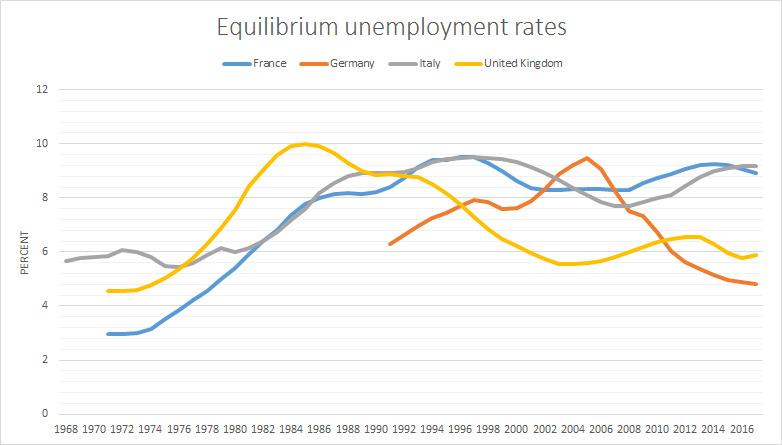
Source: OECD Economic Outlook November 2015 Data extracted on 10 Nov 2015 07:07 UTC (GMT) from OECD.Stat.
10 Nov 2015 2 Comments
in business cycles, economic history, macroeconomics, politics - USA, unemployment
The equilibrium unemployment rate in the USA has been dead flat at a little under 6% as far back as the OECD Economic Outlook November 2015 can estimate. The Canadian and British equilibrium unemployment rates have gone up and down to the point of near doubling at times. Institutions cannot be so stable in the USA and so unstable Canada and Britain in terms of the incentives to post vacancies, for search for work in the same in different industries and occupations and revise asking wages. We’re talking about a 35 year stretch macroeconomic and labour market policy in the USA.
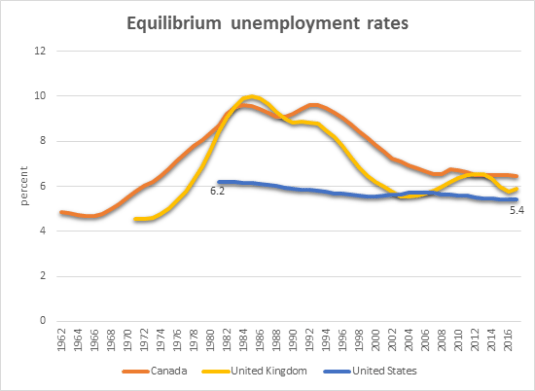
Source: OECD Economic Outlook November 2015 Data extracted on 10 Nov 2015 07:07 UTC (GMT) from OECD.Stat.
Furthermore, there is a large literature in the early 1970s and late 1990s arguing that the US equilibrium unemployment rate dropped as low as 4%.
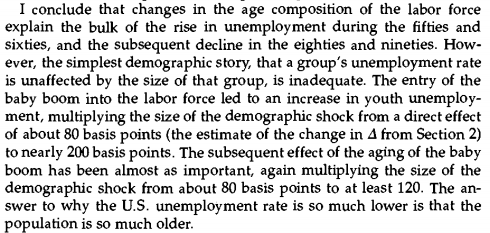
Source: Robert Shimer, Why is the U.S. Unemployment Rate So Much Lower? (1999).
More correctly, for the early 1970s literature, the equilibrium unemployment rate had risen to 4% after being at an equilibrium rate of about 3%. Something doesn’t add up.
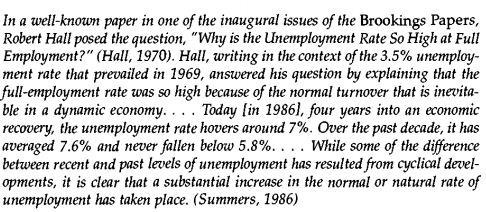
Source: Robert Shimer, Why is the U.S. Unemployment Rate So Much Lower? (1999).
This estimate of an unchanging US equilibrium unemployment rate doesn’t add up even more when you consider the discussions after the Great Recession about how the extensions to unemployment insurance from a time limit of 26 weeks to 99 weeks would increase the equilibrium unemployment rate. Something really doesn’t add up for the US equilibrium unemployment rate to be so stable and the British and Canadian equilibrium unemployment rates to be so volatile.
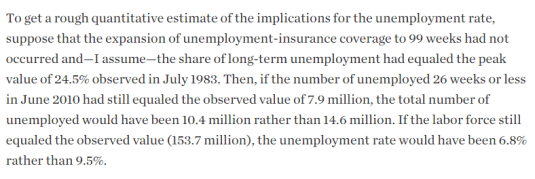
Source: Robert Barro: The Folly of Subsidizing Unemployment – WSJ.
08 Nov 2015 Leave a comment
in applied price theory, economics of regulation, fiscal policy, politics - New Zealand, urban economics Tags: housing affordability, land supply, New Zealand Greens, New Zealand Labour Party, RMA
Labour yesterday announced an excellent policy on housing affordability. The reforms proposed by Labour stress increasing the supply of land and improvements to local government finances surrounding infrastructure investments for new housing:
Labour will free up density and height controls to allow more medium density housing and reform the use of urban growth boundaries so they don’t drive up section costs. This will curb land bankers and speculators.
Labour has struck at the heart of two major constraints on urban land supply New Zealand: restrictions on density and height of new developments, and much more importantly, the use of urban growth boundaries to drive up land prices. These proposed regulatory reforms could not be more welcome.
The other shoe of Labour’s housing affordability reform proposals is improving the incentives for local councils to support new housing developments:
The other new element is changing the way we fund infrastructure for new developments. Currently those costs are either subsidised by the ratepayer or passed by the developer onto the price tag of a new home. That makes houses much more expensive. It also means they are paid off through mortgages at expensive bank interest rates.
Our new policy will see infrastructure funded by local government bonds, paid off over the lifetime of the asset through a targeted rate on the properties in the new development. This will substantially reduce the cost of new housing.
The reforms proposed by Labour to local government financing will reduce the financial burden on existing ratepayers of the local government funded infrastructure necessary to support new land developments.
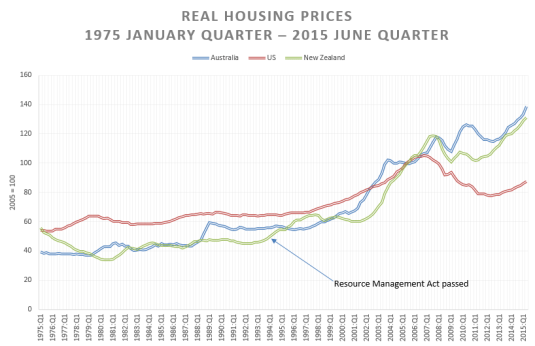
Source and notes: International House Price Database – Dallas Fed June 2015; nominal housing prices for each country is deflated by the personal consumption deflator for that country.
These Labour Party reforms are fantastic because the main party on the left-wing of New Zealand politics has faced up to restricted land supply as a key reason behind housing unaffordability. I wonder what the New Zealand Greens will think of these major new reforms.
Of course, nothing is perfect in the art of policy development. New Zealand Labour continue to want government to build 100,000 affordable houses and scapegoat foreigners for high housing prices.
A few more sensible economic and fiscal policy announcements such as those today by the New Zealand Labour Party and it will start looking like a credible alternative government.
06 Nov 2015 Leave a comment
in economic growth, economic history, fiscal policy, George Stigler, Marxist economics, Public Choice, public economics Tags: conspiracy theories, growth of government, Leftover Left, median voter theorem, neoliberalism, rational ignorance, Sam Peltzman, size of government
I learnt a new word today off the back of Jane Kelsey winning a $600,000 Marsden grant to study embedded neoliberalism and her latest transnational conspiracy theory about trade agreements.
I’ve never heard of embedded liberalism before today despite a keen interest in popular and academic news. I don’t think I’m poorer for that ignorance but let’s push on. According to that source of all knowledge and truth Wikipedia, embedded neoliberalism’s been around for about 35 years:
Embedded liberalism is a term for the global economic system and the associated international political orientation as it existed from the end of World War II to the 1970s. The system was set up to support a combination of free trade with the freedom for states to enhance their provision of welfare and to regulate their economies to reduce unemployment. The term was first used by the American political scientist John Ruggie in 1982.[1]
Mainstream scholars generally describe embedded liberalism as involving a compromise between two desirable but partially conflicting objectives. The first objective was to revive free trade. BeforeWorld War I, international trade formed a large portion of global GDP, but the classical liberal order which supported it had been damaged by war and by the Great Depression of the 1930s. The second objective was to allow national governments the freedom to provide generous welfare programmes and to intervene in their economies to maintain full employment.[2] This second objective was considered to be incompatible with a full return to the free market system as it had existed in the late 19th century—mainly because with a free market in international capital, investors could easily withdraw money from nations that tried to implement interventionist and redistributive policies.[3]
The resulting compromise was embodied in the Bretton Woods system, which was launched at the end of World War II. The system was liberal[4] in that it aimed to set up an open system of international trade in goods and services, facilitated by semi fixed exchange rates. Yet it also aimed to “embed” market forces into a framework where they could be regulated by national governments, with states able to control international capital flows by means of capital controls. New global multilateral institutions were created to support the new framework, such as the World Bank and theInternational Monetary Fund.
Source: Embedded liberalism – Wikipedia, the free encyclopedia.
Decoding Marxist rhetoric is never easy, but I think what these academic Marxists are trying to do is describe the rise of the mixed economy and the welfare state over the course of the early and middle parts of 20th century.

The welfare state was never an easy thing for your card-carrying Marxist looking forward to the immiserisation of the proletariat as the trigger for the proletarian revolution.
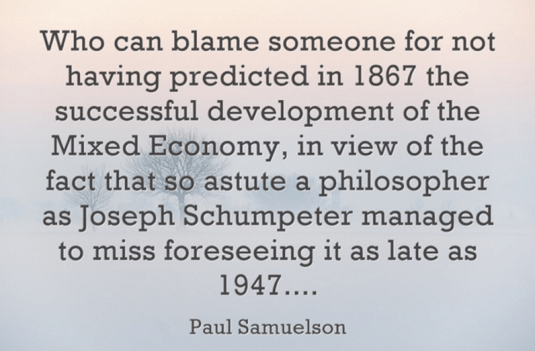
Embedded neoliberalism mostly all about what Aaron Director in the 1950s explained as the reasons for the growth of government in the 20th century. He put forward what George Stigler label for him Director’s Law of Public Expenditure. George Stigler published an article on this law because Aaron Director published next to nothing for reasons no one understands. Director founded law and economics through teaching law classes at the University of Chicago law school.
Long live the Slopegraph. Long live Edward Tufte. tinyurl.com/naeh7rc http://t.co/C8Lgnupxz9—
Amity Shlaes (@AmityShlaes) May 16, 2015
Sam Peltzman pointed out that most of modern public spending is supported by the median voter – the ‘swinging’ voter. He observed that governments at the start of the 20th century were a post office and a military; at the end of the 20th century, governments are a post office, a larger military and a very large welfare state.
Studies starting from Peltzman in 1980 showed that governments grew in line with the growth in the size and homogeneity of the middle class that was organised and politically articulate enough to implement a version of Director’s Law.
Director’s Law of public expenditure is that public expenditure is used primary for the benefit of the middle class, and is financed with taxes which are borne in considerable part by the poor and the rich. Based on the size of its population and its aggregate wealth, the middle class will always be the dominant voting bloc in a modern democracy. Growth in the size of governments across the developed world took off in the mid-20th century as the middle class blossomed. Peltzman maintained that:
“The levelling of income differences across a large part of the population … has in fact been a major source of the growth of government in the developed world over the last fifty years” because the levelling created “a broadening of the political base that stood to gain from redistribution generally and thus provided a fertile source of political support for expansion of specific programs. At the same time, these groups became more able to perceive and articulate that interest … [and] this simultaneous growth of ‘ability’ served to catalyse politically the spreading economic interest in redistribution.”
After the 1970s economic stagnation, the taxed, regulated and subsidised groups had an increasing incentive to converge on new, lower cost modes of income redistribution.
Sweden, Norway and Denmark could be examples of Gary Becker’s idea that political systems converge on the more efficient modes of both regulation and income redistribution as their deadweight losses grew in the 1970s and 1980s and after. Unlike some of their brethren abroad, more of the Nordic Left and, more importantly, the Nordic median voter were cognizant of the power of incentives and to not killing the goose that laid the golden egg. Taxes on income from capital are low in Scandinavia.
The rising deadweight losses of taxes, transfers and regulation all limit the political value of inefficient redistributive policies. Tax and regulatory policies that are found to significantly cut the total wealth available for redistribution by governments are avoided relative to the germane counter-factual, which are other even costlier modes of redistribution.
An improvement in the efficiency of either taxes or spending reduces political pressure from taxed and regulated groups for suppressing the growth of government and thereby increases total tax revenue and spending because there is less political opposition. Efficient taxes lead to higher taxes.
Improvements in the efficiency of taxes, regulation and in spending reduce political pressure from the taxed and regulated groups in society. This suppressed the growth of government and thus increased or prevented cuts to both total tax revenue and spending since 1980. Economic regulation lessened after 1980 and there were privatisations, but social and environmental regulation grew unabated. Certainly in New Zealand the post-1984 economic reforms followed a good 10 years of economic stagnation and regular economic crises:
In the early 1980s, New Zealand’s economy was in trouble. The country had lost its guaranteed export market when Britain joined the European Economic Union in 1973. The oil crisis that year had also taken a toll.
The post-1980 reforms of Thatcher, Reagan, Clinton, Hawke and Keating, Lange and Douglas and others saved the modern welfare state for the middle class. Most income transfer programmes in modern welfare states disproportionately benefit older people. With an aging society, that trend can only continue. That is why these reforming policies survived political competition, election after election. The political parties on the left and right that delivered efficient increments and streamlined the size of government were elected, and in turn, got thrown out from time to time because they became tired and flabby.

The rest of embedded neoliberalism is trying to explain widespread economic deregulation and liberalisation of international trade along with the continual growth of social regulation. This is something that Gary Becker, George Stigler and Sam Peltzman have written on previously.
The continued growth of social regulation is best explained by the median voter theorem. Both Bryan Caplan and Sam Peltzman pointed out that it’s hard to think of any major government program or regulation that does not enjoy widespread popular support.
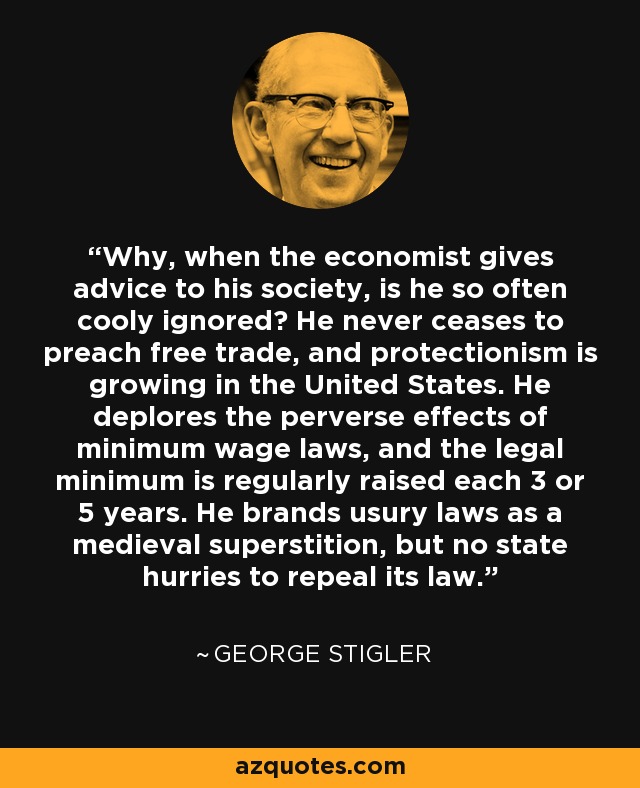
As for the public been duped by neoliberal economists, George Stigler argued that ideas about economic reform need to wait for a market. As Stigler noted, when their day comes, economists seem to be the leaders of public opinion but when the views of economists are not so congenial to the current requirements of special interest groups and voting public, these economists are left to be the writers of letters to the editor in provincial newspapers. These days they would run an angry blog.
05 Nov 2015 Leave a comment
in development economics, growth disasters, growth miracles, macroeconomics, Robert E. Lucas Tags: capitalism and freedom, industrial revolution, The Great Enrichment, The Great Escape, The Great Fact
03 Nov 2015 Leave a comment
in economic history, macroeconomics, monetarism, monetary economics Tags: forecasting errors, Paul Krugman, public intellectuals
03 Nov 2015 Leave a comment
in economic growth, economic history, poverty and inequality
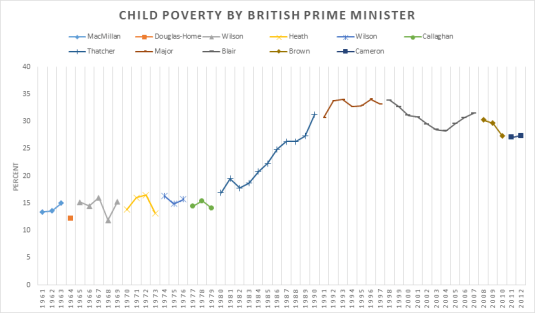
When I pointed out yesterday that the only periods of sustained real household income growth in recent British history was under those neoliberal lapdogs Thatcher and Blair, the Twitter Left on Reddit decided rather prematurely I might say that:
The prime minister rarely influences broad economic realities — like commodity prices or interest rates, or double digit economic growth in china. Elections frequently change the party in power AFTER the economy turns downwards. As though that party had anything to do with the down turn.
I’m sure that the morally centred Twitter Left will be equally forgiving of the sustained rise in child poverty due to many more workless households shown in the chart below under Thatchernomics. The only sustained fall in child poverty rates in recent British history was under Tony Blair. The British Left and current British Labour Party leadership dismiss him as a continuation of Thatchernomics.
Source: Incomes in the UK – Institute For Fiscal Studies – IFS.
03 Nov 2015 Leave a comment
in applied welfare economics, economic growth, economic history, macroeconomics, poverty and inequality Tags: British economy, British politics, Margaret Thatcher, Tony Blair
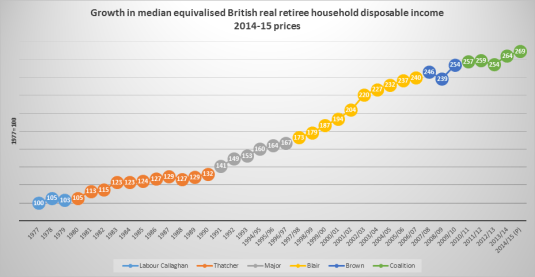
The British disease and the horrors of Thatchernomics past British retirees by as did pretty much the Global Financial Crisis. Slow and steady as she goes under every Prime Minister since 1977 has been year in year out result for the real disposable median incomes of British retired households. Despite it all, British retiree household incomes increased by 170% since the winter of discontent. The fastest growth in retiree incomes was under Tony Blair.
Source: Release Edition Reference Tables – ONS.
Notes:
1 Households are ranked by their equivalised disposable incomes, using the modified-OECD scale.
2 1994/95 represents the financial year ending 1995, and similarly through to 2014/15, which represents the financial year ending 2015.
3 Income figures have been deflated to 2014/15 prices using an implied deflator for the household sector.
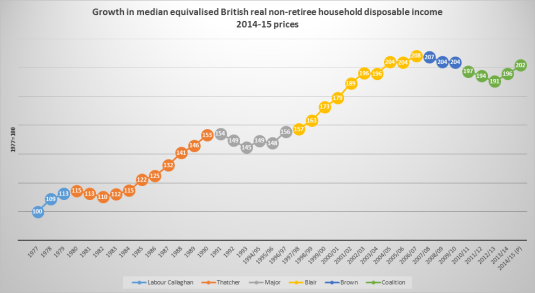
It has been a much rockier ride for British households yet to retire. Once again, the only time a sustained real income increases for non-retired households was under Thatcher and Blair. Despite it all, household real incomes have doubled since the winter of discontent. The majority of that doubling was under the dead hand of Tony Blair. British Labour now spends a considerable amount of time repudiating that time of unusually rapid household income growth across all of British society.
Source: Release Edition Reference Tables – ONS.
Notes:
1 Households are ranked by their equivalised disposable incomes, using the modified-OECD scale.
2 1994/95 represents the financial year ending 1995, and similarly through to 2014/15, which represents the financial year ending 2015.
3 Income figures have been deflated to 2014/15 prices using an implied deflator for the household sector.
03 Nov 2015 2 Comments
in applied welfare economics, economic growth, economic history, macroeconomics
The only two periods of sustained increases in median equivalised British real household disposable income is was under Mrs Thatcher, once she got going on Thatchernomics and under Tony Blair. Despite the ups and downs, real household incomes more than doubled in Britain since the winter of discontent. Equivalised income takes account of changes in the composition of households such as more single-parent households and fewer children since 1977.

Source: Release Edition Reference Tables – ONS.
Notes:
1 Households are ranked by their equivalised disposable incomes, using the modified-OECD scale.
2 1994/95 represents the financial year ending 1995, and similarly through to 2014/15, which represents the financial year ending 2015.
3 Income figures have been deflated to 2014/15 prices using an implied deflator for the household sector
01 Nov 2015 Leave a comment
in econometerics, macroeconomics
The Scandinavians and Swiss been way up there in terms of purchasing power parity is no surprise but why is Australia up there with the expensive places?
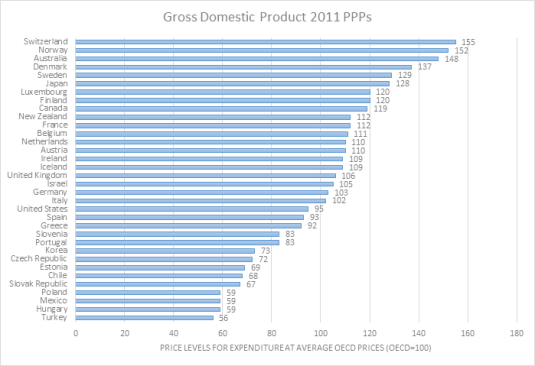
Data extracted on 01 Nov 2015 06:17 UTC (GMT) from OECD.Stat
Celebrating humanity's flourishing through the spread of capitalism and the rule of law
Celebrating humanity's flourishing through the spread of capitalism and the rule of law
Celebrating humanity's flourishing through the spread of capitalism and the rule of law
Celebrating humanity's flourishing through the spread of capitalism and the rule of law
Celebrating humanity's flourishing through the spread of capitalism and the rule of law
A History of the Alt-Right
Econ Prof at George Mason University, Economic Historian, Québécois
Celebrating humanity's flourishing through the spread of capitalism and the rule of law
Scholarly commentary on law, economics, and more
Beatrice Cherrier's blog
Celebrating humanity's flourishing through the spread of capitalism and the rule of law
Celebrating humanity's flourishing through the spread of capitalism and the rule of law
Celebrating humanity's flourishing through the spread of capitalism and the rule of law
Why Evolution is True is a blog written by Jerry Coyne, centered on evolution and biology but also dealing with diverse topics like politics, culture, and cats.
Celebrating humanity's flourishing through the spread of capitalism and the rule of law
A rural perspective with a blue tint by Ele Ludemann
DPF's Kiwiblog - Fomenting Happy Mischief since 2003
Celebrating humanity's flourishing through the spread of capitalism and the rule of law
The world's most viewed site on global warming and climate change
Tim Harding's writings on rationality, informal logic and skepticism
A window into Doc Freiberger's library
Let's examine hard decisions!
Commentary on monetary policy in the spirit of R. G. Hawtrey
Thoughts on public policy and the media
Celebrating humanity's flourishing through the spread of capitalism and the rule of law
Politics and the economy
A blog (primarily) on Canadian and Commonwealth political history and institutions
Reading between the lines, and underneath the hype.
Economics, and such stuff as dreams are made on
"The British constitution has always been puzzling, and always will be." --Queen Elizabeth II
Celebrating humanity's flourishing through the spread of capitalism and the rule of law
Celebrating humanity's flourishing through the spread of capitalism and the rule of law
WORLD WAR II, MUSIC, HISTORY, HOLOCAUST
Undisciplined scholar, recovering academic
Celebrating humanity's flourishing through the spread of capitalism and the rule of law
Res ipsa loquitur - The thing itself speaks
In Hume’s spirit, I will attempt to serve as an ambassador from my world of economics, and help in “finding topics of conversation fit for the entertainment of rational creatures.”
Researching the House of Commons, 1832-1868
Articles and research from the History of Parliament Trust
Reflections on books and art
Posts on the History of Law, Crime, and Justice
Celebrating humanity's flourishing through the spread of capitalism and the rule of law
Exploring the Monarchs of Europe
Cutting edge science you can dice with
Small Steps Toward A Much Better World
“We do not believe any group of men adequate enough or wise enough to operate without scrutiny or without criticism. We know that the only way to avoid error is to detect it, that the only way to detect it is to be free to inquire. We know that in secrecy error undetected will flourish and subvert”. - J Robert Oppenheimer.


Recent Comments