In 1993, >30% of India's urban population lived in extreme poverty. In 2011? Only 13%. buff.ly/1iutlQA http://t.co/238hsW2aeF—
HumanProgress.org (@humanprogress) September 09, 2015
The Great Escape actually accelerated after the GFC
10 Sep 2015 Leave a comment
in development economics, economic history, global financial crisis (GFC), growth disasters, growth miracles, health economics, labour economics, macroeconomics, poverty and inequality Tags: child poverty, extreme poverty, global poverty, India, The Great Escape, The Great Fact
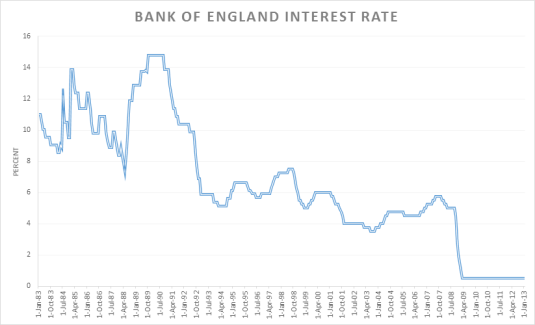
A history of interest rates
07 Sep 2015 Leave a comment
in business cycles, economic history, financial economics, macroeconomics, monetary economics Tags: central banking
The mancession
06 Sep 2015 Leave a comment
in business cycles, economic history, global financial crisis (GFC), great recession, job search and matching, labour economics, labour supply, macroeconomics, unemployment Tags: reversing gender gap
How frequent are simultaneous financial crises in one country?
04 Sep 2015 Leave a comment
in business cycles, currency unions, development economics, economic growth, economic history, Euro crisis, financial economics, global financial crisis (GFC), great depression, great recession, growth disasters, growth miracles, law and economics, macroeconomics, monetary economics, property rights Tags: bank runs, banking crises, banking panics, currency crises, current account crises, debt crises, pseudo financial crises, real financial crises, sovereign debt crises, sovereign default
Longest time without a recession
02 Sep 2015 Leave a comment
in business cycles, economic growth, economic history, fiscal policy, global financial crisis (GFC), great recession, macroeconomics, monetary economics, politics - Australia, politics - New Zealand, politics - USA Tags: Australia, recessions and recoveries
Human capital accumulation and economic growth
01 Sep 2015 Leave a comment
in economic growth, economics of education, human capital, labour economics, macroeconomics Tags: educational attainment, endogenous growth theory, human capital, knowledge capital
Did Obama’s fiscal stimulus work?
30 Aug 2015 Leave a comment
in budget deficits, business cycles, fiscal policy, great recession, macroeconomics, politics - USA Tags: fiscal stimulus, obama
Forecasting is not getting any easier
28 Aug 2015 Leave a comment
in business cycles, financial economics, macroeconomics, monetary economics Tags: forecasting errors, monetary policy, The fatal conceit, The pretence to knowledge
Economists: They refuse to accept low interest rates! http://t.co/WyTlm6L1KS—
Tim Fernholz (@TimFernholz) August 18, 2015
The ups and downs of the Greek economy
25 Aug 2015 1 Comment
in budget deficits, business cycles, currency unions, economic history, Euro crisis, fiscal policy, macroeconomics, Public Choice, rentseeking Tags: Eurosclerosis, Greece, sovereign debt crisis, sovereign defaults
@ObsoleteDogma @rodrikdani http://t.co/xKx43wjWHy—
David Andolfatto (@dandolfa) June 30, 2015
Could Wealth Redistribution End Global Poverty?
24 Aug 2015 Leave a comment
in development economics, economic growth, economic history, growth disasters, growth miracles, liberalism Tags: capitalism and freedom, extreme poverty, global poverty, The Great Enrichment, The Great Fact
@NZGreens @TransportBlog cars rule in Auckland! Auckland commuting times by transport mode
21 Aug 2015 1 Comment
in job search and matching, labour economics, occupational choice, politics - New Zealand, transport economics, urban economics Tags: Auckland, bicycles, commuting times, compensating differentials, expressive voting, green rent seeking, Inner-city Left, New Zealand Greens, public transport, rational irrationality, search and matching, The fatal conceit, The pretense to knowledge
I am not surprised only 7% of Auckland’s take public transport to work considering it takes much longer than any other form of commuting.
The average commute by public transport is 40 minutes as compared to less than 25 in a car. 74% of Aucklanders drive to work and another 9% are a passenger in a car.
No information was available on those who bike to work because only 1% of Aucklanders bike to work. Only 2% of all New Zealanders take a bike to work. The sample size was therefore too small. Yet another reason to ban bikes at night. Few commute on this mode of transport in Auckland.
The near identical commuting distances irrespective of the mode of transport except walking is further evidence that people are quite discerning in balancing commuting times and job selection as per the theory of compensating differentials. Indeed, average commuting times in Auckland are much the same as the average commuting time in America.

The Auckland transport data showing people commute much the same distance by any mode of transport bar walking also validates Anthony Downs’ theory of triple convergence.

Improving the commuting times in one mode of transport will mean people simply take the mode of peak hour transport that is suddenly become less congested while others who were not going to commute at peak times or start commuting at peak times as Anthony Downs explains:
If that expressway’s capacity were doubled overnight, the next day’s traffic would flow rapidly because the same number of drivers would have twice as much road space.
But soon word would spread that this particular highway was no longer congested. Drivers who had once used that road before and after the peak hour to avoid congestion would shift back into the peak period. Other drivers who had been using alternative routes would shift onto this more convenient expressway. Even some commuters who had been using the subway or trains would start driving on this road during peak periods.
Within a short time, this triple convergence onto the expanded road during peak hours would make the road as congested as it was before its expansion.
Marginal tax rate of average earners in USA, UK, Australia and New Zealand since 2000
21 Aug 2015 Leave a comment
in applied price theory, business cycles, economic growth, economic history, labour economics, labour supply, macroeconomics, politics - Australia, politics - New Zealand, politics - USA, public economics Tags: Australia, British economy, productivity shocks, real business cycles, taxation and labour supply
Interesting to notice that in New Zealand and the USA after these increases in marginal tax rates on single taxpayers, their economies slowed down. What appears to have happened is a number of people reached the next income tax marginal tax rate threshold.
Source: OECD StatExtract.
The current sizes of government
19 Aug 2015 Leave a comment
in fiscal policy, Public Choice Tags: size of government
Marginal tax rates of New Zealand average households since 2000
19 Aug 2015 Leave a comment
in economic growth, fiscal policy, labour economics, labour supply, macroeconomics, politics - Australia, politics - New Zealand Tags: Australia, lost decades, marriage and divorce, productivity shocks, real business cycles, taxation and labour supply
In 2000 in New Zealand, the marginal tax rates of single earners, married couples and dual income couples were 21%.
Sources: OECD StatExtract.and OECD Taxing Wages.
Net personal marginal income tax rates increased:
- to 51% for one earner couples with two children in 2001 and stayed up above 50% until 2014; and
- to 33% for single earners with no children in 2004 because income growth pushed them into the next tax rate bracket which then dropped down to 30% in 2011.
Sources: OECD StatExtract.and OECD Taxing Wages.
Net personal marginal income tax rates increased:
- to 33% in 2004 for two earner couples with the second earner earning 33% of average earnings and then increased to 53% in 2006 and stayed high thereafter;
- to 33% in 2004 for a two earner couple with the second earner earning 67% of average earnings and then increased further to 53% in 2006 and stayed high until 2014 when their marginal income tax rate dropped to 30%; and
Sources: OECD StatExtract.and OECD Taxing Wages.
These large increases in marginal tax rates on single earners and families coincided with a slowing of the economy in about 2005. The economy started to pick up again when there were tax cuts introduced by the incoming National Party Government. Is that more than a coincidence?
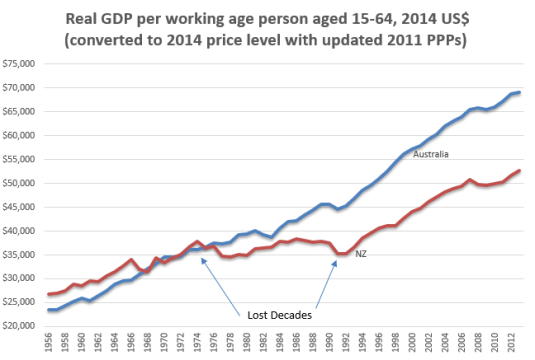
Sources: Computed from OECD StatExtract and The Conference Board. 2015. The Conference Board Total Economy Database™, May 2015, http://www.conference-board.org/data/economydatabase/.
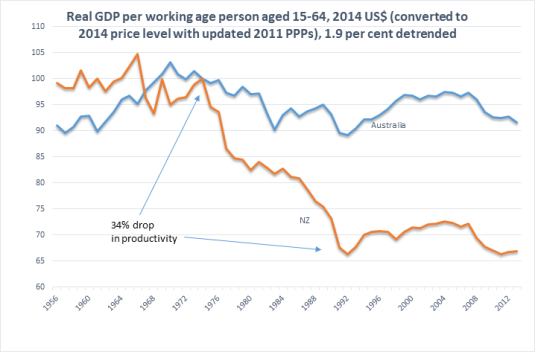
A flat line in the above figure is growth at the trend growth rate of 1.9% of the USA in the 20th century. A rising line is above trend growth for that year while a falling lined is below trend rate in GDP per working age person.
In the lost decades of New Zealand growth between 1974 In 1992, New Zealand lost 34% against trend growth which was never recovered. There was about 13 years of sustained growth at about the trend rate or slightly above that between 1992 and 2005. The entire income gap between Australia and New Zealand open up during these lost decades of growth between 1974 and 1992.
Sources: Computed from OECD StatExtract and The Conference Board. 2015. The Conference Board Total Economy Database™, May 2015, http://www.conference-board.org/data/economydatabase/.
Australia grew pretty much in its trend rate of growth since the 1950s. The so-called resources boom is not visible such as showing up as above trend rate growth.
Recent Comments