US corporate earnings vs. European corporate earnings. Kinda tells the whole story. pic.twitter.com/Aaq66HBjBH
— Joe Weisenthal (@TheStalwart) November 19, 2014
US corporate earnings vs. European corporate earnings
19 Nov 2014 Leave a comment
in Euro crisis, great recession, macroeconomics, politics - USA Tags: Euroland, GFC, great recession
The great stagnation continues
19 Nov 2014 Leave a comment
in global financial crisis (GFC), great recession, politics - USA Tags: GFC, Great Deviation, The Great Recession
Operations Research and The Revolution in Aggregate Economics – Edward Prescott 2012
18 Nov 2014 Leave a comment
in applied welfare economics, business cycles, economic growth, fiscal policy, global financial crisis (GFC), great depression, great recession, macroeconomics Tags: Edward Prescott, real business cycle theory
The extension of recursive methods to dynamic equilibrium modelling spawned a revolution in aggregate economics.
This revolution has resulted in aggregate economics becoming, like physics, a hard science and not exercises in storytelling.
Operations research played a major role in the development of practical methods to model dynamic aggregate economic phenomena and to predict the consequences of policy regimes.
Subsequently recursive methods were used to develop a quantitative theory of aggregate fluctuations and other aggregate phenomena.
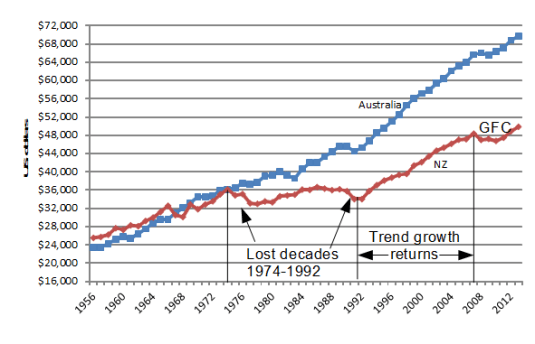
Real GDP per New Zealander and Australian aged 15-64, PPP, 1956-2013, $US
18 Nov 2014 1 Comment
in business cycles, economic growth, geography, global financial crisis (GFC), great recession, macroeconomics, politics - Australia, politics - New Zealand Tags: lost decades, prosperity and depression
Figure 1: Real GDP per New Zealander and Australian aged 15-64, converted to 2013 price level with updated 2005 EKS purchasing power parities, 1956-2013, $US
Source: Computed from OECD Stat Extract and The Conference Board, Total Database, January 2014, http://www.conference-board.org/economics
Figure 1 shows that New Zealand lost two decades of growth between 1974 and 1992 after level pegging with Australia for the preceding two decades.
New Zealand returned to trend growth between 1992 and 2007. New Zealand did not make up the lost growth of the previous two decades to catch up to Australia.
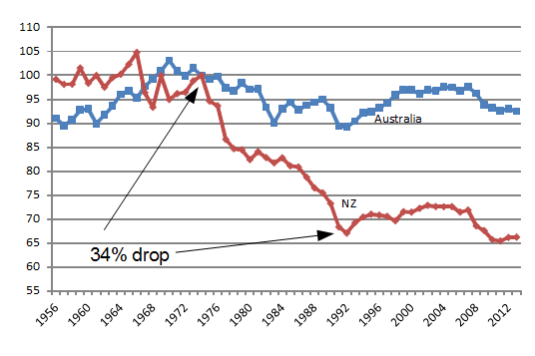
Figure 2: Real GDP per New Zealander and Australian aged 15-64, converted to 2013 price level with updated 2005 EKS purchasing power parities, 1.9 per cent detrended, base 100 = 1974, 1956-2013, $US
Source: Computed from OECD Stat Extract and The Conference Board, Total Database, January 2014, http://www.conference-board.org/economics
In Figure 2, a flat line equates to a 1.9% GDP annual growth rate; a falling line is a below trend growth rate; a rising line is an above 1.9% growth rate.
Figure 2 shows that there was a 34% drop against trend between 1974 and 1992; a return to trend growth and slightly better between 1992 and 2007; and then a recession to 2010.
Australia had its ups and downs since 1956 but essentially grew at the trend growth rate of 1.85% since 1970. The so-called resources boom in Australia does not show up in Figures 1 or 2.
There was no growth rebound in New Zealand to recover the lost ground, either in the lost decades between 1974 and 1992, or after the Global Financial Crisis. The strong GDP growth in Australia after that Keating recession in 1991 is an example of the country recovering lost ground after a recession – See Figure 2.
A trend growth rate of 1.9% is the 20th century trend growth rate that Edward Prescott currently estimates for the global industrial leader, which is the United States of America.
Sam Peltzman radio interview
17 Nov 2014 Leave a comment
in applied price theory, applied welfare economics, business cycles, economics of regulation, history of economic thought, industrial organisation, law and economics, liberalism, macroeconomics, Sam Peltzman Tags: Sam Peltzman
Financial regulation and financial crisis | Sam Peltzman Oct 19, 2014
17 Nov 2014 Leave a comment
in economics of regulation, global financial crisis (GFC), macroeconomics, monetary economics, Sam Peltzman Tags: economics of regulation, financial crises, offsetting behaviour, Sam Peltzman
Economic freedom in America and Scandinavia, excluding taxes
17 Nov 2014 Leave a comment
in international economics, macroeconomics, politics - USA Tags: capitalism and freedom, capitalism and prosperity, Trans-Atlantic gap
Human Capital, Development, and Growth | Lars Peter Hansen, Edward Glaeser, Claudia Goldin and Robert Lucas
16 Nov 2014 Leave a comment
in development economics, economic growth, Gary Becker, growth disasters, growth miracles, history of economic thought, human capital, labour economics, law and economics, property rights Tags: Claudia Goldin, Edward Glaeser, Gary Becker, Robert Lucas
Euroland and Japan compared since 2008
16 Nov 2014 Leave a comment
in budget deficits, business cycles, economic growth, global financial crisis (GFC), great recession Tags: Euroland, great recession, Japan, lost decades
The Greek great depression
15 Nov 2014 Leave a comment
in Euro crisis, global financial crisis (GFC), great depression, great recession, macroeconomics, politics Tags: euro crisis, Euroland, Greece

Europe’s dismal economy
15 Nov 2014 Leave a comment
in applied welfare economics, business cycles, Euro crisis, global financial crisis (GFC), great recession, macroeconomics Tags: Euroland, Euros crisis


If you’re so smart, why aren’t you rich: Deirdre McCloskey on economists as forecasters
10 Nov 2014 1 Comment

Policy bubble alert: R&D is an investment and like all investments, it must be cost justified
07 Nov 2014 Leave a comment

Average Marginal Income Tax Rates for New Zealand, 1907-2009 (WP 12/04) — The Treasury – New Zealand
07 Nov 2014 Leave a comment
in applied price theory, fiscal policy, politics - New Zealand Tags: Marginal tax rates, public economics, public finance

Note: Average marginal tax rate calculations exclude the impact of ACC levies, the Benefit system and the Family Tax Credit (FTC) system which, at various times since the 1970s, involved lump sum transfers to lower income families with children that were withdrawn at higher income levels at rates of up to 30c/$, thereby adding to effective MTRs.
Comment: The average marginal tax rate has been pretty stable in New Zealand since about 1990 excepting for a drop in the late 1990s and then an increase in 1999.
via http://www.treasury.govt.nz/publications/research-policy/wp/2012/12-04


Recent Comments