
Andolfatto and McDonald (1996) on the cycle is the trend
02 Jan 2020 Leave a comment
in business cycles, econometerics, economic growth, economic history, economics of education, entrepreneurship, human capital, industrial organisation, macroeconomics, monetary economics, survivor principle, unemployment Tags: creative destruction, real business cycles, technology diffusion
.@ProfDBernstein on Posner on racial discrimination by minority businesses in hiring
02 Jan 2020 Leave a comment
in applied price theory, discrimination, economics of bureaucracy, economics of information, economics of regulation, entrepreneurship, industrial organisation, job search and matching, labour economics, labour supply, law and economics, managerial economics, market efficiency, organisational economics, personnel economics, politics - USA, Public Choice, Richard Posner, survivor principle, theory of the firm Tags: affirmative action, job search, labour market search, racial discrimination

Eugene Fama on share market bubbles
02 Jan 2020 Leave a comment
in business cycles, economic history, economics of information, entrepreneurship, financial economics, global financial crisis (GFC), great depression, great recession, industrial organisation, macroeconomics, monetary economics, survivor principle Tags: efficient markets hypothesis, pessimism bias, rational expectations

The Reformation was mentioned in my Catholic education but never the Great Schism
02 Jan 2020 Leave a comment
in economic history, economics of education, economics of religion

Sinclair Davidson on privatisation
02 Jan 2020 Leave a comment
in applied price theory, applied welfare economics, comparative institutional analysis, constitutional political economy, econometerics, economic history, economics of bureaucracy, entrepreneurship, financial economics, industrial organisation, law and economics, managerial economics, organisational economics, personnel economics, politics - Australia, politics - New Zealand, property rights, Public Choice, public economics, rentseeking, survivor principle Tags: /, privatisation
Some propositions for chartalists (wonkish)
02 Jan 2020 Leave a comment
Nice summary

I’ve been asked quite a few times about chartalism and its recent rebadging as modern monetary theory (MMT). My answer has been that I really should get around to looking into this. However, the issue came up again at Crooked Timber following my post on hard Keynesianism. Looking around, I drew the conclusion that an attempt to define and assess the various versions of MMT would take more time than I had available. So, instead, I thought I would draw up a set of propositions bearing on the claims I made about hard Keynesianism and invite comment from MMT advocates and others as to whether they disagree. Here they are
1. Except during the period since the GFC, money creation has not been an important source of finance for developed countries
2. Except under extreme conditions like those of the GFC, money creation cannot be used as a significant source…
View original post 448 more words
Sadly, wokeness to a tee
02 Jan 2020 1 Comment
in economics of religion, law and economics, politics - Australia, politics - New Zealand, politics - USA, Public Choice Tags: Freedom of religion, political correctness, regressive left, sex discrimination


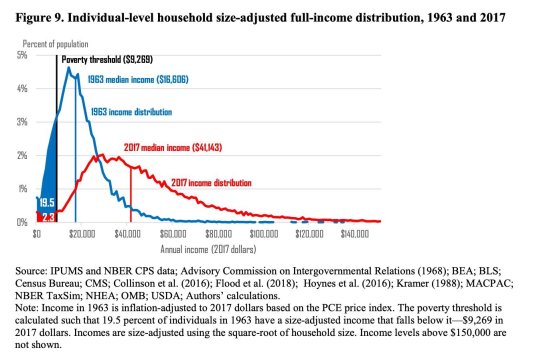
Bad news for @AOC @berniesanders @SenWarren
02 Jan 2020 Leave a comment
in applied welfare economics, economic history, labour economics, poverty and inequality, welfare reform Tags: 2020 presidential election, child poverty, family poverty


The Irrelevance of Deposit Creation for Prices and Allocation: Comments on Selgin
02 Jan 2020 Leave a comment

by Arash Molavi Vasséi
In a previous post, Andreas refers to George Selgin’s recent discussion of the place of fractional reserve banking in the Austrian Business Cycle Theory (ABCT). There, Selgin takes a swipe at the monetary pillar of the ABCT. According to the Austrian model, fractional reserve banking is inclined to create money out of “thin air” and, therewith, admits investment spending in excess of “voluntary saving”. This imbalance, allegedly induced by a decline in reserve ratios, is reflected in a Wicksellian interest rate gap, which is supposed to impact prices and the allocation in a systematic way (the real pillar of the ABCT). Selgin argues that fractional reserve banking does not account for the Austrian business cycle, and Andreas expresses sympathy for this view.
View original post 1,129 more words
The problems with the MMT-derived banking theory
01 Jan 2020 Leave a comment

(Update: Following Scott Fullwiler’s comment, I published an update here, in which I provide extra clarifications and introduce what I see as the fallacy of composition of the endogenous money theory (I moved this update to the top of my post following a few questions I received).)
Today will be a little long and technical… Many people have heard of the classic textbook story of the banking money multiplier, a characteristic of fractional reserve banking systems. Banks obtain reserves (i.e. central bank-issued high-powered money – HPM, which forms the monetary base) as customers deposit their money in, then lend out a fraction of those deposits that gets redeposited at another bank, effectively creating money in the process, and so on. In fine, reserve requirements at central banks prevent banks from expanding lending (and hence money supply) beyond a certain point. This led to the view that banks’ expansion…
View original post 3,133 more words
Another year of gender gaps
01 Jan 2020 Leave a comment
in discrimination, economics of crime, economics of education, gender, health and safety, health economics, human capital, labour economics, labour supply, law and economics, occupational choice, politics - Australia, politics - New Zealand, politics - USA, poverty and inequality Tags: gender wage gap, reversing gender gap


Recent Comments