The World Bank and other Western institutions retreat from fossil fuel finance has created a significant geopolitical opportunity for China. China is willing to finance fossil fuel projects in Africa and the developing world and reap the strategic benefit of control of energy infrastructure in many countries.
World Bank Reduces Emissions, Not Poverty
World Bank Reduces Emissions, Not Poverty
12 Oct 2025 Leave a comment
in defence economics, economics of bureaucracy, economics of climate change, energy economics, environmental economics, environmentalism, global warming, politics - USA, Public Choice Tags: climate alarmism
Is the earned income tax overrated?
09 Oct 2025 Leave a comment
in applied price theory, economics of education, human capital, income redistribution, labour economics, labour supply, occupational choice, Public Choice, public economics, welfare reform Tags: taxation and labour supply
This policy has been so popular with economists on a bipartisan basis, yet a recent piece in ReStud raises some doubts, as the wage subsidies induce many to drop out of school: As a complement to the federal earned income tax credit (EITC), some states offer their own EITC, typically calculated as a percentage of […]
Is the earned income tax overrated?
The Green Party Calls for the Abolishment of Private Landlords in the United Kingdom
08 Oct 2025 Leave a comment
in economics of regulation, income redistribution, industrial organisation, law and economics, Marxist economics, property rights, Public Choice Tags: British politics

On Sunday, the Green Party in the United Kingdom voted to “abolish” private landlords in a move that reaffirms the…
The Green Party Calls for the Abolishment of Private Landlords in the United Kingdom
Cassandra Somers-Joce: A New Chapter for Governmental Candour? The Public Office (Accountability) Bill
07 Oct 2025 Leave a comment
in economics of bureaucracy, economics of crime, health and safety, health economics, labour economics, law and economics, Public Choice Tags: British constitutional law, British politics, Internet

The Public Office (Accountability) Bill was introduced into the House of Commons on 16 September 2025. It gives effect to the Labour Party’s 2024 Manifesto commitment to introduce a ‘Hillsborough Law’ which will ‘place a legal duty of candour on public servants and authorities and provide legal aid for victims of disasters or state-related deaths’. As the Government’s ‘Duty of […]
Cassandra Somers-Joce: A New Chapter for Governmental Candour? The Public Office (Accountability) Bill
Getting rid of subidies creates wealth
06 Oct 2025 Leave a comment
in applied price theory, comparative institutional analysis, energy economics, industrial organisation, Public Choice, public economics Tags: electric cars, Internet, subsidies
REASON: Starting Today, Electric Vehicle Buyers No Longer Get a Federal Tax Credit. It’s bad news for upper-income motorists wanting a deal, but good news for taxpayers. In 2022, then-President Joe Biden signed the Inflation Reduction Act (IRA) into law…,[awarding] up to $7,500 for purchasing an electric vehicle. …Donald Trump [terminated the subsidy] on September…
Getting rid of subidies creates wealth
Unbeatable: The Brutally Honest Case for Free Markets | Bryan Caplan
04 Oct 2025 Leave a comment
in applied price theory, comparative institutional analysis, economic growth, economic history, income redistribution, industrial organisation, labour economics, law and economics, liberalism, libertarianism, macroeconomics, Public Choice Tags: The Great Enrichment
Francesca Jackson: The Oath of Allegiance, and the Battle for Independence
04 Oct 2025 Leave a comment
in constitutional political economy, Public Choice Tags: British constitutional law, British politics

In the UK and Commonwealth, an oath of allegiance is a promise to be loyal to the monarch, their heirs and successors. Also known as ‘swearing in’, it is pledged in various contexts, including at the beginning of a Parliament and when government ministers assume office. The allegiance is pledged to the monarch as the […]
Francesca Jackson: The Oath of Allegiance, and the Battle for Independence
The terrible US fiscals
03 Oct 2025 Leave a comment
in budget deficits, fiscal policy, macroeconomics, politics - USA, Public Choice
Bryce Wilkinson writes: Imagine that your family spent twice as much as it earned last month. Around the kitchen table, the mood would be grim and the bank’s patience likely wearing thin. In August 2025, the United States federal Government spent over twice its income, US$689 billion ($1.152 trillion) versus receipts of US$344b. Even doubling […]
The terrible US fiscals
The role and power of the Victorian House of Lords
01 Oct 2025 Leave a comment
in constitutional political economy, economic history, Public Choice Tags: British constitutional law, British politics

Dr Philip Salmon looks at a key element of Parliament which we don’t usually have much opportunity to reflect on in our work on Victorian MPs and constituencies: the House of Lords. As he explains below, the upper chamber played a vital role in many important 19th century reforms and continued to wield significant influence […]
The role and power of the Victorian House of Lords
A ban on lying
29 Sep 2025 Leave a comment
in economics of bureaucracy, politics, Public Choice Tags: British politics
A new law is going through Parliament to ban public officials from misleading the public. It sounds like a good idea, but it has the potential to spiral out of control very quickly. I’ve written about it for The Critic. The bear trap in the Public Office (Accountability) Bill is the unprecedented creation of a new…
A ban on lying
H1-B visa fees and the academic job market
28 Sep 2025 1 Comment
in applied price theory, economics of education, international economic law, international economics, politics - USA, Public Choice, rentseeking Tags: free trade, tariffs
Assume the courts do not strike this down (perhaps they will?). Will foreigners still be hired at the entry level with an extra 100k surcharge? I would think not,as university budgets are tight these days. I presume there is some way to turn them down legally, without courting discrimination lawsuits? What if you ask them […]
H1-B visa fees and the academic job market
Part I: Yes, Taxes Change Behavior
26 Sep 2025 Leave a comment
in applied price theory, economic growth, entrepreneurship, fiscal policy, human capital, labour economics, labour supply, macroeconomics, Public Choice, public economics Tags: taxation and entrepreneurship, taxation and investment, taxation and labour supply
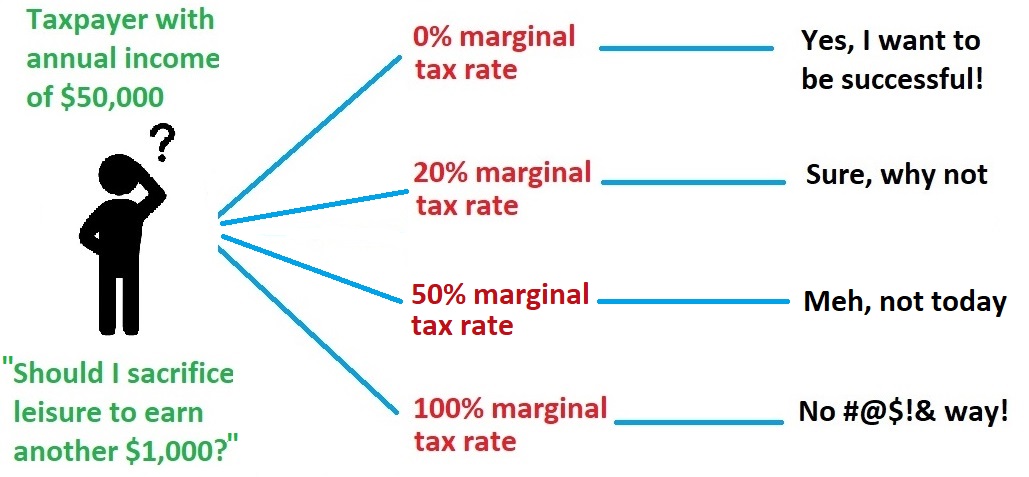
From a big-picture economic perspective, I worry most about the damage of high tax burdens on innovation, entrepreneurship, and investment. Those are things that generate enormous benefits for society, yet also things that are very sensitive to bad tax policy (specifically high marginal tax rates and the tax code’s bias against saving and investment). Sadly, […]
Part I: Yes, Taxes Change Behavior
Newsflash! The super-rich are mobile, and higher taxes incentivise them to move away
25 Sep 2025 1 Comment
in applied price theory, human capital, income redistribution, labour economics, labour supply, occupational choice, Public Choice, public economics Tags: taxation and entrepreneurship, taxation and investment
The super-rich are super-mobile. So, if a country decides to increase taxes on the super-rich (for example, with a wealth tax), some (but not all) of the super-rich will simply move elsewhere. This should not be a surprise to anyone. And yet, simplistic proposals to tax the super-rich are a favourite policy for some political…
Newsflash! The super-rich are mobile, and higher taxes incentivise them to move away
Article for Central Banking magazine on Orr/Quigley/Willis saga, and lessons
25 Sep 2025 Leave a comment
in economics of bureaucracy, inflation targeting, macroeconomics, politics - New Zealand, Public Choice
A couple of weeks ago the editor of Central Banking magazine (something of an house journal for central bankers, and for whom I’ve done book reviews for some years) invited me to write a fairly full article for a non-NZ audience on the extraordinary events of recent months. Having been so caught up in the […]
Article for Central Banking magazine on Orr/Quigley/Willis saga, and lessons
A very British fudge
23 Sep 2025 1 Comment
in constitutional political economy, economic history, economics of bureaucracy, Public Choice Tags: British constitutional law, British politics
On September 10, 2022, Penny Mordaunt presided over the King’s Accession Council. Since then, there has been some confusion regarding the nature of her role. Was she Lord President or merely Acting Lord President? What seems like a straightforward question at first glance turns out to be surprisingly complex. Appointing the Lord President The […]
A very British fudge
 Utopia, you are standing in it!
Recent Comments