Congratulations to Switzerland, the “improbable success” that is home to the world’s most sensible voters. The left put a referendum on the ballot to impose a national death tax and the people of Switzerland overwhelmingly voted against the class warfare initiative. Every single canton in every single region voted no. More than 90 percent of […]
I often get asked when the United States will suffer a Greek-style fiscal crisis. My answer is always “I don’t know,” though I freely admit we are heading in that direction. My lack of specificity isn’t merely because economists are lousy forecasters. I tell people it’s all about investor sentiment, and it’s hard to know […]
I’ve never really been persuaded that it is a good idea for public servants to be giving speeches, unless perhaps they are simply and explicitly explaining or articulating government policy. If they are, instead, purporting to run their own views or those of their agency it is almost inevitable that we will be getting less […]
One of Argentine President Milei’s radical reforms was to “take a chainsaw” to rent control laws. Argentina had had some of the most restrictive rent control regimes ever. All of that was abandoned almost over night. Many media outlets noted with glee that rents fell dramatically. Even most economists were surprised by how much supply…
Economists and [insert basically every other group of people] often don’t agree. Take, for instance, the recent discussion of price controls. The headline of this opinion piece on the subject in The New York Times literally begins with “Economists Hate This Idea.” Yet voters aren’t so skeptical. (I’m not ready to say the idea has…
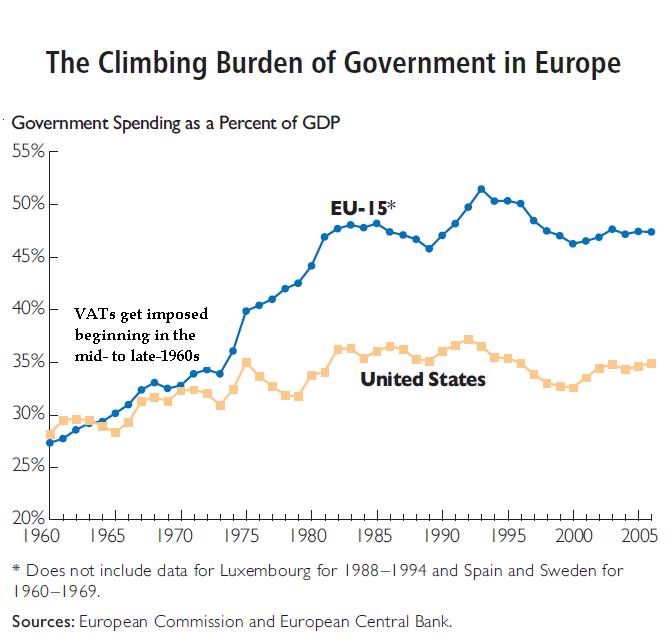
The case against the value-added tax (VAT) is not complicated. Simply stated, this hidden type of national sales tax was a key precursor for the expansion of the European welfare state. As you can see in the chart, the burden of government spending in Europe after World War II was similar to the size of […]
A good report from the NZ Initiative that looks at whether ownership of state houses is the best way to help low income NZ families with housing. Some key extracts: That $29,000 per unit estimated cost is not the cost of income related rents – they are the same regardless of whether the state or […]
Peter Dunne writes – In 1994 the then Labour Opposition resolved to introduce a new top tax rate of 39 cents in the dollar. The reason for the policy was purely political, not fiscal. Labour was shedding votes to Jim Anderton’s left-wing Alliance at the time and wanted to do something symbolic to staunch the flow. […]
There can be honest and constructive debates about the size of government, such as when I cross swords with someone on the left who understands Arthur Okun’s efficiency-equity tradeoff. Another legitimate debate is about the impact of tax policy, specifically whether higher or lower tax rates have big effects or small effects. But to have […]
A report by the New Zealand Initiative shows that the state is a very expensive landlord: Why does the government need to continue owning or managing more than 77,000 housing units, given its poor track record in this area, especially when state assistance can be provided without extensive government ownership? And why does it not […]
I wrote a column about taxes and growth in 2020. Let’s augment that analysis by digging into some details. I decided to address the issue today after seeing a tweet with this helpful summary of how different taxes cause different levels of economic damage (the Tax Foundation also has a table that ranks different taxes, […]
This policy has been so popular with economists on a bipartisan basis, yet a recent piece in ReStud raises some doubts, as the wage subsidies induce many to drop out of school: As a complement to the federal earned income tax credit (EITC), some states offer their own EITC, typically calculated as a percentage of […]
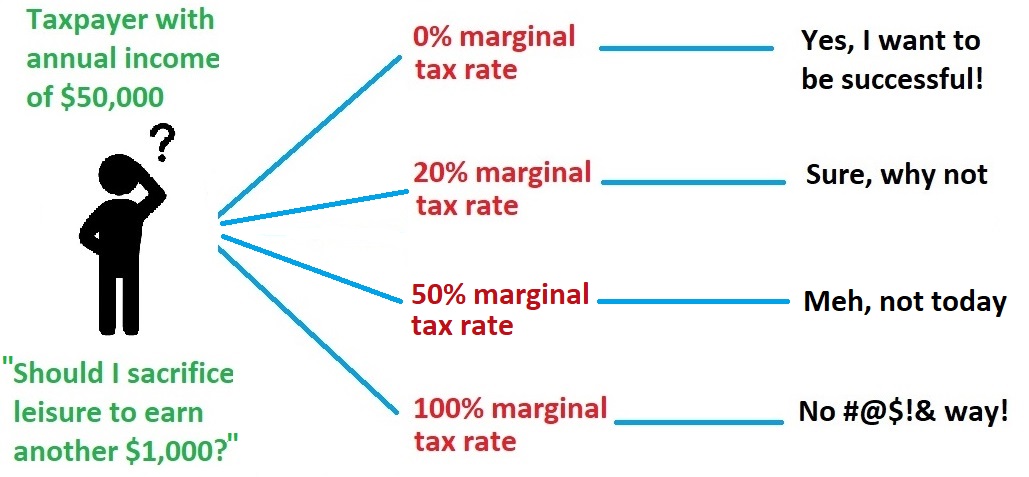
There are several visual ways of helping people understand how fiscal policy (and especially marginal tax rates) can change behavior. The philoso-raptor meme. The questioning worker. Supply-and-demand curves. The Wizard-of-Id parody. To augment these examples, I’ve started a series that is based on real-world examples. Part I of the series highlighted how the capital gains […]
REASON: Starting Today, Electric Vehicle Buyers No Longer Get a Federal Tax Credit. It’s bad news for upper-income motorists wanting a deal, but good news for taxpayers. In 2022, then-President Joe Biden signed the Inflation Reduction Act (IRA) into law…,[awarding] up to $7,500 for purchasing an electric vehicle. …Donald Trump [terminated the subsidy] on September…
From a big-picture economic perspective, I worry most about the damage of high tax burdens on innovation, entrepreneurship, and investment. Those are things that generate enormous benefits for society, yet also things that are very sensitive to bad tax policy (specifically high marginal tax rates and the tax code’s bias against saving and investment). Sadly, […]
Why Evolution is True is a blog written by Jerry Coyne, centered on evolution and biology but also dealing with diverse topics like politics, culture, and cats.
“We do not believe any group of men adequate enough or wise enough to operate without scrutiny or without criticism. We know that the only way to avoid error is to detect it, that the only way to detect it is to be free to inquire. We know that in secrecy error undetected will flourish and subvert”. - J Robert Oppenheimer.




 Utopia, you are standing in it!
Recent Comments