If this Norwegian policy of banning petrol cars by 2025 was repeated in New Zealand, most New Zealanders could not afford a new car or indeed any car at all. The cheapest electric car is $55,000 new and often much more. They also still have serious, indeed crippling range anxiety as the adjacent screen snapshot shows from the New Zealand electric cars buyers guide.
These type of policies from the Greens show how impractical they are and how contemptuous they are of ordinary families having a decent lifestyle, affordable cars and cheap energy. The Greens prefer ordinary people to have to scrimp and save for expensive cars that lose value quickly and do not go very far.
I just wrote an op-ed for National Business Review online (pay-walled) agreeing with an op-ed last week by Green MP Julie Anne Genter on transport investment. My op-ed started
The Taxpayers’ Union welcomes the commitment of the Green Party yesterday to evaluating transport investments without any bias or favouritism to one transport mode over another.
The Taxpayers’ Union could not agree more with Julie Anne Genter when she said that the question ministers should always ask is “what is the best investment we can make?”
This op-ed was my rejoinder to her reply to my op-ed criticising a recent Green Party on national freight policy. That policy called for 25% of all freight by kilometres travelled to each go by rail and road. That would near double their freight market share from 30% currently to 50% when measured by kilometre.
Yes. And they all need to be evaluated on the same basis, and funded accordingly. Which is what we suggested. https://t.co/5caSJiAr9R
— Julie Anne Genter (@JulieAnneGenter) June 10, 2016
For my troubles I got nothing but criticism and accusations in the comments section in National Business Review Online. A tweet by Genter was far more gracious.
There was no praise in the comment section at the National Business Review online for agreeing with the Green policy. In the first comment I was told I did not understand economics and that
When the policy default is “cut taxes and spending and let me selfishly keep my money” they miss out on the much larger benefit to everyone, including themselves, by nudging or economy to spend more on intrinsically more efficient transport – like rail – and less on alternatives.
No thanks at all for agreeing that transport investments should be the best we can make. After saying that in their recent freight policy, the Greens set targets were specific transport technologies they favour, which are rail and sea freight.
You cannot argue that transport investments should be the best we can make then declare a preference for a particular technology or mode of transport. But let us not quibble over that glaring contradiction.
The broader principle was agreed which is transport investments should be driven by cost benefit analysis and value for money. It should be technology neutral and transport mode neutral. That, of course, means the Greens cannot declare targets for the market shares of particular modes of freight shipment if they want to follow their own policy about value for money.
The Left thinks the solution to poverty is giving the poor more money because poverty is caused by the poor not having enough money.
Labour MP Jacinda Ardern introduced the exception in an op-ed in the Sunday Star Times. People are poor because they do not have enough money unless that is because of a lack of money because you are not married or not living with the father of the child.
I’ve spent the better part of six years reading and researching the issue of child poverty, and what we need to do to resolve this complex problem in New Zealand.
And yet here it was, the silver bullet we have all been looking for. Marriage. Getting hitched. Tying the knot. It turns out that we didn’t need an Expert Advisory Group on child poverty, or any OECD analysis for that matter – apparently all we really need is a pastor and a party
Ardern preferred to attribute the increase in child poverty to welfare benefit cuts in the early 1990s.
There is an exception within this exception for the living wage as Ardern says
But the other factors Family First was so quick to dismiss – low wages and staggering housing costs – mean we have 305,000 children in poverty. And this is the stuff that needs to change. It’s time we faced reality.
A living wage increase can solved family poverty. Actually getting a job and earning a wage does not reduce poverty among single-parent households but living wage increases do for families.
You cannot have it both ways. That low wages cause family poverty but no wages does not.
The best solution to child poverty is to move their parents into a job. Simon Chapple is quite clear in his book last year with Jonathan Boston that.
Sustained full-time employment of sole parents and the fulltime and part-time employment of two parents, even at low wages, are sufficient to pull the majority of children above most poverty lines, given the various existing tax credits and family supports.
The Otago Daily Times health reporter wrote today that
…individualist new-right” attitude that holds sway in New Zealand is holding back organ donation rates, a University of Otago biomedical ethics authority says
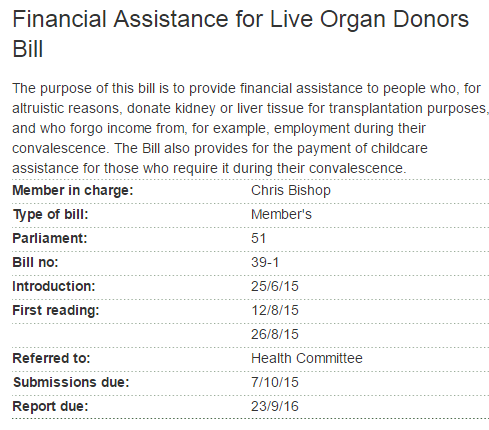
Chris Bishop’s bill passed its first reading and is now before a select committee for public hearings. Michael Woodhouse, MP first put the bill in the ballot.
This private members bill ensures that live organ donors are not out of pocket. The financial cost of time out the workforce to recover from a live organ donation is sufficient to prevent some from doing so. As Chris Bishop said in his first reading speech
I think it is wrong that at the moment live organ donors are essentially penalised for their altruism, facing a large loss of income even though their actions save lives and contribute to a healthier New Zealand.
Moreover, the current system in many ways actually favours the wealthy. If you have a relative who can afford to take time off work and make the financial sacrifice is entailed in donating an organ to you, and they are a match, then you have a good shot of getting that organ.
But if you have someone who is a match but cannot afford to take time off work to donate an organ to you, then you are obviously in a less advantageous position.
It is bizarre that people cannot donate organs because they cannot afford the time off work to recover and still pay the mortgage or rent. They currently receive a sickness benefit of $206 per week. The private members bill will ensure they receive 80% of their previous income for 12 weeks.
Organ donation is a repugnant market. Live organ markets are illegal because most people are just repelled by the very idea of such trading as The Economist explains
In most countries it is illegal to buy or sell a kidney. If you need a transplant you join a waiting list until a matching organ becomes available.
This drives economists nuts. Why not allow willing donors to sell spare kidneys and let patients (or the government, acting on their behalf) bid for them? The waiting list would disappear overnight.
The reason is that most societies find the concept of mixing kidneys and cash repugnant. People often exclude financial considerations from their most important decisions, from the person they marry to the foster child they adopt.
Because healthy people have two kidneys and can remain healthy with only one, kidneys from living donors are now widely used for kidney transplantation, the preferred treatment for end-stage renal disease.
The laws against buying or selling kidneys reflect a reasonably widespread repugnance, and this repugnance may make it difficult for arguments that focus only on the gains from trade to make headway in changing these laws.
Prof Gillett supports a shift to an opt-off organ donation system that would involve families in the decision-making process.
He said the political ideology of the Ministry of Health and the Government hindered efforts to foster a different view of organ donation.
“The ministry’s got quite an individualist new-right sort of agenda.
“I think it’s shared by the Government at large; I think that’s the reason why we are encouraged to tolerate the inequalities [in society].”
“It’s fundamental to neoliberalism that every individual should be able to be accountable for their own stuff, wrapped up in their own life, and not have dues to others.”
Organ donation should be seen as a normal way to contribute to society, Prof Gillett believed.
“An opt-off system is consistent with the solidarity view of human beings.”
Requiring people to opt out rather than opt in wastes political energy on a losing proposal when far simpler reforms are yet to be done. Piecemeal social reform in the tradition of Karl Popper is better. We should first do simpler things like making sure that people do not donate organs to a relative because they cannot afford to do so.
When I heard of Chris Bishop’s private members bill, it is one of those social reforms you wonder why it was not done years ago. The notion of someone not been able to donate an organ to a relative to save their life because of financial constraints is far more repugnant than an organ market. Their financial constraint is the need to pay the rent and buy the groceries while off work recovering from the live organ donation. As Roth says
One often-noted regularity is that some transactions that are not repugnant as gifts and in-kind exchanges become repugnant when money is added…
Many people clearly regard monetary compensation for organ donation as something that transforms a good deed into a bad one.
While a repugnance against an organ market is a common preference, I cannot see anyone opposing making sure that live organ donors are not out of pocket because of their tremendous generosity. There is no slippery slope you despite some people’s concerns as Roth explains
Concern that monetizing some transactions might lead to other changes seems to lurk beneath the more explicit concerns. Some critics fear a commercial dystopia in which kidney sales would enter into contracts: for example, as collateral, or as payment for other medical services, or to repay debts, or as means tests for eligibility for social services and financial aid. Such scenarios have found their way into fiction and movies
Repugnance is a real constraint on the emergence of markets. The issue of making sure the people are not out of pocket for live organ donations is separate from the repugnance against commercial transactions over human organs.
I have made a complaint to the editor of the Otago Daily Times about sloppy journalism and sloppy editing. If I am not satisfied with their response, I will take the matter to the Press Council. Yes, I have a bee in my bonnet.
The universal basic income is a rare bird for the left. It is the only time the usual suspects on the left are happy to cut government bureaucracy.
Furthermore, the left makes no inquiries as to how these redundant bureaucrats who administered the welfare state will find jobs. The market is left to work its magic for once. How convenient.
When a tariff cut is proposed, a trade deal signed, or job reduction in a bureaucracy suggested perhaps as the result of a privatisation, left-wing activists chain themselves to factory gates or government offices in solidarity. The social upheaval from the job losses among existing workers and their dim prospects of reemployment are paramount in their minds.
The universal basic income is the only time the left welcomes a reduction in bureaucracy and the role in the state. This switch from welfare payments to a universal basic income does not make those on the benefit any better off. Normally they are worse off under a universal basic income.
None of the the less well groups which of the concern of the left gain from a universal basic income. Despite this, they sell the jobs of their comrades in the public sector down the river.
I cannot believe the explanation is job losses are OK as long as they are the result of left-wing policies. Unless the labour market is liberalised, its ability to find new jobs for workers, for example, made redundant in the public sector after the introduction of a universal basic income is not any under greater than under a right-wing policy that costs jobs.
Much is made of the fact that drug prices are lower in Canada and Western Europe as compared to the USA. Indeed, day trips are made across the Canadian border to buy cheaper drugs as compared to the local pharmacy pricin in a US city.
Bringing in new drug to the market is a seriously expensive business these days. That is before you consider the commercial risk of inventing a drug that isn’t much better than its competitors.
Of course, you can always be leapfrogged by another drug company brining on a better drug not long after you have brought yours to market. None of this is getting any cheaper.
Innovation by specific drug company is a form of public good production known as best shot public goods. Under a best-shot rule, the socially available amount is the maximum of the individual quantities. There is is a single prize of overwhelming social importance, such as a major drug breakthrough, with any individual’s effort having a chance of securing the prize.
The amount to be produced of a best shot public good depends on the best contribution rather than the usual situation of any contribution is interchangeable. Another example is a large number of people shooting at an incoming missile. The best shot counts, all the others don’t matter.
High drug prices in the USA could be the price of the weakest shot or weakest link public good. Weakest shot public good is where the socially available amount is the minimum of the quantities individually provided. One example a weakest link public goods are military alliances where the success of the alliance depends upon everyone contributing
In the weakest shot or weakest link theory of public good production, the free riding countries of Europe will bring the whole show down by not making their contribution to drug research by buying at good prices from the US pharmaceutical companies.
Perhaps a better way to look at drug innovation is a good shot public good. Someone has to make a reasonable contribution; that has to be the USA because it is such a large market. Without access to good prices in the USA, there wouldn’t be enough of an incentive for drug innovation.
In the case of the start of World War I, Triple Entente against Germany was a weaker shot public good. Its defensive wall depended on the strength of the weakest country defending i.e. the unfortified Belgian border (in both wars). The Tripartite Alliance was a best shot public good depending on the strength of Germany’s attack for ultimate success or failure.
Why Evolution is True is a blog written by Jerry Coyne, centered on evolution and biology but also dealing with diverse topics like politics, culture, and cats.
In Hume’s spirit, I will attempt to serve as an ambassador from my world of economics, and help in “finding topics of conversation fit for the entertainment of rational creatures.”




Recent Comments