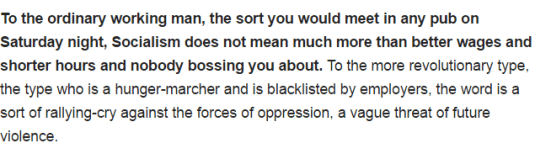
Source: The Road to Wigan Pier – Wikiquote.
Celebrating humanity's flourishing through the spread of capitalism and the rule of law
07 Jun 2016 Leave a comment
in economic growth, labour economics, Marxist economics, politics - New Zealand
Source: The Road to Wigan Pier – Wikiquote.
07 Jun 2016 Leave a comment
in applied price theory, comparative institutional analysis, labour economics, minimum wage, politics - USA, Public Choice Tags: antimarket bias, expressive voting, living wage, rational rationality
Any decent political movement makes an ambit claim in expectation of being beaten back to its real position. That is basic negotiation tactics in politics.
Such is the volatility of expressive politics that the fight for 15 campaign has taken on a life of its own and is actually delivering on a $15 living wage as the minimum wage in the USA in a growing number of states and cities as well is in Democratic party presidential campaign pledges.
If there is any degree of economic sanity and practicality among living wage advocates, they know that such a high living wage increase will cost jobs.
After all, if a large wage increase for low-paid workers cost no jobs, why not increase everyone’s wage by a similar percentage, which is about 100% in the USA?
07 Jun 2016 Leave a comment
in economics, economics of media and culture, politics - New Zealand Tags: 2014 New Zealand election, 2017 New Zealand election, Attack Ads, New Zealand Greens, New Zealand Labour Party
07 Jun 2016 Leave a comment
in politics - USA Tags: 2016 presidential election
06 Jun 2016 Leave a comment
in politics - New Zealand, poverty and inequality, public economics, urban economics Tags: economics of housing, homelessness, social insurance, welfare state
Statistics New Zealand spent 21 pages trying to define the term homeless. How Orwellian.
When I first moved to Canberra and when I moved back, I stayed with friends. Some regard that as being homeless under the Statistics New Zealand definition, much to my own surprise.
I qualify because I shared accommodation . Having shared or short-term accommodation is not homeless. The descriptions shared and short-term accommodation quite adequate to the task.
People living in temporary accommodation including with friends are not homeless. Their situation is unsatisfactory but describing it does not justify butchering the English language by conflating their inconveniences with the few hundred people who live rough each night.
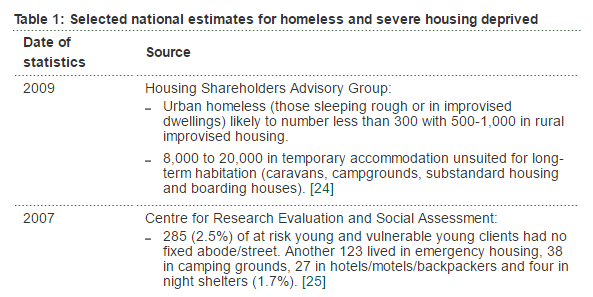
Source: New Zealand Parliament – Homelessness in New Zealand.
Those that conflate having a roof over your head tonight with living rough take advantage of the great sympathy people have for those living rough for people in far less dire situations.
05 Jun 2016 Leave a comment
in applied price theory, applied welfare economics, comparative institutional analysis, constitutional political economy, development economics, economic history, economics, economics of regulation, entrepreneurship, growth disasters, growth miracles, income redistribution, industrial organisation, labour economics, macroeconomics, Milton Friedman, minimum wage, occupational choice, politics - USA, Public Choice, public economics Tags: 2016 presidential election, Leftover Left
04 Jun 2016 Leave a comment
in labour economics, labour supply, politics - New Zealand, poverty and inequality Tags: expressive voting, growth of government, New Zealand Labor Party, rational irrationality, size of government, social insurance, universal basic income, welfare state
A universal basic income in New Zealand will have to be financed by a great big new tax because the existing ones are not enough according to the Economist calculations below.
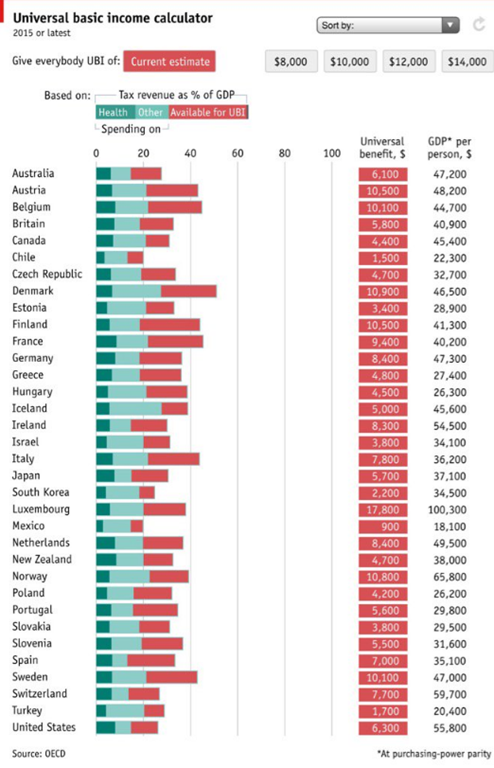
HT: Paul Kerby.
04 Jun 2016 Leave a comment
in applied welfare economics, economic history, politics - USA Tags: living standards, measurement error, middle class stagnation, wage stagnation
02 Jun 2016 Leave a comment
in managerial economics, organisational economics, politics - USA Tags: 2016 presidential election, email privacy, information security, Internet privacy, privacy
My only experience with secure email networks is pretty pesky filters stopping you from sending confidential material outside the network. The emails bounced.
![secure-email-links[1]](https://utopiayouarestandinginit.com/wp-content/uploads/2016/06/secure-email-links1.jpg "secure-email-links[1]")
I do not understand how a secure email server could communicate with one that is not such as Hillary Clinton’s private email server thin the secure network without a special dispensation.
With hundreds of thousands use secure email servers in the US government, the network administrator would have to have filters that bounce emails with keywords and classifications.
More sensible agencies that handle classified materials do not allowstaff to take work home. If they do, it must be on a secure laptop with no capacity to print or download.
02 Jun 2016 Leave a comment
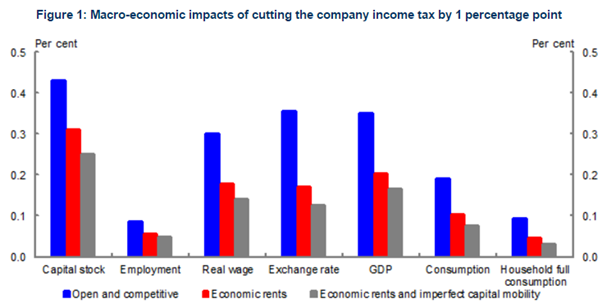
in applied price theory, politics - Australia, politics - New Zealand, public economics Tags: Australia, company tax, international tax competition, tax incidents, taxation and entrepreneurship, taxation and investment
02 Jun 2016 Leave a comment
in constitutional political economy, politics - New Zealand, Public Choice Tags: 2017 New Zealand election, MMP, New Zealand Greens, New Zealand Labour Party, tactical voting
There is a memorandum of understanding agreed yesterday between the New Zealand Labour Party and the New Zealand Greens. There is some speculation that there will be more coordination over electorate votes so that the Labour Party wins more electorate seats.
Labour has five list MPs at the moment. Winning a few more electorate seats will mean that the leader of the party and a future leader may be out of parliament if there is more tactical voting.
Unless this tactical voting leads to an overhang in parliament with Labour holding more electoral seats than it is entitled to on the basis of its party vote, it seems to be shooting itself in the foot.
02 Jun 2016 Leave a comment
in politics - New Zealand, transport economics Tags: celebrity technologies, expressive voting, KiwiRail, network economics, picking losers, picking winners, rational irrationality, urban transport
$5.2 billion in rail spending since the 2003 budget! This $5.2 billion does not include any spending on urban rail, commuter train networks or their electrification. The $5.2 billion since the 2003 budget is for the passenger and freight network, not the urban metro contracts
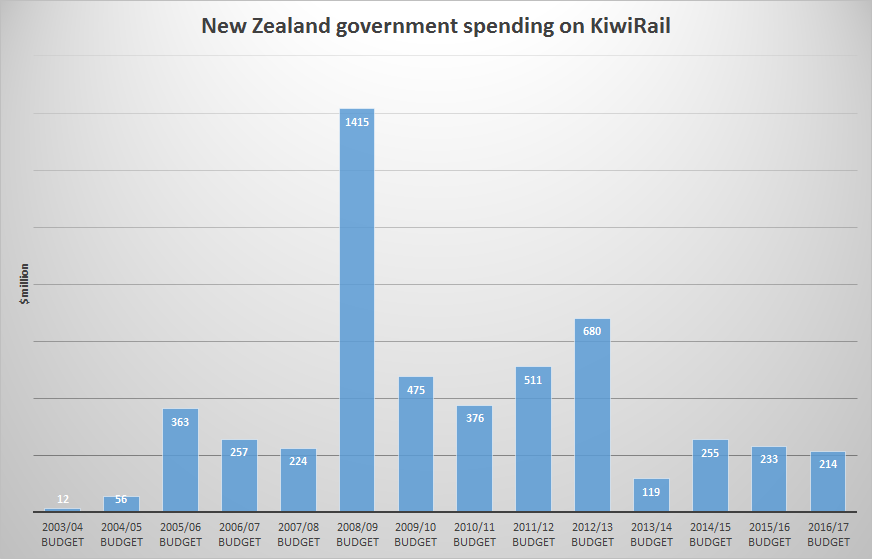
Source: New Zealand Budget Papers, various years.
Desperately waiting for that dividend the taxpayers lose if any of these assets are privatised. The spending listed below in the two charts includes loans, capital injections and the purchase of the track and of the train operator itself. The latter was purchased for $690 million which was soon written down to zero.
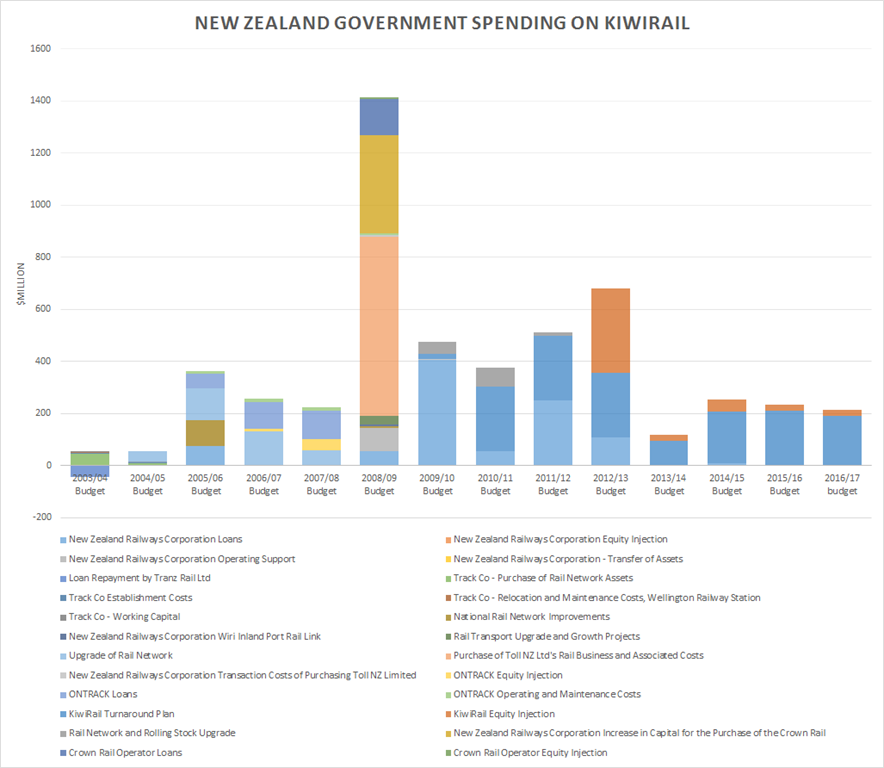
Source: New Zealand Budget Papers, various years.
There is no table because the table format breaks down when blogged.
At various times, OnTrack and KiwiRail was subsidiaries of the New Zealand Railways Corporation, which was the holding company. Now OnTrack is a division of KiwiRail.
01 Jun 2016 Leave a comment
in economics of crime, law and economics, politics - New Zealand Tags: crime and punishment, game theory, law and order, plea-bargaining
The sensible sentencing trust wants to greatly curtail if not abolish plea-bargaining. Its petition is motivated by a recent plea bargain where a particularly horrendous child murder was pleaded down to two manslaughter guilty pleas.
I have no knowledge of the details of that case or the plea-bargain other than a male and female caregiver were charged with the brutal murder of a 3-year-old child in their foster care.
 My speculation is two guilty pleas to manslaughter is better than one of the accused getting off through a cutthroat defence.
In this defence, the co-accused blame each other for the worst and minimises their own culpability. Sometimes this backfires. The jury convicts both on the evidence of the other but ignores self-serving testimony. But sometimes a cutthroat defence works and a guilty goes free.
A few years ago a father was accused of murdering his 3 month old twins. The chief witness against him was their mother.
By the end of the trial, his defence counsel made the mother look far more guilty than the accused. So much so that the jury returned a not guilty verdict in 10 minutes.One of the two did it, but the jury could not work out which one so there was reasonable doubt.
In the case motivating the petition to abolish plea-bargaining, the accused pleaded down to manslaughter pleas. Both are certain to be punished rather than one perhaps get off.
Plea-bargain are a compromise but they are still justice. The punishment is less but is more certain. Plea-bargaining allows scarce prosecution resources to be better targeted, which means more convictions in those cases that do go to trial.
Following Landes (1971), plea bargaining is a rational response to the costs of trial for prosecutors intent on maximizing the sum of punishments imposed on defendants as a class and for defendants seeking to minimize the expected costs of punishment to them as individuals.
A plea-bargain spares witnesses the ordeal of a trial; justice is speedier, less a severe but more certain as there is no chance of the not guilty verdict at trail. Testifying against an accused found not guilty because a reasonable doubt rather than actual innocence must be disheartening.
31 May 2016 Leave a comment
in industrial organisation, politics - New Zealand, survivor principle, technological progress Tags: anti-trust economics, barriers to entry, competition law, creative destruction, network goods, The meaning of competition

Source: New Zealand Commerce Commission.
Celebrating humanity's flourishing through the spread of capitalism and the rule of law
Celebrating humanity's flourishing through the spread of capitalism and the rule of law
Celebrating humanity's flourishing through the spread of capitalism and the rule of law
Celebrating humanity's flourishing through the spread of capitalism and the rule of law
Celebrating humanity's flourishing through the spread of capitalism and the rule of law
Celebrating humanity's flourishing through the spread of capitalism and the rule of law
A History of the Alt-Right
Econ Prof at George Mason University, Economic Historian, Québécois
Celebrating humanity's flourishing through the spread of capitalism and the rule of law
Scholarly commentary on law, economics, and more
Beatrice Cherrier's blog
Celebrating humanity's flourishing through the spread of capitalism and the rule of law
Celebrating humanity's flourishing through the spread of capitalism and the rule of law
Celebrating humanity's flourishing through the spread of capitalism and the rule of law
Why Evolution is True is a blog written by Jerry Coyne, centered on evolution and biology but also dealing with diverse topics like politics, culture, and cats.
Celebrating humanity's flourishing through the spread of capitalism and the rule of law
A rural perspective with a blue tint by Ele Ludemann
DPF's Kiwiblog - Fomenting Happy Mischief since 2003
Celebrating humanity's flourishing through the spread of capitalism and the rule of law
The world's most viewed site on global warming and climate change
Tim Harding's writings on rationality, informal logic and skepticism
A window into Doc Freiberger's library
Let's examine hard decisions!
Commentary on monetary policy in the spirit of R. G. Hawtrey
Thoughts on public policy and the media
Celebrating humanity's flourishing through the spread of capitalism and the rule of law
Politics and the economy
A blog (primarily) on Canadian and Commonwealth political history and institutions
Reading between the lines, and underneath the hype.
Economics, and such stuff as dreams are made on
"The British constitution has always been puzzling, and always will be." --Queen Elizabeth II
Celebrating humanity's flourishing through the spread of capitalism and the rule of law
Celebrating humanity's flourishing through the spread of capitalism and the rule of law
WORLD WAR II, MUSIC, HISTORY, HOLOCAUST
Undisciplined scholar, recovering academic
Celebrating humanity's flourishing through the spread of capitalism and the rule of law
Res ipsa loquitur - The thing itself speaks
In Hume’s spirit, I will attempt to serve as an ambassador from my world of economics, and help in “finding topics of conversation fit for the entertainment of rational creatures.”
Researching the House of Commons, 1832-1868
Articles and research from the History of Parliament Trust
Reflections on books and art
Posts on the History of Law, Crime, and Justice
Celebrating humanity's flourishing through the spread of capitalism and the rule of law
Exploring the Monarchs of Europe
Cutting edge science you can dice with
Small Steps Toward A Much Better World



Recent Comments