
Source: Investigation: People shot and killed by police this year – Washington Post.
Celebrating humanity's flourishing through the spread of capitalism and the rule of law
07 Mar 2016 Leave a comment
in economics of crime, politics - USA Tags: crime and punishment, criminal deterrence, law and order, police killings
06 Mar 2016 Leave a comment
As the New Zealand Medical Association has pointed out tackling obesity needs to be embedded in everything, from new buildings to school classrooms…
The food industry needs a rev up as well. There’s no reason manufacturers couldn’t already have been reducing sugar and saturated fat in process food. That shows there needs to be some very strong directives from the Government.
Andrew Little, Leader of the Opposition, 19 October 2015
I’m really concerned that we’ve wasted eight years in terms of doing anything about obesity since the government’s been in after they cancelled all programmes, and what they have put in place is timid. They are not treating obesity with the seriousness that they ought to.
They’ve got to a bind now it’s hard to get out of without looking like nanny-state. They’ve got to get over themselves and think about the health of New Zealanders rather than their own political backsides.
Labour Party health spokesperson Annette King, 11 December 2015
06 Mar 2016 Leave a comment
in economics of crime, politics - USA
Once again, few are shot by police if they are unarmed, much less with their hands in the air and not offering resistance. A leading cause of death of unarmed civilians is stray bullets. The lesson there is do not travel in cars or live with armed criminals.

Source: Investigation: People shot and killed by police this year – Washington Post.
06 Mar 2016 Leave a comment
in applied price theory, economic growth, fiscal policy, macroeconomics, politics - USA, public economics Tags: 2016 presidential election, taxation and entrepreneurship, taxation and investment, taxation and labour supply
[/embed]https://www.facebook.com/UnbiasedAmerica/photos/pb.123061011213236.-2207520000.1457089554./449398021912865/?type=3&theater[/embed]
05 Mar 2016 Leave a comment
in applied welfare economics, economic history, economics of media and culture, industrial organisation, politics - USA Tags: good old days, Leftover Left, pessimism bias, rational irrationality, smart phones, The Great Enrichment

Source: When I Was Your Age | Center for American Progress.
The claim by the Centre for American progress is that despite being more educated and working in a more productive economy, 30-year-olds today barely make more than 30-year-old Baby Boomers did in 1984.

Source: When I Was Your Age | Center for American Progress.
Nearly everything from RadioShack ad in 1991 is replaced by a smartphone. https://t.co/xGh6ZzW1Nx—
Vala Afshar (@ValaAfshar) December 19, 2015
The apps in your smartphone cost $900,000 thirty years ago —@datarade https://t.co/pjw7q4QGDp—
Vala Afshar (@ValaAfshar) October 29, 2015
05 Mar 2016 Leave a comment
in economics of love and marriage, fiscal policy, gender, labour economics, labour supply, law and economics, politics - Australia, politics - New Zealand, politics - USA, public economics Tags: Australia, British economy, Canada, Denmark, effective marginal tax rates, family tax benefits, family tax credits, France, Germany, in-work tax credits, Italy, poverty traps, rational irrationality, social insurance, Sweden, taxation and labour supply
Some countries including New Zealand and Australia do not give ordinary families much of an incentive to earn more. Effective marginal tax rates on low income families is one of the few times that the Left discovers supply-side economics.
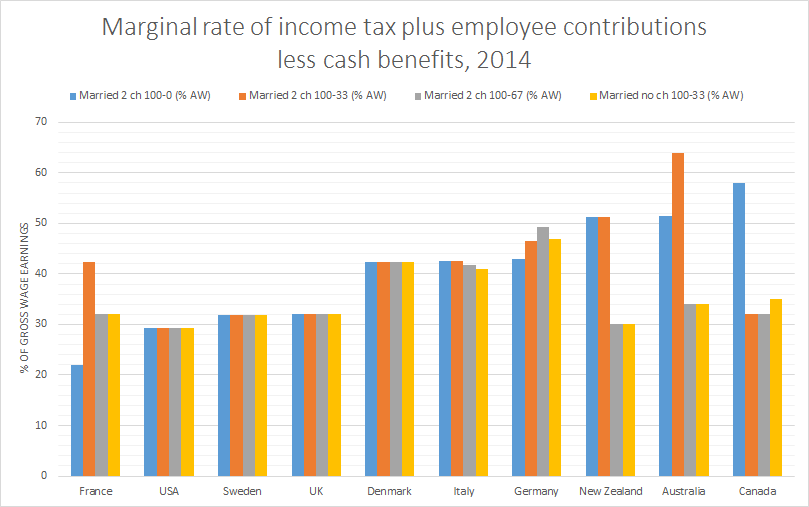
Source: Taxing Wages 2015 – OECD 2015.
05 Mar 2016 Leave a comment
in economics, gender, labour economics, labour supply, politics - USA Tags: maternity leave
05 Mar 2016 Leave a comment
in fiscal policy, politics - Australia, politics - New Zealand, politics - USA, public economics Tags: Australia, British economy, Canada, Denmark, family taxation, France, Germany, Italy, social insurance, Sweden, taxation and labour supply
Those sensitive and caring northern European welfare states do tax families rather heavily even after accounting for family cash benefits.
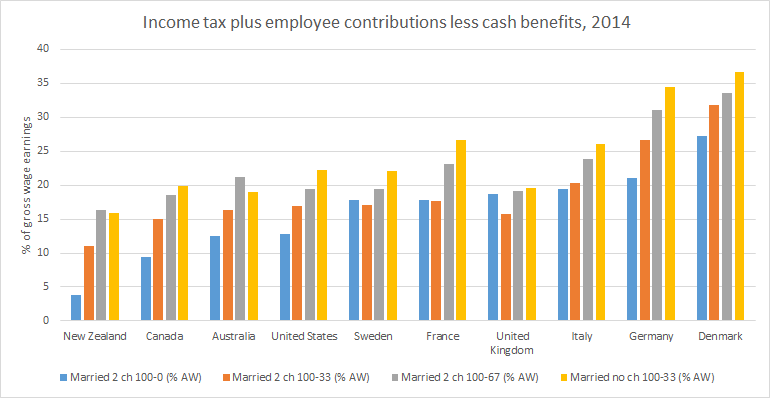
Source: Taxing Wages 2015 – OECD 2015.
04 Mar 2016 Leave a comment
in economics of media and culture, politics - USA
Trump has voted consistently in general elections. There is no indication that he has voted in a presidential primary of any kind since 1989.
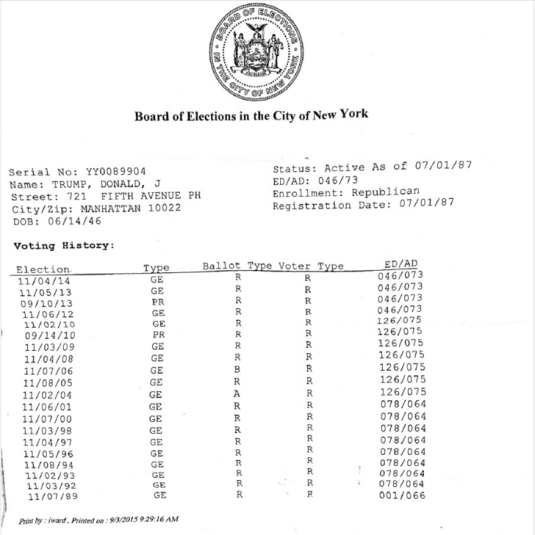
Source: Donald Trump, Melania & Ivanka have never voted in a GOP presidential primary | Daily Mail Online.
Donald Trump first registered to vote at Trump Tower in 1987. Since then, he has been a Republican three times, a Democrat once, a member of the Independence Party once and, for a brief period, had no party identification at all.
Since he registered to vote for the Republican Party just before the 2012 election, he hasn’t missed a vote. He registered too late to vote for Mitt Romney.
Trump spent the entire Bush years as a registered Democrat.
Source: Donald Trump’s got a particularly strange voting history – The Washington Post.
04 Mar 2016 Leave a comment
in constitutional political economy, politics - USA, Public Choice
04 Mar 2016 Leave a comment
in economics of media and culture, politics - USA
04 Mar 2016 Leave a comment
in fiscal policy, politics - Australia, politics - New Zealand, politics - USA, public economics Tags: Australia, British economy, Canada, Denmark, France, Germany, Italy, social insurance, Social Security, Sweden, taxation and labour supply
Those much admired northern European welfare states tax families and individuals much more than do the Anglo-Saxon welfare states.
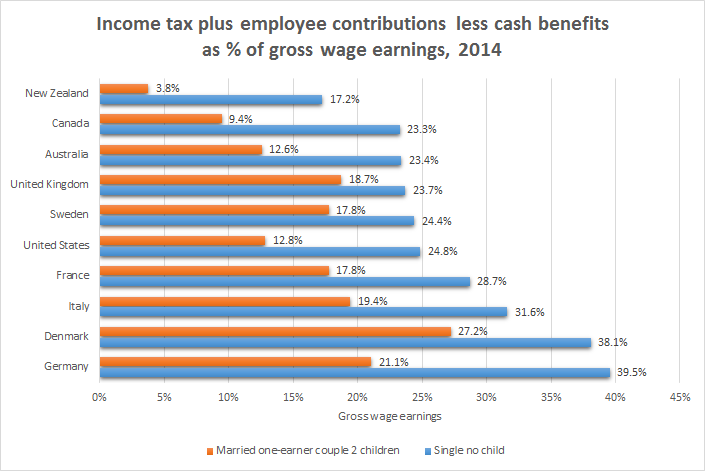
Source: Taxing Wages 2015 – OECD 2015.
04 Mar 2016 Leave a comment
in comparative institutional analysis, constitutional political economy, politics - New Zealand, Public Choice
After reflecting far more than I should on some conspiracy laden testimony at Parliament yesterday, one of the things I recall was a demand that the approval of the TPPA be put to binding referendum. The conspiracy theorist at hand was deeply concerned about how that treaty was encroaching on New Zealand’s sovereignty.
Why did this conspiracy theorist assume that a binding referendum will go his way and that opposing conspiracy theorists will not put up their own binding referendums in which he will lose?

The major drawback of citizen initiated referendums is any bunch of people can put them up much to the annoyance of those who will be a victim of the law to be passed.

Just as rotation of power is inherent to Parliamentary democracy, the ability of the crazies to the either the left or the right of you to initiate their own binding citizen initiated referendums. The first referendum is likely to be on one of the following:
Binding referenda are unworkable. Parliament can’t amend them later as we learn from the implementation of the law and unintended consequences arise. Every new law is riddled with unintended consequences and blow-backs.
Do you really want to have to have another referendum to undo a binding referendum that turned out to be a bit of a mistake? One of the few redeeming features of the Parliament that is sovereign – a parliament for can make or unmake any law whatsoever – is it can repeal its mistakes quickly.
The first citizens initiated referendum was held on 2 December 1995. The question was
Should the number of professional fire-fighters employed full-time in the New Zealand Fire Service be reduced below the number employed in 1 January 1995?
Turnout was low as the referendum was not held in conjunction with a general election, and the measure was voted down easily, with just over 12% voting “Yes” and almost 88% voting “No”.
The key to constitutional design is not empowering you and yours – it is how to restrain those crazies to the Left or the Right of you, as the case may be, when they get their hands on the levers of power, as they surely will in three, six or nine years’ time.
The one inevitability of democracy is power rotates – unbridled power and binding referenda lose their shine when you must share that power with the opposing side of politics who put up their own referendum question.
Constitutions are brakes, not accelerators. Much of constitutional design is about checks and balances and the division of power to slow the impassioned majority down.
Conspiracy theorists that pretty much sore losers. The last thing they want is a binding referendum on a topic on which they are going to vote no.

The problem of constitutional design was ensuring that government powers would be effectively limited. The constitutions were designed and put in place by the classical liberals to check or constrain the power of the state over individuals.
The motivating force of the classical liberals was never one of making government work better or even of insuring that all interests were more fully represented. Built in conflict and institutional tensions were to act as constraints on the power and the size of government.
Modern democracy is government subject to electoral checks. Citizens do have sufficient knowledge and sophistication to vote out leaders who are performing poorly or contrary to their wishes. Modern democracy is the power to replace governments at periodic elections.
The power of the electorate to turn elected officials out of office at the next election gives elected officials an incentive to adopt policies that do not outrage public opinion and administer the policies with some minimum honesty and competence.
Too many want to remake democracy with the faculty workshop as their model. Such deliberation has demanding requirements for popular participation in the democratic process, including a high level of knowledge and analytical sophistication and an absence, or at least severe curtailment, of self-interested motive. The same goes for citizen initiated binding referendums.
The rotation of power is common in democracies, and the worst rise to the top, so it is wise to design constitutional safeguards to minimise the damage done when those crazies to the right or left of you get their chance in office, as they will.
State power was something that classical liberals feared, and the problem of constitutional design is insuring that such power would be effectively limited. Conspiracy theorists lose all their fear of power by drinking on the heady wine of citizens initiated referendum. Be careful for what you wish for.
Celebrating humanity's flourishing through the spread of capitalism and the rule of law
Celebrating humanity's flourishing through the spread of capitalism and the rule of law
Celebrating humanity's flourishing through the spread of capitalism and the rule of law
Celebrating humanity's flourishing through the spread of capitalism and the rule of law
Celebrating humanity's flourishing through the spread of capitalism and the rule of law
Celebrating humanity's flourishing through the spread of capitalism and the rule of law
A History of the Alt-Right
Econ Prof at George Mason University, Economic Historian, Québécois
Celebrating humanity's flourishing through the spread of capitalism and the rule of law
Scholarly commentary on law, economics, and more
Beatrice Cherrier's blog
Celebrating humanity's flourishing through the spread of capitalism and the rule of law
Celebrating humanity's flourishing through the spread of capitalism and the rule of law
Celebrating humanity's flourishing through the spread of capitalism and the rule of law
Why Evolution is True is a blog written by Jerry Coyne, centered on evolution and biology but also dealing with diverse topics like politics, culture, and cats.
Celebrating humanity's flourishing through the spread of capitalism and the rule of law
A rural perspective with a blue tint by Ele Ludemann
DPF's Kiwiblog - Fomenting Happy Mischief since 2003
Celebrating humanity's flourishing through the spread of capitalism and the rule of law
The world's most viewed site on global warming and climate change
Tim Harding's writings on rationality, informal logic and skepticism
A window into Doc Freiberger's library
Let's examine hard decisions!
Commentary on monetary policy in the spirit of R. G. Hawtrey
Thoughts on public policy and the media
Celebrating humanity's flourishing through the spread of capitalism and the rule of law
Politics and the economy
A blog (primarily) on Canadian and Commonwealth political history and institutions
Reading between the lines, and underneath the hype.
Economics, and such stuff as dreams are made on
"The British constitution has always been puzzling, and always will be." --Queen Elizabeth II
Celebrating humanity's flourishing through the spread of capitalism and the rule of law
Celebrating humanity's flourishing through the spread of capitalism and the rule of law
WORLD WAR II, MUSIC, HISTORY, HOLOCAUST
Undisciplined scholar, recovering academic
Celebrating humanity's flourishing through the spread of capitalism and the rule of law
Res ipsa loquitur - The thing itself speaks
In Hume’s spirit, I will attempt to serve as an ambassador from my world of economics, and help in “finding topics of conversation fit for the entertainment of rational creatures.”
Researching the House of Commons, 1832-1868
Articles and research from the History of Parliament Trust
Reflections on books and art
Posts on the History of Law, Crime, and Justice
Celebrating humanity's flourishing through the spread of capitalism and the rule of law
Exploring the Monarchs of Europe
Cutting edge science you can dice with
Small Steps Toward A Much Better World


Recent Comments