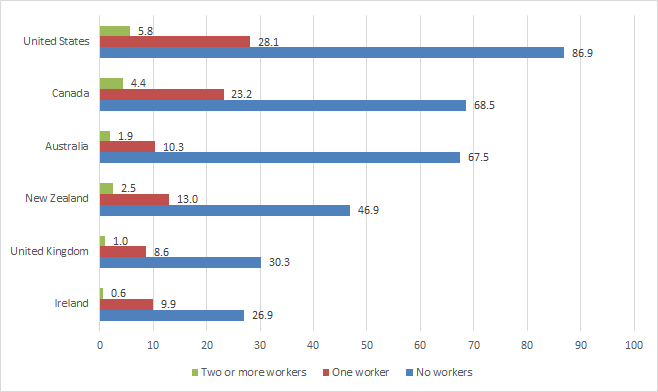
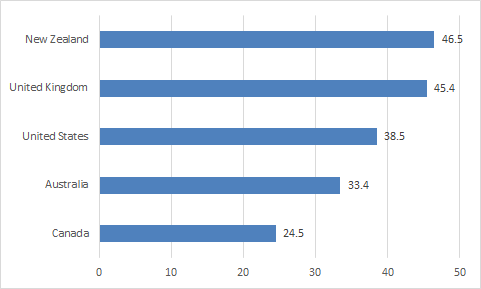
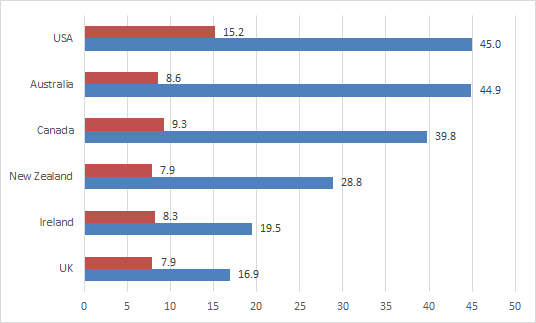
How motherhood in America has changed pewrsr.ch/1kRRCey http://t.co/9lTNrzDlSJ—
PewResearch FactTank (@FactTank) May 10, 2015
How motherhood in America has changed
14 May 2015 Leave a comment
in discrimination, economic history, gender, job search and matching, labour economics, labour supply, politics - USA Tags: female labour force participation
Does tax reform lead to lower taxes?
14 May 2015 Leave a comment
in politics - Australia, politics - New Zealand, politics - USA, public economics, taxation Tags: efficient taxes, tax reform
Why is the gender gap so large and the glass ceiling so thick in Sweden?
14 May 2015 1 Comment
in discrimination, economics of love and marriage, gender, human capital, labour economics, occupational choice, politics - USA Tags: asymmetric marriage premium, do gooders, economics of families, gender wage gap, maternity leave, Sweden, The fatal conceit, unintended consequences
The gender wage gap is no better than the OECD average, despite generous maternity and paternity leave. What gives?
America: one day a year celebrating mothers, fathers.
Sweden: 480 days paid leave per child. vox.com/2014/5/12/5708… http://t.co/weFDrTj7Jb—
Ezra Klein (@ezraklein) May 11, 2015
Source: Closing the gender gap: Act now – http://dx.doi.org/10.1787/9789264179370-en
How big is the wage gap in your country? bit.ly/18o8icV #IWD2015 http://t.co/XTdntCRfDQ—
(@OECD) March 08, 2015
One important question is whether government policies are effective in reducing the gap. One such policy is family leave legislation designed to subsidize parents to stay home with new-born or newly adopted children.
One of the RLE articles shows that for high earners in Sweden there is a large difference between the wages earned by men and women (the so-called “glass ceiling”), which is present even before the first child is born. It increases after having children, even more so if parental leave taking is spread out.
These findings suggest that the availability of very long parental leave in Sweden may be responsible for the glass ceiling because of lower levels of human capital investment among women and employers’ responses by placing relatively few women in fast-track career positions. Thus, while this policy makes holding a job easier and more family-friendly, it may not be as effective as some might think in eradicating the gender gap.
via New volume on gender convergence in the labour market | IZA Newsroom.
Labour lost the working-class vote a long time ago
13 May 2015 Leave a comment
in economic history, politics - Australia, politics - New Zealand, politics - USA, Public Choice Tags: British Labour Party, Labour Party, Leftover Left, Twitter left, UK politics, withering away the of proletariat
Black and Hispanic poverty dropped by a third after the 1996 US welfare reforms
13 May 2015 Leave a comment
in labour economics, labour supply, politics - USA, poverty and inequality, welfare reform Tags: 1996 welfare reforms, child poverty, family poverty, welfare state
Just passed 40th anniversary of top climate scientists wanting to melt Arctic ice cap
13 May 2015 Leave a comment
in environmental economics, global warming, politics - Australia, politics - New Zealand, politics - USA Tags: climate alarmism, global cooling, global warming
We have just passed the 40th anniversary of our top climate scientists wanting to melt the Arctic ice cap. http://t.co/2ccvJgBREy—
Steve Goddard (@SteveSGoddard) May 12, 2015
How the Socialists lost the British general election
12 May 2015 Leave a comment
Official: Lazy Socialists Lost the Election order-order.com/2015/05/12/off… http://t.co/zv9CfEjFbu—
Guido Fawkes (@GuidoFawkes) May 12, 2015
Annual hours worked per working age American, German and French, 1950–2013
12 May 2015 Leave a comment
in applied price theory, economic growth, economic history, great depression, labour economics, labour supply, macroeconomics, politics - USA, Public Choice, public economics, taxation Tags: Edward Prescott, Euroclerosis, France, Germany, labour supply, Robert Lucas, taxation and labour supply
Figure 1 shows that Americans work the same hours per year pretty much the entire post-war period. By contrast, there is been a long decline in hours worked in Germany and France. The large drop in 1992 was German unification.
Figure 1: annual hours worked per working age American, German and French, 1950 – 2013
Source: OECD StatExtract and The Conference Board Total Economy Database™,January 2014, http://www.conference-board.org/data/economydatabase/
The long decline seemed to tally with the disproportionately sharp rise in the average tax rate on labour income, including social security contributions in France and Germany. When tax rates on labour income, including social security contributions stabilised in about 1980, hours worked stabilised in all countries.
Figure 2: average tax rate on labour income,USA, Germany and France, 1950 – 2013
Source: Source: Cara McDaniel.
Some pander to the great vacation theory of European labour supply. This is the hypothesis of a large increase in the preference for leisure in the European Union member states. That is, mass voluntary unemployment and mass voluntary reductions and labour supply by choice by Europeans. They just decided to work less.
This is not the first outing for the great vacation theory of labour supply. In the late 1970s, Modigliani dismissed the new classical explanation of Lucas and Rapping (1969) of the U.S. great depression in which the 1930s unemployment was voluntary unemployment – the great depression was just a great vacation – with the following remarks:
Sargent (1976) has attempted to remedy this fatal flaw by hypothesizing that the persistent and large fluctuations in unemployment reflect merely corresponding swings in the natural rate itself.
In other words, what happened to the U.S. in the 1930’s was a severe attack of contagious laziness!
I can only say that, despite Sargent’s ingenuity, neither I nor, I expect most others at least of the non-Monetarist persuasion, are quite ready yet. to turn over the field of economic fluctuations to the social psychologist!
As Prescott has pointed out, the USA in the Great Depression and France since the 1970s both had 30% drops in hours worked per adult. That is why Prescott refers to France’s economy as depressed. The reason for the depressed state of the French (and German) economies is taxes, according to Prescott:
Virtually all of the large differences between U.S. labour supply and those of Germany and France are due to differences in tax systems.
Europeans face higher tax rates than Americans, and European tax rates have risen significantly over the past several decades.
Countries with high tax rates devote less time to market work, but more time to home activities, such as cooking and cleaning. The European services sector is much smaller than in the USA.
Time use studies find that lower hours of market work in Europe is entirely offset by higher hours of home production, implying that Europeans do not enjoy more leisure than Americans despite the widespread impression that they do. Europeans did not work less. They worked more on activities that were not taxed.
Why is the gender wage gap so big in the public sector that the unions invoiced the government for it?
12 May 2015 1 Comment
in discrimination, gender, human capital, labour economics, politics - New Zealand, unions Tags: employer discrimination, gender wage gap, gender wage gap discrimination, government discrimination, New Zealand Greens, sex discrimination
The unions representing public servants and the Green Party are very excited about the gender wage gap this week. So much so that the public service union presented the Treasury with an invoice for that wage gap in the public sector of 14.1%.
Women in the public service are paid 14.1% less than men. We've invoiced @honbillenglish for the missing $294,827,136 http://t.co/QW5z4tU7bv—
(@NZPSA) May 11, 2015
Oddly enough, despite their concerns with the gender wage gap in the public service, the public service unions are stridently against both privatisation and contracting out.
It is almost trite to note is that one of the earliest analytical results in the labour economics of discrimination was that profit maximising employers are much less likely to discriminate than firms that are not subject to a profit and loss constraint and the discipline of bankruptcy.
A prejudiced employer pays a wage above the competitive wage to attract the particular recruits he or she is prejudiced in favour of and does not hire enough workers because he must pay higher wages. This results in lower output and profits than without discrimination.
@greencatherine Unadjusted NZ gender pay gap is 6%, the best in world. http://t.co/2fYuVbJg9E—
Jim Rose (@JimRose69872629) March 19, 2015
Bureaucrats can indulge their prejudices without putting the survival of their business in jeopardy. Entrepreneurs who don’t hire on merit risk running out of going out of business because their costs are hire and their businesses less productive.
…market mechanisms impose inescapable penalties on profits whenever for-profit enterprises discriminate against individuals on any basis other than productivity. Though bigoted managers may hold sway for a time, in the long run the profit penalty makes profit-seeking enterprises tenacious champions of fair treatment.
Early examples of the greater propensity for discrimination in the public sector and non-profit organisations are by Armen Alchian and Ruben Kessel in Competition, Monopoly, and the Pursuit of Money in 1962 and Gary Becker’s pioneering The Economics of Discrimination in 1957.
The average CEO in America earns about as much as the average dentist
12 May 2015 Leave a comment
in human capital, labour economics, labour supply, occupational choice, politics - USA, poverty and inequality Tags: CEO pay, top 1%
Are 40% of workers on zero hours contracts, almost?
12 May 2015 1 Comment
in labour economics, labour supply, managerial economics, organisational economics, personnel economics, politics - Australia, politics - New Zealand, politics - USA, theory of the firm Tags: zero hours contracts
4 in 10 hourly workers know their schedules just a week or less in advance brook.gs/1wkfkXW http://t.co/6JNkYlftjL—
Richard V. Reeves (@RichardvReeves) December 11, 2014
The economic forces underpinning the housing affordability crisis
12 May 2015 2 Comments
in applied price theory, economics of regulation, politics - Australia, politics - New Zealand, politics - USA, urban economics Tags: housing affordability, land supply, land use regulation, RMA, zoning
The key point is that increases (declines) in demand can bring sharply rising (falling) house prices when supply is constrained. However, when land supply is not regulated, it adjusts to demand and house price volatility is reduced.
As long as commentators focus primarily on the demand side of the housing market, whilst ignoring supply-side constraints, they will never fully understand the drivers of housing bubbles and busts. The resulting incorrect diagnosis will inevitably lead to poor policy prescriptions and outcomes.
Can there be a shy NZ Labour vote when voter turnout is already high?
12 May 2015 Leave a comment
in politics - Australia, politics - New Zealand, politics - USA, Public Choice Tags: a shy Labour voter, shy Tories, voter demographics, voter turnout
The Left over Left truly believes there is a shy Labour vote out there waiting for the call of hard left policies. One flaw in that hypothesis is voter turnout in New Zealand is high by international standards.
Indeed, voter turnout doesn’t seem to vary that much with the political composition of governments. Despite compulsory voting, where those shy Labour voters would have to vote, most of the post-war period in Australia was governed by the Liberal party.
Do violent protests win votes for your cause?
12 May 2015 Leave a comment
in constitutional political economy, economic history, economics of crime, law and economics, politics - Australia, politics - New Zealand, politics - USA, Public Choice Tags: 1960s, activists, civil disobedience, Democratic Party, George Wallace, nonviolent protest, Richard Nixon, riots, Vietnam war, violent protests
Monkey Cage blogged on a very timely study on the impact of violent and nonviolent protests on voting behaviour. Non-violent protest in the 60s enticed sympathy and increased voter support for the Democratic Party in the 1964, 1968 to 1972 presidential elections:
Black-led nonviolent protests… exhibit a statistically significant positive relationship with county-level Democratic vote-share in the same period.
This is not surprising because nonviolent protest acknowledge fidelity to law and democratic equality. No one likes to be bullied and one of the purposes of the secret ballot is to prevent voters from being bullied because no one knows how you voted.
Indeed, there is a long history of anonymous pamphleteering, which has evolved into anonymous trolling as a way of people expressing their political views without facing backlash from both the majority and a vindictive minority.
In a democracy, it’s up to me to persuade you to change your mind – that what you took for granted for so long is not so. That’s how liberal democracies work: by trying to persuade each other and voting.
Violent protests had the exact opposite effect to peaceful protests on Democratic Party voting shares in the 1964, 1968 in 1972 presidential elections. There was a law and order backlash among voters against what were relatively widespread rioting and civil disorder:
…black-led protests in which some violence occurs are associated with a statistically significant decline in Democratic vote-share in the 1964, 1968 and 1972 presidential elections.
This is a roundabout way of saying that a Republican won the 1968 election on a law and order platform, not a Democrat on a peace platform. The country was convinced, including Liberal Democrats, that law and order had broken down and that the Democratic Party could not restore law and order.
In the 1968 presidential election, there is a third party candidate, George Wallace, who won won almost ten million popular votes and 46 electoral votes, including in the electoral college on an even harsher law and order platform than Nixon.
Wallace was a racist Southern Democrat the Democratic Party would prefer us to forget and a nasty political opportunist to boot. His political rhetoric included the only words four letter words the protesters didn’t know was work and soap.
As I recall warmed over Marxism, the idea of violent protests is to provoke a law and order backlash, initially with popular support of the working class. The resulting police repression will overreach and cause the proletariat to breakthrough their false consciousness to see that capitalists for whom they are and rise up to overthrow them.

Rise up ye workers, rise up for you have nothing to lose but your chains. These days that call to the barricades would have to be rise up ye workers, rise up for you have nothing to lose what your smart phone and air points.
The killer air pollution that the Greens never mention
12 May 2015 Leave a comment
4.3 million die every year. Indoor air pollution is the least reported problem of the world. bit.ly/1BfMiZg http://t.co/CDhafWSbj8—
Max Roser (@MaxCRoser) May 07, 2015


Recent Comments