The personnel economics of putting up election billboards

I’ve been out of late, helping put up election billboards. Maybe I should get a life, but I noticed that the quality of effort by volunteers was much better than that by the contractors hired by the Internet – Mana party. Everybody in that party appears to be paid including the leader for $140K year. She is not yet in Parliament.

The Internet-Mana party election billboards are very heavy, solid wooden signs and obviously pre-manufactured and must be driven around in a truck. They are certainly too heavy to be put on the back of a trailer behind a private car.

Our signs are constructed on site from a dozen pieces of wood of various sizes. The only pre-prepared part is the billboard itself with fits on the back of a trailer.

What first took my interest is the contractors hired by the Internet – Mana party signs seem to pay not all that much regard to the traffic flow. Some of their signs are parallel with the traffic so hardly anybody can see them. They are all one sided signs.

When we are putting up a election billboard, we squabble like a bunch of old women over the exact angle each sign should face the traffic to capture the most number of passing cars and buses. Everybody has an opinion including those doing it for the first time.

We then squabble about whether the sign should be one-sided or two sided depending upon how well it can be viewed from the other side by traffic coming the other way.

We also squabble about its positioning and height to maximise the number of views by the passing traffic relative to the positioning all the other signs.

There is also a lot of vandalism of these signs by rather naive people who don’t understand that the passing motorist looks at the vandalised signs first.

It takes a whole lot of hatred to vandalised a sign in this way. Photos of the above sign immediately went viral. For some reason, the National party has repaired that sign. I don’t know why.

Progress with the Christchurch earthquake rebuild

Embedded image permalink

Image

The repeal of the Australian carbon tax: proof of falling power prices

Embedded image permalink

Image

Anti-science Left alert: NZ Green Party condones the antifluoridation movement and can’t make up its mind on vaccinations

It’s one thing to condone parents not vaccinating their children on religious grounds or who are just plain nutters who should be allowed to flourish in all their dottiness in a free society.

The presumption that parents know the best interests of their children requires very strong evidence before it is overturned. Of course, you do not have too tolerate their unvaccinated children coming to school.

It is another thing for the Green Party of New Zealand to see both sides of the fluoridation argument:

C. Fluoridation of Community Water Supplies

The issue of fluoridating community water supplies requires a difficult balance between the public health effects and the rights of individuals to opt out altogether or avoid excessive intake. The Party membership has indicated that when considering fluoridation proposals, the Green Party caucus shall:

  • Have particular regard to the public health benefits of fluoridated community water supplies.
  • Have particular regard to the potential public health risks of excessive fluoride consumption via community water supplies.
  • Have regard for the ability of individuals to opt out.

The Green Party will:

  1. Support the use of ‘opt-out’ options by local authorities for residents living in areas with fluoridated public water supplies, where shown to be feasible.
  2. Commission an independent study on the impacts of fluoridation to public health.
  3. Support education initiatives to advise caregivers of the potential for babies to develop dental fluorosis when mixing formula with fluoridated water

Green Party of the New Zealand – health policy

This is the same party is more than happy to accuse sceptics of being a denier on global warming and a lackey of the multinational corporations on GMOs. You cannot, on the one hand, accuse others of denying a scientific consensus and then indulge cranks and quacks.

This is the same nanny state party that wants to tax and regulate drinking fatty foods and sugary drinks in its diabetes action plan:

      1. Ensure evidence-based healthy eating and activity programmes are available and promoted to all New Zealanders.
      2. Introduce mandatory ‘traffic light’ style labelling of fat and sugar content on all food and drinks, including a version for restaurant, café and takeaway foods.
      3. Instatement of a ‘living wage’ to ensure that healthy foods and drinks are within the reach of all New Zealanders.
      4. Severe restriction on the advertising of unhealthy foods and drinks, and on sponsorship by the companies that produce them.
      5. Tax sugary drinks to make them more expensive and drive down consumption. Revenue generated from this tax to be made available to fund other programmes.
      6. Investigation of taxes and other disincentive measures for other foods and drinks with high sugar or fat content.

I am diabetic, but I am not so arrogant as to expect all of society to be reorganised to my advantage because I occasionally lapse from my diet. When I was diagnosed as diabetic, I lost 15 kilos.

Note carefully that on the issue of healthy eating in their diabetes action plan, the Greens are very strong on education as well as taxation and regulation. The Greens are not keen on correcting misconceptions about the evidence base behind fluoridation. No nanny state here.

For a Party that is all for the nanny state and fatty  foods and sugary drinks and is happy to have a nanny state discussion on that, fluoridation is a bridge too far. Obviously the word fluoridation denier is not in the Green vocabulary.

Now let’s turn to the issue of vaccination and the Green Party of New Zealand. One thing to have rotten teeth; it’s another thing to have dead children because of your inability to face the facts of the vaccinations and preventable diseases.

Green Party policy is to sit on the fence on settled science because everyone  in their party is yet to accept the settled science:

Our official position is influenced by the fact that we do not have a firm policy on it as we don’t have consensus from our members.

No steps to ensure evidence-based vaccination programs are made available and promoted to new all New Zealanders, such as with fatty foods and sugary drinks. No traffic like system to warn that unvaccinated children coming to school will stop no investigation of taxes and other disincentives measures regarding unvaccinated children. The safety Nazis in the Greens have become high school libertarians at their worst on fluoridation and vaccinations.

Tolerating eccentrics doesn’t mean you have to step back from telling these eccentrics and nutters that they are eccentrics and nutters, and attempting to persuade them that they are wrong.

A party that says it speaks truth to power is not too keen on speaking the truth to nutters and eccentrics. Even worse,  the Green Party indulges their dangerous ignorance. The case is different for  their action plan on diabetes:

Substantially increase funding for health promotion approaches in those communities most at risk to prevent or minimise obesity-related diseases, including diabetes.

One Green MP in a public speech in 2004 said she was absolutely convinced that her child became ill because of his triple MMR vaccine at 15 months, and refused all further vaccinations:

My own interest in vaccination began when I gave birth to my son 14 years ago. Whether or not to vaccinate our children was a hot topic at our regular mother’s group meetings, but eventually I had my son vaccinated.

Shortly after receiving his triple MMR vaccine at 15 months, he developed a horrendous incident of croup — to the point where he was taken to the emergency department. He subsequently developed a weakness in the chest which led to childhood asthma, which fortunately, through my various remedies, he has managed to shake off.

At the time I said to my doctor, I am certain the croup was triggered by the vaccination, but the doctor dismissed my suggestion as ludicrous, and certainly never forwarded it as an adverse reaction to the Centre for Adverse Reactions, which records significant adverse reactions to vaccination. I was convinced it was, however, and my son has never received another vaccination since.

Her speech also spoke of the link between vaccinations and autism. Even if that was true about the adverse reactions for that particular child of the Green party MP, the relatively rare adverse reactions to vaccinations are part of the risks and rewards trade-off.

That small risk is no reason to bring back measles, mumps and rubella for every child in New Zealand. The Green party is not only anti-science, it is pro-disease.

It is bizarre that vaccination programs that are eliminated terrible diseases are not supported by the Green Party of New Zealand – a party very ready to accuse its opponents have been anti-science and deniers.

There is a difference between the classical liberal argument that people have the right to be wrong and make mistaken choices for themselves and the merits of those choices.

The classical liberal will happily defend your right to be wrong and foolish while at the same time calling you out as a crank and a quack and telling that to your face until he is blue in the face telling you that you were a crank.

There are also third external effects or externality issues: most vaccinations are against contagious diseases where the previous response was quarantining the sick until they stopped being contagious.
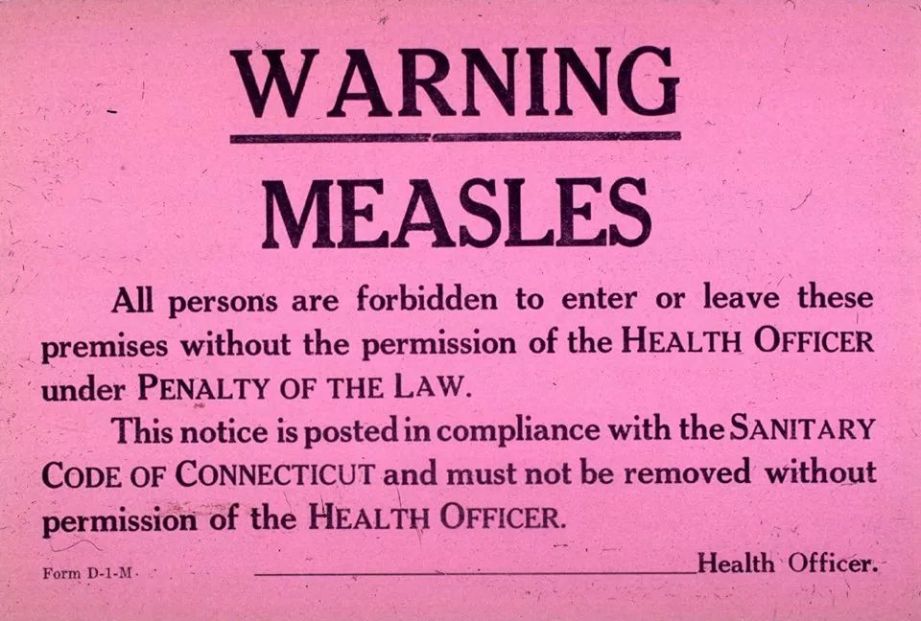
image

The Age of Enlightenment is also the Age of Reason. It is time for the Green Party of New Zealand to join both.

West Wing on the fight for privacy

https://www.youtube.com/watch?v=pj4PwyfDNuI

HT: Whale Oil

The criminally large difference between leaks to the media and hacking

There is a difference between hacking and leaks.

For example, Julian Assange is unlikely to face charges under American espionage laws because the FBI would have too pop down and arrest everybody at the New York Times and Washington Post  and the U.S. offices of the Guardian and more than a few famous book authors.

U.S. media organizations could be prosecuted for printing leaked classified information under US espionage legislation, but that prospect is unlikely because of official aversion to running afoul of the First Amendment.

If the government were to prosecute the  recipient of classified information – as opposed to the individual who leaked it from within the government such as Bradley Manning – mainstream media would fear that they could face prosecution for reporting information they routinely receive from government sources. There is no way to prosecute Assange for publishing information without the same theory being applied to journalists.

Assigned is in criminal law trouble only if he assisted Bradley Manning to leak the information as distinct from simply receive it from him. An example might be advising Manning on how to  get around computer security at his Defence Department workplace.

Hacking involves breaking into someone else’s place in the full knowledge that this is prohibited under computer crimes laws. Heavy penalties apply in the same way as physically braking in and stealing the documents. There is no moral or legal distinction.

The outrage against the phone hacking scandal in the UK was based upon breaches of computer crime law and corruption of public officials through bribes. The moral outrage in that scandal was topped up by the glee which some papers had at the fall from grace of their commercial and ideological rivals.

Christchurch Earthquake | Libertarianz TV

Devastating effect of government bureaucracy following the earthquakes of 2010 and 2011. As told by two business owners, an economist and an engineer. Concludes with the Libertarianz policy to make Christchurch a free enterprise zone.

Stephen Williamson on Marginal Taxation

Karl Smith's avatarModeled Behavior

He says a lot. I’ll try to address piece by piece.

Next, some people have shown interest in this paper by Diamond and Saez. A key result that seemed to get these people excited is the calculation of a top optimal marginal tax rate (including all taxes) of 73%, relative to the current rate of 42.5%. There are two key assumptions that Diamond and Saez make to come up with the 73% optimal rate. First, we should not care about the welfare (at the margin) of the rich people. This argument is based solely on the notion that marginal utility of income is low for the top income-earners. Second, Diamond and Saez use a “behavioral elasticity” of tax revenue with respect to the tax rate of 0.25. To see how this matters, if you use their formula and an elasticity of one, you get an optimal top tax rate…

View original post 1,215 more words

Teen employment and the minimum wage: sixty years of U.S. experience

Teenemployment

In every episode, except 1996 (which is the smallest hike relative to average wages), there was a distinct decline in the trend of teen employment in the few months before the initial hike until a few months after the follow-up hike. This led Kevin Erdmann to ask:

Is there any other issue where the data conforms so strongly to basic economic intuition, and yet is widely written off as a coincidence?

HT: idiosyncraticwhisk.blogspot

Justice Thomas, a colour-blind Constitution and Brown v. Board of Education (1954)

Image

How flexible is the New Zealand labour market

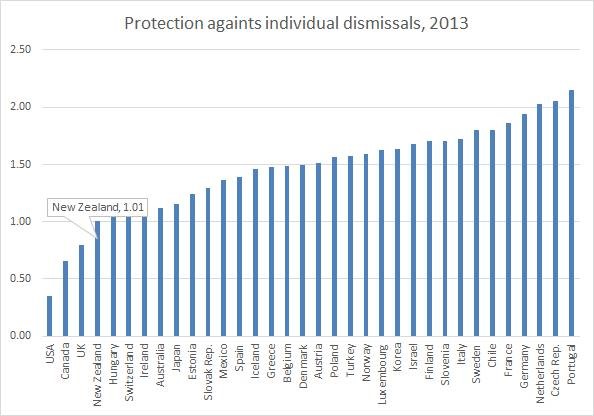
The first chart below shows that NZ is the 4th most deregulated labour market for individual dismissals.

clip_image002

Source: OECD employment protection index

The next figure below shows that NZ is top of the world for deregulation of lay-offs and redundancies.

clip_image002[7]

Source: OECD employment protection index

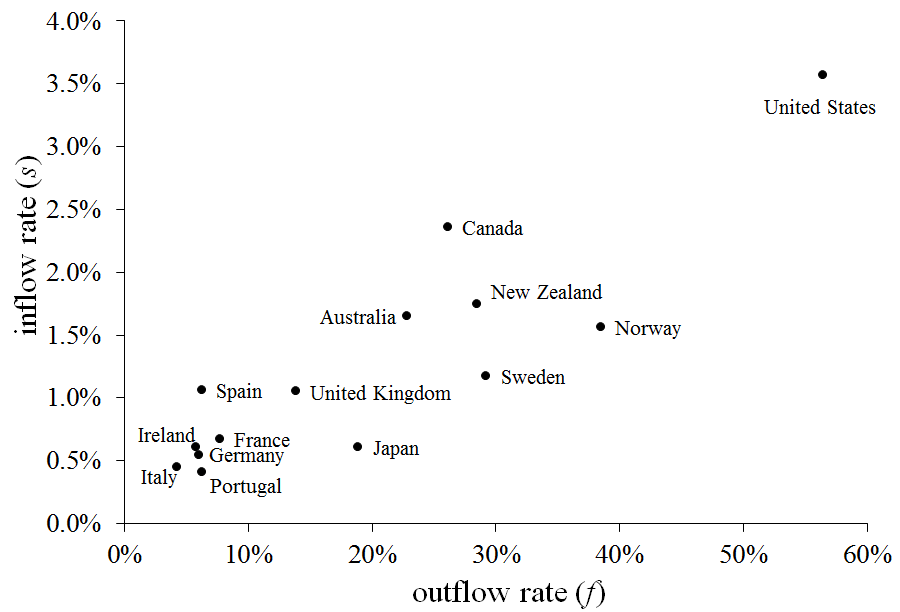
The chart below shows that New Zealand is far more flexible than in Western Europe and is pretty near the USA in terms of people moving in and out of the unemployment pool every month with great ease.

image

Source: Elsby, Hobijn  and Şahin (2013).

There are very high outflow rates from unemployment among the Anglo-Saxon and Nordic economies. The economies of Continental Europe stand in stark contrast. Unemployment outflow rates in these economies lie below 10% at a monthly frequency.

A major labour market reform in recent years in New Zealand was introduction of the option of a 90 day trial for new employees, initially in small businesses and then in all businesses.

The UK recently extended its trial period from one-year to two-years. Trial periods are common in OECD member countries.

There is plenty of evidence to back-up the notion that increased job security leads to less employee effort and more absenteeism. Some examples are:

· Sick leave spiking straight after probation periods ended;

· Teacher absenteeism increasing after getting tenure after 5-years; and

· Academic productivity declining after winning tenure.

The MBIE research into the actual operation of 90-day trials was highly favourable in terms of increased employment, the hiring of riskier applicants and lower costs of ending bad job matches (about 15-20% of trials did not work out). These outcomes are the usual importance of a test drive argument for employment trial periods.

Interestingly, the MBIE research also found that some employers hired new employees on 90-day trials for positions about which these employers were uncertain might be profitable. But for the option of the trial period, these jobs never would have existed.

This suggests that in some firms, 90-day trials are a decisively cheaper alternative to hiring an employee and perhaps making them redundant later if the new position does not pay for itself. No one’s fault: the market just did not sustain the expansion in staff as expected.

The MBIE research shows that winners from 90-day trials are new labour force entrants, the unemployed and beneficiaries, migrants and labour force re-entrants such as mothers.

I kept note of an interesting press report adding to this where Hospitality New Zealand Wellington president Jeremy Smith said he had hired dozens of staff he would not otherwise have considered. Because of the transient nature of the hospitality industry, it was often difficult to check references so a trial period “levelled the playing field”.

The politics of ethnicity-based research in New Zealand

When Simon Chapple in 2000 wrote “Māori Socio-Economic Disparity”, which showed that disadvantage in New Zealand is more closely tied to age, marital status, education, skills, and geographic location than it is to ethnicity, broadly conceived, such as Māori ethnicity:

  • He was summoned before the Māori Affairs Committee of parliament to defend his paper! His chief executive at the Ministry of Social Policy went along with him to defend what he wrote while employed as a senior analyst at the Department of Labour. Staff at his new ministry launched a petition to have Simon fired.
  • The head of the Māori Affairs Ministry accused Simon of breaching the public service code of conduct.

Chapple also found that there are important differences in socio economic development by Māori self-identity. Those who identified only as Māori did worse than those that are identified as Māori and another ethnicity. Identifying only as Māori also correlated with living in rural New Zealand.

In terms of employment discrimination, employers would not know whether a Māori job applicant identified as only as Māori or also with another ethnicity, so discrimination is not a good explanation of Māori disadvantage because of this counterfactual. A major driver of Māori disadvantage, which is identifying on the Census form solely as Maori, is simply unknown to discriminating employers as a basis for discrimination in hiring and promotion.

There were editorials in the Dominion Post, which I cannot find online,  and in the New Zealand Herald. The latter said:

The Government is being prodded to recognise that Maori deprivation has more to do with socio-economic factors than ethnicity.

This was the conclusion of a report by the Labour Department’s senior research analyst, Simon Chapple. Helen Clark might well have had that finding partly in mind when she referred to a lot of water having gone under the bridge since the Government first formulated legislation.

Mr Chapple said, in essence, that place of residence, age, education and skills had more to do with poverty than race. In areas such as South Auckland, Northland and the central North Island, there were poor Maori, but there were also poor Pākehā and poor Pasifika.

The Minister attacked him and the paper as well for contradicting the Minister’s claim during the election campaign that everything got worse for Maori in the 1990s.

image

Real equivalised median household income rose 47% from 1994 to 2010; for Māori, this rise was 68%; for Pasifika, 77% (Perry July 2014)

See Karen Baehler’s Ethnicity-based research and politics: snapshots from the United States and New Zealand for more information and a comparison with the similar response to Daniel Patrick Moynihan’s The Negro Family: A Case for National Action in 1965.

About a quarter of Negro families are headed by women. The divorce rate is about 2 1/2 times what it is [compared with whites],” Moynihan said. “The number of fatherless children keeps growing. And all these things keep getting worse, not better, over recent years.”

Moynihan, now retired from the United States Senate, was a senior official in LBJ’s Labor Department in 1965. He wrote his report on a typewriter over a few weeks and had the publications office in the basement of the Labor Department print 100 of them, marked “For Official Use Only.”

  • He warned about the breakdown of the African-American family where deprivation and disorganisation had formed their own vicious circle.
  • Many civil rights leaders had labelled Moynihan’s report a subtle form of racism because of its unflattering portrayal of the black family (Wilson 1987).
  • These accusations of racism helped make the breakdown of the family a taboo subject in social policy in the USA

see The Moynihan Report Revisited: Lessons and Reflections after Four Decades for a review by the best and the brightest in American economics and sociology on Daniel Patrick Moynihan’s prophetic warnings. Holzer says, for  example:

Moynihan was extremely insightful and even prescient in arguing that the employment situation of young black men was a “crisis . . . that would only grow worse.”

He understood that these trends involve both limits on labour market opportunities that these young men face as well as skill deficits of and behavioural responses by the young men themselves.

More children are growing-up without a working father living in the home and glean the awareness that work is a central expectation of adult life (Wilson 1987, 1996).

Single-parent households increased from 13 per cent of all Māori households in 1981 to 24.4 per cent in the 2006 Census. In the 2006 Census, 70 per cent of Māori single parent households were on a low income compared to 15 per cent of other Māori one family households (Kiro, Randow and Sporle 2010).

Most of the skill gaps that are present at the age of 18 – skill gaps which substantially explain gaps in adult earnings and employment in all groups – are also present at the age of five (Cunha and Heckman 2007). There is much evidence to show that disadvantaged children have lower levels of soft skills (non-cognitive skills): motivation, persistence, self-discipline, the ability to work with others, the ability to defer gratification and plan ahead, etc. (Heckman 2008). Most of the skills that are acquired at school build on these soft skills that are moulded and reinforced within whānau.

When I started working on labour economics in 2007 I found that the labour economics of Māori was very narrowly written and stayed well clear of the minefield that Simon braved about how ethnicity does not matter that much to Māori social disadvantage.

Why New Zealanders support MMP

Most people seem to give the same reason to me in conversations as to why they support the MMP voting system – Mixed Member Proportional representation.

The reason is profoundly democratic: their party vote always counts no matter where they live in the country or how safe or how marginal the local electorate might be.

Under first past the post, it didn’t matter who you voted for if you lived in a safe electorate because the local MP of whatever political party would always be elected.

What is underplayed in these conversations is how close all elections are in New Zealand, and how likely it is that your vote might be decisive rather than just one of millions.

Under MMP, the last seat in Parliament is a contest between several parties. If anyone just gets a couple of dozen more votes, they get another seat.

In the current parliament of 121, the National Party Government has 59 seats, with the ACT party one seat and the United Future Party one seat.

One more seat for ACT or one less seat for the National Party would have made a big difference to the election outcome. ACT was only 45 votes short of getting that second seat in the 2011 General Election.

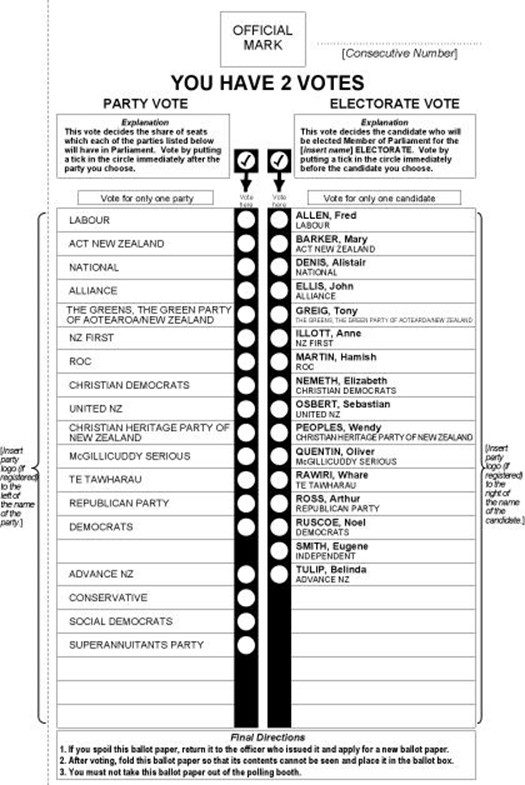
Note: Under MMP, the New Zealand House of Representatives is a mix of MPs from single-member electorates
and those elected from a party list, and a Parliament in which a party’s share of the seats roughly mirrors its share of the overall nationwide party vote. There is a minimum party vote threshold to get into Parliament. The party votes of those parties with less than 5% of the party vote do not count unless they win a constituency seat.

Household Incomes in NZ: trends in indicators of inequality and hardship 1982-2013

Real household income trends, 1982 to 2013 ($2013) before housing costs (BHC) and after housing costs (AHC)

real household income 1982-2013

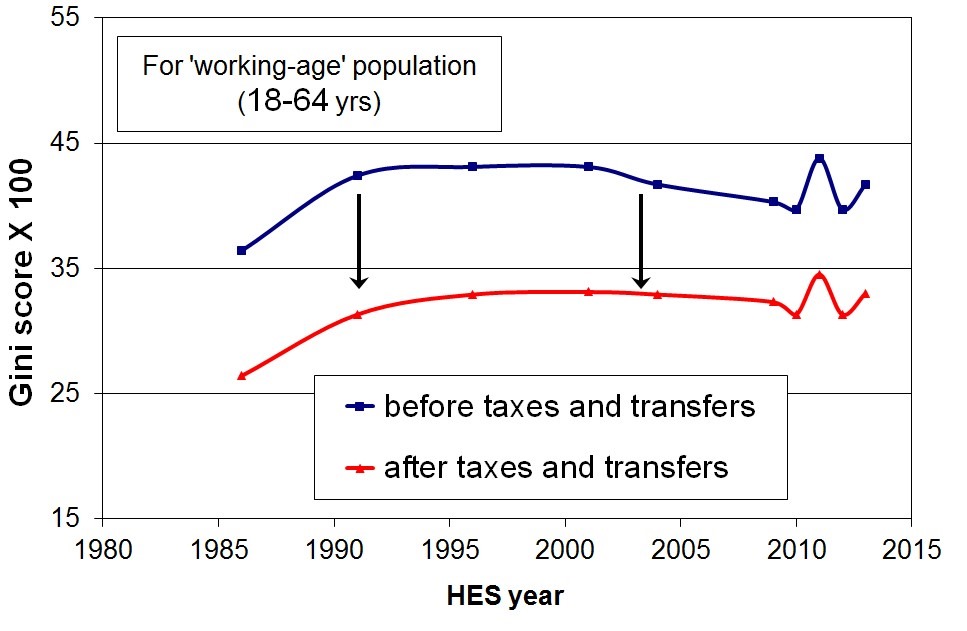
Gini coefficient 1980 – 2015

gini coefficient 1980 2015

The tax and transfer system significantly reduces the inequality

The tax and transfer system significantly reduces the inequality

image

the increases were 55% for Pakeha, 57% for Pasifika, and 64% for Māori since 1994.

The golden thread running through British justice

Previous Older Entries Next Newer Entries

The War on Prices

Celebrating humanity's flourishing through the spread of capitalism and the rule of law

The Bleeding Heart Libertarian

Celebrating humanity's flourishing through the spread of capitalism and the rule of law

More Stories from the Stories I Publish!

Celebrating humanity's flourishing through the spread of capitalism and the rule of law

In My Tribe

Celebrating humanity's flourishing through the spread of capitalism and the rule of law

Coordination Problem

Celebrating humanity's flourishing through the spread of capitalism and the rule of law

Libertarian Land

Celebrating humanity's flourishing through the spread of capitalism and the rule of law

Arin’s Substack

Celebrating humanity's flourishing through the spread of capitalism and the rule of law

David Andolfatto

Celebrating humanity's flourishing through the spread of capitalism and the rule of law

Monetary Non-Neutrality

Celebrating humanity's flourishing through the spread of capitalism and the rule of law

Reason Magazine

Celebrating humanity's flourishing through the spread of capitalism and the rule of law

Coyote Blog

Celebrating humanity's flourishing through the spread of capitalism and the rule of law

Thoughts from the North

Celebrating humanity's flourishing through the spread of capitalism and the rule of law

Fardels Bear

A History of the Alt-Right

Vincent Geloso

Econ Prof at George Mason University, Economic Historian, Québécois

Bassett, Brash & Hide

Celebrating humanity's flourishing through the spread of capitalism and the rule of law

Truth on the Market

Scholarly commentary on law, economics, and more

The Undercover Historian

Beatrice Cherrier's blog

Matua Kahurangi

Celebrating humanity's flourishing through the spread of capitalism and the rule of law

Temple of Sociology

Celebrating humanity's flourishing through the spread of capitalism and the rule of law

Velvet Glove, Iron Fist

Celebrating humanity's flourishing through the spread of capitalism and the rule of law

Why Evolution Is True

Why Evolution is True is a blog written by Jerry Coyne, centered on evolution and biology but also dealing with diverse topics like politics, culture, and cats.

NoTricksZone

Celebrating humanity's flourishing through the spread of capitalism and the rule of law

Homepaddock

A rural perspective with a blue tint by Ele Ludemann

Kiwiblog

DPF's Kiwiblog - Fomenting Happy Mischief since 2003

The Dangerous Economist

Celebrating humanity's flourishing through the spread of capitalism and the rule of law

Watts Up With That?

The world's most viewed site on global warming and climate change

The Logical Place

Tim Harding's writings on rationality, informal logic and skepticism

Doc's Books

A window into Doc Freiberger's library

The Risk-Monger

Let's examine hard decisions!

Uneasy Money

Commentary on monetary policy in the spirit of R. G. Hawtrey

Barrie Saunders

Thoughts on public policy and the media

Liberty Scott

Celebrating humanity's flourishing through the spread of capitalism and the rule of law

Point of Order

Politics and the economy

James Bowden's Blog

A blog (primarily) on Canadian and Commonwealth political history and institutions

Science Matters

Reading between the lines, and underneath the hype.

Peter Winsley

Economics, and such stuff as dreams are made on

A Venerable Puzzle

"The British constitution has always been puzzling, and always will be." --Queen Elizabeth II

The Antiplanner

Celebrating humanity's flourishing through the spread of capitalism and the rule of law

Bet On It

Celebrating humanity's flourishing through the spread of capitalism and the rule of law

History of Sorts

WORLD WAR II, MUSIC, HISTORY, HOLOCAUST

Roger Pielke Jr.

Undisciplined scholar, recovering academic

Offsetting Behaviour

Celebrating humanity's flourishing through the spread of capitalism and the rule of law

JONATHAN TURLEY

Res ipsa loquitur - The thing itself speaks

Conversable Economist

In Hume’s spirit, I will attempt to serve as an ambassador from my world of economics, and help in “finding topics of conversation fit for the entertainment of rational creatures.”

The Victorian Commons

Researching the House of Commons, 1832-1868

Books & Boots

Reflections on books and art