#OTD – August 3rd 1914. Europe is at war. #nytimes #ww1 pic.twitter.com/mWqOIibLOD
— New York Times OTD (@OnThisDayNYT) August 3, 2015
The lamps were going out all over Europe this day 1914
03 Aug 2015 Leave a comment
in economic history, liberalism, politics - Australia, politics - New Zealand, politics - USA, war and peace Tags: World War I
TPP – Trojan Horse in a global race to the bottom
03 Aug 2015 Leave a comment
in international economics, International law, law and economics, politics - Australia, politics - New Zealand, politics - USA, property rights, Public Choice Tags: free trade agreements, ISDS, regional trade agreements, TPPA
I can’t think of a single fact that this crank got right in this clip on the Trans-Pacific partnership agreement (TPPA).
Robert Reich, a Democratic party hack, referred to the TPPA as the biggest trade deal ever. He ignored a large number of multinational trade deals under the World Trade Organisation and the GATT such as the Uruguay round and the current Doha round.
http://www.cuts-international.org/brf-97-1.gif
Reich claims the deal is negotiated in secret and later talks about its submission to the Congress for fast track.
Robert Reich claims that investor state dispute settlement allows challenges to any regulation and compensation for unfair reductions in profits. It is a far narrow criteria than that involving discrimination against foreigners.
http://images.slideplayer.com/5/1585527/slides/slide_6.jpg
Currently, about 3000 international treaties give the ability to sue governments. Some 2700 of these are Bilateral Investment Treaties. The rest are trade treaties, including NAFTA. These treaties have spread rapidly around the world since the 1990s.
The TPP draft chapter says that the point of investment protection has long been “to encourage and promote the flow of investment…as a means to promote economic growth.”
At the same time, the TPP draft chapter specifically highlights “the inherent right to regulate…to protect legitimate public welfare objectives, such as public health, safety, the environment, the conservation of living or non-living exhaustible natural resources, and public morals.”


Robert Reich talks about the Trans Pacific Partnership and its implications especially if it is signed. It would be the largest trade deal in history representing 792 million people and accounting for 40% of the world economy. Well worth a look.
The Great Escape – vaccine preventable deaths
02 Aug 2015 Leave a comment
in applied welfare economics, economic history, health economics, politics - USA Tags: anti-vaccination movement, The Great Escape, vaccinations, vaccines
Death rates from the two leading causes of death in the USA since 1950
02 Aug 2015 Leave a comment
in economic history, health economics, politics - USA Tags: life expectancies, The Great Escape
Figure 1: age-adjusted death rates from heart and cerebrovascular diseases, USA, 1950 – 2013

Source: Centres for Disease Control and Prevention.
A lot more Americans have a passport
02 Aug 2015 Leave a comment
in international economics, law and economics, politics - USA Tags: passports
From 3% to 38%, America Has Seen A Staggering Growth In Passport Holders: dadaviz.com/i/3323 #dataviz http://t.co/4IJweXJvK0—
Randy Olson (@randal_olson) February 20, 2015
Tax rates on labour income across the OECD area
02 Aug 2015 Leave a comment
in labour economics, labour supply, politics - Australia, politics - New Zealand, politics - USA, public economics Tags: Australia, British economy, Canada, France, Germany, taxation and labour supply
How high is the US #tax burden on labor? Here's an OECD comparison tax.foundation/1KojUv9 by @samcjordan_ @kpomerleau http://t.co/fSAT8ut52z—
Tax Foundation (@taxfoundation) July 24, 2015
Motor vehicle related death rates for males and females aged 15 to 24 by race since 1950 in the USA
01 Aug 2015 Leave a comment
in economic history, politics - USA, transport economics Tags: road accident rates, road safety
The large drop in white young white male deaths so dominates figure 1 that it conceals a halving in white female deaths. These measures in figure 1 are not related to propensity to drive a car. It must be hypothesised that women were driving more than they used to in the 1950s and 1960s. Nearly all of the decline in white young female road deaths has been since 1990.
Figure 1: motor vehicle related deaths of males and females aged 15 to 24 by race, USA, 1950 – 2013

Source: Centres for Disease Control and Prevention.
Deaths of black males young black males in the road actually increased in the 1980s before falling again. There has been no change at all really in the number of deaths of young black females since 1950.
Cumulative Growth in Average Inflation-Adjusted After-Tax Income by Before-Tax Income Group, 1979 to 2011 with 1% annual adjustment for inflation measurement bias
01 Aug 2015 Leave a comment
in applied price theory, applied welfare economics, economic history, politics - USA Tags: CPI bias, living standards, measurement errors, The Great Enrichment
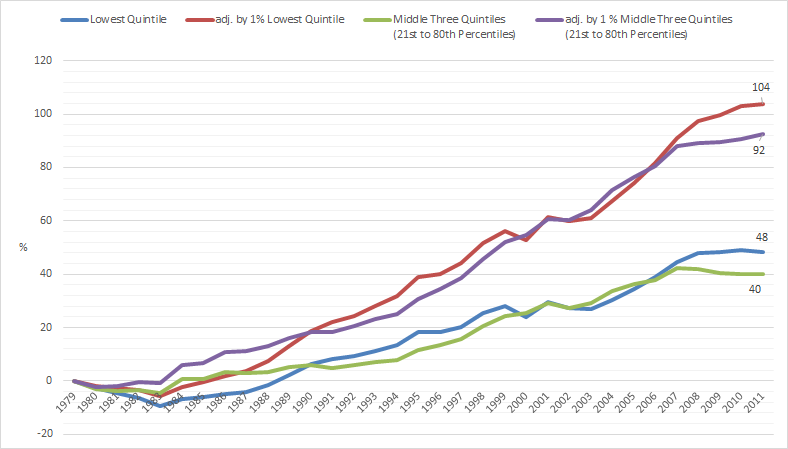
The Congressional Budget Office did its best to adjust after-tax incomes for inflation between 1979 in 2011. In figure 1, I added an extra 1% inflation adjustment in every year from 1979. 1% per annum is a common estimate of the inflation bias introduced by the inability of most measures of inflation to account for new goods and upgrades in the quality of existing goods to name but a few bias is in the measurement of consumer price inflation.
Figure 1: Cumulative Growth in Average Inflation-Adjusted After-Tax Income, by Before-Tax Income Group, USA, 1979 to 2011, 1% upward annual adjustment for inflation bias for new goods and quality upgrades
Source: derived from Congressional Budget Office, The Distribution of Household Income and Federal Taxes, 2011.
As can be seen from figure 1, with a 1% up left for measurement bias, instead of increases of 48% and 40% in the incomes of the lowest quartile in the middle three quartiles respectively, their after-tax, after inflation incomes about doubled since 1979.
"The rich got richer, true. But…" —@DeirdreMcClosk buff.ly/1Imdv4o http://t.co/M3ERx3JTIn—
HumanProgress.org (@humanprogress) June 28, 2015
Well done, capitalism. Everyone was on a working class income in the 1970s is now on a middle-class income. Such are the joys of compounding 1% per year over more than 30 years.
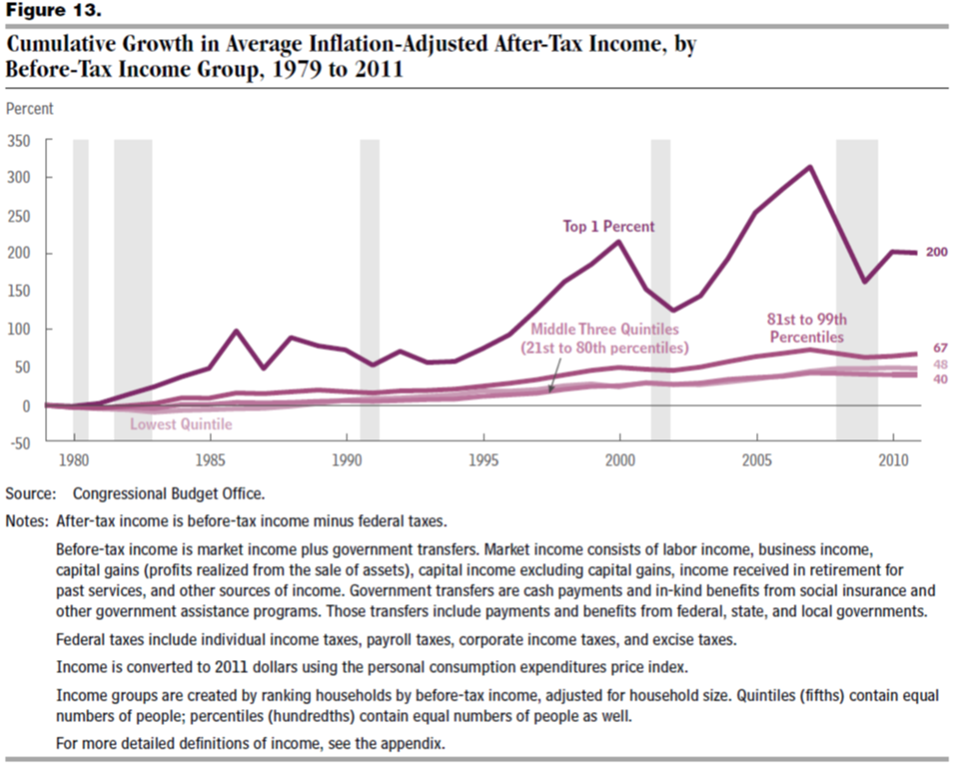
Source: Congressional Budget Office, The Distribution of Household Income and Federal Taxes, 2011.
The original Congressional Budget Office diagram above with the higher income quartiles is presented for comparison. I didn’t present the top quartiles in figure 1 because it made it unreadable because of the dominant influence of the top 1%’s increase in income.
The lesson for the day is small inaccuracies in the measurement of prosperity can over several decades through compounding lead to massive misunderstandings of the increases in prosperity.
The American stock market is highly regulated
01 Aug 2015 Leave a comment
in economic history, economics of regulation, financial economics, industrial organisation, politics - USA Tags: financial regulation, rational ignorance, rational irrationality
Check out this awesome chart of U.S. Market Complexity
bloomberg.com/news/articles/… http://t.co/gRQNnhwjZo—
Barry Ritholtz (@ritholtz) July 09, 2015
Would the reckless maritime protests of @Greenpeace be tolerated on land?
01 Aug 2015 Leave a comment
in economics of crime, environmental economics, environmentalism, law and economics, politics - Australia, politics - New Zealand, politics - USA, property rights, Rawls and Nozick, transport economics Tags: Greenpeace, John Rawls, peaceful protest
Were the Greenpeace runabouts observing maritime safety rules such as avoiding collisions and giving way? Any protester that behaved like that in a car would be immediately arrested and charged.
Why it is tolerated in the high seas is beyond me when it would never be tolerated on the road. No one would pretend reckless driving was peaceful protest. Is it okay to behave recklessly in a boat? No one would accept that in a car on land.
Central to the notion of peaceful protest is fidelity to democracy and the rule of law. The idea is not to impose your will upon others, but to persuade the majority to reconsider their position by showing the passionate extent to which you disagree with them and honestly believe they are mistaken.
The civil disobedient is attempting to appeal to the “sense of justice” of the majority and a willingness to accept arrest is proof of the integrity of the act says Rawls:
…any interference with the civil liberties of others tends to obscure the civilly disobedient quality of one’s act.
Rawls argues that the use or threat of violence is incompatible with a reasoned appeal to fellow citizens to move them to change a law. The actions are not a means of coercing or frightening others into conforming to one’s wishes. That is a breach of the principles of a just society.
Death rates for homicide, black and white males aged 15 to 19, USA, 1950-2013
01 Aug 2015 Leave a comment
in economic history, economics of crime, law and economics, politics - USA Tags: crime and punishment, life expectancies
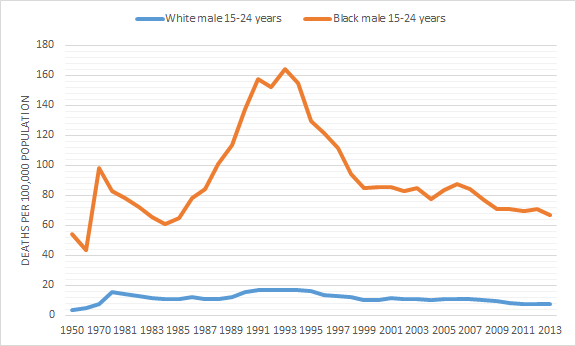
Figure 1: Death rates for homicide, black and white males aged 15 to 19: United States, selected years 1950-2013
Source: Centres for Disease Control and Prevention.
Life expectancies at age 65 by sex and race, USA, 1950 – 2010
31 Jul 2015 1 Comment
in applied welfare economics, economic history, health economics, politics - USA Tags: life expectancies, The Great Escape
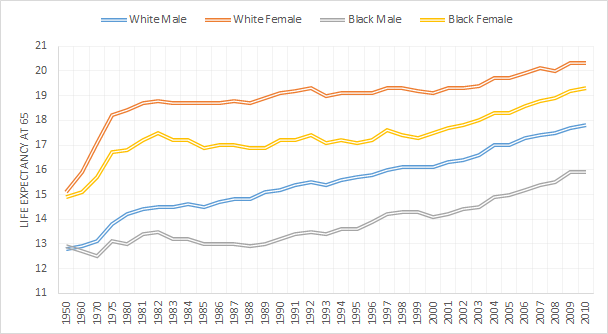
There was quite a jump in life expectancy in the decades of the 1950s and 1960s, followed by slow progress for white females and black females. In the case of men of both races, the situation appears to be steady progress in post retirement life expectancy since 1950. Black male life expectancy actually fell in the 1960s for those aged 65.
Figure 1: life expectancies at age 65 by sex and race, USA, 1950 – 2010
Source: Centres for Disease Control and Prevention.
Who is unpopular in the Republican primaries?
31 Jul 2015 Leave a comment
in politics - USA Tags: 2016 presidential election
Trump ahead in polls. So much more more ahead in negatives. Who's most popular in GOP? So far, Walker. http://t.co/MCgZQoougF—
ian bremmer (@ianbremmer) July 30, 2015


Recent Comments