From Natalia Emanuel, Valentin Bolotnyy, and Pim Welle: The involuntary hospitalization of people experiencing a mental health crisis is a widespread practice, as common in the US as incarceration in state and federal prisons and 2.4 times as common as death from cancer. The intent of involuntary hospitalization is to prevent individuals from harming themselves…
Is involuntary hospitalization working?
Is involuntary hospitalization working?
17 Dec 2025 Leave a comment
in applied price theory, econometerics, economic history, economics of crime, health economics, law and economics Tags: economics of mental health
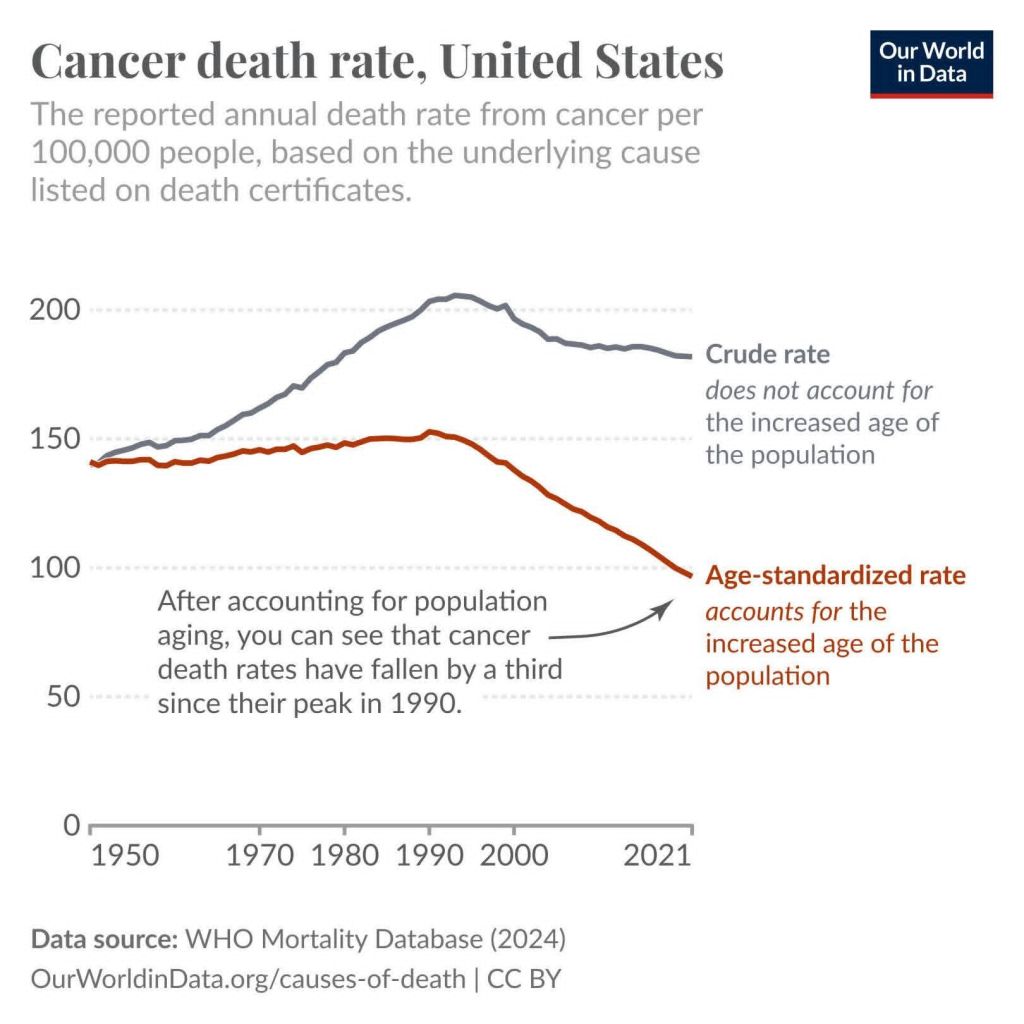
The Great Escape from cancer
16 Dec 2025 Leave a comment
in economic history, health economics Tags: life expectancies, The Great Escape
Miliband Isolated as EU Prepares to Reverse Petrol Car Ban
16 Dec 2025 1 Comment
in economics of climate change, economics of regulation, energy economics, environmental economics, environmentalism, global warming, transport economics, urban economics Tags: British politics, electric cars
Ed Miliband has been left isolated over his Net Zero policies after the European Union dropped “indefinitely” a flagship pledge to ban sales of new petrol cars.
Miliband Isolated as EU Prepares to Reverse Petrol Car Ban
Europe’s Grim Fiscal Future
16 Dec 2025 Leave a comment
in budget deficits, economic growth, fiscal policy, labour economics, labour supply, macroeconomics, public economics Tags: ageing society, European Union, population bust

If you want to know why I’m pessimistic about Europe (particularly compared to the U.S.), this chart is a good example. It shows that many European nations have enormous long-run liabilities for their Social Security systems. It’s an understatement to observe that Spain, Austria, and Italy have very grim fiscal futures. Keep in mind that […]
Europe’s Grim Fiscal Future
Demographic Decline, Part I: Baby Subsidies Are an Ineffective Response
15 Dec 2025 Leave a comment
in economic growth, fiscal policy, labour economics, labour supply, macroeconomics, population economics, urban economics Tags: ageing society, population bust

I have a five-part series (here, here, here, here, and here) explaining that demographic decline will lead to fiscal crisis. The main takeaway is that entitlement programs are a ticking time bomb, and I castigate politicians who want to kick the can down the road (or make a bad situation even worse). This is a global problem, not merely an American problem, as […]
Demographic Decline, Part I: Baby Subsidies Are an Ineffective Response
“AI is everywhere but in the productivity statistics…”
15 Dec 2025 Leave a comment
in applied price theory, econometerics, economic history, economics of information, entrepreneurship, history of economic thought, industrial organisation Tags: creative destruction
These people are saying it is there too. Though I am not quite sure what they (or anyone, for that matter) mean by AI: First, we argue that AI can already be seen in productivity statistics for the United States. The production and use effects of software and software R&D (alone) contributed (a) 50 percent…
“AI is everywhere but in the productivity statistics…”
Astrophysicist Dr. Willie Soon Challenges The Climate Consensus … It’s The Sun, Not CO2
15 Dec 2025 Leave a comment
in economic history, economics of climate change, economics of education, energy economics, environmental economics, environmentalism, global warming Tags: climate alarmism
His advice for policymaking is simple: Prioritize realism and resilience. This means adapting infrastructure, strengthening flood protection, investing in technology, and most importantly, exercising humility before the complexity of nature.
Astrophysicist Dr. Willie Soon Challenges The Climate Consensus … It’s The Sun, Not CO2
SURVIVING KATYN: STALIN’S POLISH MASSACRE AND THE SEARCH FOR TRUTH by Jane Rogoyska
15 Dec 2025 Leave a comment
in defence economics, economic history, economics of crime, law and economics, laws of war, Marxist economics, war and peace Tags: Poland, World War II
(Mass grave of Polish officers in Katyn Forest, exhumed by Germany in 1943) The Katyn forest massacre committed by the Soviet Union occurred between April and May 1940. Though killings took place in Kalinin and Kharkiv prisons operated by the NKVD and elsewhere, the massacre is named after the Katyn forest where mass graves were […]
SURVIVING KATYN: STALIN’S POLISH MASSACRE AND THE SEARCH FOR TRUTH by Jane Rogoyska
JOHN RAINE: DRIVE CLIMATE CHANGE POLICY WITH EVIDENCE NOT ALARMISM
14 Dec 2025 1 Comment
in economic history, economics of climate change, economics of education, energy economics, environmental economics, environmentalism, global warming, politics - New Zealand, politics - USA Tags: climate alarmism
The Challenge of Opening Closed Minds The media and many politicians worldwide continue to push a narrative of impending climate catastrophe. Whether or not you are a climate change pessimist, we live on a gradually warming planet and will need to adapt to this. As global temperature rise continues, alarmists will continue to ascribe much…
JOHN RAINE: DRIVE CLIMATE CHANGE POLICY WITH EVIDENCE NOT ALARMISM
Time to Stop Pretending Renewables Are Cheap
14 Dec 2025 1 Comment
in economics of climate change, economics of regulation, energy economics, entrepreneurship, environmental economics, environmentalism, global warming, politics - Australia, politics - New Zealand, politics - USA, Public Choice, rentseeking Tags: celebrity technologies, solar power, wind power
Policymakers would do well to heed energy experts like Schernikau and Stein. Chasing luxury beliefs do not cost well-heeled climate bureaucrats and renewables ideologues much, but the burdens of irrational energy policies will be borne by the world’s poorest. The real path forward lies in pragmatic, technology-neutral approaches that prioritise energy abundance over austerity.
Time to Stop Pretending Renewables Are Cheap
The Minister for Abundance
13 Dec 2025 Leave a comment
in economics of regulation, politics - New Zealand
Joel McManus at The Spinoff writes: Bishop sided with former Wellington mayor Tory Whanau’s call to allow more housing in the capital, even though every conservative councillor was opposed. He made Christchurch zone for high-density housing, which centre-right mayor Phil Mauger called a “kick in the guts”. In Auckland he could barely disguise his glee…
The Minister for Abundance
A Case For Human Progress
13 Dec 2025 Leave a comment
in economic history, liberalism Tags: Age of Enlightenment, pessimist bias, The Great Enrichment
Steven Pinker’s claim that human beings are now better off than at any time since the beginning of recorded history has provoked fierce resistance. Critics often regard it as complacent, technocratic, or morally obtuse in the face of ongoing suffering. Yet when the claim is properly understood—not as a denial of present evils, but as […]
A Case For Human Progress
New Zealand’s Planning Revolution: bye bye RMA
13 Dec 2025 Leave a comment
in applied price theory, economics of bureaucracy, economics of regulation, law and economics, politics - New Zealand, property rights, Public Choice, urban economics Tags: housing affordability, land supply, zoning

Inside the reform that will change how New Zealand is built Ani O’Brien writes – If you’ve ever tried to build a deck, subdivide a section, or watched a major infrastructure project slowly suffocate in a decade of “consenting hell,” you already know the RMA is New Zealand’s great productivity killer. For over 30 years, […]
New Zealand’s Planning Revolution: bye bye RMA
Humanity Has a Huge Surplus of Economic Misunderstanding
13 Dec 2025 Leave a comment
in applied price theory, history of economic thought, industrial organisation, international economics, politics - USA, Public Choice, rentseeking Tags: free trade, tarrifs
TweetHere’s a letter to AP Fact Check. Editor: Melissa Goldin does a deep dive into the cause(s) of the U.S. “agricultural trade deficit” (“FACT FOCUS: Trump blames Biden for the agricultural trade deficit. It’s not that simple,” December 10). To what extent is this “deficit” caused by the policies of Biden? To what extent is…
Humanity Has a Huge Surplus of Economic Misunderstanding
The Legacy of Manifest Destiny: America’s Ambitious—and Controversial—Dream
13 Dec 2025 Leave a comment
in economic history, politics - USA

On December 2, 1845, U.S. President James K. Polk addressed Congress, advocating for the aggressive westward expansion of the United States—a philosophy widely known as “Manifest Destiny.” I first encountered the term in the 1970s when I heard it mentioned in Redbone’s song Wounded Knee. For years, however, I misheard the lyrics, thinking they sang […]
The Legacy of Manifest Destiny: America’s Ambitious—and Controversial—Dream
 Utopia, you are standing in it!
Recent Comments