21 Aug 2015
by Jim Rose
in applied price theory, business cycles, economic growth, economic history, labour economics, labour supply, macroeconomics, politics - Australia, politics - New Zealand, politics - USA, public economics
Tags: Australia, British economy, productivity shocks, real business cycles, taxation and labour supply
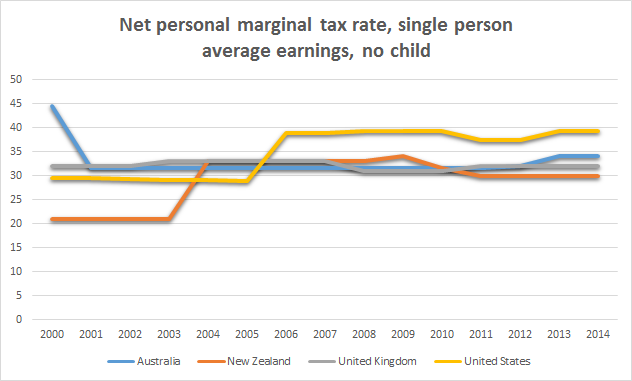
Interesting to notice that in New Zealand and the USA after these increases in marginal tax rates on single taxpayers, their economies slowed down. What appears to have happened is a number of people reached the next income tax marginal tax rate threshold.
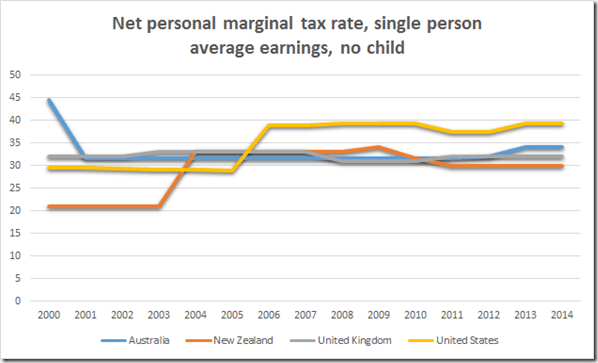
Source: OECD StatExtract.
19 Aug 2015
by Jim Rose
in economic growth, fiscal policy, labour economics, labour supply, macroeconomics, politics - Australia, politics - New Zealand
Tags: Australia, lost decades, marriage and divorce, productivity shocks, real business cycles, taxation and labour supply
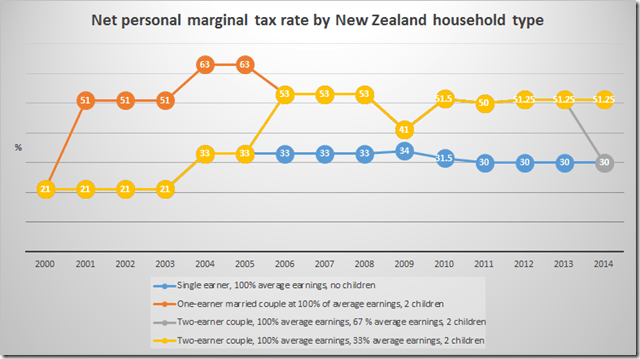
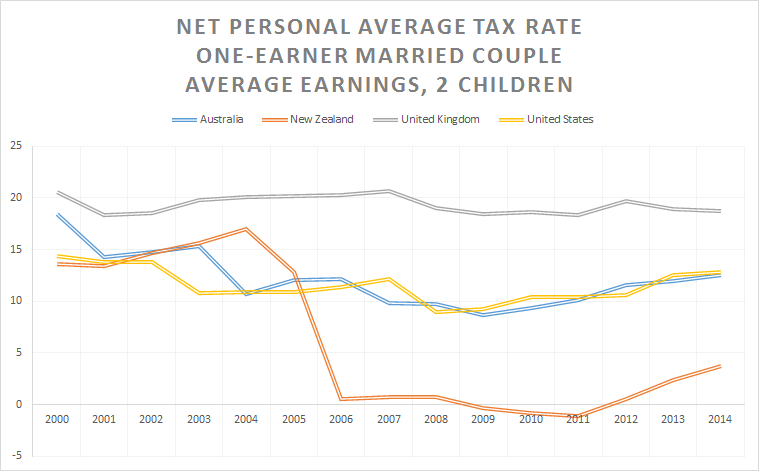
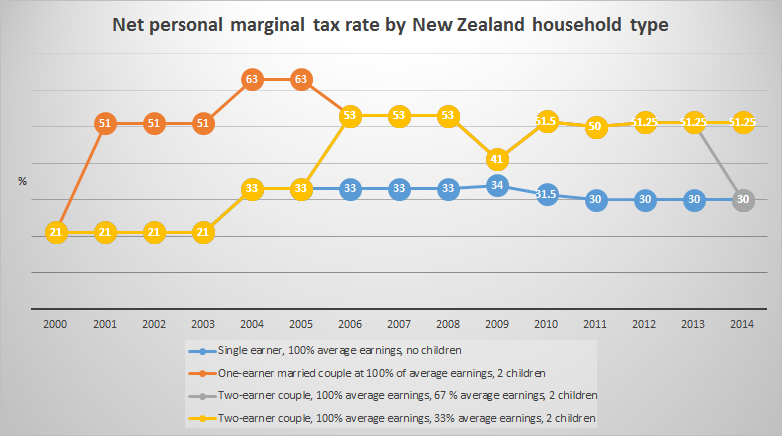
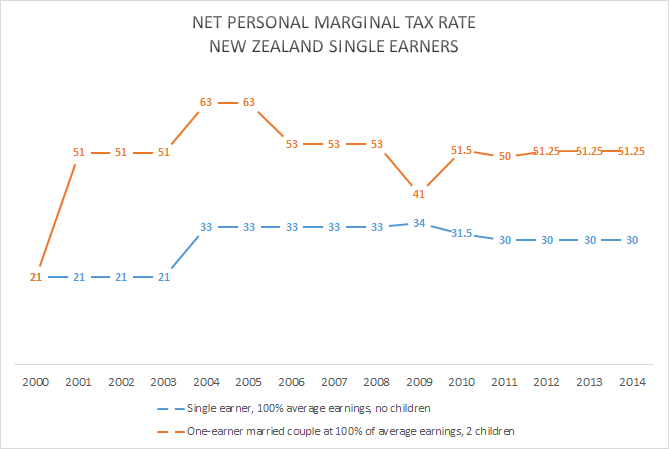
In 2000 in New Zealand, the marginal tax rates of single earners, married couples and dual income couples were 21%.
Sources: OECD StatExtract.and OECD Taxing Wages.
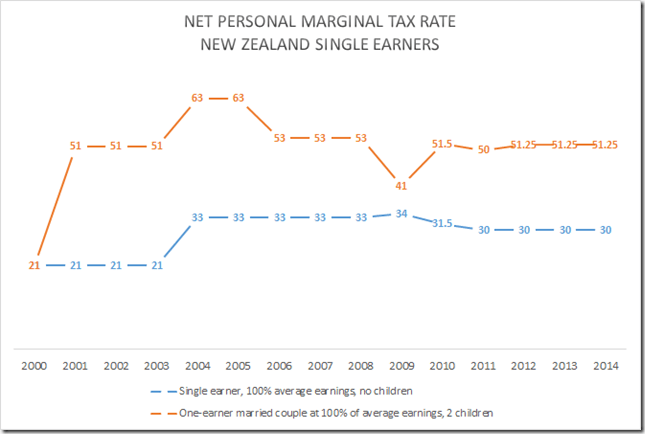
Net personal marginal income tax rates increased:
- to 51% for one earner couples with two children in 2001 and stayed up above 50% until 2014; and
- to 33% for single earners with no children in 2004 because income growth pushed them into the next tax rate bracket which then dropped down to 30% in 2011.
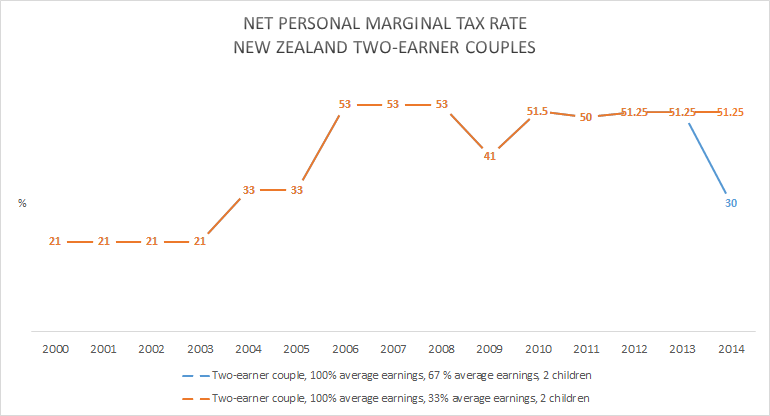
Sources: OECD StatExtract.and OECD Taxing Wages.
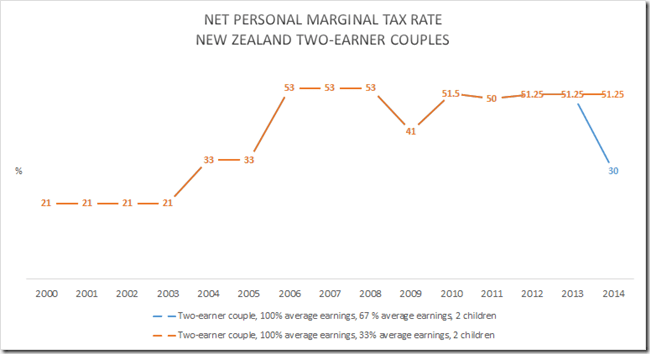
Net personal marginal income tax rates increased:
- to 33% in 2004 for two earner couples with the second earner earning 33% of average earnings and then increased to 53% in 2006 and stayed high thereafter;
- to 33% in 2004 for a two earner couple with the second earner earning 67% of average earnings and then increased further to 53% in 2006 and stayed high until 2014 when their marginal income tax rate dropped to 30%; and
Sources: OECD StatExtract.and OECD Taxing Wages.
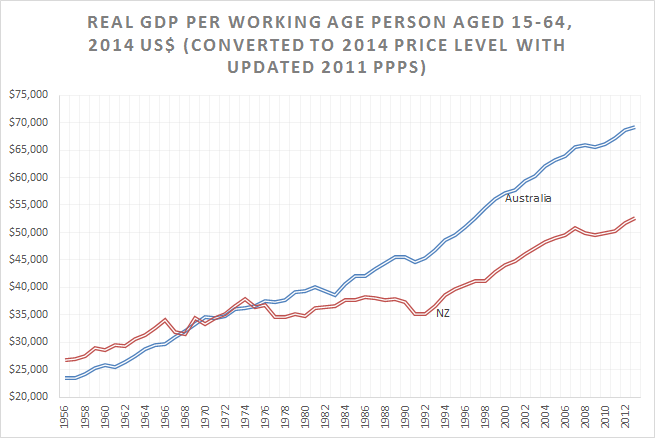
These large increases in marginal tax rates on single earners and families coincided with a slowing of the economy in about 2005. The economy started to pick up again when there were tax cuts introduced by the incoming National Party Government. Is that more than a coincidence?
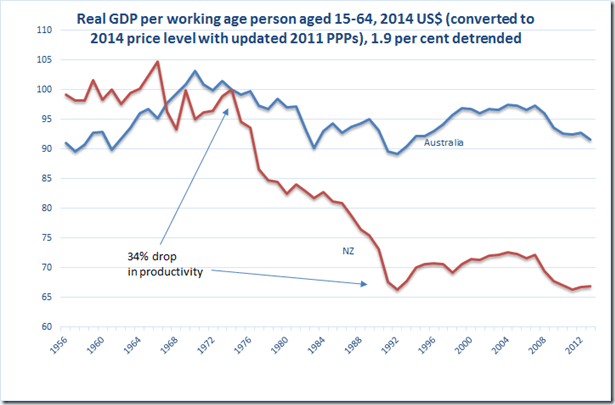
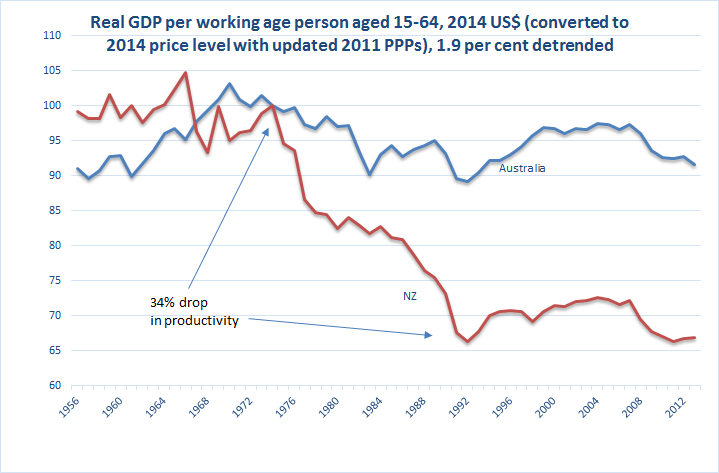
Sources: Computed from OECD StatExtract and The Conference Board. 2015. The Conference Board Total Economy Database™, May 2015, http://www.conference-board.org/data/economydatabase/.
A flat line in the above figure is growth at the trend growth rate of 1.9% of the USA in the 20th century. A rising line is above trend growth for that year while a falling lined is below trend rate in GDP per working age person.
In the lost decades of New Zealand growth between 1974 In 1992, New Zealand lost 34% against trend growth which was never recovered. There was about 13 years of sustained growth at about the trend rate or slightly above that between 1992 and 2005. The entire income gap between Australia and New Zealand open up during these lost decades of growth between 1974 and 1992.
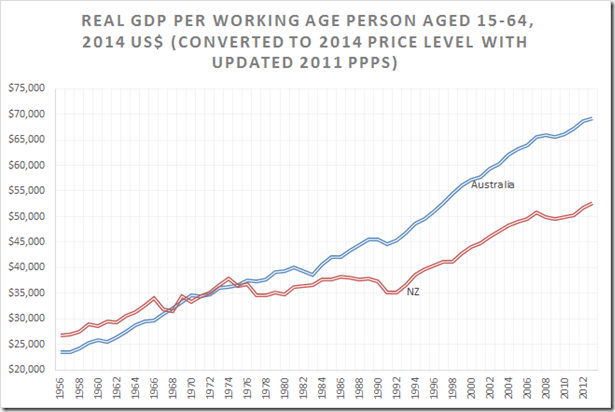
Sources: Computed from OECD StatExtract and The Conference Board. 2015. The Conference Board Total Economy Database™, May 2015, http://www.conference-board.org/data/economydatabase/.
Australia grew pretty much in its trend rate of growth since the 1950s. The so-called resources boom is not visible such as showing up as above trend rate growth.
17 Aug 2015
by Jim Rose
in economics of regulation, entrepreneurship, financial economics, politics - New Zealand
Tags: Australia, Canada, China, FDI, Japan, Left-wing hypocrisy, left-wing popularism, New Zealand Greens, right-wing popularism
Canada was the largest source of foreign investment during the period, as its pension fund bought 18 properties in a portfolio from AMP and increased its stake in Kaingaroa Forest.
13 Aug 2015
by Jim Rose
in labour economics, politics - Australia, politics - New Zealand, politics - USA, unions
Tags: Australia, British economy, union membership, union power, union wage premium
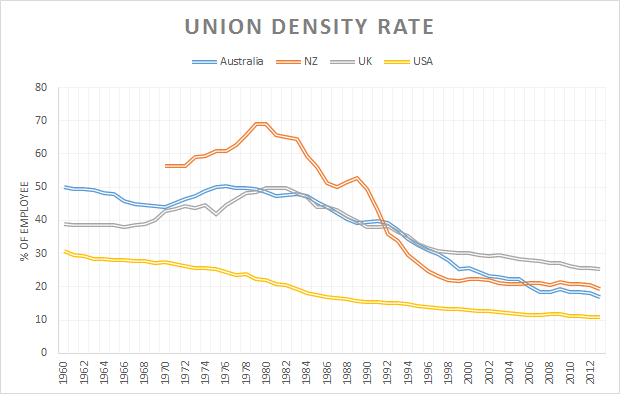
Unions have been in a long-term decline in Australia, New Zealand, the UK and the USA for as far back as survey and administrative data can be collected. There is a bit of a hump in union membership in the mid-1970s in New Zealand, Australia and the UK but that was about it.
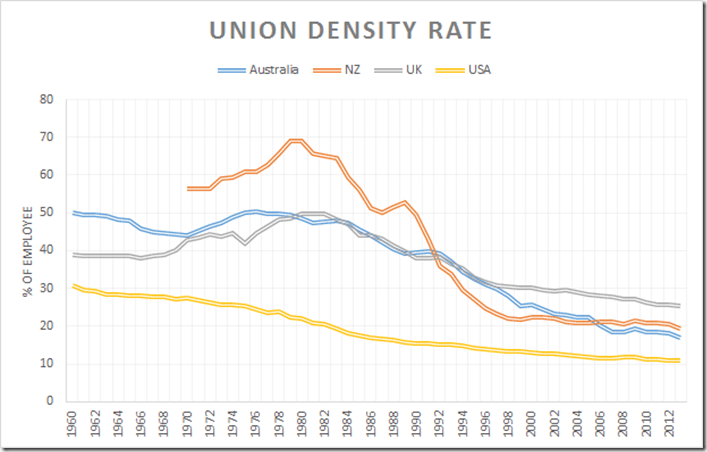
Source: Source: OECD and J.Visser, ICTWSS database (Institutional Characteristics of Trade Unions, Wage Setting, State Intervention and Social Pacts, 1960-2010), version 3.0 (http://www.uva-aias.net/).
12 Aug 2015
by Jim Rose
in applied price theory, applied welfare economics, environmental economics, global warming, politics - Australia, politics - New Zealand, politics - USA, Public Choice, rentseeking
Tags: Australia, China, climate alarmism, climate change treaties, free-riders, game theory, global warming, international free riders, international public goods, public goods
08 Aug 2015
by Jim Rose
in business cycles, economic history, global financial crisis (GFC), great recession, job search and matching, labour economics, labour supply, macroeconomics, unemployment
Tags: Australia, Canada, unemployment rates
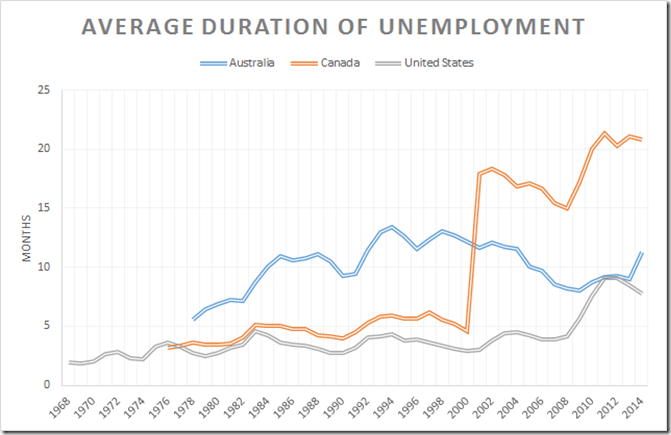
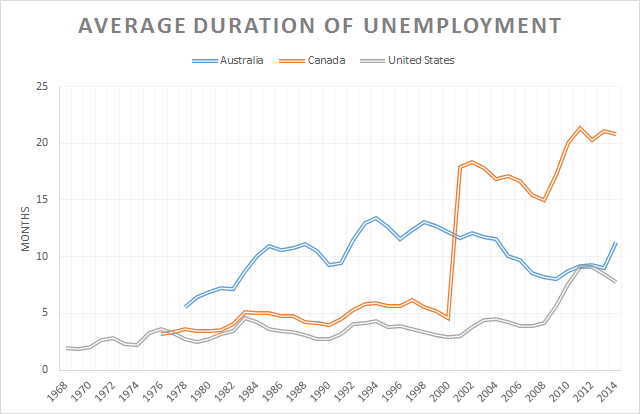
Source: OECD StatExtract.
I have no information as to why there is a sudden surge in the Canadian unemployment duration rate in 2001.
07 Aug 2015
by Jim Rose
in economic history, global financial crisis (GFC), job search and matching, labour economics, labour supply, macroeconomics, politics - New Zealand, unemployment
Tags: Australia, equilibrium unemployment rate, natural unemployment rate, unemployment duration
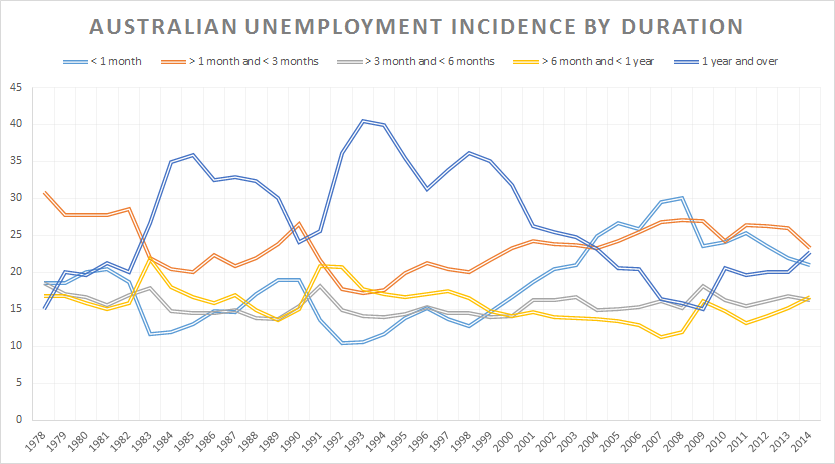
As with New Zealand, Australian long-term unemployment seems to go up and down quite a lot with recessions such as those in the early 1980s and early 1990s but not after the global financial crisis.
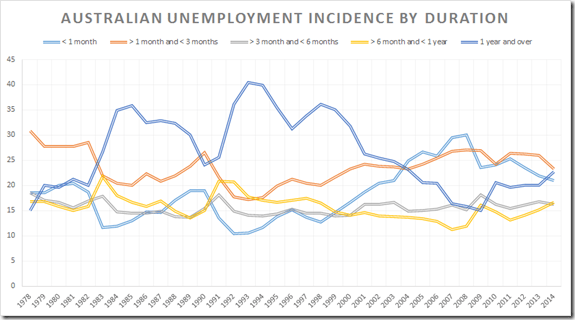
Source: OECD StatExtract.
04 Aug 2015
by Jim Rose
in discrimination, gender, labour economics, politics - Australia, politics - New Zealand, politics - USA
Tags: Australia, British economy, gender wage gap
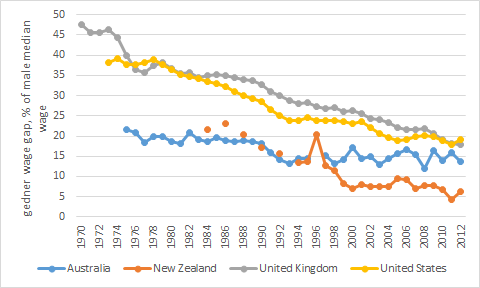
New Zealand does much better than most on the gender wage gap for full-time workers.
Figure 1: gender wage, % of median male wage, full-time employees, USA, UK, Australia and New Zealand, 1970 – 2012
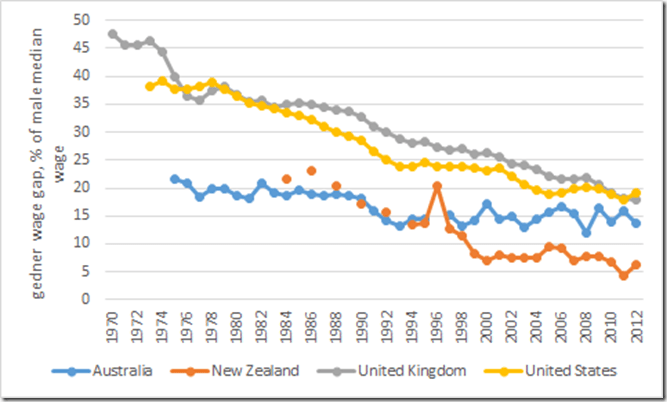
Source: Earnings and wages – Gender wage gap – OECD Data.
The gender wage gap in figure 1 is unadjusted and defined as the difference between median earnings of men and women relative to median earnings of men. Data refer to full-time employees.
I never found it terribly helpful to include part-time workers, such as in an hourly measure of the gender wage gap because of a larger trade-off between cash wages and work life balance in part-time jobs.
02 Aug 2015
by Jim Rose
in labour economics, labour supply, politics - Australia, politics - New Zealand, politics - USA, public economics
Tags: Australia, British economy, Canada, France, Germany, taxation and labour supply
29 Jul 2015
by Jim Rose
in economic history, job search and matching, labour economics, labour supply, law and economics, minimum wage, politics - Australia, politics - New Zealand, politics - USA, unions
Tags: Australia, British economy, employment law, employment law regulation
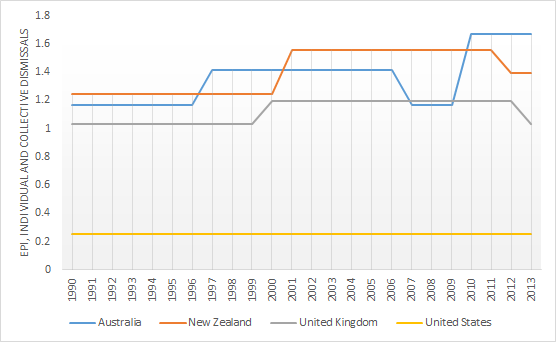
Major deregulations and re-regulations of the labour market in Australia and New Zealand did not move the employment protection inducts around that much in figure 1. All is been quiet on the labour market regulation front of the UK pretty much since the index was started.
Figure 1: OECD employment protection index (EPI), strictness of employment protection – individual and collective dismissals, USA, UK, Australia and New Zealand, 1990 – 2013
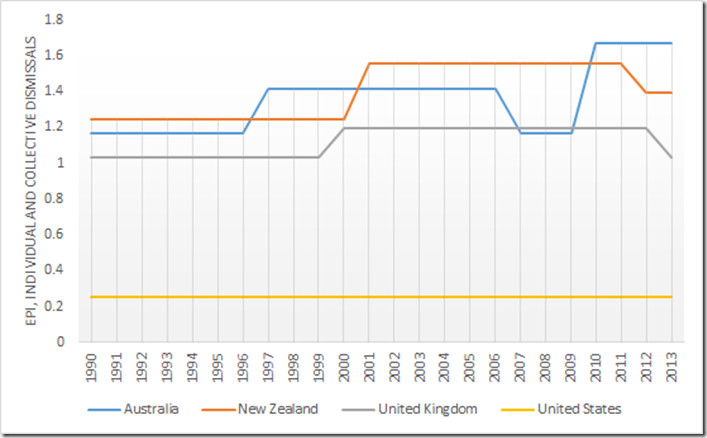
Source: OECD StatExtract.
The Work Choices legislation in Australia in 2006 was looked upon by the OECD as a somewhat minor deregulation not much more in scale than the deregulation introduced in 2008 with the election of the National Party led government.

Nobody told the unions that.
26 Jul 2015
by Jim Rose
in labour economics, minimum wage, politics - Australia, politics - New Zealand, politics - USA, population economics, public economics
Tags: Australia, British economy, Canada, Japan, social insurance, Social Security taxes, taxation and labour supply
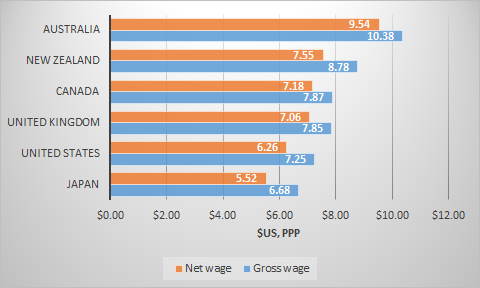
Figure 1: Hourly minimum wage before and after taxes, 2013, US dollars at purchasing power parities, single-person household
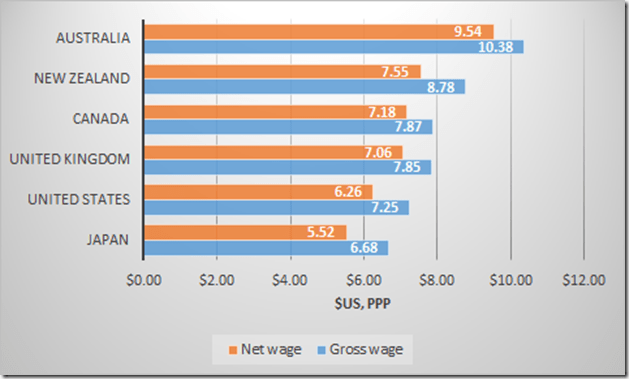
Source: OECD Focus on Minimum Wages after the crisis (2015).
25 Jul 2015
by Jim Rose
in international economic law, international economics, International law, politics - Australia, politics - USA
Tags: Australia, British politics, economics of immigration, EU, illegal immigration, Mexico, North Korea, Spain
24 Jul 2015
by Jim Rose
in economic history, labour economics, labour supply, politics - Australia, politics - New Zealand
Tags: ageing society, Australia, demographic crisis, economics of retirement, effective retirement ages, female labour force participation, female labour supply, male labour force participation, male labour supply, old age pensions, older workers, retirement ages, social insurance, Social Security, welfare state
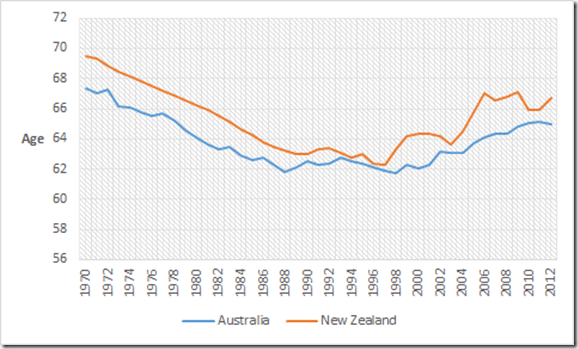
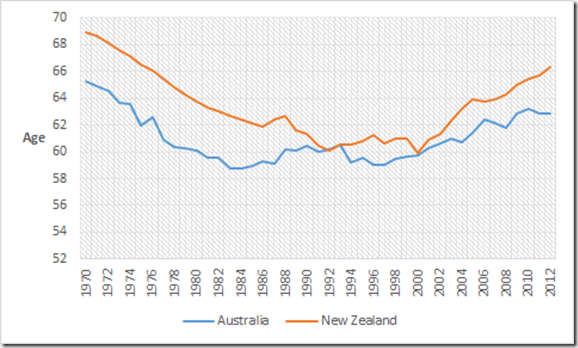
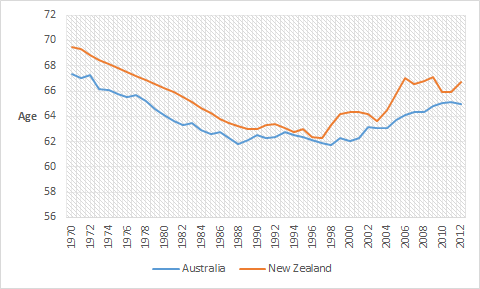
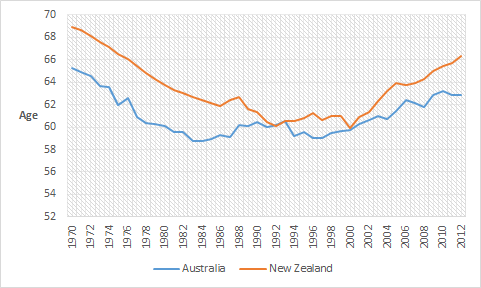
Figures 1 and 2 shows a sharp increase in the average effective retirement age for men and women in both Australia and New Zealand between 1970 and 1990. After that, retirement ages for men in both countries stabilised for about a decade. effective retirement age than Australia.
Figure 1: average effective retirement age for men, Australia and New Zealand, 1970 – 2012, (five-year average)
Source: OECD Pensions at a Glance.
Interestingly, in the 1970s and 1980s, New Zealand had an old-age pension scheme, known as New Zealand Superannuation, whose eligibility age was lowered from 65 to 60 in one shot in 1975. This old-age pension in New Zealand had no income test or assets test, but there was for a time a small surcharge on any income of pensioners. Nonetheless, New Zealand had a higher effective retirement age than in Australia where the old-age pension eligibility age is 65 with strict income and assets tests.
Figure 2: average effective retirement age for women, Australia and New Zealand, 1970 – 2012, (five-year average)
Source: OECD Pensions at a Glance.
Figure 1 and figure 2 also shows that the sharp increase in effective retirement ages in New Zealand for both men and women after the eligibility age for New Zealand’s old-age pension was increased from 60 to 65 over 10 years.
Figures 1 and 2 also show the gradual increase in effective retirement ages for Australian men and women from the end of the 1990s.
Previous Older Entries Next Newer Entries


 Utopia, you are standing in it!
Recent Comments