29 Jul 2015
by Jim Rose
in economic history, job search and matching, labour economics, labour supply, law and economics, minimum wage, politics - Australia, politics - New Zealand, politics - USA, unions
Tags: Australia, British economy, employment law, employment law regulation
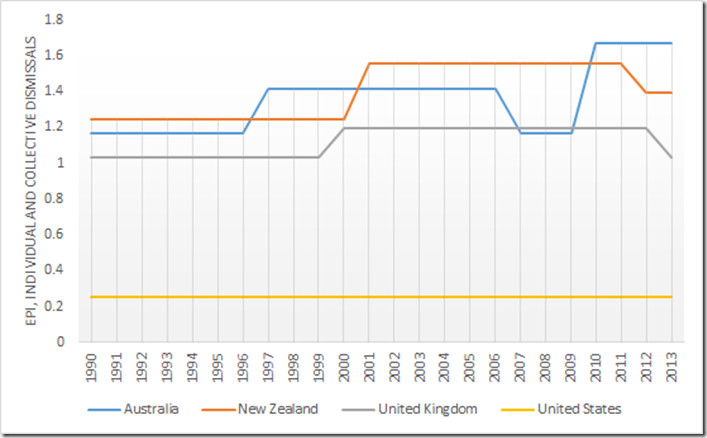
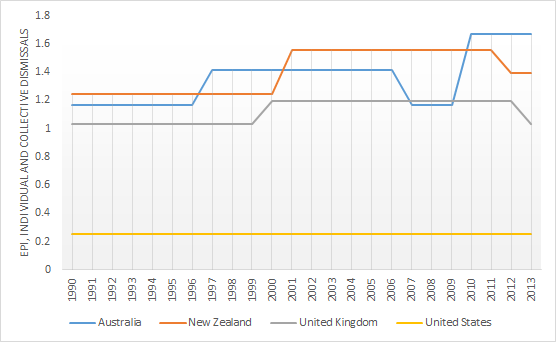
Major deregulations and re-regulations of the labour market in Australia and New Zealand did not move the employment protection inducts around that much in figure 1. All is been quiet on the labour market regulation front of the UK pretty much since the index was started.
Figure 1: OECD employment protection index (EPI), strictness of employment protection – individual and collective dismissals, USA, UK, Australia and New Zealand, 1990 – 2013
Source: OECD StatExtract.
The Work Choices legislation in Australia in 2006 was looked upon by the OECD as a somewhat minor deregulation not much more in scale than the deregulation introduced in 2008 with the election of the National Party led government.

Nobody told the unions that.
28 Jul 2015
by Jim Rose
in Euro crisis, job search and matching, labour economics, law and economics, macroeconomics
Tags: British economy, employment law, employment law regulation, Eurosclerosis, France, Germany, Greece, Italy, Portugal, Spain
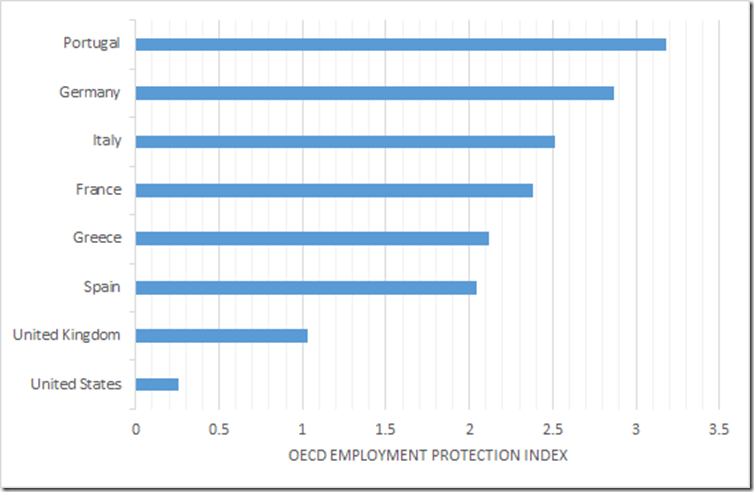
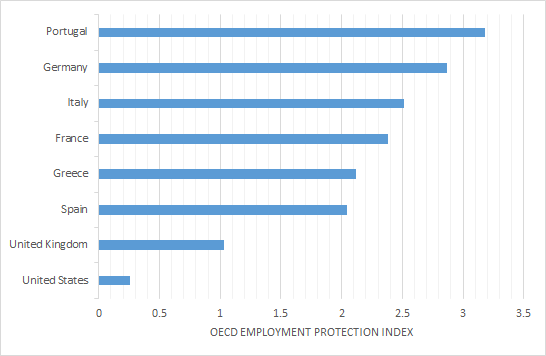
Much easier to fire someone in the USA or UK than on continental Europe. Greece and Spain aren’t that bad by continental European standards for employment law protections against dismissals of individuals.
Figure 1: Strictness of employment protection for individual dismissals, 2013
Source: OECD StatExtract.
26 Jul 2015
by Jim Rose
in labour economics, minimum wage, politics - Australia, politics - New Zealand, politics - USA, population economics, public economics
Tags: Australia, British economy, Canada, Japan, social insurance, Social Security taxes, taxation and labour supply
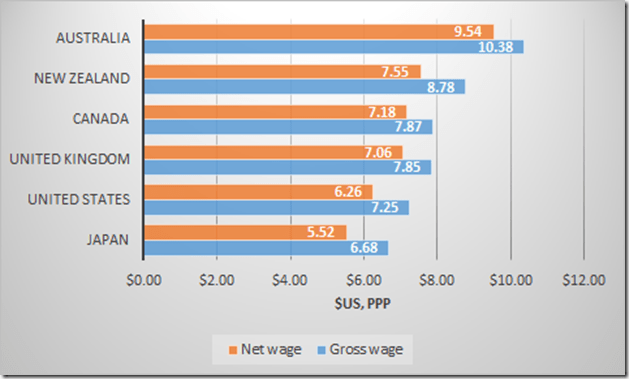
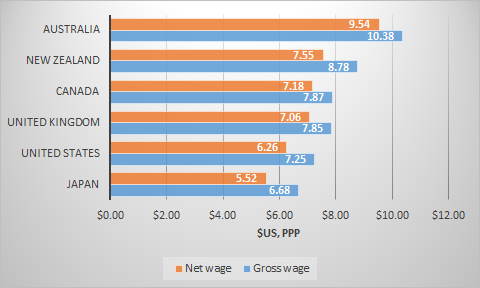
Figure 1: Hourly minimum wage before and after taxes, 2013, US dollars at purchasing power parities, single-person household
Source: OECD Focus on Minimum Wages after the crisis (2015).
25 Jul 2015
by Jim Rose
in economic history, gender, labour economics, labour supply, politics - USA
Tags: ageing society, British economy, demographic crisis, economics of retirement, effective retirement ages, female labour force participation, female labour supply, France, Germany, male labour force participation, male labour supply, old age pensions, older workers, retirement ages, social insurance, Social Security, welfare state
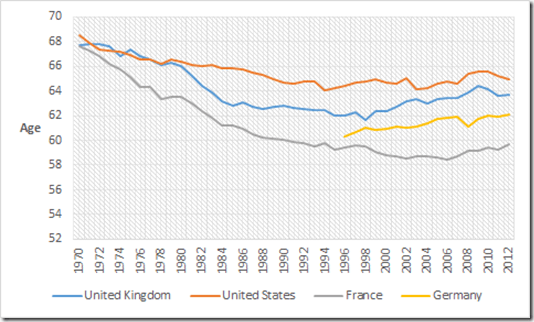
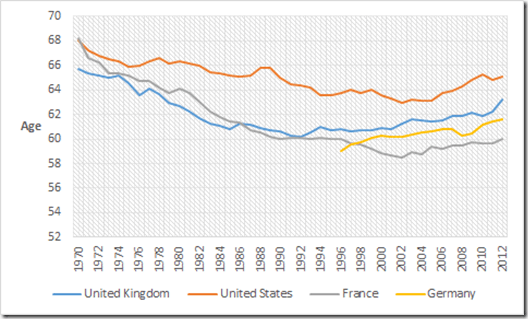
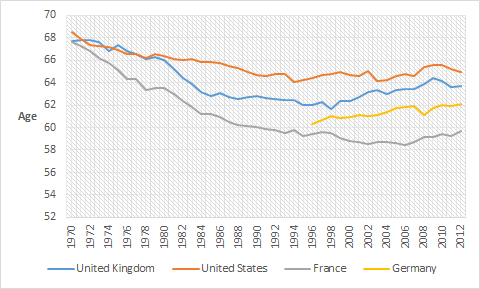
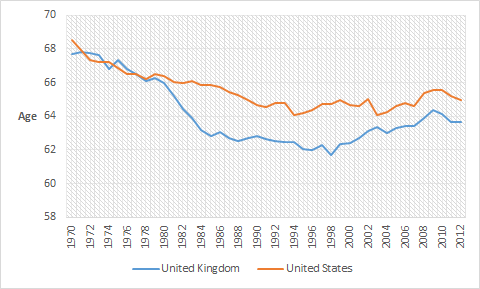
Figure 1 shows a divergence from a common starting point in 1974 effective retirement ages. The French in particular were the first to put their feet up and start retiring by the age of 60 by the early 1990. There was also a sharp increase in the average effective retirement age for men in the UK over a short decade. After that, British retirement ages for men started to climb again in the late 1990s. Figure 1 also shows that the gentle taper in the effective retirement age for American men stopped at the 1980s and started to climb again in the 2000s. The German data is too short to be of much use because of German unification. France only recently stopped seeing its effective retirement age fall and it is slightly increased recently – see figure 1
Figure 1: average effective retirement age for men, USA, UK, France and Germany, 1970 – 2012, (five-year average)
Source: OECD Pensions at a Glance.
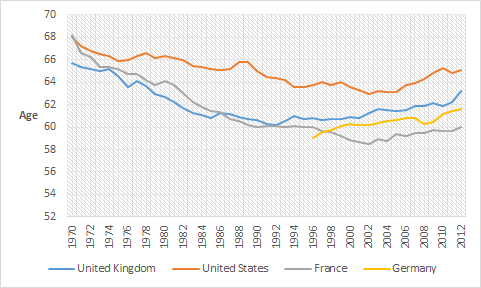
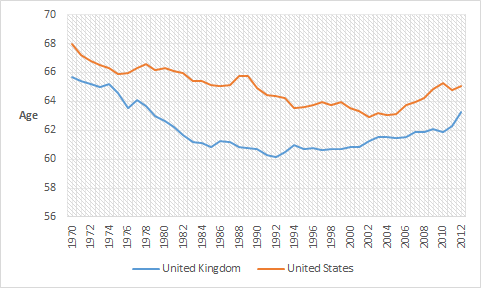
Figure 2 shows similar results for British and American women as for men in the same country shown in figure 1 . That is, falling effective retirement ages for both British and American women in the 1970s and 1980s followed by a slow climb again towards the end of 1990s. French effective retirement ages for women followed the same pattern as for French retirement ages for men – a long fall to below the age of 60 with a slight increase recently. The German retirement data suggest that effective retirement ages for German women is increasing.
Figure 2: average effective retirement age for women, USA, UK, France and Germany 1970 – 2012, (five-year average)
Source: OECD Pensions at a Glance.
23 Jul 2015
by Jim Rose
in economic history, gender, labour economics, labour supply
Tags: ageing society, British economy, demographic crisis, economics of retirement, effective retirement ages, female labour force participation, female labour supply, male labour force participation, male labour supply, old age pensions, older workers, retirement ages, social insurance, Social Security, welfare state
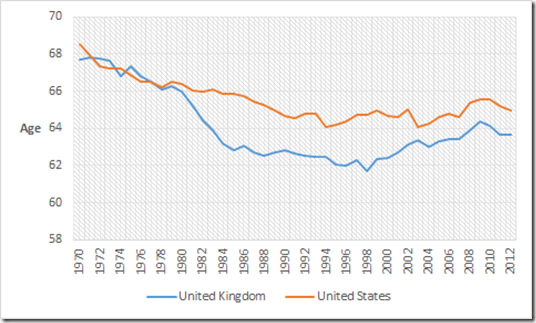
Figure 1 shows a divergence in the 1970s where there is a sharp increase in the average effective retirement age for men in the UK over a short decade. After that, British retirement ages for men started to climb again in the late 1990s. Figure 1 also shows that the gentle taper in the effective retirement age for American men stopped at the 1980s and started to climb again in the 2000s.
Figure 1: average effective retirement age for men, USA and UK, 1970 – 2012, (five-year average)
Source: OECD Pensions at a Glance.
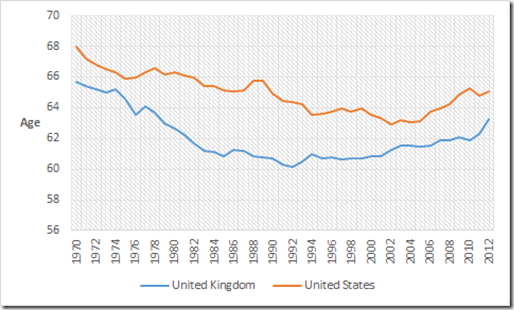
Figure 2 shows similar results to figure 1 for British and American women. That is, falling effective retirement ages for both British and American women in the 1970s and 1980s followed by a slow climb again during the 1990s.
Figure 2: average effective retirement age for women, USA and UK, 1970 – 2012, (five-year average)
Source: OECD Pensions at a Glance.
21 Jul 2015
by Jim Rose
in economic history, economics of regulation, global financial crisis (GFC), job search and matching, labour economics, labour supply, law and economics, minimum wage, politics - USA, unions
Tags: British economy, employment law, employment regulation, Eurosclerosis, France, Germany, Index of Economic Freedom
The writers of the Index of Economic Freedom at the Heritage foundation really loves the USA and didn’t think much of the Conservative Party – Liberal Democratic Party coalition government because labour market freedom actually fell in the UK during their administration. Bring back Tony Blair, all is forgiven. The information on their website throws no insight into why this reduction in labour market freedom in Britain happened.
Figure 1: Index of Economic Freedom, Argentina, Brazil, Chile and Venezuela, 95 – 2015 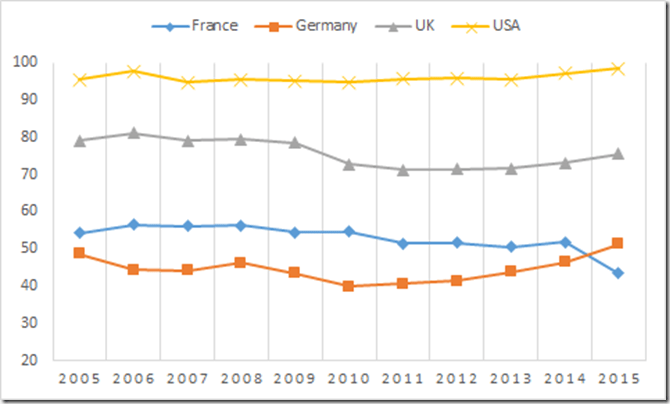
Source: Index of Economic Freedom 2015.
Fortunately for Germany, labour market freedom increased over the course of the global financial crisis and its aftermath. This helps explains low unemployment in Germany during that period. Nothing much happened in France in regard to labour market freedom.
18 Jul 2015
by Jim Rose
in business cycles, job search and matching, labour economics, labour supply, macroeconomics, unemployment
Tags: British economy, Canada, equilibrium unemployment rate, natural unemployment rate
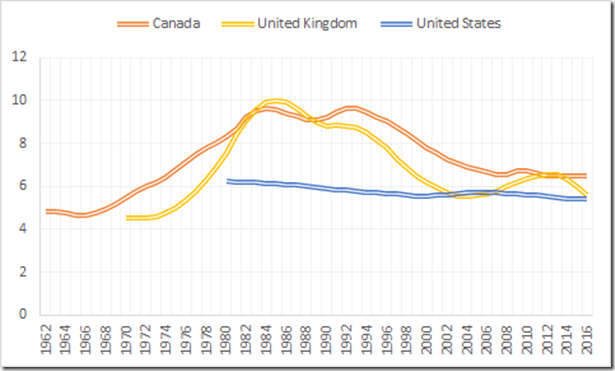
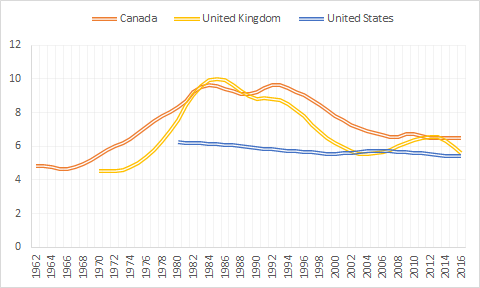
Figure 1 suggests a lot more structural change in the Canadian and British labour market in the 1970s and 1980s.
Figure 1: equilibrium unemployment rates, Canada, USA and UK, 1962 – 2016
Source: OECD Economic Outlook June 2015 via OECD StatExtract.
Nothing much at all seems to have happened to the equilibrium unemployment rate in the USA since the OECD first started calculating it. I doubt that so that will be subject of a future blog. Namely, the large changes in natural unemployment rates in the post-war period, largely to demographic changes such as the baby boom.
17 Jul 2015
by Jim Rose
in economics of regulation, industrial organisation, international economics, politics - USA
Tags: border costs, British economy, Canada, Common market, Common markets, customs unions, EU, France, free trade areas, Germany, Italy, NAFTA, trade costs
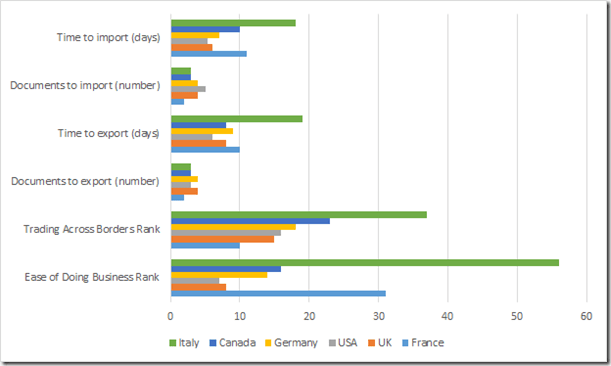
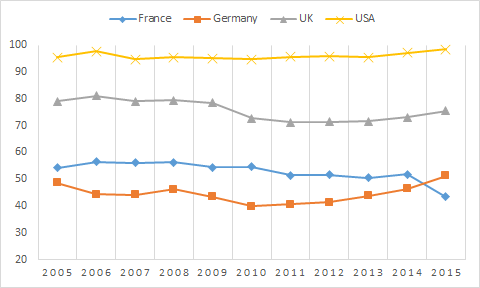
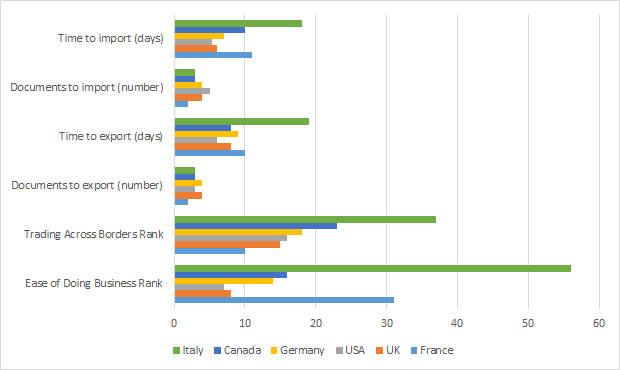
Figure 1: World Bank Doing Business rankings and sub rankings for trading across the French, German, Italian, British, Canadian and US borders, 2014
Source: World Bank Doing Business database; note: cost of importing and exporting not included.
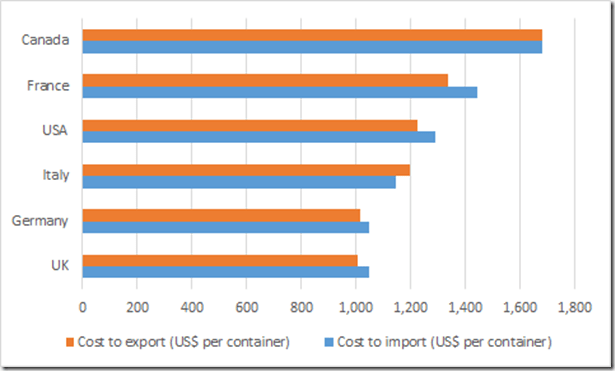
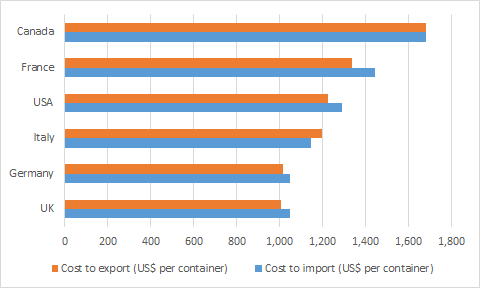
Figure 2: World Bank Doing Business rankings – cost of importing and exporting across the French, German, Italian, British, Canadian and US borders, 2014
Source: World Bank Doing Business database; note: cost of importing and exporting not included.
14 Jul 2015
by Jim Rose
in international economics, labour supply, minimum wage, politics - Australia, politics - New Zealand, politics - USA, poverty and inequality, welfare reform
Tags: Australia, British economy, Canada, low pay, New Zealand, social insurance, welfare state, working poor
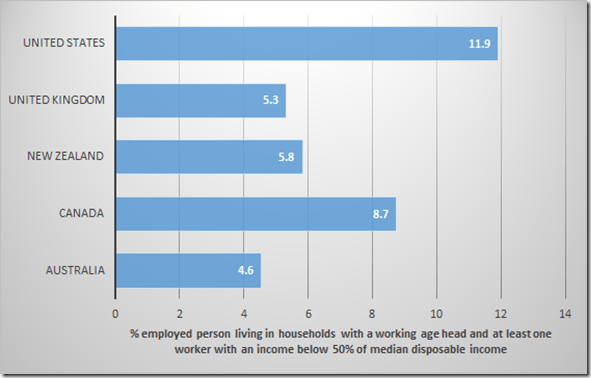
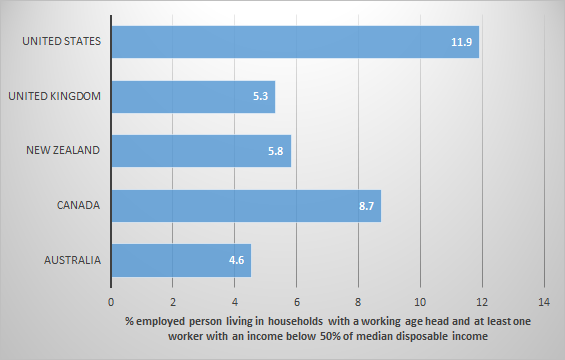
Figure 1: working poor – proportion of employed persons with income below the poverty line (50% of median disposable income) living in households with a working age head and at least one worker in USA, UK, Canada, Australia and New Zealand, 2013
Source: In It Together – Why Less Inequality Benefits All – © OECD 2015, OECD Income Distribution Database (IDD), www.oecd.org/social/income-distribution-database.htm, Table 1.A1.1. Key indicators on the distribution of household disposable income and poverty, 2007, 2011 and 2013 or most recent year.
13 Jul 2015
by Jim Rose
in applied welfare economics, development economics, economic history, growth disasters, growth miracles, health economics
Tags: Africa, British economy, British history, child mortality, child poverty, infant mortality, life expectancies, The Great Enrichment, The Great Escape, The Great Fact
13 Jul 2015
by Jim Rose
in applied price theory, applied welfare economics, economics of religion, law and economics, politics - USA, property rights
Tags: British economy, doing business, France, Germany
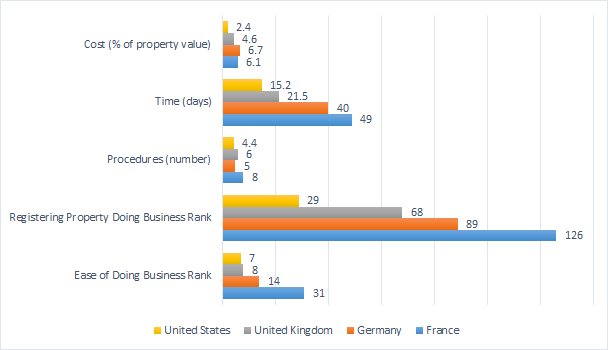
Figure 1: registering property rankings, USA, UK, Germany and France – World Bank Doing Business rankings, 2014
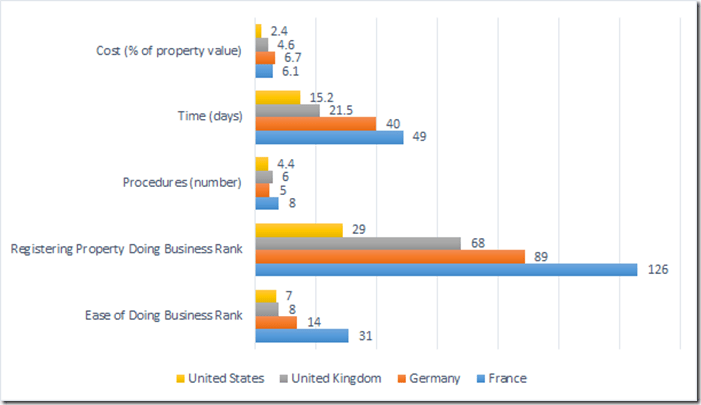
Source: Doing Business – Measuring Business Regulations – World Bank Group.
12 Jul 2015
by Jim Rose
in discrimination, economics of love and marriage, gender, labour economics, labour supply, law and economics, occupational choice, politics - USA, poverty and inequality
Tags: asymmetric marriage premium, British economy, Canada, gender wage gap, marriage and divorce, motherhood penalty
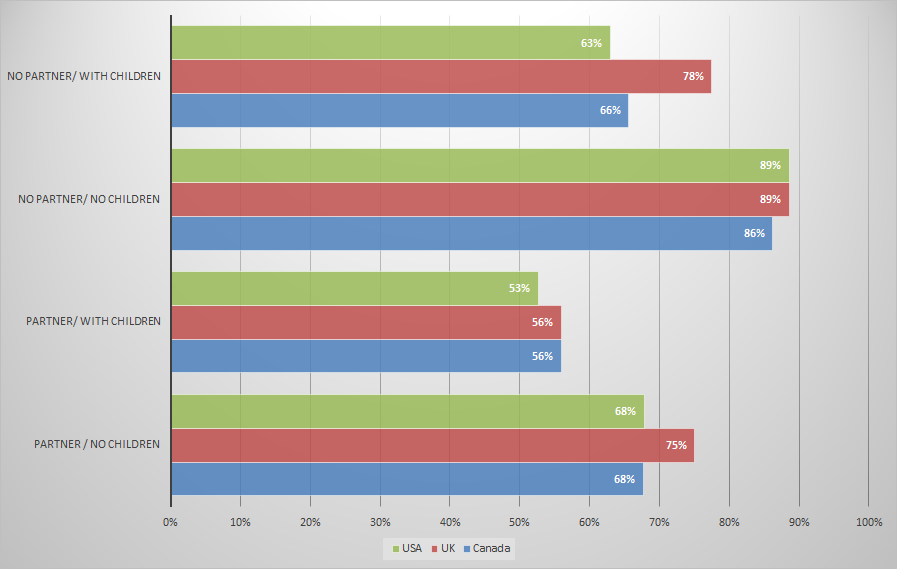
Figure 1: Female/male earnings ratio by partner status and motherhood, 2004 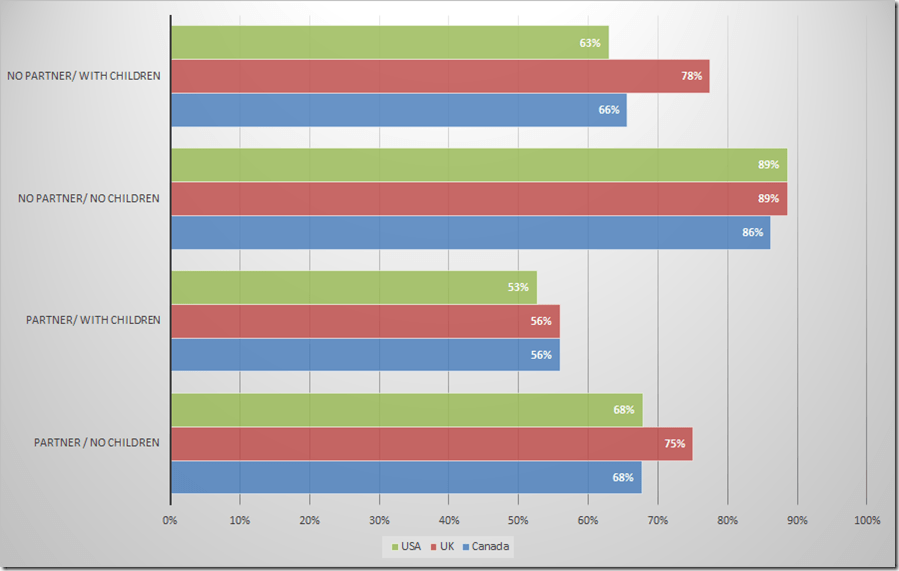 Source: LIS Cross-National Data Center in Luxembourg – Wave VI; individuals with positive earnings only. .
11 Jul 2015
by Jim Rose
in economics of love and marriage, labour economics, labour supply, law and economics, politics - Australia, politics - USA, poverty and inequality, welfare reform
Tags: Australia, British economy, Canada, child poverty, family poverty, marriage and divorce, single mothers, single parents
Figure 1: poverty rates by age of youngest child, 2004
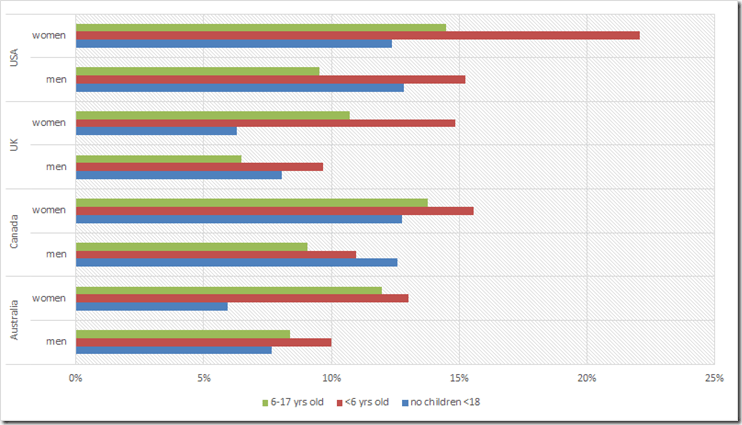
Source: LIS Cross-National Data Center in Luxembourg.
Previous Older Entries Next Newer Entries

 Utopia, you are standing in it!
Recent Comments