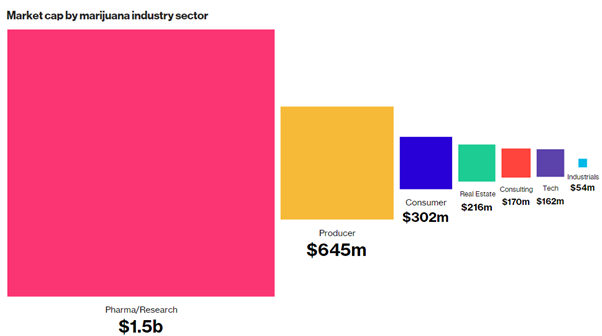
Source: For These 55 Marijuana Companies, Every Day is 4/20.
Celebrating humanity's flourishing through the spread of capitalism and the rule of law
24 May 2016 Leave a comment
in entrepreneurship, financial economics, health economics Tags: creative destruction, efficient markets hypothesis, entrepreneurial alertness, marijuana decriminalisation, medical marijuana decriminalisation, R&D
05 May 2016 Leave a comment
in financial economics Tags: BDS, efficient markets hypothesis, entrepreneurial alertness, ethical investing
The Vanguard Investment Fund has set up an passive investment index to invest in ethical investments. No flies on them regarding entrepreneurial alertness.
The drawback of ethical investing is the higher management expenses to administer negative screens (to eliminate arms manufacturers and other frowned upon activities) and positive screens (to favour businesses with a good record on corporate social responsibility or that are involved in low-carbon industries etc.)
An index-linked passive fund allows socially conscious investor to have a diversified ethical portfolio at least cost. Vanguard pitches its ethical investing passive fund thus
Some individuals choose investments based on social and personal beliefs. For this type of investor, we have offered Vanguard FTSE Social Index Fund since 2000.
This low-cost fund seeks to track a benchmark of large- and mid-capitalization stocks that have been screened for certain social, human rights, and environmental criteria.
In addition to stock market volatility, one of the fund’s other key risks is that this socially conscious approach may produce returns that diverge from those of the broad market.
The expenses ratio of this index linked passive fund for socially conscious investors is 0.25%. The usual investment expenses ratio of a Vanguard Fund is 0.1% which is much less than that of active funds.
As is well known, ethical investing offers a poorer return on standard diversification strategies as the chart below show.
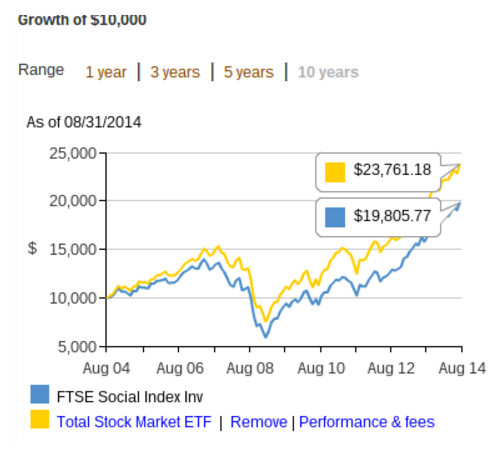
Source: The case against socially responsible investing (SRI) – Flannel Guy ROI.
Virtue must be its own reward because it does not pay off in the share market
As you can see value of $10,000 at the end of 10 years would be worth almost $24,000 with the total stock market ETF but only about $20,000 with the FTSE social index.
The initial reaction is that $4,000 over 10 years isn’t that big of a deal, but there are two things to point out. First, that $4,000 difference is worth almost half the initial investment! Secondly, on a compound annual basis, the SRI fund returns about 2% less than the total stock market fund.
04 May 2016 Leave a comment
in economics of regulation, economics of religion, entrepreneurship, financial economics Tags: efficient markets hypothesis, entrepreneurial alertness, ethical investing
Virtue is not its own reward if you invest in the Ave Maria Catholic Values Fund which is AVEMX in the head-to-head comparison with the Barriers Fund, formerly the Vice Fund. The Ave Maria Catholic Values Fund return since inception was 5.63% as compared to the 9.95% return of the Barrier Fund.
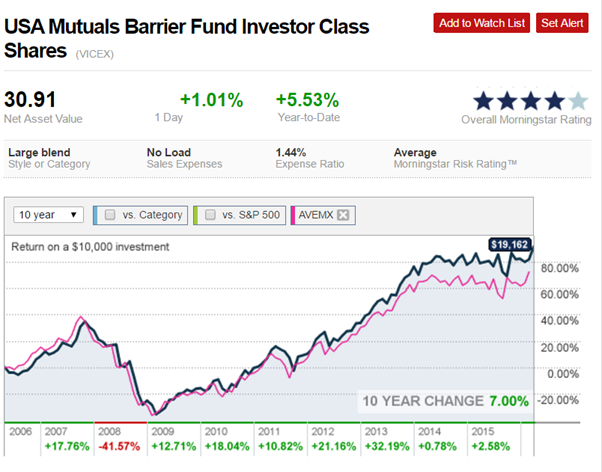
Source: VICEX – USA Mutuals Barrier Fund Investor Class Shares Mutual Fund Quote – CNNMoney.com
The S&P index grew by 8 .34% since the inception of the then Vice Fund, now the Barrier Fund. Such is the price of risking of going to hell if you lose Pascal’s wager by investing in tobacco, alcoholic beverage, gaming and defence/aerospace industries.
All of the equity investments (which include common stocks, preferred stocks and securities convertible into common stock) and at least 80% of the net assets of the Ave Maria Catholic Values Fund is invested in companies meeting its religious criteria as the fund manager explains
Morally Responsible Investing (MRI) is a subset of socially responsible investing, which often screens out companies engaged in environmental issues, tobacco products, alcohol, nuclear power, defense, oil and “unfair” labor practices. MRI is different in that it screens out companies engaged in activities that are not pro-life or pro-family…
All investments are screened to eliminate any company engaged in abortion, pornography, embryonic stem cell research, or those that make corporate contributions to Planned Parenthood
Traditional ethical funds use negative screens (to eliminate arms manufacturers and other frowned upon activities) and positive screens (to favour businesses with a good record on corporate social responsibility or that are involved in low-carbon industries etc).
03 May 2016 Leave a comment
in defence economics, energy economics, entrepreneurship, financial economics, health economics Tags: BDS, efficient markets hypothesis, entrepreneurial alertness, ethical investing
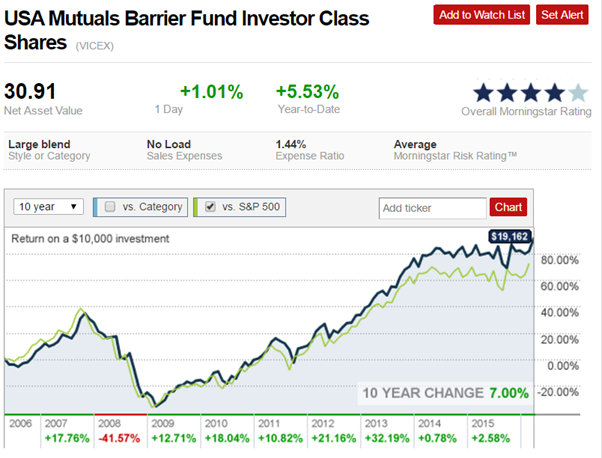
Source: VICEX – USA Mutuals Barrier Fund Investor Class Shares Mutual Fund Quote – CNNMoney.com
The Vice Fund has outperformed the S&P 500 since 2004 as shown by the green line. This mutual fund invests invest in sinful stocks as its managers describe it:
Designed with the goal of delivering better risk-adjusted returns than the S&P 500 Index. It invests primarily in stocks in the tobacco, alcohol, gaming and defence industries. Vice Funds believes these industries tend to thrive regardless of the economy as a whole.
The Vice Fund is now known as the Barrier Fund because it extended out of sinful stocks into industries with high barriers to entry. Minimum Investment is $2,000.
The Barrier Fund primarily invests in the following industries: Aerospace/Defense, Gaming, Tobacco and Alcoholic Beverages. These four industries were chosen because they demonstrate one or more of these compelling and distinctive investment characteristics:
The Barrier Fund believes numerous investment opportunities in these industries which have been largely overlooked by other funds.
The Fund has high management fees of 2%. Americans can buy Vanguard’s or Fidelity’s index funds and pay only 0.1% in expenses.
16 Apr 2016 Leave a comment
in economic history, entrepreneurship, financial economics Tags: active investing, efficient markets hypothesis, Index linked funds, passive investing

Source: These Charts Show the Astounding Rise in Passive Management – Bloomberg.
https://twitter.com/pmarca/status/718341190123458560

Source: The Financial Industry Is Having Its Napster Moment – Bloomberg.
17 Dec 2015 Leave a comment
in economics of natural disasters, economics of regulation, politics - New Zealand, urban economics Tags: earthquakes, efficient markets hypothesis, entrepreneurial alertness
Within the Wellington CBD, the average value of a commercial building is almost halved if it receives a legally binding earthquake-prone declaration. Discounts on specific buildings will vary around this average level, reflecting a number of factors such as costs of remediation and the nature of existing rental agreements.
29 Aug 2015 Leave a comment
in economic history, economics of media and culture, entrepreneurship, financial economics, industrial organisation, survivor principle Tags: competition as a discovery procedure, creative destruction, efficient markets hypothesis, entrepreneurial alertness, ICT, Silicon Valley
Surging #SiliconValley — in 5 charts ow.ly/Qftvp http://t.co/1bGCz8G1dB—
(@AEI) July 29, 2015
17 Aug 2015 Leave a comment
in applied price theory, applied welfare economics, economic growth, economic history, entrepreneurship, financial economics, fiscal policy, industrial organisation, labour economics, labour supply, macroeconomics, politics - New Zealand, public economics Tags: ageing society, company tax rate, deadweight cost of taxes, demographic crisis, efficient markets hypothesis, laffer curve, New Zealand superannuation fund, old age pensions, retirement savings, social insurance, sovereign wealth funds, taxation and entrepreneurship, taxation and investment, taxation and labour supply
Most mutual funds still can't beat their benchmark read.bi/1GkTig1 http://t.co/r7ezoDGJbV—
BI Chart of the Day (@chartoftheday) June 03, 2015
The New Zealand Superannuation Fund, the sovereign wealth fund part funding New Zealand’s old-age pension from 2029/2030 onwards, has been a bit of a wild ride. Sometimes the earnings of the Fund were well below and sometimes earning well above the long-term bond rate.
![image_thumb[3]](https://utopiayouarestandinginit.com/wp-content/uploads/2015/08/image_thumb310.png "image_thumb[3]")
Source: New Zealand Superannuation Fund Annual Report 2014.
Since its inception, the Fund earned an average annual return of 9.78%, which was 5.06% above the long-term bond rate, and 1.03% above its reference portfolio.

No information was given in the annual report of the New Zealand Superannuation Fund on the marginal dead weight cost of the taxes raised to fund the New Zealand Superannuation Fund to see whether there is any net benefit to taxpayers from its establishment and continued operation.
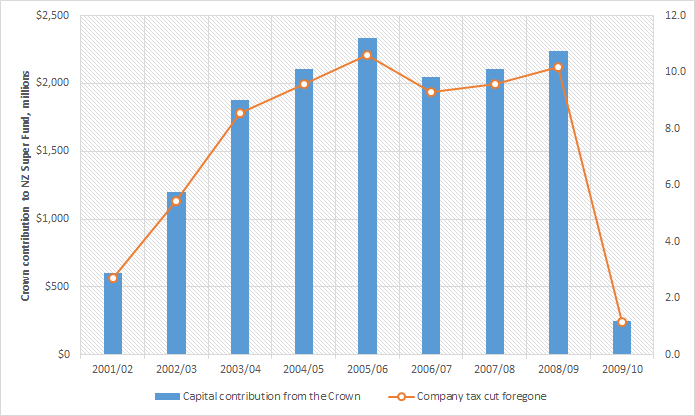
The New Zealand Government has contributed $14.88 billion to the fund from prior its inception in 2001 to the suspension of contributions in 2009 by the incoming National Party Government.
Source: New Zealand Treasury.
Over the nine years in which contributions were made, the company tax rate of 28% could have easily been up to 10 percentage points lower.
The New Zealand Treasury estimates that a one percentage point cut in the company tax costs about $220 million in forgone revenue if there are no other changes to the tax system. These are static estimates that do not include any feedback from greater investment and higher growth.
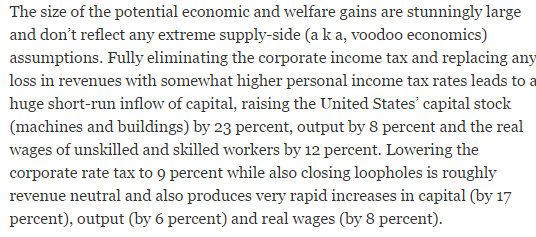
The New Zealand Superannuation Fund must beat the market every single year to make up for the deadweight cost of its funding, a premium for the investment risk added to the Crown’s portfolio and the cost to New Zealand’s growth rate of higher than otherwise taxes on income, entrepreneurship and investment.
Source: Abolish the Corporate Income Tax – The New York Times.
13 Aug 2015 Leave a comment
in entrepreneurship, industrial organisation, survivor principle Tags: competition as a discovery procedure, efficient markets hypothesis, entrepreneurial alertness, market selection, technology diffusion, Uber
There are 74 "unicorns” in US tech sector, valued at $273 billion. Will they become extinct? econ.st/1ISYkvd http://t.co/ATyuzMsZwA—
The Economist (@EconBizFin) August 11, 2015
11 Aug 2015 Leave a comment
in economic history, financial economics, Music Tags: efficient markets hypothesis, The Beatles
#TBT Remember when Bob Prechter explained the entire stock market simply by using The Beatles? http://t.co/u1UHW8lv1L—
Joseph Weisenthal (@TheStalwart) July 22, 2015
30 Jul 2015 Leave a comment
in applied price theory, comparative institutional analysis, economics of bureaucracy, entrepreneurship, financial economics, human capital, industrial organisation, labour economics, managerial economics, occupational choice, organisational economics, rentseeking, survivor principle Tags: active investing, corporate welfare, efficient markets hypothesis, entrepreneurial alertness, hedge funds, industry policy, passive investing, picking winners, The fatal conceit, The pretence to knowledge
Page 32 of "An Illustrated Guide to Income" more economic #dataviz at: bit.ly/12SEI9p http://t.co/HYm0II2UNI—
Catherine Mulbrandon (@VisualEcon) May 08, 2013
Page 33 of "An Illustrated Guide to Income" more economic #dataviz at: bit.ly/10M7lqR http://t.co/FcmaqZWB32—
Catherine Mulbrandon (@VisualEcon) May 09, 2013
The hedge fund industry held $2.9 trillion of assets in June. Exchange-traded funds did better econ.st/1DdXgWS http://t.co/CK2foqMOpw—
The Economist (@EconEconomics) August 01, 2015
12 Jul 2015 Leave a comment
in financial economics Tags: British politics, efficient markets hypothesis, event studies
Do British general election results have a big impact on the stockmarket? Yes, sometimes econ.st/1PUBhEh http://t.co/Ye7ede34HA—
The Economist (@ECONdailycharts) May 19, 2015
Celebrating humanity's flourishing through the spread of capitalism and the rule of law
Scholarly commentary on law, economics, and more
Beatrice Cherrier's blog
Celebrating humanity's flourishing through the spread of capitalism and the rule of law
Celebrating humanity's flourishing through the spread of capitalism and the rule of law
Celebrating humanity's flourishing through the spread of capitalism and the rule of law
Why Evolution is True is a blog written by Jerry Coyne, centered on evolution and biology but also dealing with diverse topics like politics, culture, and cats.
Celebrating humanity's flourishing through the spread of capitalism and the rule of law
Celebrating humanity's flourishing through the spread of capitalism and the rule of law
A rural perspective with a blue tint by Ele Ludemann
DPF's Kiwiblog - Fomenting Happy Mischief since 2003
Celebrating humanity's flourishing through the spread of capitalism and the rule of law
The world's most viewed site on global warming and climate change
Tim Harding's writings on rationality, informal logic and skepticism
A window into Doc Freiberger's library
Let's examine hard decisions!
Commentary on monetary policy in the spirit of R. G. Hawtrey
Thoughts on public policy and the media
Celebrating humanity's flourishing through the spread of capitalism and the rule of law
Politics and the economy
A blog (primarily) on Canadian and Commonwealth political history and institutions
Reading between the lines, and underneath the hype.
Economics, and such stuff as dreams are made on
"The British constitution has always been puzzling, and always will be." --Queen Elizabeth II
Celebrating humanity's flourishing through the spread of capitalism and the rule of law
Celebrating humanity's flourishing through the spread of capitalism and the rule of law
WORLD WAR II, MUSIC, HISTORY, HOLOCAUST
Undisciplined scholar, recovering academic
Celebrating humanity's flourishing through the spread of capitalism and the rule of law
Res ipsa loquitur - The thing itself speaks
Celebrating humanity's flourishing through the spread of capitalism and the rule of law
Researching the House of Commons, 1832-1868
Articles and research from the History of Parliament Trust
Reflections on books and art
Posts on the History of Law, Crime, and Justice
Celebrating humanity's flourishing through the spread of capitalism and the rule of law
Exploring the Monarchs of Europe
Cutting edge science you can dice with
Small Steps Toward A Much Better World
“We do not believe any group of men adequate enough or wise enough to operate without scrutiny or without criticism. We know that the only way to avoid error is to detect it, that the only way to detect it is to be free to inquire. We know that in secrecy error undetected will flourish and subvert”. - J Robert Oppenheimer.
The truth about the great wind power fraud - we're not here to debate the wind industry, we're here to destroy it.
Celebrating humanity's flourishing through the spread of capitalism and the rule of law
Celebrating humanity's flourishing through the spread of capitalism and the rule of law
Economics, public policy, monetary policy, financial regulation, with a New Zealand perspective
Celebrating humanity's flourishing through the spread of capitalism and the rule of law
Restraining Government in America and Around the World

 Utopia, you are standing in it!
Recent Comments