Fastest-growing economies and fastest-growing populations
28 Jun 2015 Leave a comment
in development economics, growth disasters, growth miracles, population economics Tags: ageing society, labour demographics
The average wage for almost every job in America
26 Jun 2015 Leave a comment
in human capital, labour economics, labour supply, occupational choice Tags: labour demographics
This epic chart shows the average wage for almost every job in America buff.ly/1cWtQj3 http://t.co/7wudAaWF6d—
Business Insider (@businessinsider) June 16, 2015
The median age in each country
24 Jun 2015 Leave a comment
in population economics Tags: ageing society, labour demographics
The median age in each country http://t.co/nUHGzTpwFc—
Amazing Maps (@Amazing_Maps) March 10, 2015
Gender wage gaps for tertiary educated and high school educated full-time workers in Anglo-Saxon countries
13 Jun 2015 Leave a comment
in discrimination, gender, human capital, labour economics, labour supply, occupational choice, politics - Australia, politics - New Zealand, politics - USA, poverty and inequality Tags: asymmetric marriage premium, Australia, British economy, Canada, gender wage gap, Ireland, labour demographics, maternal labour supply
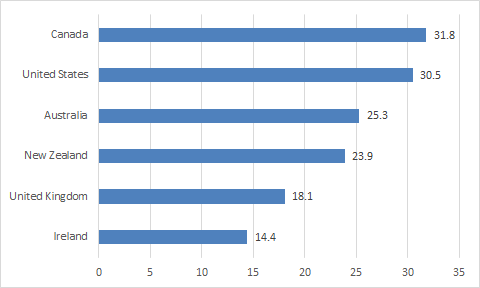
In another blow for the inherent inequality of bargaining power between workers and employers, and for the patriarchy, the wage gap is larger for tertiary educated female full-time workers aged 35-44 than it is for female full-time workers who just finished high school.
Figure 1: gender wage gap for mean full-time, full-year earnings for tertiary educated workers aged 35 – 44, 2012
Source: OECD family database.
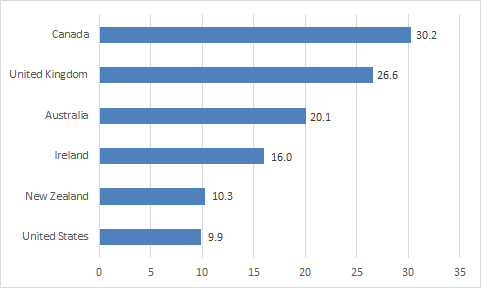
To add insult to injury, the gender wage gap further tertiary educated female workers is quite large in the USA but quite small for high school graduates.
Figure 2: gender wage gap for mean full-time, full-year earnings for below upper secondary educated workers aged 35 – 44, 2012
Source: OECD family database.
Canada seems to be a bit of a patriarchal hellhole while New Zealand does pretty well in gender wage gaps.
The gender gap in figure 1 and in figure 2 are unadjusted and calculated as the difference between mean average annual full-time, full-year earnings of men and of women as a percentage of men’s earnings.
Male labour force participation has been in a long-term decline
24 May 2015 Leave a comment
in gender, labour economics, labour supply, occupational choice, unemployment Tags: labour demographics, labour force participation, male labour force participation, reversing gender gap
NEWS FLASH: The Labor Force Participation Rate for Men Has Been Steadily Trending Downward for the last 67 Years! http://t.co/N66WJJnHsF—
Mark J. Perry (@Mark_J_Perry) May 08, 2015
Youth unemployment in America by sex and education
21 May 2015 Leave a comment
in economics of education, human capital, labour economics, labour supply, unemployment Tags: great recession, labour demographics
The age composition of the US labour force
19 May 2015 Leave a comment
in labour economics, labour supply Tags: ageing society, labour demographics, labour force participation, older workers
It happened: Millennials are now the biggest generation in the U.S. workforce on.wsj.com/1IugHMe http://t.co/lUDjT1Rjwk—
Becky Bowers (@beckybowers) May 11, 2015
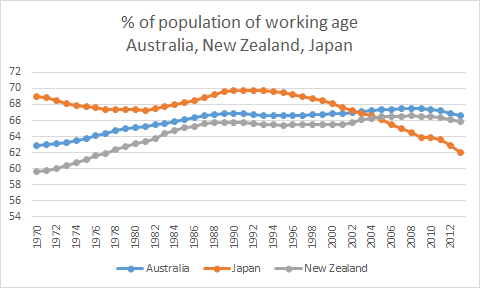
Working age populations of Australia, New Zealand and Japan
18 May 2015 Leave a comment
in labour economics, labour supply, politics - New Zealand, politics - USA Tags: ageing society, Australia, Japan, labour demographics, New Zealand
HT: OECD
Income by educational attainment in the USA
10 May 2015 Leave a comment
in economics of education, human capital, labour economics, labour supply, occupational choice Tags: College premium, education premium, labour demographics
Unemployment isn’t much of an issue for the well educated in recessions
09 May 2015 Leave a comment
in business cycles, economic growth, economics of education, human capital, job search and matching, labour economics, labour supply, macroeconomics, occupational choice, unemployment Tags: labour demographics, prosperity and depression
#StayinSchool
April jobless rate for people 25+ with
B.A. or more: 2.7%
No h.s. diploma: 8.6%
on.wsj.com/1H63SHl http://t.co/UwzHjiaQz9—
Sudeep Reddy (@Reddy) May 08, 2015
April jobless rate by race/ethnicity:
Black 9.6%
Hispanic: 6.9%
White 4.7%
Asian 4.4%
on.wsj.com/1H619hg http://t.co/qgRWa7MB85—
Sudeep Reddy (@Reddy) May 08, 2015
College graduates don’t really notice recessions
02 May 2015 Leave a comment
in business cycles, economics of education, great recession, human capital, labour economics, macroeconomics, occupational choice, politics - USA, unemployment Tags: College premium, education premium, labour demographics
Our monthly update on the question: should I stay in school? blogs.wsj.com/economics/2015… http://t.co/IaVxoAJmqe—
Josh Zumbrun (@JoshZumbrun) April 03, 2015
Working age populations start falling in many countries by 2025
29 Apr 2015 Leave a comment
in labour economics, labour supply Tags: ageing society, labour demographics
Would a living wage reduce poverty in America?
28 Apr 2015 Leave a comment
in labour economics, minimum wage, politics - Australia, politics - New Zealand, politics - USA, poverty and inequality Tags: labour demographics, living wage, poverty and inequality
How to argue for welfare reform when sincerely arguing against the 1996 US Federal welfare reforms
28 Apr 2015 Leave a comment
in labour economics, labour supply, occupational choice, poverty and inequality, welfare reform Tags: 1996 US welfare reforms, female labour supply, labour demographics, welfare state
The share of single mothers without a high school degree with earnings rose from 49 percent to 64 percent between 1995 and 2000 but has since fallen or remained constant almost every year since then. At 55 percent, it’s now just slightly above its level in 1997, the first full year of welfare reform (see first graph).

TANF now serves only 25 of every 100 families with children that live below the poverty line, down from AFDC’s 68 of every 100 such families before the welfare law
Over the last 18 years, the national TANF average monthly caseload has fallen by almost two-thirds — from 4.7 million families in 1996 to 1.7 million families in 2013 — even as poverty and deep poverty have worsened.
The number of families with children in poverty hit a low of 5.2 million in 2000, but has since increased to more than 7 million. Similarly, the number of families with children in deep poverty (with incomes below half of the poverty line) hit a low of about 2 million in 2000, but is now above 3 million.

The employment situation for never-married mothers with a high school or less education — the group of mothers most affected by welfare reform — has changed dramatically over the last several decades.
In the early 1990’s, when states first made major changes to their cash welfare programs, only about half of these mothers worked.
Importantly, there was a very large employment gap between the share of these never-married mothers and single women without children with similar levels of education, suggesting that there was substantial room for these never-married mothers to increase their participation in the labour force.
By 2000, the employment gap between these two groups of women closed, and it has remained so. But in the years since, the employment rate for both groups has fallen considerably.
The employment rate for never-married mothers is now about the same as when welfare reform was enacted 18 years ago. This suggests that the economy and low education levels are now the causes of limited employment among never-married mothers — not the availability of public benefits or anything particular to never-married mothers.

The Centre on Budget and Policy Priorities, who hail clearly from the Left of American politics, scrupulously documented the following:
- Big gains in the employment of single mothers until a setback in the Great Recession but is still much better than in 1996;
- Welfare dependency dropped by two thirds;
- Despite this two third drop in welfare dependency, and earnest predictions of acute poverty and deprivation made in 1996, the number of families in deep poverty has not changed, and the number of families in poverty fell significantly and only rose again with the Great Recession; and
- There was a dramatic increase in the percentage of never married mothers in employment, so much so that there is no difference in the employment rate of single women with no children and never married mothers!
Welfare dependency down by two thirds, employment of never married mothers up to levels no one thought possible, family poverty down, and economic independence is much more widespread and all because of the 1996 US Federal welfare reforms. That sounds like success to me – a great success.
via Chart Book: TANF at 18 | Center on Budget and Policy Priorities.
Japanese population has peaked and is now in rapid decline to 2050
27 Apr 2015 Leave a comment
in labour economics, labour supply, population economics Tags: ageing society, economics of fertility, Japan, labour demographics
Japan's projected population through 2050. #dataviz
Source: washingtonpost.com/blogs/worldvie… http://t.co/79DKF0mQTs—
Randy Olson (@randal_olson) January 06, 2015
 Utopia, you are standing in it!
Recent Comments