Elasticity and Slave Redemption in the Sudan in the 1990s
24 Jul 2016 Leave a comment
in applied price theory Tags: unintended consequences
Expressive voting, more gun control or fewer gun free zones
18 Jun 2016 Leave a comment
in applied price theory, applied welfare economics, comparative institutional analysis, economics of crime, economics of regulation, law and economics, politics - USA Tags: expressive voting, game theory, gun control, offsetting the, unintended consequences
https://twitter.com/Thomas_Conerty/status/649800146528563200
If you want fewer mass shootings, reduce the supply of gun free zones where even the craziest gunmen have been able to find despite being tormented by the voices as John Lott explains
Time after time, we see that these killers tell us they pick soft targets. With just two exceptions, from at least 1950, the mass public shootings have occurred in these gun-free zones. From last summer’s mass public killers in Santa Barbara and Canada, to the Aurora movie theatre shooter, these killers made it abundantly clear in their diaries or on Facebook how they avoided targets where people with guns could stop them.
And even when concealed handgun permit holders don’t deter the killers, the permit holders stop them. Just a couple of weeks ago, a mass public shooting at a liquor store in Conyers, Ga., was stopped by a concealed handgun permit holder.
The USA is in an arms race between criminals and law-abiding citizens. Both have lots of guns so the only people who gain from disarmament to those who obey the law to have fewer guns. They are in a high gun equilibrium where it very difficult to get out of this arms race.
Demands for more gun control and bans on specific weapons postpone the hard work of how to reduce mass shootings in a society with easy gun access. It is expressive politics at its worse.
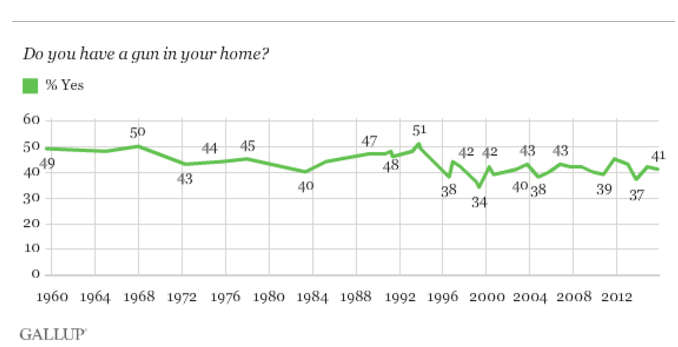
What does U.S. gun ownership really look like? Load up with #PollPosition’s @Johnnydontlike: bit.ly/1y2EMjX http://t.co/fn5EpM75U7—
(@PJTV) March 25, 2015
An Australian politician today in an unrelated context regarding universal health insurance in Australia called Medicare made this point about politics is hard work, not political theatre
It’s so much easier today to be a cynical poseur than a committed democrat, it’s easier to retreat to observer status than convince your friends of the merits of incremental change.
It required hard slog to ensure those institutions could survive the heat of adversarial politics. Then it took election campaign after election campaign, tough political negotiation, administrative effort, and the making and breaking of careers and governments to finally make Medicare stick,” she said.
The creation of Medicare took more than a hollow-principled stand, it took more than just wishful thinking, it took more than slogans, it took more than protests. It took real, tough politics. It took idealists who were prepared to fight to win government.
Expressive politics is about what voters boo and cheer, not whether policies actually work if adopted. Voters want to feel good about what they voted for and find a sense of identity in who they oppose and what they support. After a mass shooting, voters feel they must do something, cheer for something better and cheering for more gun control is an easy way to feel better.
Gun control is not going to happen in the USA because of the poor incentives for law-abiding individuals to retreat from high levels of legal private gun ownership when criminals will keep their guns. Harry Clarke pointed out that:
The political popularity of guns is strengthened by Prisoner’s Dilemma disincentives for individuals to retreat from high levels of gun ownership.
Accepting a gun buyback would be unattractive to citizens who would recognize high levels of overall gun ownership in the community and, hence, their own personal increased vulnerability if those with criminal intent acted rationally and kept their weapons.
If you want fewer mass shootings, fewer gun free zones is the way to go. That might have other unintended consequences but more mass shootings is not likely to be one of them. Ready access to guns in moments of despair increases suicide rates. Suicides in the Israeli Defence Force fell 40% when young soldiers were not allowed to take their guns home at the week-end. Suicides do not increase during the week so the lack of weekend access to guns got them through dangerous moments of despair where ready access to a firearm would have led to a suicide.
The last thing spree killers want is to be quickly shot down like the dogs they are such as at an American church in 2007. The last wannabe jihadist to try it on in Texas died in a hail of gunfire.
The U.S. Department of Justice’s National Crime Victimization Survey showed the risk of serious injury from a criminal attack is 2.5 times greater for women offering no resistance than for women resisting with a gun. 97% of murders are by men. Any arguments about gun control should be about gun control for men.
The sharemarket perception of gun control is every time there are calls for more gun controls, the share prices of gun manufacturers surge of the back of an anticipated spike in sale. Buying two gun shares on the first trading day after 12 recent mass shootings and selling them 90 days later produces a return of 365% over a nine-year period compared to 66 percent for the S&P 500 Index. A buy-and-hold bet on Smith & Wesson stock starting in January 2007returns 137%.
What gun-control headlines mean for gun-industry bottom lines: reut.rs/20LPJGf via @specialreports https://t.co/R3QiG4MuSM—
Reuters Top News (@Reuters) February 05, 2016
The key to the success of Australian and New Zealand gun laws was low levels of gun crime and minimal use of guns for self-defence. There was no arms race as compared to the USA where criminals and civilians are both armed. It is easy to control an arms race that has not started. The New Zealand, Australian and even the British police rarely have to discharge their weapons.
Martin Luther King was a gun owner for obvious reasons. Tom Palmer was the lead litigant in the recent Supreme Court case on gun control in the USA. He saved himself and a fellow gay man from a severe beating in 1987 by gang of 20 men by pulling a gun on them. Pink pistols has been in the thick of anti-gun control litigation in the USA.
Repugnant markets and the demand and supply for counterfeit legal ivory
17 Jun 2016 Leave a comment
in applied price theory, economics of crime, entrepreneurship, law and economics, property rights Tags: black markets, counterfeit goods, economics of prohibition, endangered species, offsetting the, unintended consequences
A huge legal sale of ivory in 2008 backfired. Instead of crashing the price of ivory and undermining poaching, poaching exploded in East Africa. It increased by 65%.
The international trade in ivory was banned in 1989. In 2008, China and Japan were allowed to pay $15m for 107 tonnes of ivory from elephants that died naturally in four African nations.
Source: Study finds global legalization trial escalates elephant poaching | Berkeley News.
Hsiang and Sekar this week found that this legal sale of ivory was followed by “an abrupt, significant, permanent, robust and geographically widespread increase” in ivory poaching. They were right to conclude that the legal sale provided a cover for poached ivory.
The economic intuition was that if we allow the sale of some legal ivory in Japan and China, then there would be fewer people left to purchase it illegally. We found that that intuition was incorrect. The black market for ivory responded to the announcement of a legal sale as an opportunity to smuggle even more ivory.
The legal sale of ivory created new demand for ivory in China, where it no longer had the stigma of an illicit product. The presence of legal ivory provided cover for smugglers trying to peddle illegal ivory sourced from poachers.
As illegal ivory can now masquerade as legal ivory in China, transporting and selling illicit ivory has gotten easier and cheaper, which can boost illegal production even though prices are falling.
Ivory is a repugnant market. Many friends will be revolted by you having ivory products.
The presence of legal ivory made it possible for counterfeit legal ivory to be passed off as legal ivory and therefore your friends will not reject you. This is a real and striking example of a unintended consequence. The solution to poaching is property rights.
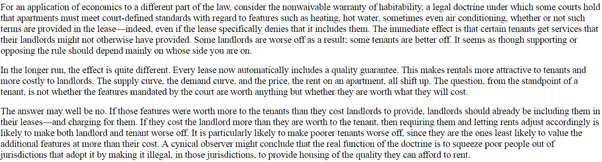
@jacindaardern @NZLabour’s Healthy Homes Bill will raise rents to poor tenants and students
05 May 2016 1 Comment
in David Friedman, economics of regulation, law and economics, politics - New Zealand Tags: avoiding difficult decisions, housing habitability laws, living standards, New Zealand Labour Party, offsetting, rent control, The fatal conceit, The pretense to knowledge, unintended consequences
Source: David Friedman, Chapter 1: What Does Economics Have to Do with Law?
@AmyAdamsMP 3 strikes deters many crimes but with a twist @dbseymour @greencatherine
17 Mar 2016 Leave a comment
in applied price theory, economics of crime, law and economics Tags: career criminals, criminal deterrence, habitual criminals, Leftover Left, marginal deterrence, offsetting behaviour, primate punishment, unintended consequences
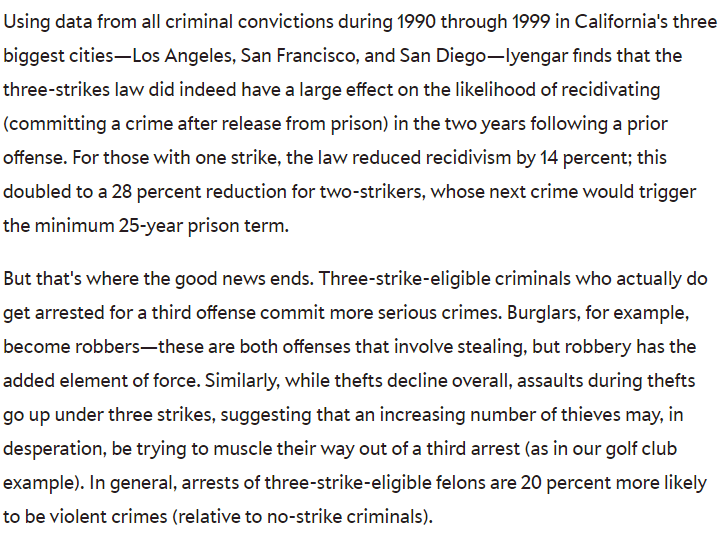
A card-carrying Leftist would not know what to do with this study by Radha Iyengar. In their life mission of excusing criminals, they could bait and switch. Quickly acknowledged the results of the study, a massive reduction in serious crime, then go on as fast as possible to the unintended consequences on marginal deterrence. 3rd strike offenders tend to commit more violent crimes because they have less to lose. That is basic applied price theory.
Source: Do three-strikes laws make criminals more violent?
Sadly, card-carrying leftists denied themselves this argument when arguing against 3 strikes when the laws before Parliament. You have to admit the deterrence works in order to argue that 3 strikes and you are out screws up marginal deterrence.
To be fair, the Left did not do that fully. The standard argument against life without parole is that these prisoners will have nothing to lose and will be difficult for the prison guards to manage. That is, life without parole screws up marginal deterrence even among hardened criminals.
Greater maternity leave will increase the gender wage gap
31 Jan 2016 Leave a comment
in discrimination, gender, labour economics, labour supply, occupational choice, poverty and inequality Tags: asymmetric marriage premium, gender wage gap, high-powered jobs, offsetting behaviour, Parental leave, paternity leave, unintended consequences
@donal_curtin @smalltorquer Does competition law in high-tech markets help consumers?
14 Dec 2015 2 Comments
in applied price theory, economics of regulation, Gary Becker, industrial organisation, politics - New Zealand, politics - USA, Sam Peltzman Tags: Aaron Director, anti-trust law, cartels, competition law, creative destruction, entrepreneurial alertness, merger law enforcement, offsetting the, The fatal conceit, unintended consequences
New Zealand has decriminalised cartels. Price fixers cannot be sent to prison but can still be fined. Some agree, some disagree with the wisdom of this move.
Those that agreed with the wisdom of this move were christened cartel apologists by one of those that disagree with the removal of criminal penalties for cartels.
There is an infallible rule in competition law enforcement. It arises mostly crisply in merger law enforcement. If competitors oppose a merger, the merger must be pro-consumer. If the merger is anti-competitive, that merger will increase prices. The competing firms can follow those prices up and profit from the weakening of competition.
Under the collusion hypothesis, rivals of the merging firm benefit since there is a higher probability of successful collusion limits output and raises product prices. The share prices of these rival firms should increase in anticipation of enhanced cartel profits. As Eckbo explains:
Using Stigler (1964) theory of oligopoly, a horizontal merger can reduce the monitoring costs by reducing the number of independent producers in the industry. The fewer the members of the industry the more “visible” are each producers actions, and the higher is the probability of detecting members who try to cheat on the cartel by increasing output.
When was the last time an entrepreneur complained about his rivals putting their prices up? The entrepreneur can either match that price increase or undercut it to win more business. The real reason competitors oppose a merger is the merged firm will have lower costs, making it a fiercer competitor.

If the share prices of competitors fall on news of the merger, they are worse off as a result because they face a fiercer competitor. If their share prices rise, that suggests either that others in the industry are to benefit from higher prices or rival firms will soon replicate the cost savings discovered in the course of the merger. The latter is the information effect of mergers:
…since the production technologies of close competitors are (by definition) closely related, the news of a proposed efficient merger can also signal opportunities for the rivals to increase their productivity
Mergers are a high-risk way of securing higher prices unless there are offsetting cost saving of combining the two firms. Mergers disturb previously efficient firm sizes and risk diseconomies of scale and a burgeoning corporate hierarchy. A cartel is a safer way to raise prices by jointly agreeing to restrict output.
Cartels have few redeeming features. Cartels are inherently unstable because the history of cartels is the history of double-crossing. The best place in a cartel is to be on the outside undercutting it slightly to sell as you can at inflated cartel price.
The complication with cartels is competitors must sometimes coordinate their activities with their rivals in various ways such as agreeing product standards, undertaking joint ventures or licensing technologies to them.
Criminalisation of cartels may deter these business practices that promote consumer welfare. The process of innovation in new industries in particular often involves successful firms taking over the unsuccessful firms.
Serial competition is common in rapidly innovating industries with one dominant firm making hay for a while then quickly swept away. Merger law enforcement agencies do not handle the wake of creative destruction well.

There is no more cutthroat market than Hollywood. Yet the movie industry is riddled with collusion and joint ventures. Actors and producers can be collaborating on one film and also be making another film that will be its rival in the box office when released.
The movie industry would not work without this incestuous mix of competition and collaboration. Joint ventures are aplenty between otherwise direct competitors in the film industry. When do these joint ventures become cartels threatened with criminal penalties?
What should be another working rule in competition law enforcement is when there is reasons to stay your hand, that is usually a good idea even if you do not have the reasons worked out yet. When in doubt, stay your hand.
It goes back to that extremely famous 1984 essay by Frank Easterbrook on the limits of anti-trust law. The essay was about errors in competition policy and law enforcement:
- When a competition law enforcer makes a mistake and closes off an efficiency enhancing practice or stops a pro-consumer merger, there are few mechanisms to correct this mistake; and
- If a competition law enforcer inadvertently does not stop a anti-competitive merger or lets a collusive or inefficient practice get through, at least there is market processes that will slowly chip away at his mistake.
Easterbrook argued that courts and enforcers should craft liability and procedural rules to minimise the sum of competition law’s error and decision costs:
The legal system should be designed to minimize the total costs of (1) anticompetitive practices that escape condemnation; (2) competitive practices that are condemned or deterred; and (3) the system itself
Competition law enforcers and policymakers made plenty of errors in the past. Chastened by their follies aplenty in the past, competition law policymakers should not approach any issue with overconfidence. They have had a dismal track record in aligning competition law with applied price theory and the basics of the economics of industrial organisation.
That is at best only a good start for the competition law enforcement agencies. This is because the economics of industrial organisation spent a lot of time condemning practices that neither restricted output or increased prices.
It took many decades for consumer welfare to be the exclusive goal of competition. Time and again protecting competitors from competition was the priority of competition law enforcement agencies.

The ICT revolution coincided with a revolution in competition law economics and policy. That revolution consisted of basing competition law on applied price theory and not condemning every novel or as yet unexplained practice.
In the high-tech industries, competition law runs a high risk of chilling innovation. As Joshua Wright said:
Innovation is critical to economic growth. Incentives to innovate are at the heart of the antitrust enterprise in dynamically competitive industries, and, thus, getting antitrust policy right in high-tech markets is an increasingly important component of regulatory policy in the modern economy. While antitrust enforcement activity in high-tech markets in the United States and the rest of the world is ever-increasing, there remain significant disputes as to how to assess intervention in dynamically competitive markets.
The relentless pursuit of Microsoft by the US Department of Justice at the behest of its competitors such as Netscape is notorious example of the chilling of innovation.
You are showing your age if you even remember who Netscape was. Its complaint was that Microsoft by giving away its browser was engaging in predatory competition.

Netscape want to protect consumers from the scourge of lower prices – from not having to pay $49 for the Netscape browser. You are showing your age if you have ever paid to install a browser.
Netscape had the advantage of a senior US senator representing the state where it was based. He happened to sit on the committee overseeing the budget of the US Anti-trust enforcement agencies.
We are still waiting for the day when Microsoft finishes giving away its browser, excludes competition from the market for browsers, jacks up its price to make up for a good 20 years of giving away its browser and is not immediately threatened by new entry.
Facebook is now worth more than Walmart
buff.ly/1fuvV7V h/t @DKThomp
$FB $WMT buff.ly/1fuvSZB http://t.co/FtIIJP3EGN—
Ninja Economics (@NinjaEconomics) June 22, 2015
The intrepid competition law enforcers of the 1990s did not anticipate a business model where competitors profitably give their product away.
Thankfully, Facebook did not face competitors who charged for their social media. If Facebook had faced such competition, what would the US Department of Justice thought of this anti-competitive practice of giving social media away. The scourge of lower prices again. That great bugbear of competition law enforcement agencies.
10 years ago today Facebook was founded by Mark Zuckerberg and his college friends http://t.co/IVFDFvu2VM—
History Pics (@HistoryPixs) February 04, 2014
Facebook is doing the exact same thing that Microsoft did when it gave away the Internet Explorer browser. To this day, competition law enforcement agencies including the New Zealand Commerce Commission do not accept lower prices to be lawful in all cases without exception.

A test of how imbibed you are with the fatal conceit about competition law is to cast your mind back as to what your attitude was to the Department of Justice anti-trust lawsuit against Microsoft.
If you thought the anti-trust lawsuit against Microsoft was well-founded, you are an optimist about the efficient scope of competition law. To quote McKenzie and Shughart:
Microsoft’s critics come far closer to the mark when they complain that Microsoft has been “brutally competitive” than when they claim Microsoft is a “monopoly.” From our perspective, it appears that once again the Justice Department is using the antitrust laws to thwart competition by a highly successful American firm. To protect unsuccessful competitors, it is squelching competition.
A long time has passed since that suit. People can reflect upon the extent to which Microsoft have successfully monopolised browsing the Internet. It hasn’t. As Gary Becker said:
Anti trust policy should recognize that dynamic competition is often a powerful force when static competition is weak. The big policy question then is whether it is worthwhile to bring expensive and time consuming anti trust cases against still innovating firms that have considerable profits and monopoly power, given the significant probability that new competitors will before long greatly erode this power through different products? I believe the answer to that is no, and that policy should often rely on dynamic competition, even when that allows dominant firms only temporarily to enjoy economic power.
The law and economics of competition has been a bit of a glass house for the last 50 years. People should be careful about criticising new idea and attempts to be more modest about the positive contribution the competition law makes to society.
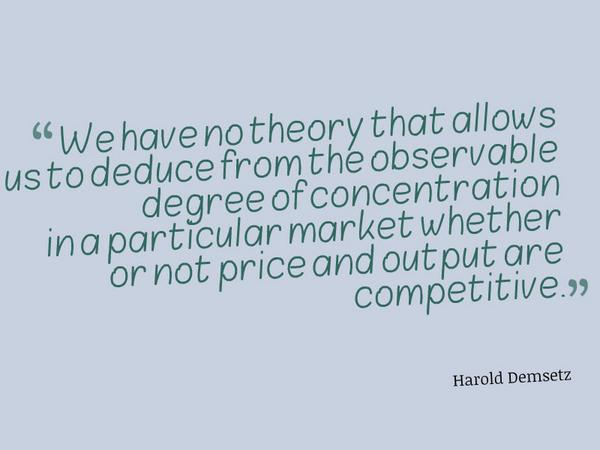
Competition law can subvert competition by stymieing the introduction of new goods and the temporary monopoly often necessary to recoup their invention costs and induce innovation. Sam Peltzman, when reflecting on the contributions of Aaron Director to the law and economics of competition said:
There are the myriad of ways in which real world business practices behave differently from the caricaturing in textbooks. Those differences sometimes arouses suspicious responses from economists. Visions of market power and deadweight loss triangles dance their heads, and some of the suspect practices have been constrained by anti-trust policy. Director rejected this kind of intellectual laziness, and he sought, sometimes successfully, to inoculate those around him against it.
Director approached all business practices with the methodology that entailed asking very basic questions and answering them in a rigorous logic that it appealed ultimately to facts. The style was verbal – some combination of Socratic dialogue and Adam Smith. This style had the disadvantage of producing few closed-form solutions. But it had the advantage of permitting analysis of the kind of problems that eluded simple solutions.
Indeed I believe that one reason for Director’s lasting influence he was able to show that simple judgements about business practices often cannot withstand rigorous scrutiny.
Economic theory and empirical evidence are full of examples of business conduct that reduce choice but increase consumer welfare through lower prices, more innovation, or higher quality products and services. Manne and Wright noted in the paper, Innovation and the Limits of Antitrust that:
Both product and business innovations involve novel practices, and such practices generally result in monopoly explanations from the economics profession followed by hostility from the courts (though sometimes in reverse order) and then a subsequent, more nuanced economic understanding of the business practice usually recognizing its pro-competitive virtues.
Competition law enforcement agencies are suing Google because it is anti-competitive. The dead hands of the competitors to Google are buried somewhere in those suits. Is there no learning. There is certainly no modesty about past mistakes about the proper scope of competition law.

Milton Friedman explains the public choice error
12 Dec 2015 Leave a comment
in comparative institutional analysis, constitutional political economy, economics of bureaucracy, Milton Friedman, Public Choice Tags: grass is greener fallacy, public choice error, The fatal conceit, The pretense to knowledge, unintended consequences
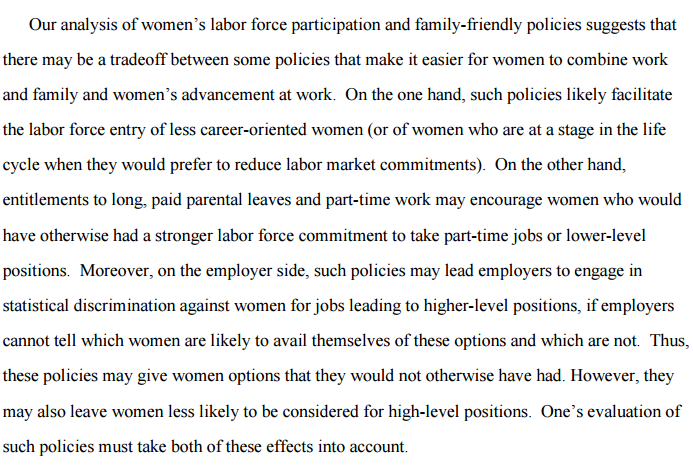
@suemoroney more generous maternity leave increases the gender wage gap @JanLogie
07 Dec 2015 Leave a comment
in applied price theory, discrimination, economics of love and marriage, gender, labour economics, labour supply, law and economics, occupational choice, politics - New Zealand Tags: do gooders, expressive voting, female labour force participation, gender wage gap, maternal labour supply, maternity leave, The fatal conceit, unintended consequences

Source: Why Are Women Paid Less? – The Atlantic.
Source: AEAweb: AER (103,3) p. 251 – Female Labor Supply: Why Is the United States Falling Behind?
Will global warming boost economic growth? @GreenpeaceNZ @RusselNorman The revenge of the broken window fallacy
03 Dec 2015 Leave a comment
in applied price theory, economic growth, entrepreneurship, environmental economics, global warming, macroeconomics, Robert E. Lucas Tags: climate alarmists, endogenous growth theory, entrepreneurial alertness, exogenous growth theory, global warming, Matthew Kahn, neoclassical growth theory, offsetting, Robert Solow, unbalanced growth, unintended consequences
A hidden cost of terrorism
28 Nov 2015 1 Comment
in applied price theory, applied welfare economics, economics of crime, law and economics, transport economics, war and peace Tags: offsetting the, risk risk trade-offs, unintended consequences, war against terror
Peak China
20 Nov 2015 Leave a comment
in development economics, population economics Tags: China, offsetting behaviour, one child policy, The fatal conceit, The pretence to knowledge, unintended consequences
The costs of solar energy to the environment are underestimated
13 Nov 2015 Leave a comment
in energy economics, environmental economics, global warming Tags: Big Solar, expressive voting, renewable energy, solar energy, unintended consequences
https://twitter.com/roomfordebate/status/662290426083328000
Source: The Costs of Solar Energy to the Environment – Room for Debate – NYTimes.com.
Chinese birth and death rates and the Chinese population since 1950
04 Nov 2015 Leave a comment
in development economics, growth disasters, growth miracles, labour economics, labour supply, population economics Tags: China, economics of fertility, one child policy, The fatal conceit, The pretense to knowledge, unintended consequences


Recent Comments