Henry Hazlett on why economics is so difficult
20 Aug 2015 Leave a comment
in applied price theory, applied welfare economics, comparative institutional analysis, constitutional political economy, economics of bureaucracy, income redistribution, Public Choice, rentseeking Tags: antiforeign bias, antimarket bias, bootleggers and baptists, green rent seeking, Henry Hazlett, makework bias, methodology of economics, philosophy of economics
Should We Subsidize Scientific Research?
18 Aug 2015 Leave a comment
in applied price theory, applied welfare economics, entrepreneurship, industrial organisation, Public Choice, rentseeking, survivor principle Tags: competition as a discovery procedure, economics of science, industry policy, losers, picking winners, R&D, The meaning of competition, The pretence the knowledge
Julian Simon and William Buckley on Cross–Fire
18 Aug 2015 Leave a comment
in applied price theory, applied welfare economics, economic history, energy economics, entrepreneurship, environmental economics, environmentalism, liberalism, resource economics Tags: commodity prices, creative destruction, entrepreneurial alertness, Julian Simon, peak oil, The Great Enrichment, The Great Escape, The Great Fact, William Buckley
Joseph Schumpeter on The Great Enrichment
18 Aug 2015 Leave a comment
in applied welfare economics, economic history, entrepreneurship, liberalism Tags: capitalism and freedom, creative destruction, Joseph Schumpeter, The Great Enrichment, The Great Escape, The Great Fact
Everything’s Amazing and Nobody’s Happy
18 Aug 2015 Leave a comment
in applied welfare economics, development economics, economic history, economics of information, economics of media and culture, growth disasters, growth miracles, liberalism Tags: antimarket bias, Bryan Caplan, capitalism and freedom, life expectancies, living standards, pessimism bias, The Great Enrichment, The Great Escape, The Great Fact
The Great Escape is on-going
18 Aug 2015 Leave a comment
in applied welfare economics, development economics, economic history, environmental economics, growth disasters, growth miracles, health economics Tags: child mortality, global poverty, infant mortality, life expectancies, stream poverty, The Great Escape, The Great Fact
https://twitter.com/humanprogress/status/631179133989617665/photo/1
The total number of undernourished persons is falling despite population growth. buff.ly/1MgKWqd #food #health http://t.co/YfAltqvxVy—
HumanProgress.org (@humanprogress) August 11, 2015
Extreme poverty is declining, but more quickly in some places than others. See the data: buff.ly/1DDz0O5 http://t.co/W1a0WpCxHI—
HumanProgress.org (@humanprogress) August 11, 2015
Julian Simon on Resources, Growth and Human Progress
17 Aug 2015 Leave a comment
in applied welfare economics, development economics, economic history, energy economics, entrepreneurship, environmentalism, health economics, liberalism, resource economics Tags: capitalism and freedom, commodity prices, creative destruction, entrepreneurial alertness, Julian Simon, life expectancies, peak oil, The Great Enrichment, The Great Escape, The Great Fact
On the inefficiency of fuel efficiency standards
17 Aug 2015 Leave a comment
in applied price theory, applied welfare economics, economics of regulation, energy economics, environmental economics Tags: fuel efficiency standards, offsetting behaviour, The fatal conceit, The pretense to knowledge, unintended consequences
The benefits and costs of the @NZSuperFund since its inception
17 Aug 2015 Leave a comment
in applied price theory, applied welfare economics, economic growth, economic history, entrepreneurship, financial economics, fiscal policy, industrial organisation, labour economics, labour supply, macroeconomics, politics - New Zealand, public economics Tags: ageing society, company tax rate, deadweight cost of taxes, demographic crisis, efficient markets hypothesis, laffer curve, New Zealand superannuation fund, old age pensions, retirement savings, social insurance, sovereign wealth funds, taxation and entrepreneurship, taxation and investment, taxation and labour supply
Most mutual funds still can't beat their benchmark read.bi/1GkTig1 http://t.co/r7ezoDGJbV—
BI Chart of the Day (@chartoftheday) June 03, 2015
The New Zealand Superannuation Fund, the sovereign wealth fund part funding New Zealand’s old-age pension from 2029/2030 onwards, has been a bit of a wild ride. Sometimes the earnings of the Fund were well below and sometimes earning well above the long-term bond rate.
![image_thumb[3]](https://utopiayouarestandinginit.com/wp-content/uploads/2015/08/image_thumb310.png "image_thumb[3]")
Source: New Zealand Superannuation Fund Annual Report 2014.
Since its inception, the Fund earned an average annual return of 9.78%, which was 5.06% above the long-term bond rate, and 1.03% above its reference portfolio.

No information was given in the annual report of the New Zealand Superannuation Fund on the marginal dead weight cost of the taxes raised to fund the New Zealand Superannuation Fund to see whether there is any net benefit to taxpayers from its establishment and continued operation.
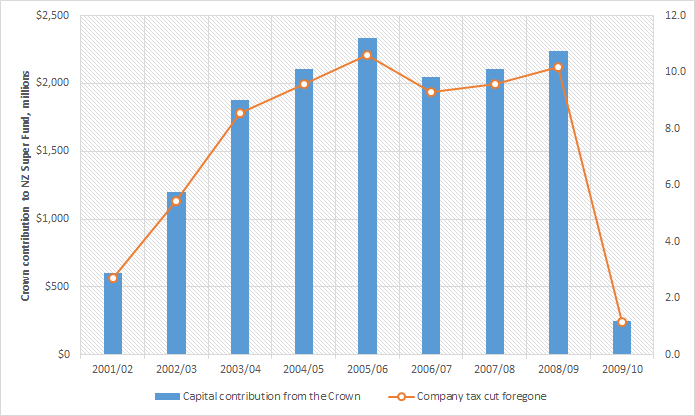
The New Zealand Government has contributed $14.88 billion to the fund from prior its inception in 2001 to the suspension of contributions in 2009 by the incoming National Party Government.
Source: New Zealand Treasury.
Over the nine years in which contributions were made, the company tax rate of 28% could have easily been up to 10 percentage points lower.
The New Zealand Treasury estimates that a one percentage point cut in the company tax costs about $220 million in forgone revenue if there are no other changes to the tax system. These are static estimates that do not include any feedback from greater investment and higher growth.
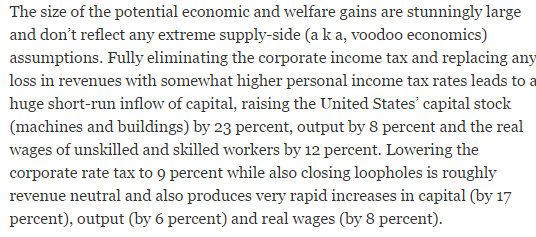
The New Zealand Superannuation Fund must beat the market every single year to make up for the deadweight cost of its funding, a premium for the investment risk added to the Crown’s portfolio and the cost to New Zealand’s growth rate of higher than otherwise taxes on income, entrepreneurship and investment.
Source: Abolish the Corporate Income Tax – The New York Times.
Settled science part 1: Is science ever actually settled?
17 Aug 2015 Leave a comment
in applied welfare economics, energy economics, environmental economics, history of economic thought Tags: climate alarmism, conjecture and ref patient, global warming, methodology of economics, philosophy of science, philosophy of social sciences

 We are constantly told that “everyone has a right to their opinion” and “there are two sides to every story.” Our entire news system is predicated on the notion that we need to give fair time to both sides of every situation. The problem with this type of thinking is that it leads to the misconception that both sides are equally valid, or, at the very least, that there must be some truth to both sides, but in many cases, only one side has any merit. In other words, it’s often not opinion #1 vs. opinion #2, rather, it is fact vs. fiction. One “side” is reality, while the other “side” is a fairy tail. For example, if you want to say that the island of Jamaica is being carried around on the back of giant sea turtle, that’s not your opinion, you’re just wrong. There wouldn’t be two legitimate…
View original post 1,489 more words
Mises on the role of statistics
16 Aug 2015 Leave a comment
in applied price theory, applied welfare economics, comparative institutional analysis, econometerics, economic history, Ludwig von Mises Tags: methodology of economics, philosophy of economics, statistics
The Battle Over Global Warming Is All in Your Head
16 Aug 2015 Leave a comment
in applied price theory, applied welfare economics, economics of information, economics of media and culture, energy economics, environmental economics, global warming Tags: climate alarmism, doomsday prophecies, global warming, political psychology
% of unemployment lasting longer than 12 months in Scandinavia since 1976
16 Aug 2015 Leave a comment
in applied welfare economics, business cycles, constitutional political economy, economic history, job search and matching, labour economics, labour supply, macroeconomics, Public Choice, unemployment Tags: borders, deployment subsidies, economics of borders, equilibrium unemployment rate, Finland, labour market programs, long-term unemployment, maps, natural unemployment rate, Norway, Scandinavia, search and matching, Sweden, unemployment durations
As I recall, most unemployed have been unemployed longer than 12 months in Sweden have to go on a labour market program. When they returned to unemployment after the program, the clock starts again. They are deemed to be freshly unemployed rather than adding to the previous spell with an interlude on a make work program. This makes Swedish long-term unemployment data rather unintelligible.
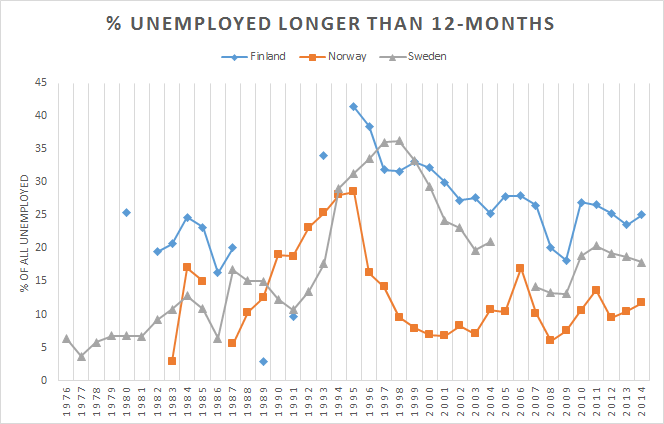
Source: OECD StatExtract.
Finland was recovering from its worst depression since the 1930s and the early 1990s when its data on long-term unemployment started to be continuous. This makes Finnish unemployment data rather difficult to interpret. Norway’s data for the long-term unemployed goes up and down a bit too much to be trustworthy without a background policy narrative.
 Utopia, you are standing in it!
Recent Comments