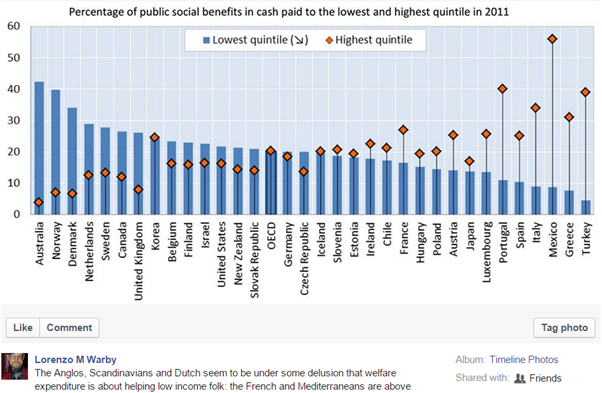
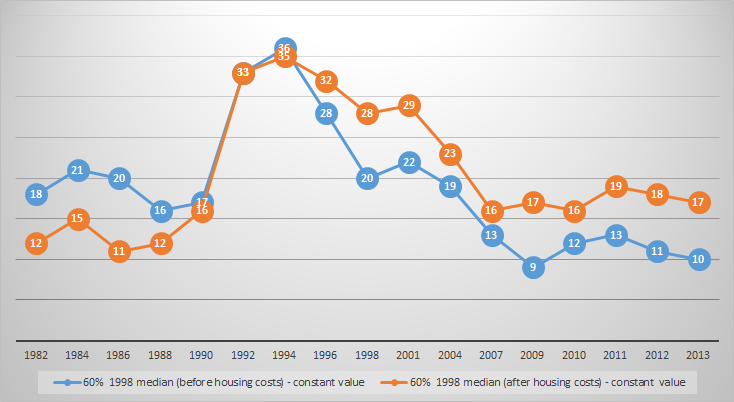
New from @iealondon: Scandinavian success is not due to high taxes and welfare spending. iea.org.uk/in-the-media/p… http://t.co/QVH566KNtV—
IEA (@iealondon) July 07, 2015
The impact of welfare states on life expectancy
07 Aug 2015 Leave a comment
in applied welfare economics, fiscal policy, labour economics, politics - Australia, politics - New Zealand, politics - USA, poverty and inequality, welfare reform Tags: Denmark, Finland, life expectancies, Norway, Sweden, welfare state
Taxes on minimum wage earners across the OECD area
28 Jul 2015 Leave a comment
in labour economics, labour supply, politics - Australia, politics - New Zealand, politics - USA, welfare reform Tags: earned income tax credits, family tax credits, in-work tax credits, taxation and the labour supply
#MinimumWage shd be combined w/ #tax policies to help both workers & their employers; see bit.ly/1KfRNOB http://t.co/8klfJXmY4s—
(@OECD) July 25, 2015
Did the 1996 federal welfare reforms increase child poverty in America?
25 Jul 2015 Leave a comment
in applied welfare economics, economic history, labour economics, poverty and inequality, welfare reform Tags: 1996 U.S. welfare reforms, child poverty, family poverty
Number of black children in poverty may have eclipsed whites for the first time on record pewrsr.ch/1M7La40 http://t.co/wnb9sLo9Fv—
PewResearch FactTank (@FactTank) July 18, 2015
@Income_Equality there’s an Internet you know – was there next to no unemployment prior to the mid-1980s in New Zealand?
24 Jul 2015 Leave a comment
in business cycles, econometerics, economic growth, economic history, job search and matching, labour economics, labour supply, macroeconomics, politics - New Zealand, Public Choice, unemployment, unions, welfare reform Tags: antimarket bias, Don Brash, economic reform, expressive voting, Homer Simpson, Leftover Left, lost decades, makework bias, neoliberalism, rational ignorance, rational irrationality, Sir Roger Douglas, Twitter left
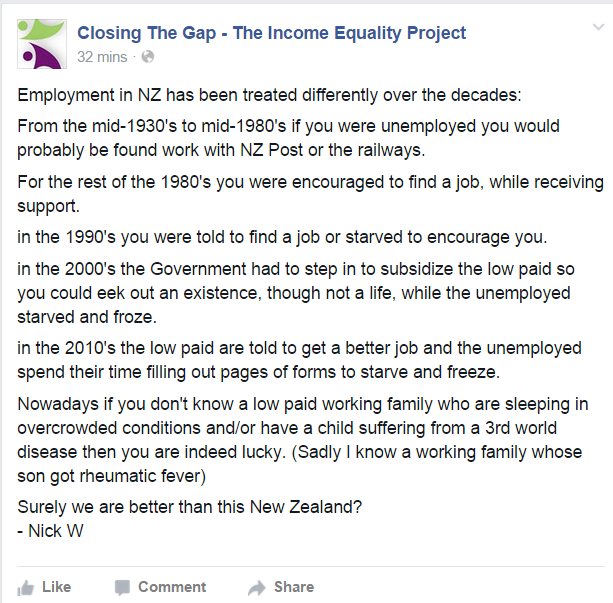
Today, Closing The Gap – The Income Inequality Project boldly claimed today that there was next to no unemployment in New Zealand prior to the onset of the curse of neoliberalism.
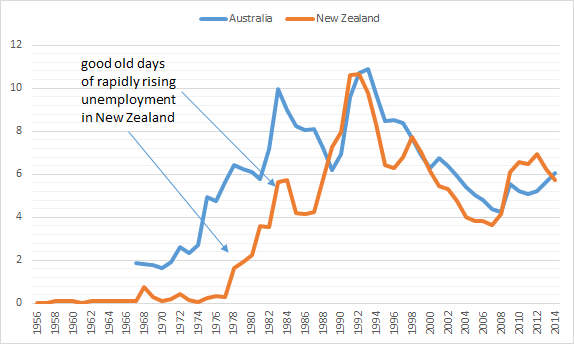
There is an Internet on computers now where it is easy to find data showing that the unemployment rate was rising rapidly in New Zealand in the 1970s and in double digits by the end of the 1980s – see figure 1.
Figure 1: harmonised unemployment rates, Australia and New Zealand, 1956-2014
Source: OECD StatExtract.
Figure 1 shows unemployment was rising rapidly in the 1970s and wasn’t much different by the end of the 1970s to the unemployment rates recorded after about 2000 in New Zealand.

One of the reasons that Sir Roger Douglas wrote There’s Got To Be A Better Way was the rapidly rising unemployment in New Zealand and the stagnant economic growth in the late 1970s and early 1980s.
![]()
New Zealand was one of the most regulated economies, so much so that Prime Minister David Lange said:
We ended up being run very similarly to a Polish shipyard.
As for those jobs on the railways, the then Reserve Bank Governor Don Brash said in 1996:
Railways cut its freight rates by 50 percent in real terms between 1983 and 1990, reduced its staff by 60 percent, and made an operating profit in 1989/90, the first for six years.
More on unemployment: In 1955 the New Zealand’s prime minister knew all unemployed personally.
– Atkinson’s new book http://t.co/x37Vxya97C—
Max Roser (@MaxCRoser) July 24, 2015
Low pay across the OECD
18 Jul 2015 Leave a comment
in minimum wage, politics - Australia, politics - New Zealand, politics - USA, poverty and inequality, unions, welfare reform Tags: living wage, low pay, minimum wage
Poverty rates among immigrants and natives across the OECD
16 Jul 2015 Leave a comment
in income redistribution, labour economics, politics - Australia, politics - New Zealand, politics - USA, poverty and inequality, welfare reform Tags: Australia, child poverty, economics of immigration, family poverty
There were large cross-country differences in long-term unemployment duration both before and after the GFC
15 Jul 2015 Leave a comment
in Euro crisis, global financial crisis (GFC), great recession, job search and matching, labour economics, labour supply, macroeconomics, unemployment, welfare reform Tags: equilibrium unemployment rate, Eurosclerosis, natural unemployment rate, unemployment duration
77% more long-term unemployed people than before the crisis – We need them back in work! bit.ly/1JTTzYm #Jobs http://t.co/EFRGclFVms—
OECD Social (@OECD_Social) July 10, 2015
Hysteresis in practice, Delong-Summers Variety @delong @LHSummers http://t.co/urqxQBi6NE—
Roger E. A. Farmer (@farmerrf) July 23, 2015
Recent Comments