Thinking about The Great Leap Forward | Econbrowser
19 Apr 2016 Leave a comment
in applied price theory, applied welfare economics, comparative institutional analysis, development economics, economic growth, economic history, growth disasters, industrial organisation, law and economics, Marxist economics, Public Choice, rentseeking Tags: China, economics of planning, extreme poverty, famine, Great Leap Forward
Will the population bomb prevent the great stagnation?
16 Apr 2016 Leave a comment
in applied price theory, development economics, economic growth, industrial organisation, P.T. Bauer, population economics Tags: doomsday prophecies, endogenous growth theory, pessimism bias, population bomb

If only Paul Ehrlich had been right! Population explosion would have meant an explosion in people who could invent new technologies and populate in much larger markets to provide an incentive to invent new products.

Among Paul Ehrlich’s many analytical errors, he did not take into account that more people meant more inventors and more untapped markets.
Jones argued that in the very long run the only way to have further innovation is to have more people. If there are more people undertaking R&D and more people to populate the markets for those inventions, there will be further growth because the decreasing returns to knowledge creation will be overcome by having more R&D workers.
Jones attributes much of the growth in the 20th century to one-off effects that cannot be repeated such as putting more people into higher education:
… growth in educational attainment, developed-economy R&D intensity, and population are all likely to be slower in the future than in the past. These factors point to slower growth in US living standards.
Second, a counterbalancing factor is the rise of China, India, and other emerging economies, which likely implies rapid growth in world researchers for at least the next several decades.
Third, and more speculatively, the shape of the idea production function introduces a fundamental uncertainty into the future of growth. For example, the possibility that artificial intelligence will allow machines to replace workers to some extent could lead to higher growth in the future.
A larger population increases the rate of technological progress by increasing the number of geniuses and other creative people.The doomsday prophecies about the population bomb never took that into account. That is why they are wrong.
What will global GDP look like in 2030?
11 Apr 2016 Leave a comment
in development economics, economic growth, economics, economics of media and culture, growth disasters, growth miracles Tags: The Great Enrichment
What Was the Industrial Revolution? – Robert E. Lucas
04 Apr 2016 Leave a comment
in development economics, economic growth, economic history, history of economic thought, Robert E. Lucas Tags: industrial revolution
Unemployment rates across the OECD in 2015
26 Mar 2016 Leave a comment
in business cycles, economic growth, Euro crisis, global financial crisis (GFC), great recession, job search and matching, labour economics, macroeconomics, unemployment
@danielbenami on Ferraris For All
20 Mar 2016 Leave a comment
in development economics, economic growth, economics, economics of media and culture Tags: The Great Enrichment
British tax mix as a percentage of GDP
19 Mar 2016 Leave a comment
in economic growth, economic history, entrepreneurship, fiscal policy, macroeconomics, public economics Tags: British disease, British economy, growth of government, sick man of Europe, size of government, taxation and entrepreneurship, taxation and investment, taxation and labour supply, Thatchernomics
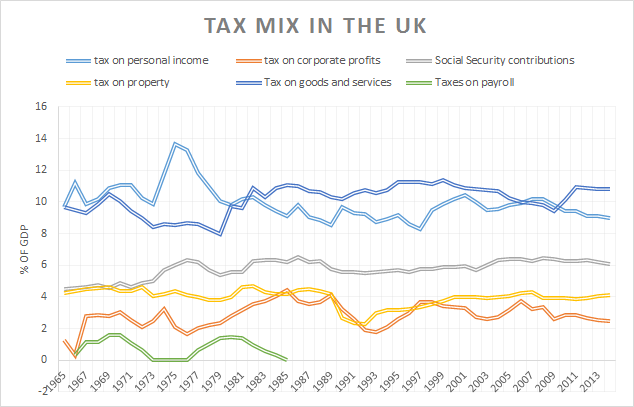
The large rise in tax in personal income in the 1970s coincided with the rise of the British disease and British economy becoming widely known as the sick man of Europe. The large decline in taxation in personal income under Thatchernomics was followed by an economic boom.
Source: OECD Stat.
Lunch and Conversation with Thomas J. Sargent
18 Mar 2016 Leave a comment
in economic growth, economics, Euro crisis, fiscal policy, global financial crisis (GFC), great recession, job search and matching, macroeconomics, monetary economics, Public Choice Tags: Thomas Sargent
@James_ARobins yet another @MaxRashbrooke #inequality fact check
17 Mar 2016 Leave a comment
in applied welfare economics, economic growth, economic history, labour economics, poverty and inequality, unemployment Tags: antimarket bias, pessimism bias, rational irrationality, The Great Enrichment, top 1%

Source: Do inequality and poverty matter? | Pundit – Brian Easton (2016) .
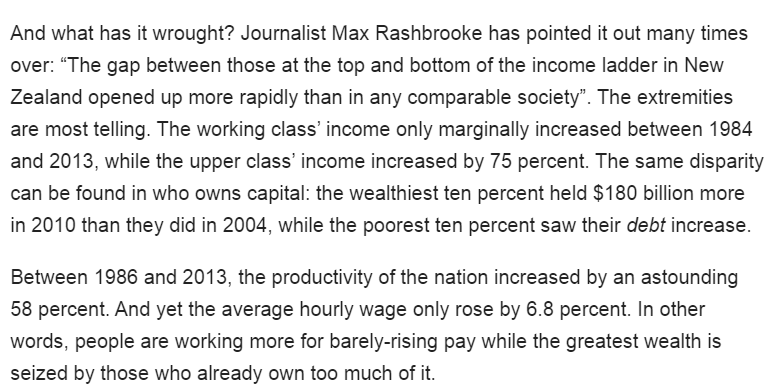
I will outsource to Brian Easton, the CTU, the CTU’s Bill Rosenberg and Closer Together Whakatata Mai – reducing inequalities because the continual correction of Max Rashbrooke on poverty and inequality is becoming tiring.
Source: Love in the time of crisis, James Robins, Wednesday, 16 March 2016, Newstalk NZ.
A brief history of inequality-from Treasury paper Fig4. Note Employment Contracts Act,GST,income tax,benefit cuts,WFF http://t.co/y4w3cUsgjD—
Bill Rosenberg (@WJRosenbergCTU) June 27, 2015
Inequality has not risen for at least 20 years as Bill Rosenberg tweeted. The rise in inequality in the late 1980s and early 1990s was followed by an employment boom that lasted to 2009.
Unemployment was as low as 3 1/2% for several years despite a large increase in labour force participation. Furthermore, the gender wage gap in New Zealand fell rapidly to now be the smallest in any industrialised country.
As the Facebook photos show, there has been strong income and wage growth despite the grizzling of the left. The return of income growth and wages growth after 20 years of real wage stagnation followed the economic reforms of the 1980s and the passage of the Employment Contracts Act in 1991.
As the CTU shows below, the economic reforms in the 1980s put an end to a sharp decline in the relative economic performance of the New Zealand economy.
Inequality is not getting worse and worse says @WJRosenbergCTU!?
09 Mar 2016 Leave a comment
in economic growth, economic history, politics - New Zealand, unions
Bill Rosenberg of the Council of Trade Unions is one of many economists who point out that income inequality has not been getting worse and worse in New Zealand since the 1990s. Inequality rose sharply in the late 1980s and early 90s but has remained high but nevertheless stable since then as he says in his 2014 paper of trends in living standards:
This is another symptom of the sharp rise in income inequality between the mid 1980s and mid 1990s, which remains high.
His employer, the Council of Trade Unions when it was denouncing the Employment Contracts Act 1991 as the reason for low wages growth has also drawn attention to the early 1990s as a turning point in the relationship between inequality, union bargaining power and wages growth.
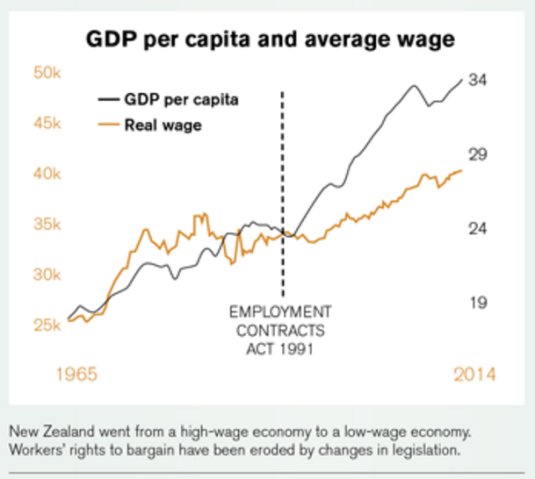
As the Council of Trade Unions showed in the chart it published during the last election campaign, which I snapshoted below and also annotated, from 1970 to 1975 there was rapid real wages growth, well in excess of real growth in per capita GDP. This wages breakout was followed by some ups and downs but essentially wages in 1995 were no higher per hour from what they were in 1975. Real wages were about $24 per hour in real terms in New Zealand for about 20 years – from 1975 to 1995.
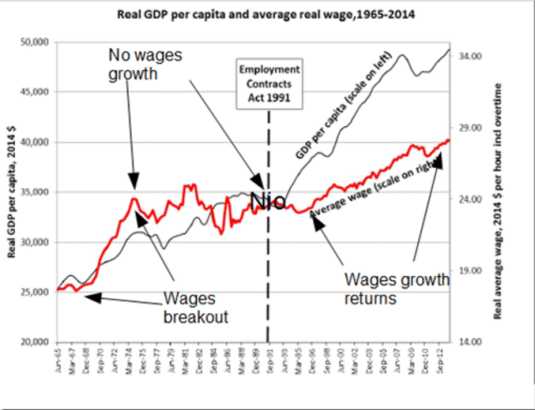
There was no real GDP per capita growth from 1975 until 1979 nor in the five years leading up to the passage of the Employment Contracts Act 1991. The period leading up to 1975 wages breakout wages was the zenith of union membership; nearly 70% of all workers belonging to a union. Less than 20% do now and less than 10% in the private sector.
Source: Income Gap | New Zealand Council of Trade Unions – Te Kauae Kaimahi.
After staying at about $24 per hour for 20 years from 1975 to the early 1990s, following the passage of the Employment Contracts Act in 1991, average wages in New Zealand have increased steadily from $24 an hour to about $28 per hour by 2014 in one of the most deregulated labour markets in the world.
As Rosenberg, who is chief economist at the Council of Trade Unions, and the Council of Trade Unions itself pointed out, there were major changes in the New Zealand economy in terms of inequality of incomes and union bargaining power in the late 80s and early 1990s.
These changes referred to by the unions as an erosion of workers bargaining power, brought an end to wage stagnation. Steady real wages growth returned after two lost decades: next to no growth in either GDP per capita or incomes of workers.
Presidential candidate tax plans and economic growth
06 Mar 2016 Leave a comment
in applied price theory, economic growth, fiscal policy, macroeconomics, politics - USA, public economics Tags: 2016 presidential election, taxation and entrepreneurship, taxation and investment, taxation and labour supply
[/embed]https://www.facebook.com/UnbiasedAmerica/photos/pb.123061011213236.-2207520000.1457089554./449398021912865/?type=3&theater[/embed]
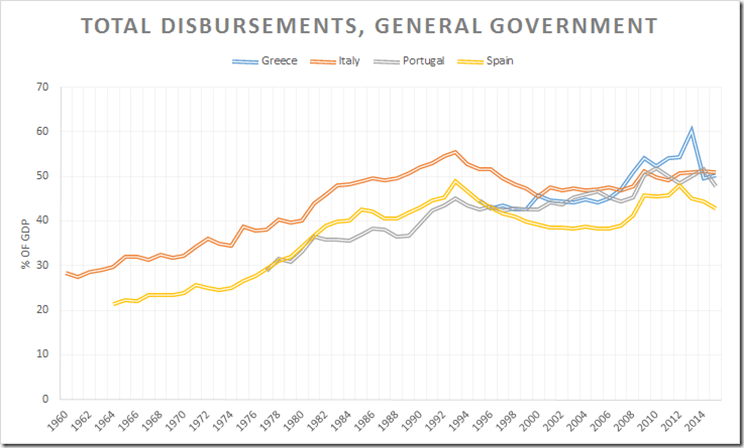
General government expenditure as % of Portuguese, Italian, Greek and Spanish GDP since 1960
24 Feb 2016 Leave a comment
in economic growth, economic history, Euro crisis, fiscal policy, macroeconomics, public economics Tags: Greece, growth of government, Italy, Portugal, size of government, Spain
I do not think any of these countries have governments who can really handle managing half of national income on a regular basis. The Italian, and I assume Greek GDPs at least are topped up quite considerably to take account of their underground economies. The top up for Italy is 20%.
Data extracted on 23 Feb 2016 07:45 UTC (GMT) from OECD.Stat.
Greece should have defaulted several years ago rather than have raised taxes
24 Feb 2016 Leave a comment
in currency unions, economic growth, Euro crisis, fiscal policy, macroeconomics Tags: Greece, sovereign debt, sovereign defaults
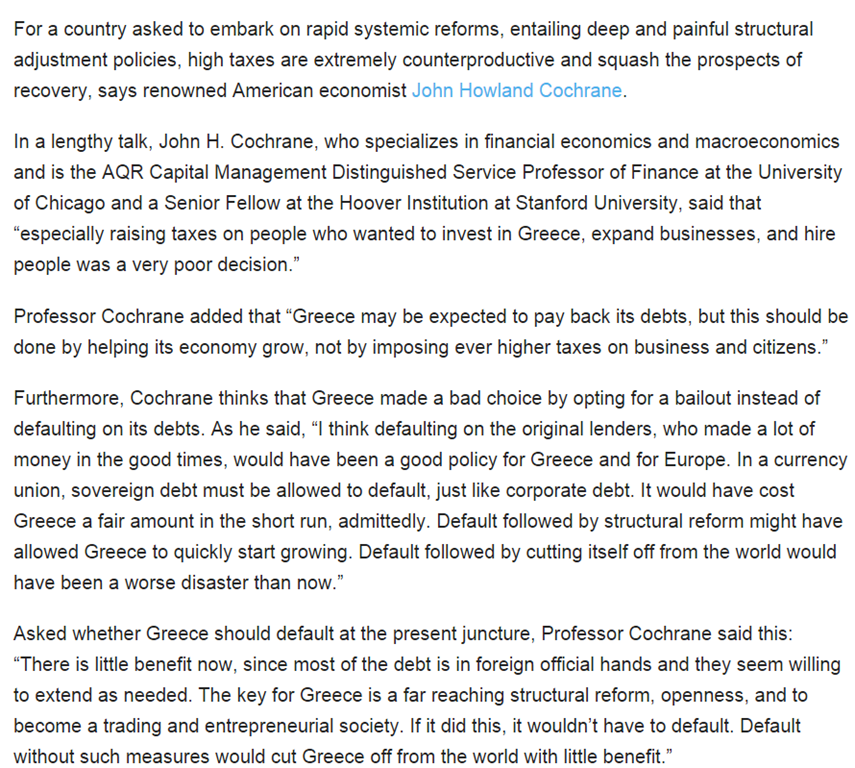
John Cochrane is the latest to join the list of economists who pointed out that Greece should have defaulted several years ago rather than put up taxes. Tax rises just made everything worse and put off the day when Greece had to reform through deregulation and privatisation.
Source: Renowned U.S. Economist Says High Taxes Squash Greece’s Prospects for Recovery | GreekReporter.com.
As early as 2011 , Jeffrey Miron was arguing the best way forward for Greece was to default and leave the Euro:
If Greece defaults, the country gets immediate relief from the crushing interest payments on its debt, leaving it with a relatively modest primary deficit which excludes the big interest payments Greece is faced with now.
In such a scenario, the pressure for austerity would therefore diminish. This would allow Greece to choose policies that encourage growth, rather than ones that shrink the deficit but retard growth by imposing higher taxes.
By abandoning the euro and adopting a properly valued currency, Greece can restore its international competitiveness. This means greater employment demand from both domestic and foreign sources.
The potential negative of default is that Greece will likely lose access, for a while, to international credit markets (although it will be a much safer investment after default than it is now).
But being cut off from foreign lending for a few years is not a disaster; if anything, it might encourage cuts in the wasteful components of government spending.
A bigger risk of default is that ending the crisis might reduce pressure for Greece to address the economy’s fundamental problems: crony capitalism, a Byzantine tax code, excessive regulation, and a bloated government sector.
If Greece fails to reform, it will suffer slow growth and a new crisis soon, regardless of what it does now.
Arellano, Conesa, and Kehoe explained in Chronic Sovereign Debt Crises in the Eurozone, 2010–2012 that the post-GFC recession in many Eurozone countries created an incentive to gamble for redemption. This gamble for redemption is betting that the post-2008 recession will soon end:
- If Greece sold more bonds to smooth government spending in the interim, and if the Greek and EU economies recover, the stronger revenue growth will pay off the enlarged Greek government debt.
- Under some circumstances, this policy is the best that a government can do for its country, but it carries a risk!
- If the recession goes on for too long (and it did in southern Eurozone), a government will either have to stop increasing its debt or default on its bonds.
The global bond markets will anticipate this prospect of default as a country’s government debt accumulates and will seek higher and higher interest for new bonds, and importantly, to roll over existing Greek Government bonds.
EU policies that result in lower interest rates and lower the cost of a sovereign default provide incentives for a government to gamble for redemption. The interventions taken to date by the EU and the IMF – lowering the cost of borrowing and reducing default penalties, the bailouts and the 50% write-off of the existing Greek government debts – encourage southern Eurozone governments to gamble for redemption.
Through history, sovereign defaults come in clusters. Is Greece the start of one? on.wsj.com/1V3XkxR via @WSJ http://t.co/Oy9aMPoHrt—
Greg Ip (@greg_ip) July 15, 2015
Greece and a few others are gambling for redemption by betting that the recession will end soon, selling more bonds to smooth government spending in the interim, and reducing the enlarged debt if their economies recover. The Greeks initially did a fine job in squeezing huge subsidies and debt write-offs!
If the recession continues for too long, the government will have to stop increasing debt or default on its bonds. Greece has been in default in more than 50% of the time since it became independent in 1822.
Greece’s problem is that it is 119th in the 2014 index of economic freedom, just ahead of India. The World Bank ranks Greece 161st in the world for ease of registering property and 91st for enforcing contracts; it takes an average of 1,300 days to enforce a contract through the Greek courts. This low base says something about how Greek politics works and will work for some time to come.
Cristina Arellano in a recent paper pointed out that if default is inevitable, raising taxes just makes everything worse:
Fiscal defaults occur because of the government’s inability to raise tax revenues. Aggregate defaults occur even if the government could raise tax revenues; debt is simply too high to be sustainable.
In a quantitative exercise calibrated to Greece, we find that our model can predict the recent default, but that increasing taxes would not have prevented it. In fact, increasing taxes would have made the recession deeper because of the distortionary effects of taxation.
More on honest @BernieSanders and his voodoo economics
24 Feb 2016 Leave a comment
in economic growth, economic history, macroeconomics, politics - USA Tags: 2016 presidential election, grates, left-wing populists, Paul Krugman, quackery, rational irrationality
Edward Prescott and @BernieSanders compared
23 Feb 2016 Leave a comment
in applied price theory, economic growth, fiscal policy, macroeconomics, politics - USA
https://twitter.com/TheNewDeal/status/696864555658539008
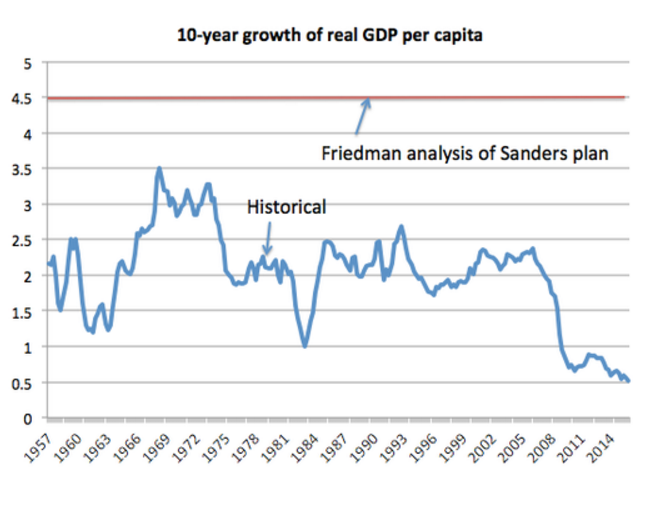
As a contrast against the Bernie Sanders tax-and-spend high-growth plan, the Edward Prescott plan is:
- mandatory savings for retirement;
- Eliminate capital income taxes;
- Broaden tax base and lower the marginal tax rate;
- Phased-in reforms so all birth-year cohorts are made better off;
- Left welfare programs and local public good shares the same; and
- Savings not part of taxable income, saving withdrawals part of taxable income – with these changes U.S. income tax would be a consumption tax.
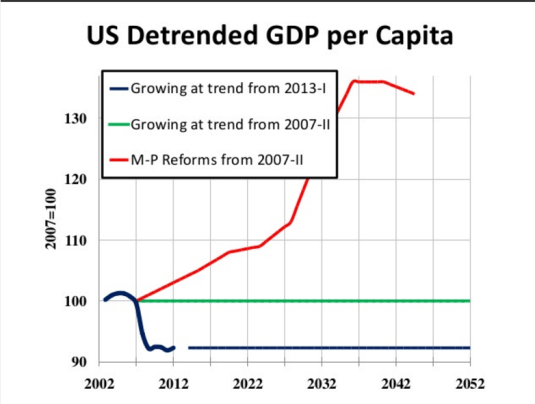
Source: Edward C. Prescott – Importance of Good Governance for Economic Prosperity.
The difference between the Prescott and Sanders plans is Prescott delivers high growth through massive supply-side reforms that include the abolition of taxes on income from capital, mandatory savings for retirement along with much lower marginal tax rates.
The Sanders plan argues that if you tax people a lot more, there is more growth, more investment, more innovation and entrepreneurship and greater labour supply. There is no historical precedent for that as an outcome from higher taxes.
In the case of Prescott, the disagreement is over how large are his growth dividends. In the case of the Sanders band, only one economist agrees that his plan will increase growth. Despite that, he is still voting for Hillary Clinton.


Recent Comments