The extreme economic outlier that is Greece, in 7 charts: 53eig.ht/1GMgIFU http://t.co/gb3zkgUqqJ—
(@FiveThirtyEight) July 04, 2015
Greece in 7 charts
06 Jul 2015 3 Comments
in budget deficits, business cycles, currency unions, economic growth, Euro crisis, fiscal policy, labour economics, labour supply, macroeconomics, unemployment Tags: Eurosclerosis, Greece
Doing business in the PIGS (Portugal, Italy, Greece and Spain) – World Bank rankings
03 Jul 2015 Leave a comment
in applied price theory, applied welfare economics, currency unions, economic growth, economics of bureaucracy, economics of regulation, Euro crisis, health and safety, income redistribution, industrial organisation, labour economics, law and economics, minimum wage, occupational regulation, property rights, Public Choice, rentseeking, survivor principle, unions, welfare reform Tags: cost of doing business, Eurosclerosis, Greece, Italy, PIGS, Portugal, Spain
Figure 1: Doing Business rankings, PIGS, 2014
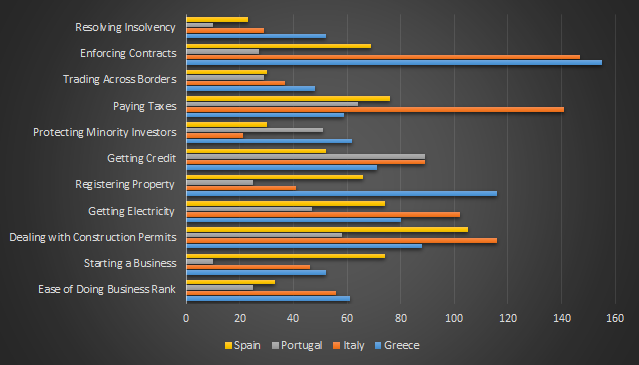
Source: World Bank Doing Business 2015.
All in all, Italy and Greece are a dog of a place to enforce a contract. The long-suffering taxpayer is better off paying taxes in Greece than in Italy! Not surprisingly, trading across borders is the greatest strength in doing business in the PIGS. The European Union does have some benefits.
Figure 2: Doing Business rankings, Greece and Italy, 2014
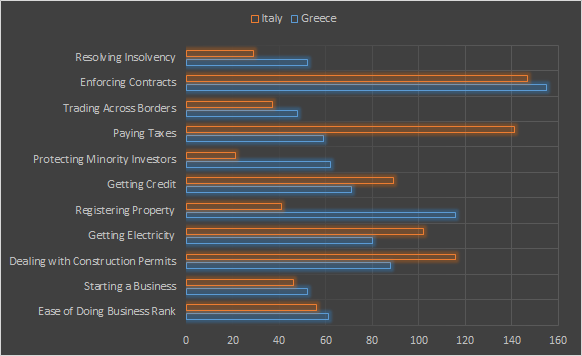
Source: World Bank Doing Business 2015.
All in all, Italy and Greece are equally bad places to do business and Italy is much worse when it comes to taxes. About the only saving graces of Italy is the registration of property and the protection of minority interests in companies.
Figure 3: Doing Business rankings, Spain and Portugal, 2014
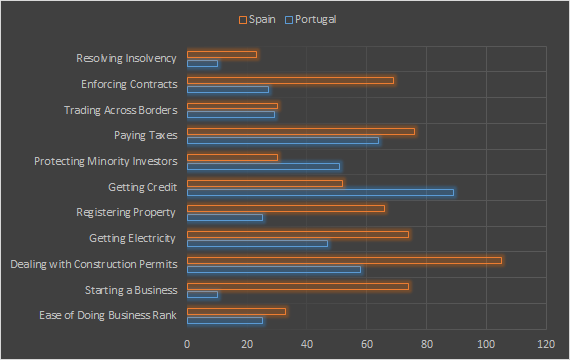
Source: World Bank Doing Business 2015.
Spain and in particular Portugal are much better places to do business than Italy and Greece.
Extreme poverty is not the same thing as digital poverty
01 Jul 2015 Leave a comment
Percentage of people around the world who own smartphones, via @conradhackett. Note #China. http://t.co/wAOmIklVbW—
Legatum Institute (@LegatumInst) May 30, 2015
The Puerto Rican sovereign default explained
30 Jun 2015 Leave a comment
in economic growth, fiscal policy, international economic law, politics - USA, population economics Tags: ageing society, economics of immigration, Puerto Rica, sovereign defaults
Puerto Rico's debt is nearly half that of California for a population one-tenth the size on.wsj.com/1Kj5XPZ http://t.co/nM2aM8kWtP—
Nick Timiraos (@NickTimiraos) June 29, 2015
Gambling for Redemption and Self-fulfilling Debt Crises in the Eurozone
29 Jun 2015 Leave a comment
in business cycles, currency unions, economic growth, Euro crisis, fiscal policy, global financial crisis (GFC), international economic law, international economics, macroeconomics Tags: game theory, Greece, Patrick Kehoe, sovereign default
Who is where on the Laffer curve?
20 Jun 2015 Leave a comment
in economic growth, fiscal policy, human capital, labour economics, labour supply, macroeconomics, politics - USA, public economics Tags: endogenous growth theory, EU, Eurosclerosis, laffer curve, optimal tax theory, taxation and entrepreneurship, taxation and investment, taxation and the labour supply
@asymmetricinfo paper:"How Far Are We From The Slippery Slope? The Laffer Curve Revisited" bit.ly/1HMhmqu http://t.co/D9IffNhd92—
Old Whig (@aClassicLiberal) April 20, 2015
Milton Friedman on the essence of the Age of the Worker
13 Jun 2015 Leave a comment
in applied price theory, applied welfare economics, economic growth, economic history, health and safety, income redistribution, industrial organisation, labour economics, labour supply, macroeconomics, Milton Friedman, occupational choice, politics - Australia, politics - New Zealand, politics - USA, Public Choice, rentseeking, unions Tags: competition and monopoly, The Great Enrichment, union power, union wage premium
Sir Humphrey was right on why Britain entered the common market in 1973? Real GDP growth per working age British and French, PPP, detrended, 1950 – 2013
11 Jun 2015 Leave a comment
in economic growth, economic history, fiscal policy, global financial crisis (GFC), macroeconomics, monetarism, monetary economics Tags: British disease, British economy, Eurosclerosis, France, Margaret Thatchernomics, sick man of Europe
Figure 1: Real GDP per British and French aged 15-64, converted to 2013 price level with updated 2005 EKS purchasing power parities, 1.9 per cent detrended, 1950-2013
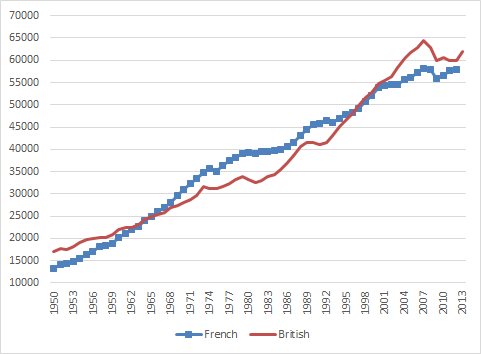
Source: Computed from OECD Stat Extract and The Conference Board, Total Database, January 2014, http://www.conference-board.org/economics
Figure 2: Real GDP per British and French aged 15-64, converted to 2013 price level with updated 2005 EKS purchasing power parities, 1.9 per cent detrended, base 100 = 1974, 1950-2013
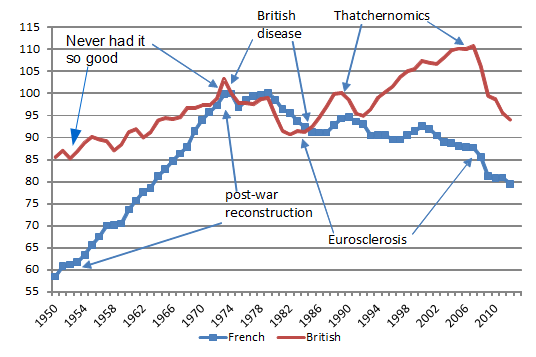
Source: Computed from OECD Stat Extract and The Conference Board, Total Database, January 2014, http://www.conference-board.org/economics
In figure 2, a flat line represents annual real GDP growth at a rate of 1.9%, which is the trend rate of annual growth of the USA in the 20th century. A rising line means annual growth at above that trend rate; a falling line means annual growth at below that trend rate of 1.9% per year.
The US share market since 1900
10 Jun 2015 Leave a comment
in business cycles, economic growth, economic history, entrepreneurship, financial economics, macroeconomics Tags: active investing, efficient market hypothesis, entrepreneurial alertness, passive investing
Here’s how Warren Buffett sees the stock market read.bi/1HsUe1p http://t.co/Zm6fDTYpf9—
BI Chart of the Day (@chartoftheday) April 23, 2015
Who will be the 20 largest economies in 2030?
10 Jun 2015 Leave a comment
in development economics, economic growth, growth miracles, macroeconomics Tags: China, convergence, India, Japan
These will be the world’s 20 largest economies in 2030 bloom.bg/1IzgMhl http://t.co/KADxgakbEj—
Bloomberg VisualData (@BBGVisualData) May 20, 2015
The Spanish economic recovery compared
10 Jun 2015 Leave a comment
in business cycles, currency unions, economic growth, Euro crisis, global financial crisis (GFC), great recession, macroeconomics Tags: Eurosclerosis, France, Germany, Italy, Spain
Spain's economic growth is being touted as a success story. Don't tell the Spaniards: on.wsj.com/1M45yzI http://t.co/pm4DAd1qkF—
Nick Timiraos (@NickTimiraos) June 03, 2015
The global business cycle in one chart
05 Jun 2015 Leave a comment
in business cycles, economic growth, macroeconomics Tags: world economy
The entire global economy. In one chart. bloom.bg/1FrXQ1A http://t.co/H07P9n2LkL—
Bloomberg VisualData (@BBGVisualData) May 22, 2015
Growth accounting for the USA in the 1930s
05 Jun 2015 Leave a comment
in business cycles, economic growth, economic history, great depression, macroeconomics Tags: great depression, growth accounting, real business cycles
Notice how productivity recovers but hours worked per working age adults does not.

via The Current Financial Crisis in Spain: What Should We Learn from the ….
John Key’s 2017 tax cuts will not be “modest”
04 Jun 2015 3 Comments
in economic growth, politics - New Zealand, Public Choice, public economics

Bill English’s 2015 New Zealand Budget foreshadows a $1.5 billion allowance in the 2017 budget for “modest tax cuts”. Any reasonable mock-up of these tax cuts, such as in table 1 using the numbers on the Treasury website for revenue losses for small tax changes show that Prime Minster Key is planning his own fistful of dollars in the lead up to the 2017 election.
Table 1: hypothetical 2017 National Party tax cuts, $1.5 billion
| Current tax rate | New tax rate | Revenue loss, static scoring |
Revenue loss, dynamic scoring |
| 33% | 31.5% | $323m | $274m |
| 30% | 27.5% | $388m | $329.4m |
| 17.5% | 16.5% | $505m | $429.3m |
| Trust tax 33% | Trust tax 31.5% | $135m | $129m |
| Company tax rate 28% | 27.5% | $113m | $90m |
| Total cost | $1.465b | $1251m |
No serious participant in public policy debate could suggest that tax cuts of the size in table 1 will not have incentive effects that will lead to growth in incomes and business profits. There will be offsetting tax revenue increases that make a more ambitious tax package possible in 2017.
The Treasury’s website on revenue losses forecasts that a 1% increase in wages growth will increase tax revenue by $300 million. A 1% increase in the growth rate of taxable business profits will increase tax revenues by $140 million again according to the Treasury. These are big differences.
Any sensible discussion of the 2017 tax cuts should be against a background of what is called dynamic scoring to use the American parlance.
When the NZ Treasury “scores” revenue losses from tax cuts on its website, its estimates of revenue changes assume no changes in behaviour. Dynamic scoring takes behavioural effects into account.
The Congressional Budget Office was recently required to use dynamic scoring when costing major tax policy proposals. New Zealand should follow this path.

Table 2 makes conservative assumptions about the behavioural effects of income tax cuts. I follow Mankiw, N. Gregory and Matthew Weinzierl “Dynamic Scoring: A Back-of-the-Envelope Guide,” Journal of Public Economics (September 2006): 1415-1433. They argue that, in the long run, about 17% of a cut in individual income taxes is recouped through higher economic growth. For a cut in company taxes, their figure is 50%. I assume 15% is recouped in this way for individuals, 20% for companies and 5% for trusts.
Table 2: hypothetical 2017 National Party tax cuts, $1.5 billion, dynamic scoring of revenue effects
| Current tax rate | New tax rate | Revenue loss static Scoring |
Revenue loss dynamic scoring |
| 33% | 31% | $430m | $366m |
| 30% | 27% | $465m | $395m |
| 17.5% | 16.5% | $505m | $429m |
| Trust tax 33% | Trust tax 31% | $180m | $171m |
| Company tax rate 28% | 27% | $225m | $180m |
| Total cost | $1.805b | $1.541b |
The $200-300 million in revenue increases from higher incomes and higher business profits incentivised by lower tax rates is not a trivial sum. It is enough on its own to cut one percentage point of the company tax rate. Spread around as in table 2, there are enough to knock another one-half of a percentage point of the top tax rate, the second top tax rate and the company tax rate. The $1.5 billion in tax cuts planned for 2017 will be neither modest in their size nor in their behavioural effects.
No budget should be published and no party in an election should assert that large changes in the tax system have no behavioural effects. Dynamic scoring makes a big difference to what scale of tax cuts are possible.
There are practical hurdles to dynamic scoring but static scoring has more important ones. The hurdles of dynamic scoring are:
- Economists do not know how to accurately measure the growth effects of most policies
- Dynamic scoring relies on less-than-accurate, theory-based macro models
- The macro models undergirding dynamic scoring have numerous controversial and unproven built-in assumptions
- The assumptions embedded in the macro models are not always carefully empirically based
- Macro models exclude theoretically and empirically supported evidence of supply-side effects of public investment
- Macro models exclude evidence-based effects of economic inequality
- Macro models exclude evidence-based effects of numerous policies
- Macro models provide different estimates of growth impacts of policy depending on guesses of how the policy may be finance
Against that is dynamic scoring removes the bias against pro-growth policies in current budgetary scoring:
[A] theoretical advantage of accurate dynamic scoring is that it is not biased against pro-growth policies compared to the current conventional scoring method. By ignoring macroeconomic effects, the conventional method overstates the true budgetary cost of pro-growth policies, such as infrastructure investments, and understates the cost of anti-growth policies.
To close on some New Zealand politics, Prime Minister Key, who is known as the smiling assassin, overtook the Labour Party and the Greens on their left In the 2015 Budget by increasing welfare benefits for the first time since 1972 in real terms, and by a large amount ($25 a week), and also increasing family tax credits.
Prime Minister Key well then pivot to the right in 2017 with a fistful of dollars to firmly camp himself over both the centre-left in the centre-right to be re-elected for a fourth term against an increasingly hapless and out-manoeuvred opposition.
 Utopia, you are standing in it!
Recent Comments