The Great Recession
14 Nov 2016 Leave a comment
in Euro crisis, fiscal policy, global financial crisis (GFC), great recession, macroeconomics

Tom Sargent on Macroeconomic Theory and the Crisis
12 Jun 2016 Leave a comment
in business cycles, currency unions, economics, Euro crisis, fiscal policy, global financial crisis (GFC), great recession, macroeconomics, monetary economics Tags: Tom Sargent
Equilibrium unemployment rate: USA, UK, France, Germany, Canada & Australia, 1985-2017
02 Jun 2016 Leave a comment
in business cycles, economic growth, economic history, global financial crisis (GFC), great recession, labour economics, labour supply, unemployment Tags: British economy, Canada, equilibrium unemployment rate, France, Germany, natural unemployment rate
I do admire the way in which the USA has been able to have a steadily falling equilibrium unemployment rate since 1984 through thick and thin. The Great Recession had no impact on the US equilibrium unemployment rate. Not only has the largest member been able to do this, the OECD host country (red squares) has had a pretty steady natural unemployment rate too all things considered.
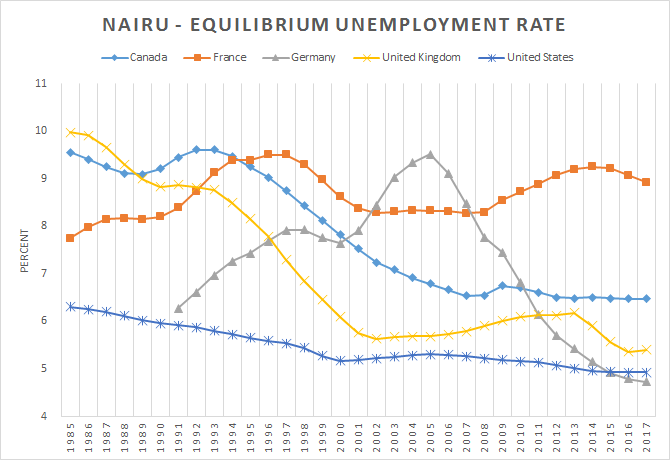
Source: OECD Economic Outlook June 2016 Data extracted on 01 Jun 2016 12:40 UTC (GMT) from OECD.Stat
Unemployment rates across the OECD in 2015
26 Mar 2016 Leave a comment
in business cycles, economic growth, Euro crisis, global financial crisis (GFC), great recession, job search and matching, labour economics, macroeconomics, unemployment
Tax mix in the USA as a percentage of GDP since 1965
18 Mar 2016 Leave a comment
in business cycles, economic history, fiscal policy, great recession, macroeconomics, politics - USA, public economics Tags: company tax, company tax rate, growth of government, GST, indirect taxation, property taxes, size of government, Social Security contributions, taxation and investment, taxation and labour supply, welfare state
The only major change in the US tax mix in the last 50 years has been greater reliance on social security contributions.
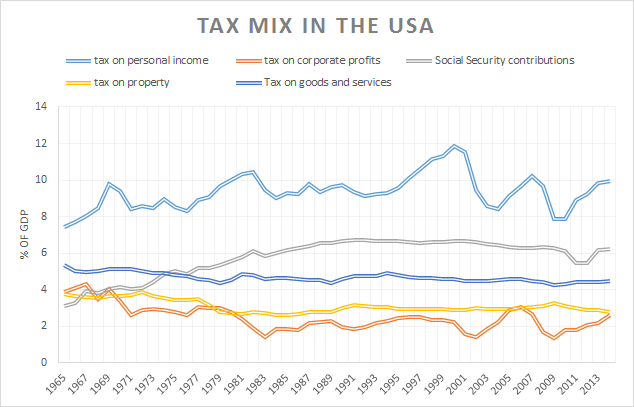
Source: OECD Stat.
The share going to income taxes bobbing up and down quite a lot in the last 30 years much of that to do with the business cycle. In the 1990s, the share of taxes from personal income increased during boom times. In the Great Recession, the tax share to income tax rose with the declining economy as did that on corporate profits.
Lunch and Conversation with Thomas J. Sargent
18 Mar 2016 Leave a comment
in economic growth, economics, Euro crisis, fiscal policy, global financial crisis (GFC), great recession, job search and matching, macroeconomics, monetary economics, Public Choice Tags: Thomas Sargent
% industrialised countries at zero or near zero central bank interest rates
04 Feb 2016 Leave a comment
in business cycles, currency unions, Euro crisis, global financial crisis (GFC), great recession, inflation targeting, macroeconomics, monetarism, monetary economics Tags: central banks, liquidity trap, monetary policy
Review of #TheBigShort including of the movie
02 Feb 2016 Leave a comment
in applied price theory, business cycles, economic history, entrepreneurship, financial economics, global financial crisis (GFC), great recession, macroeconomics, monetary economics, movies Tags: bank runs, financial crises
About the only time the Hollywood Left oozes with patriotism is when getting stuck into Wall Street. Hollywood must get its revenge for all those times investors did not back their film pitches, trimmed budgets and get the lion’s share of merchandising royalties and syndication profits. As Larry Ribstein explained:
American films have long presented a negative view of business…. it is not business that filmmakers dislike, but rather the control of firms by profit-maximizing capitalists… this dislike stems from filmmakers’ resentment of capitalists’ constraints on their artistic vision.
The Big Short is still a good film despite the left-wing populism, worth going to see. Its limitations in not discussing the monetary policy of The Fed or regulations that encouraged lending to high risk borrowers are justified poetic license and editing.
The film is already 120+ minutes long despite frequent resorts to breaking the fourth wall to explain technical terms, who was what and what they were doing, past and present. The Big Short is a film designed it make money at the box office, not a semester long documentary.
The Big Short is well acted, funny, insightful and still a good story despite the documentary element that was impossible to do without.
The Big Short highlights that its protagonists had skin in the game. They were investing in mortgages or shorting the same in the expectation of a crash. There were no windbags and armchair critics in The Big Short talking gloom and doom on the horizon without investing their own money to profit from their forecasts. That said, the protagonists betting on a sub-prime mortgages crash, bar two of them, were a little bit nutty.
I do not know any of the critics of the economics of the film’s explanation of the sub-prime crisis who suggested how they could fix these gaps in its economics without making the film much, much longer.
These critics fall into the exact same trap that the Big Short was not about. The Big Short was about investors to put their money where their mouth is. The critics of the film should put their script doctoring skills where their mouths are at least of The Big Short.
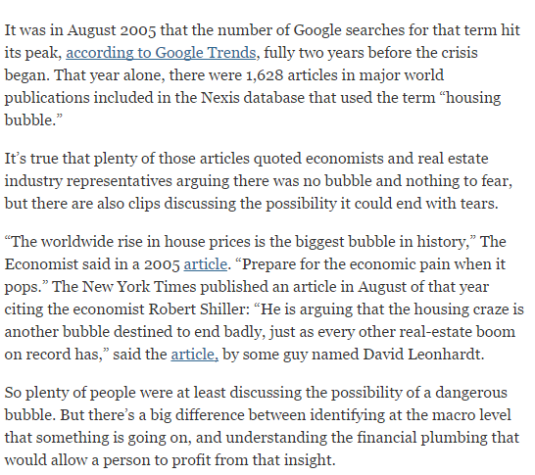
Source: What ‘The Big Short’ Gets Right, and Wrong, About the Housing Bubble – The New York Times.
Getting stuck into the role of the Fed and regulatory mandates on the banks regarding their level of sub-prime mortgages is for another film. Plenty of people warned of dark days ahead. An essay anyone can read with profit is Ross Levine’s “An Autopsy of the U.S. Financial System: Accident, Suicide, or Negligent Homicide?“
Other films, correctly documentaries, place the blame for the sub-prime crisis and the Great Recession directly on the Fed:
The financial mess we’re still climbing out of can be laid directly at the feet of the Fed, whose misguided advocacy, under Greenspan, of a borrow-and-spend economy rather than a focus on savings and investment has created a situation where, as the title implies, money is disconnected from any underlying value.
There are plenty of points that could be added to the economics of The Big Short if it was a film of more or less unlimited length:
Krugman and friends like the film because it leaves out any discussion of the main culprit behind the financial crisis, which was not Wall Street “greed” but bad monetary and credit policies from the Federal Reserve and the federal government. The movie barely hints at any exogenous factors behind the boom or bust. (This FEE report by Peter Boettke and Steven Horwitz fills in the missing information.) So the pro-regulation crowd is cheering. Viewers are given no understanding of the real causal factors and hence fill in the missing data with a feeling that banks just love ripping people off. To be sure, if you approach this movie with some knowledge of economics and monetary policy, the rest of the narrative makes sense. Of course Wall Street got it wrong, given Washington’s policies on mortgage lending!
To add to the brew, Edward Prescott points out the Great Recession can be explained through productivity shocks. Specifically, a collapse in investment and in particular investment in intangibles such as intellectual property in 2007 in anticipation of more taxes and more regulation.
The Great Recession had many of the same features of the 1990s technology boom but in reverse. The boom in the 1990s and bust in 2007 were somewhat inexplicable because major sources of volatility were unmeasured, specifically, investment in intangible capital.
V.V. Chari also points out that the extent of the financial crisis was overstated. This is because the typical firm can finance its capital expenditures from retained earnings so it was hard to see how financial market disruptions could directly affect investment.
What Chari disputed was that bank lending to non-financial corporations and individuals has declined sharply, that interbank lending is essentially non-existent; and commercial paper issuance by non-financial corporations declined sharply, and rates have risen to unprecedented levels.
John Taylor argues that we should consider macroeconomic performance since the 1960: There was a move toward more discretionary policies in the 1960s and 1970s; A move to more rules-based policies in the 1980s and 1990s; and back again toward discretion in recent years.
These policy swings are correlated with economic performance—unemployment, inflation, economic and financial stability, the frequency and depths of recessions, the length and strength of recoveries. Less predictable, more interventionist, and more fine-tuning type macroeconomic policies have caused, deepened and prolonged the current recession. Robert Hetzel puts it this way:
The alternative explanation offered here for the intensification of the recession emphasizes propagation of the original real shocks through contractionary monetary policy. The intensification of the recession followed the pattern of recessions in the stop-go period of the late 1960s and 1970s, in which the Fed introduced cyclical inertia in the funds relative to changes in economic activity.
Finn Kydland considers fiscal policy to be at the heart of the slow recovery. Instead of restructuring and investing more prudently, Western countries faced with budget shortfalls will seek to increase taxes:
- The U.S. economy isn’t recovering from the Great Recession of 2008-2009 with the anticipated strength.
- A widespread conjecture is that this weakness can be traced to perceptions of an imminent switch to a regime of higher taxes.
- The fiscal sentiment hypothesis can account for a significant fraction of the decline in investment and labor supply in the aftermath of the Great Recession, relative to their pre-recession trends.
- The perceived higher taxes must fall almost exclusively on capital income. People must suspect that the tax structure that will be implemented to address large fiscal imbalances will be far from optimal.
Now imagine trying to incorporate all the above points into a film and keeping it at its current two-hour length?
Share market losses during previous financial crises in the USA and UK
31 Jan 2016 Leave a comment
in business cycles, economic history, fisheries economics, global financial crisis (GFC), great depression, great recession, macroeconomics Tags: banking crises, financial crises, sovereign debt crises, sovereign defaults
US, Danish and NZ long-term male unemployment @grantrobertson1 @nzlabour
19 Jan 2016 Leave a comment
in Euro crisis, great recession, job search and matching, labour economics, macroeconomics, politics - New Zealand, politics - USA, unemployment Tags: Denmark, employment law, employment protection, flexicurity, labour market regulation, social insurance, welfare state
https://twitter.com/KiwiLiveNews/status/688503382181449728
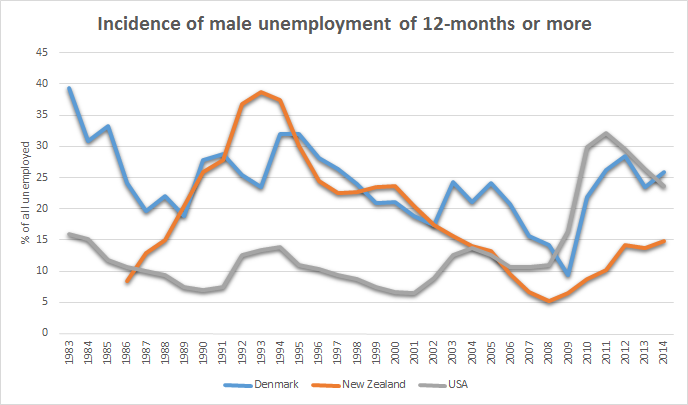
My search for an example of how Danish flexicurity might have an advantage over the status quo in the New Zealand labour market is still to yield results. Danish flexicurity is no better than New Zealand and often worse in keeping long-term male unemployment rates down as the charts below show. The flexicurity model combines flexible hiring and firing with a generous social safety net and an extensive system of activation policies for the unemployed.
Data extracted on 18 Jan 2016 21:55 UTC (GMT) from OECD.Stat.
The charts above and below do show is that a more generous social safety net for the unemployed introduced with the onset of the Great Recession in the USA was followed by a sharp increase in the incidence of long-term unemployment.
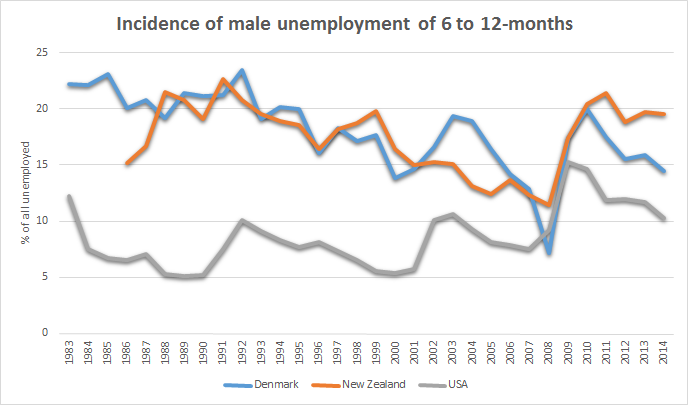
Data extracted on 18 Jan 2016 21:55 UTC (GMT) from OECD.Stat.
The modern macroeconomics of the Global Financial Crisis
02 Dec 2015 Leave a comment
in applied price theory, budget deficits, business cycles, economic growth, economic history, economics of regulation, Euro crisis, fiscal policy, global financial crisis (GFC), great depression, great recession, macroeconomics, monetary economics Tags: adverse selection, bank panics, bank runs, banking crises, deposit insurance, economics central banks, financial crises, moral hazard, sovereign defaults
The mancession
06 Sep 2015 Leave a comment
in business cycles, economic history, global financial crisis (GFC), great recession, job search and matching, labour economics, labour supply, macroeconomics, unemployment Tags: reversing gender gap
How frequent are simultaneous financial crises in one country?
04 Sep 2015 Leave a comment
in business cycles, currency unions, development economics, economic growth, economic history, Euro crisis, financial economics, global financial crisis (GFC), great depression, great recession, growth disasters, growth miracles, law and economics, macroeconomics, monetary economics, property rights Tags: bank runs, banking crises, banking panics, currency crises, current account crises, debt crises, pseudo financial crises, real financial crises, sovereign debt crises, sovereign default
Longest time without a recession
02 Sep 2015 Leave a comment
in business cycles, economic growth, economic history, fiscal policy, global financial crisis (GFC), great recession, macroeconomics, monetary economics, politics - Australia, politics - New Zealand, politics - USA Tags: Australia, recessions and recoveries


Recent Comments