The stickiest price in the world? Coin-operated laundry, which reprices every 79.9 months. klenow.com/StickyPrices.p… http://t.co/tBP0JwlErZ—
JP Koning (@jp_koning) September 19, 2015
The stickiest price in the world?
28 Sep 2015 Leave a comment
in economics of information, job search and matching, macroeconomics Tags: search and matching, sticky prices
@DavidLeyonhjelm on deregulating the Australian labour market
17 Sep 2015 1 Comment
in applied price theory, economic history, economics of regulation, industrial organisation, job search and matching, labour economics, minimum wage, survivor principle, unions Tags: Australia, employment law, employment protection law, federalism, labour market deregulation, labour market regulation, union power, unions
The mancession
06 Sep 2015 Leave a comment
in business cycles, economic history, global financial crisis (GFC), great recession, job search and matching, labour economics, labour supply, macroeconomics, unemployment Tags: reversing gender gap
@NZGreens @TransportBlog cars rule in Auckland! Auckland commuting times by transport mode
21 Aug 2015 1 Comment
in job search and matching, labour economics, occupational choice, politics - New Zealand, transport economics, urban economics Tags: Auckland, bicycles, commuting times, compensating differentials, expressive voting, green rent seeking, Inner-city Left, New Zealand Greens, public transport, rational irrationality, search and matching, The fatal conceit, The pretense to knowledge
I am not surprised only 7% of Auckland’s take public transport to work considering it takes much longer than any other form of commuting.
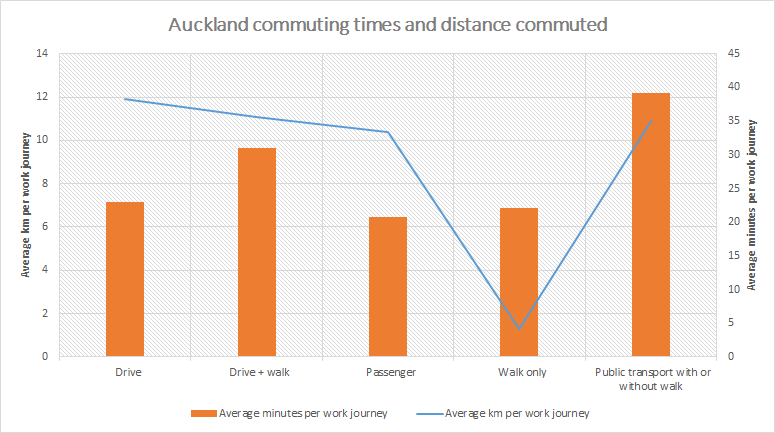
The average commute by public transport is 40 minutes as compared to less than 25 in a car. 74% of Aucklanders drive to work and another 9% are a passenger in a car.
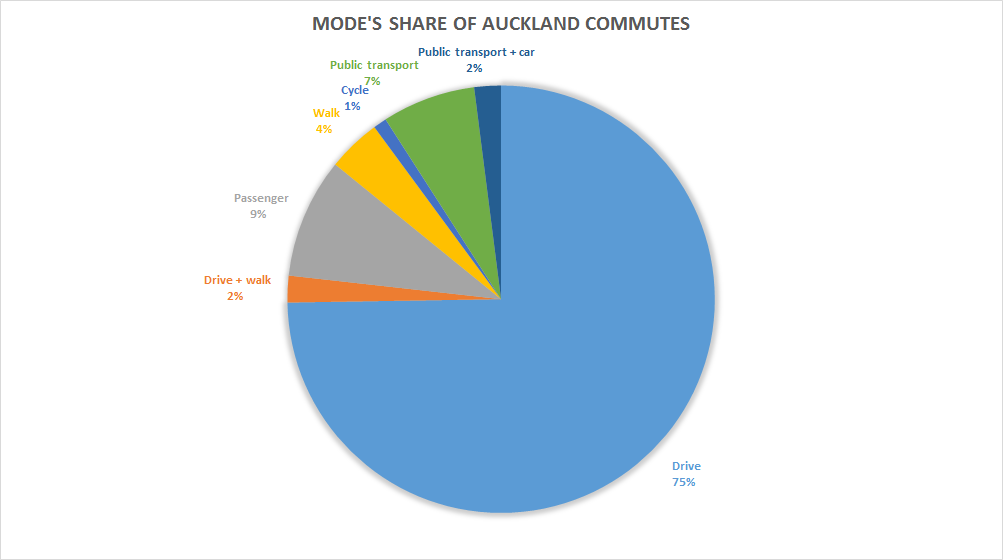
No information was available on those who bike to work because only 1% of Aucklanders bike to work. Only 2% of all New Zealanders take a bike to work. The sample size was therefore too small. Yet another reason to ban bikes at night. Few commute on this mode of transport in Auckland.
The near identical commuting distances irrespective of the mode of transport except walking is further evidence that people are quite discerning in balancing commuting times and job selection as per the theory of compensating differentials. Indeed, average commuting times in Auckland are much the same as the average commuting time in America.

The Auckland transport data showing people commute much the same distance by any mode of transport bar walking also validates Anthony Downs’ theory of triple convergence.

Improving the commuting times in one mode of transport will mean people simply take the mode of peak hour transport that is suddenly become less congested while others who were not going to commute at peak times or start commuting at peak times as Anthony Downs explains:
If that expressway’s capacity were doubled overnight, the next day’s traffic would flow rapidly because the same number of drivers would have twice as much road space.
But soon word would spread that this particular highway was no longer congested. Drivers who had once used that road before and after the peak hour to avoid congestion would shift back into the peak period. Other drivers who had been using alternative routes would shift onto this more convenient expressway. Even some commuters who had been using the subway or trains would start driving on this road during peak periods.
Within a short time, this triple convergence onto the expanded road during peak hours would make the road as congested as it was before its expansion.
Over-qualification rates in jobs in the USA, UK and Canada
19 Aug 2015 2 Comments
in economics of bureaucracy, economics of education, human capital, job search and matching, labour economics, labour supply, occupational choice, politics - USA, Public Choice Tags: British economy, Canada, compensating differentials, job shopping, offsetting behaviour, on-the-job training, search and matching, The fatal conceit, The pretense to knowledge
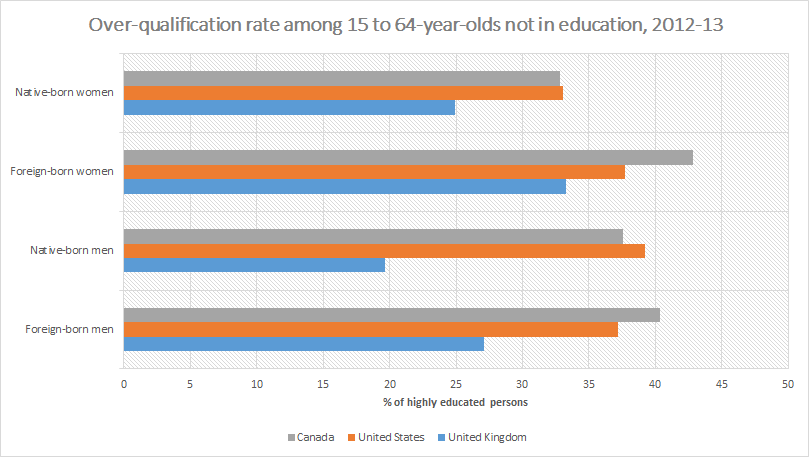
In the UK, foreign-born are much more likely to be over qualified than native born highly educated not in education with less difference between men and women. More men than women are overqualified for their jobs in the UK. Over qualification is less of a problem in the UK than in the USA and Canada.
Source: OECD (2015) Indicators of Immigrant Integration 2015: Settling In.
In the USA and Canada, there are few differences between native and foreign born men in over-qualification rates. Foreign-born women tend to be more over-qualified than native born women in the USA and more so in Canada. Many more workers are overqualified for their jobs in the USA and Canada as compared to the UK.
There are large differences in the percentage of people with tertiary degrees and the education premium between these three countries that are outside the scope of this blog post. These trends may explain differences in the degree of educational mismatch.
It goes without saying that the concept of over-qualification and over-education based mismatch in the labour market is ambiguous, if not misleading and a false construct.
To begin with, under human capital theories of labour market and job matching, what appears to be over-schooling substitutes for other components of human capital, such as training, experience and innate ability. Not surprisingly, over-schooling is more prominent among younger workers because they substitute schooling for on-the-job training. A younger worker of greater ability may start in a job below his ability level because he or she expects a higher probability to be promoted because of greater natural abilities. Sicherman and Galor (1990) found that:
overeducated workers are more likely to move to a higher-level occupation than workers with the required level of schooling
Investment in education is a form of signalling. Workers invest so much education that they appear to be overqualified in the eyes of officious bureaucrats. The reason for this apparent overinvestment is signalling superior quality as a candidate. Signalling seems to be an efficient way of sorting and sifting among candidates of different ability. The fact that signalling survives in market competition suggests that alternative measure ways of measuring candidate quality that a more reliable net of costs are yet to be discovered.
A thoroughly disheartening chart if you're a graduate in the UK i100.io/mpDbJAl http://t.co/mv9izA0mbc—
i100 (@thei100) August 20, 2015
Highly educated workers, like any other worker, must search for suitable job matches. Not surprisingly, the first 5 to 10 years in the workforce are spent in half a dozen jobs as people seek out the most suitable match in terms of occupation, industry and employer. Some of these job seekers who are highly educated will take less suitable jobs while they search on-the-job for better matches. Nothing is free or instantly available in life including a good job match.
A more obvious reason for over qualification is some people like attending university and other forms of education for the sheer pleasure of it.
Anyone who encounters the words over-qualified and over-educated should immediately recall concepts such as the pretence to knowledge, the fatal conceit, and bureaucratic busybodies. As Edwin Leuven and Hessel Oosterbeek said recently:
The over-education/mismatch literature has for too long led a separate life of modern labour economics and the economics of education.
We conclude that the conceptional measurement of over-education has not been resolved, omitted variable bias and measurement error are too serious to be ignored, and that substantive economic questions have not been rigorously addressed.
Incidence of long-term unemployment in the PIGS since 1983
17 Aug 2015 Leave a comment
in business cycles, currency unions, economic growth, economic history, Euro crisis, job search and matching, labour economics, labour supply, macroeconomics, occupational choice, unemployment, unions, welfare reform Tags: employment law, equilibrium unemployment, Greece, Italy, labour market regulation, natural unemployment rate, Portugal, Spain, unemployment duration
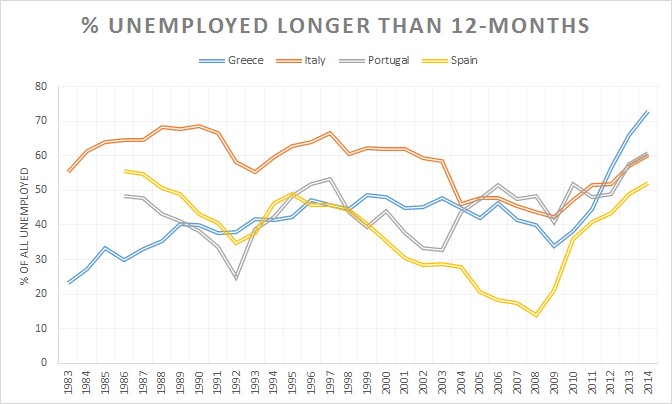
The boom that preceded the bust in the Greek economy did nothing for the rate of long-term unemployment among Greeks. Long-term unemployment had been pretty stable prior to the economic boom after joining the euro currency union.
Source: OECD StatExtract.
Nothing much happened to long-term unemployment in Italy or Portugal in recent decades. Spanish long-term unemployment fell in line with the economic boom in Spain over the 1980s and 1990s up until the global financial crisis.
% of unemployment lasting longer than 12 months in Scandinavia since 1976
16 Aug 2015 Leave a comment
in applied welfare economics, business cycles, constitutional political economy, economic history, job search and matching, labour economics, labour supply, macroeconomics, Public Choice, unemployment Tags: borders, deployment subsidies, economics of borders, equilibrium unemployment rate, Finland, labour market programs, long-term unemployment, maps, natural unemployment rate, Norway, Scandinavia, search and matching, Sweden, unemployment durations
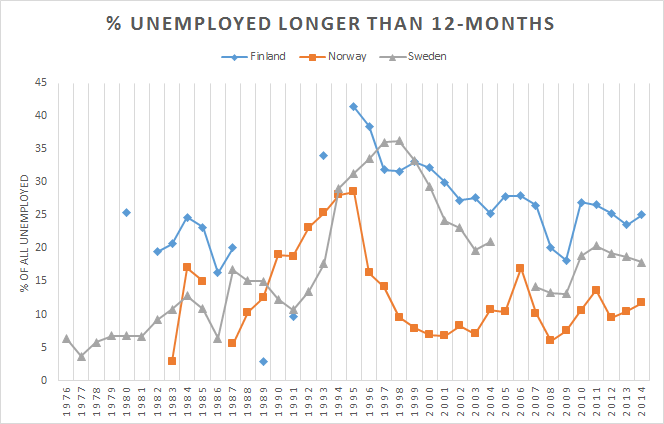
As I recall, most unemployed have been unemployed longer than 12 months in Sweden have to go on a labour market program. When they returned to unemployment after the program, the clock starts again. They are deemed to be freshly unemployed rather than adding to the previous spell with an interlude on a make work program. This makes Swedish long-term unemployment data rather unintelligible.
Source: OECD StatExtract.
Finland was recovering from its worst depression since the 1930s and the early 1990s when its data on long-term unemployment started to be continuous. This makes Finnish unemployment data rather difficult to interpret. Norway’s data for the long-term unemployed goes up and down a bit too much to be trustworthy without a background policy narrative.
% of unemployment that is more than 12 months, USA, UK, Germany and France
14 Aug 2015 Leave a comment
in currency unions, Euro crisis, job search and matching, labour economics, labour supply, macroeconomics, unemployment Tags: British economy, equilibrium unemployment rate, France, Germany, long-term unemployment, natural unemployment rate, social insurance, unemployment duration, unemployment insurance, welfare state
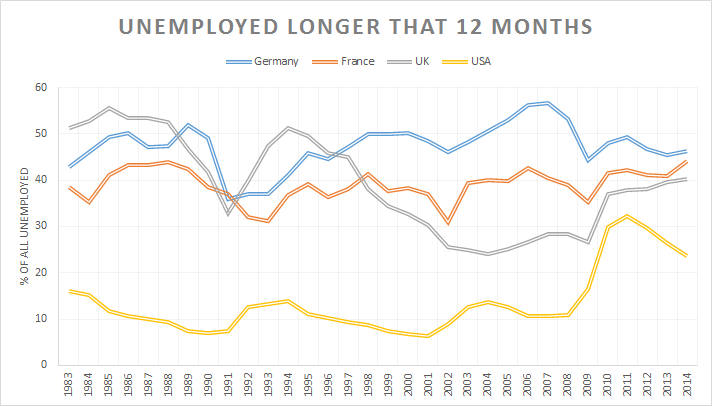
As the British labour market and long-term unemployment was starting to get something like that in the USA, the USA started to have unemployment it was more like the European labour markets in terms of the number of long-term unemployed. Nothing much happened in Germany and France.
Source: OECD StatExtract.
The man-cession illustrated
13 Aug 2015 Leave a comment
in business cycles, discrimination, gender, human capital, job search and matching, labour economics, labour supply, macroeconomics, occupational choice Tags: female labour force participation, male labour force participation, recessions and recoveries
CHART: The Great Recession Had a Disproportionately Negative Effect on Men That Continues Today @CHSommers @AsheSchow http://t.co/wnfdUOUn0a—
Mark J. Perry (@Mark_J_Perry) August 08, 2015
Italian unemployment incidence by duration since 1983
12 Aug 2015 Leave a comment
in business cycles, economic history, Euro crisis, job search and matching, labour economics, macroeconomics, unemployment Tags: employment law, equilibrium unemployment rate, Eurosclerosis, Italy, labour market regulation, natural unemployment rate, unemployment duration
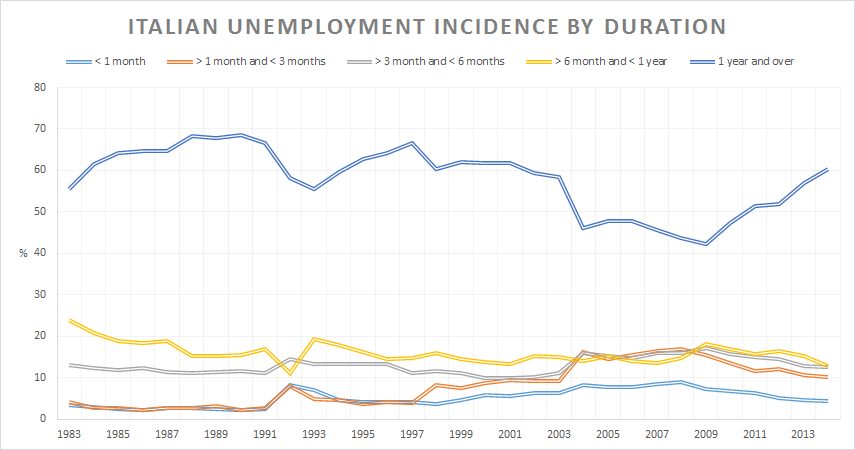
Unemployment of more than a year was slowly tapering down in Italy before the global financial crisis, but ever so slowly.
Source: OECD StatExtract.
German unemployment incidence by duration since 1983
11 Aug 2015 Leave a comment
in economic history, Euro crisis, fiscal policy, job search and matching, labour economics, labour supply, macroeconomics, unemployment, welfare reform Tags: equilibrium unemployment rate, Eurosclerosis, German unification, Germany, natural unemployment rate, poverty traps, unemployment duration, unemployment insurance, welfare state
German long term unemployment has been pretty stable albeit with an up-and-down after German unification. There is also a fall in long-term unemployment after some labour market reforms around 2005.

Source: OECD StatExtract.
New Zealand unemployment incidence by duration since 1986
10 Aug 2015 Leave a comment
in business cycles, human capital, job search and matching, labour economics, labour supply, macroeconomics, politics - New Zealand, unemployment Tags: equilibrium unemployment rate, hysteresis, long-term unemployment, natural unemployment rate, unemployment duration, unemployment rates
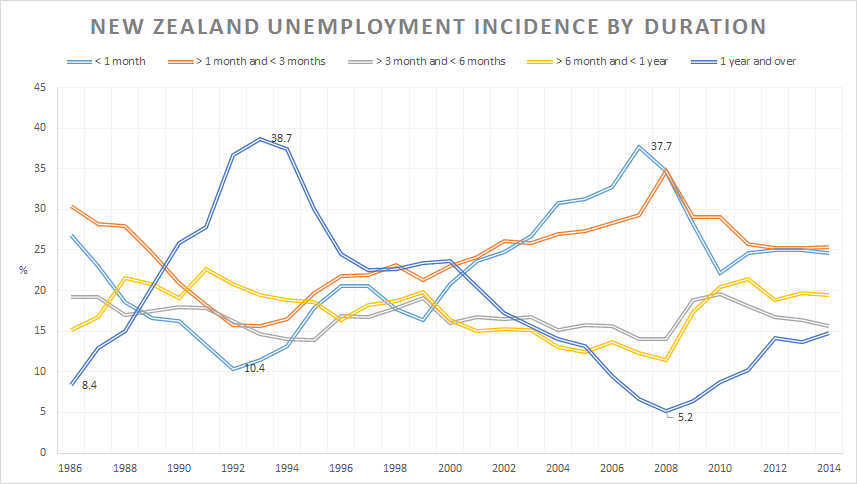
There has been bit of a wild ride in long-term unemployment in New Zealand. Long-term unemployment – longer than one year – ranging from just over 8% of unemployment in 1986 to nearly 40% in 1992 then down to 5% in 2008. Clearly the duration of unemployment in New Zealand is highly sensitive to the business cycle unlike the case in the USA or UK.
Source: OECD StatExtract.
This sensitivity of long-term unemployment to the business cycle does not bode well for the hypothesis of hysteresis where human capital depreciates the longer a jobseeker is out of employment. For this hypothesis to hold, there must be some enduring aspect of long-term unemployment rather than just going up and down with the business cycle rather noticeably.

The rival hypothesis to hysteresis is the long-term unemployed tend to be those who have a lot of trouble getting employment, which is why they end up been unemployed for a long time. Again in New Zealand, these less employable jobseekers appear to be able to find jobs quite easily when the labour market is good.
Hysteresis in practice, Delong-Summers Variety @delong @LHSummers http://t.co/urqxQBi6NE—
Roger E. A. Farmer (@farmerrf) July 23, 2015
British unemployment incidence by duration since 1983
09 Aug 2015 Leave a comment
in business cycles, economic history, global financial crisis (GFC), job search and matching, labour economics, labour supply, macroeconomics, unemployment Tags: British disease, British economy, equilibrium unemployment rate, Margaret Thatcher, natural unemployment rate, unemployment duration, unemployment rates
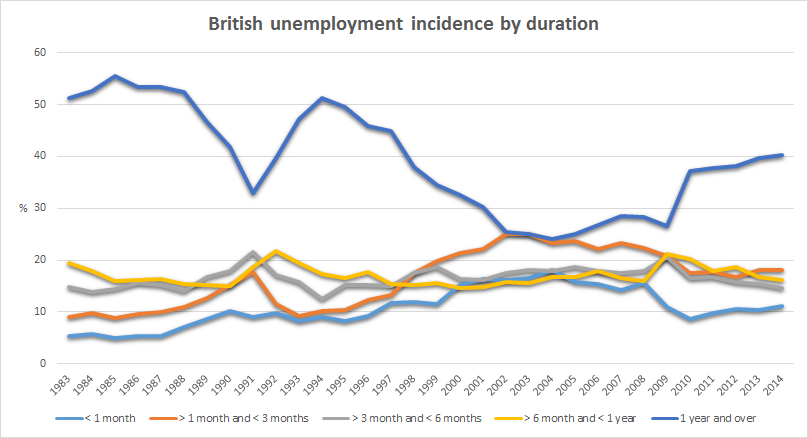
In contrast to the USA, there is been a long-term decline in long-term unemployment, that is unemployment of more than a year, in the British economy over the 1990s. The situation then stabilised and then increased after the global financial crisis. There is also a rather rapid fall in long-term unemployment in the mid-1980s as the British economy recovered under Thatchernomics
Source: OECD StatExtract.
This time it is different: unemployment incidence by duration, USA, 1968 – 2014
08 Aug 2015 1 Comment
in budget deficits, great recession, job search and matching, labour economics, labour supply, macroeconomics, politics - USA, unemployment, welfare reform Tags: natural unemployment rate, taxation and labour supply, unemployment duration, unemployment insurance, unemployment rates, welfare state
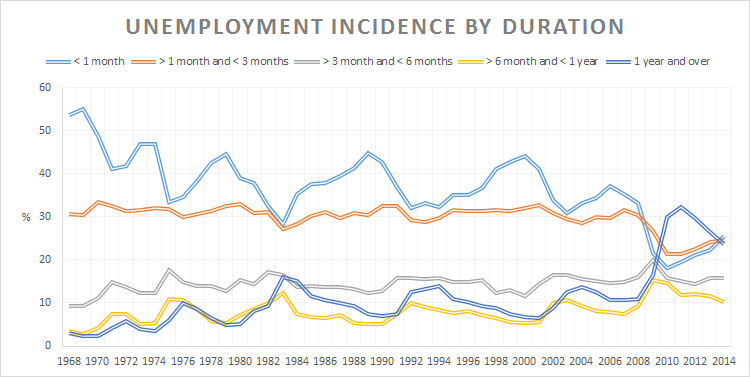
The Great Recession was the first recession in the USA in a good 40 to 50 years where the composition of employment changed by much. Even the big recession at the beginning of the 1980s did not do much to the composition of unemployment by duration in the USA.
Source: OECD StatExtract.
Those unemployed for more than a year moved from barely double digits even in a bad recession prior to 2008 to coming on one-third of all unemployed. Likewise, those unemployed for less than a month halved from 40% to 20%. Something changed in the US labour market with the Great Recession and the long extensions of unemployment insurance from 26 weeks to 52 weeks and then 99 weeks.
 Utopia, you are standing in it!
Recent Comments