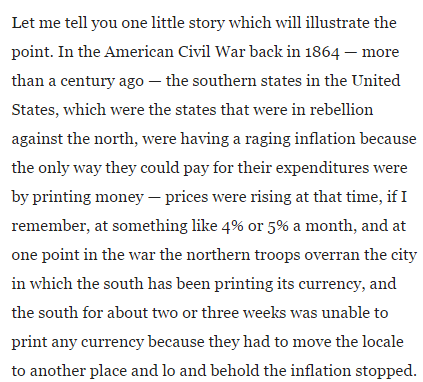
Source: 1975 Monday Conference transcript featuring Milton Friedman « Economics.org.au.
Celebrating humanity's flourishing through the spread of capitalism and the rule of law
24 May 2016 1 Comment
in macroeconomics, Milton Friedman, monetarism, monetary economics Tags: American Civil War, inflation
27 Apr 2016 Leave a comment
in applied price theory, business cycles, economics of bureaucracy, economics of regulation, fiscal policy, macroeconomics, monetary economics Tags: anti-market bias, antiforeign bias, expressive voting, lags on monetary policy, makework bias, rational rationality, tax incidence, The fatal conceit, The pretense to knowledge
I used to argue that the quality of public policy making would double if public policy analysts remembered the first 6 weeks of microeconomics 101 but on reflection more than that is required.
Could we economists today ever show such self-restraint about our own expert recommendations? https://t.co/2UE12JuIgn—
William Easterly (@bill_easterly) November 24, 2015
I picked up my initial insight out when working as a graduate economist in the Australian Department of Finance. That was a few years ago.
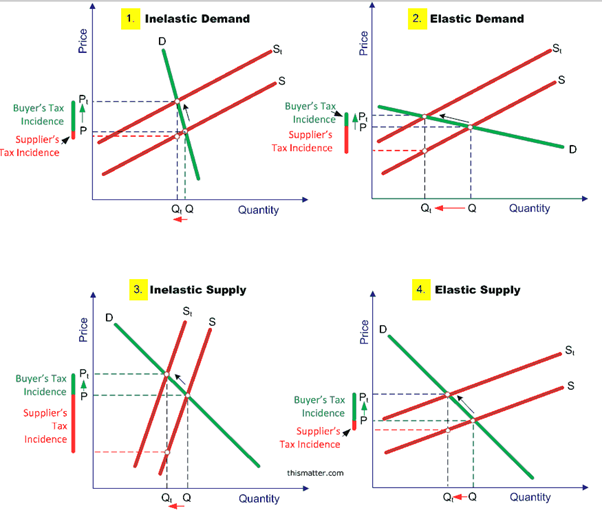
I am now concluded that policy analysts also need to know the basics of the economics of tax incidence. Who pays the tax depends on the elasticities of supply and demand rather than who writes the check to the taxman.
The number of times that I have read media and public policy analysis saying who pays the tax is the writer of the cheque to the taxman is beyond counting.
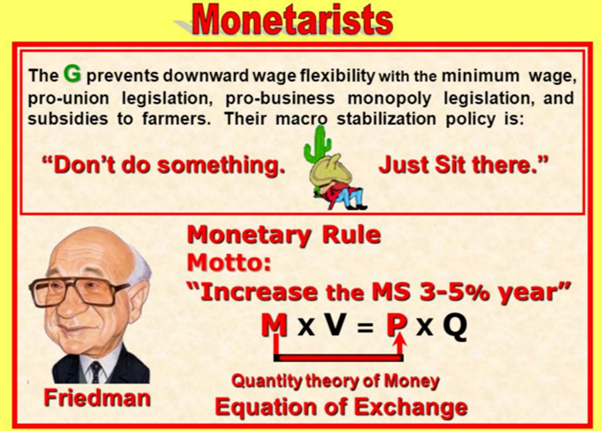
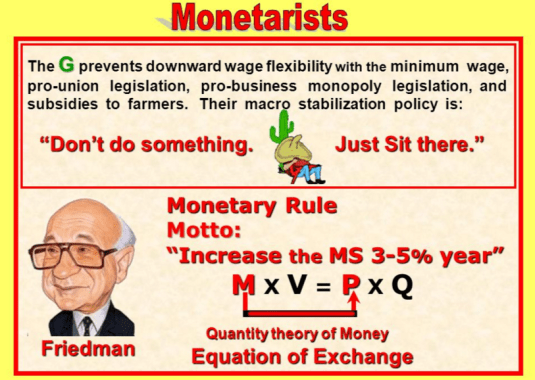
There is also what to do about unemployment and inflation. Do not just do something, sit there might be good advice on most occasions. As Tim Kehoe and Gonzalo Fernandez de Cordoba explain in the context of first do no harm:
Looking at the historical evidence, Kehoe and Prescott conclude that bad government policies are responsible for causing great depressions.
In particular, they hypothesize that, while different sorts of shocks can lead to ordinary business cycle downturns, overreaction by the government can prolong and deepen the downturn, turning it into a depression.
11 Apr 2016 Leave a comment
in applied price theory, business cycles, economic history, economics, economics of regulation, global financial crisis (GFC), macroeconomics, monetary economics, Public Choice, rentseeking Tags: bank runs, banking crises, banking panics, deposit insurance, Thomas Sargent
Many of the key issues about what modern macroeconomics has to say on global financial crises and deposit insurance are discussed in a 2010 interview with Thomas Sargent
Sargent said that two polar models of bank crises and what government lender-of-last-resort and deposit insurance do to arrest or promote them were used to understand the GFC. They are polar models because:
- in the Diamond-Dybvig and Bryant model of banking runs, deposit insurance and other bailouts are purely a good thing stopping panic-induced bank runs from ever starting; and
- in the Kareken and Wallace model, deposit insurance by governments and the lender-of-last-resort function of a central bank are purely a bad thing because moral hazard encourages risk taking unless there is regulation or there is proper surveillance and accurate risk-based pricing of the deposit insurance.
In the Diamond-Dybvig and Bryant model, if there is government-supplied deposit insurance, people do not initiate bank runs because they trust their deposits to be safe. There is no cost to the government for offering the deposit insurance because there are no bank runs! A major free lunch.
Tom Sargent considers that the Bryant-Diamond-Dybvig model has been very influential, in general, and among policy makers in 2008, in particular.
Governments saw Bryant-Diamond-Dybvig bank runs everywhere. The logic of this model persuaded many governments that if they could arrest the actual or potential runs by convincing creditors that their loans were insured, that could be done at little or no eventual cost to taxpayers.
In 2008, the Australian and New Zealand governments announced emergency bank deposit insurance guarantees. In Bryant-Diamond-Dybvig style bank panics, these guarantees ward off the bank run and thus should cost nothing fiscally because the deposit insurance is not called upon. These guarantees and lender of last resort function were seen as key stabilising measures. These guarantees were called upon in NZ to the tune of $2 billion.
- 1. The Diamond-Dybvig and Bryant model makes you sensitive to runs and optimistic about the ability of deposit insurance to cure them.
- The Kareken and Wallace model’s prediction is that if a government sets up deposit insurance and doesn’t regulate bank portfolios to prevent them from taking too much risk, the government is setting the stage for a financial crisis.
- The Kareken-Wallace model makes you very cautious about lender-of-last-resort facilities and very sensitive to the risk-taking activities of banks.
Kareken and Wallace called for much higher capital reserves for banks and more regulation to avoid future crises. This is not a new idea.
Sam Peltzman in the mid-1960s found that U.S. banks in the 1930s halved their capital ratios after the introduction of federal deposit insurance. FDR was initially opposed to deposit insurance because it would encourage greater risk taking by banks.
Late on Friday afternoon, Stuff posted an op-ed piece calling for the introduction of a (funded) deposit insurance scheme in New Zealand. It was written by Geof Mortlock, a former colleague of mine at the Reserve Bank, who has spent most of his career on banking risk issues, including having been heavily involved in the handling of the failure, and resulting statutory management, of DFC.
As the IMF recently reported, all European countries (advanced or emerging) and all advanced economies have deposit insurance, with the exception of San Marino, Israel and New Zealand. An increasing number of people have been calling for our politicians to rethink New Zealand’s stance in opposition to deposit insurance. I wrote about the issue myself just a couple of months ago, in response to some new material from the Reserve Bank which continues to oppose deposit insurance.
Different people emphasise different arguments in making the case for New Zealand to…
View original post 1,963 more words
03 Apr 2016 1 Comment
in industrial organisation, monetary economics, politics - New Zealand, survivor principle Tags: economics of banking, government ownership, KiwiBank, New Zealand Greens, offsetting behaviour, privatisation, rational irrationality, state owned enterprises, The fatal conceit
The Greens want to cut mortgage rates by having KiwiBank expand in business lending. Wrong market.
This expansion into a market that is not the mortgage market is to be underwritten by a capital injection as the Greens explain:
Note well that the $100 million capital injection is to expand in to commercial banking. More aggressive passing on of interest rate cuts may jeopardise credit ratings if this lowers the profitability of KiwiBank. KiwiBank has an A- rating
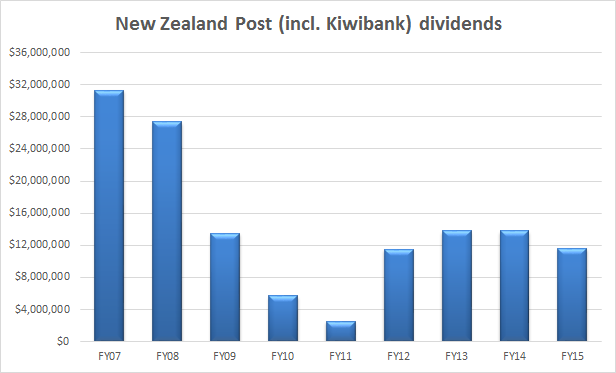
The bigger hole in the policy is the more aggressive mortgage rate setting by KiwiBank will be done by keeping more of its profits and paying fewer dividends to its parent company Kiwi Post and through that to the taxpayer. There are next to no dividends currently to stop distributing to fund a more aggressive mortgage rate setting policy.
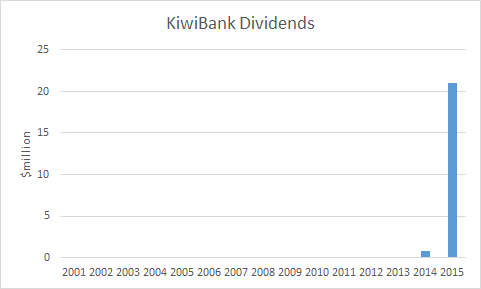
Source: KiwiBank pays its first dividend of $21 million to Government | Stuff.co.nz.
KiwiBank paid its first dividend last year. Prior to that, the bank kept all profits to allow it to expand its lending base. $20 million in foregone dividends does not go far given the actual size of all lending markets in New Zealand.
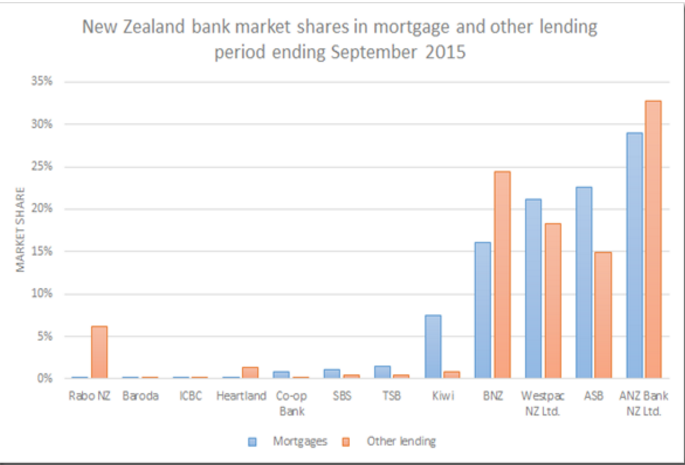
Source: G1 Summary information for locally incorporated banks – Reserve Bank of New Zealand.
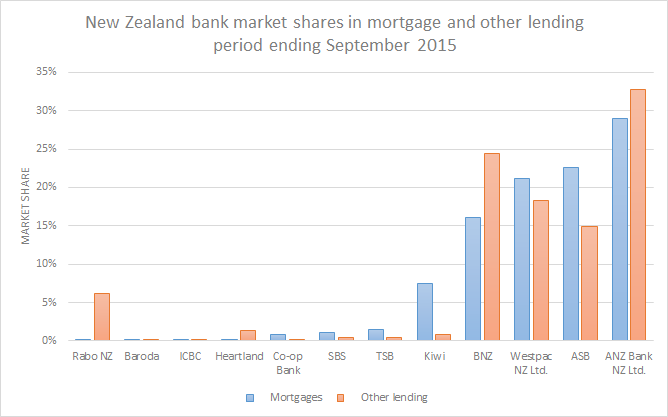
KiwiBank is minnow in the mortgage market and a pimple in commercial lending. Rapid business expansion is risky in any market, much less in banking.
The government has declined further capital injections so profits were retained to meet capital adequacy ratios. The government in 2010 earmarked NZ$300 million for an uncalled capital facility for NZ Post to help maintain its credit rating and KiwiBank’s growth.
Saving the best for last, KiwiBank last year announced plans to borrow up to $150 million through an issue of BB- perpetual capital notes to be used to bolster the bank’s regulatory capital position.
The Margin for the Perpetual Capital Notes has been set at 3.65% per annum and the interest rate will be 7.25% per annum for the first five years until the first reset date of 27 May 2020. Kiwi Capital Funding Limited is not guaranteed by KiwiBank, New Zealand Post nor the New Zealand Government.
The Perpetual Capital Notes have a BB- credit rating compared to KiwiBank which has an A- rating. These capital notes were issued in addition to prior subordinate debt in the form of CHF175 million (about NZ$233 million) worth of 5-year bonds.
I doubt that KiwiBank can raise capital through subordinated debt under normal commercial conditions if it does not plan to seek profits in the same way as other commercial banks do. The current issue of Perpetual Capital Notes are already rated as junk bonds:
An issue of $150 million of perpetual capital notes from KiwiBank with a speculative, or "junk", credit rating have been priced at the bottom of their indicative margin range.
The closest the prospectus for these Perpetual Capital Notes got to complementing KiwiBank changing from a normal business to being a public good is the following risk statement:
Kiwibank’s banking activities are subject to extensive regulation, mainly relating to capital, liquidity levels, solvency and provisioning.
Its business and earnings are also affected by the fiscal or other policies that are adopted by various regulatory authorities of the New Zealand Government.
The interest rate on this subordinate debt will go up to offset the additional risk of aggressive lending and aggressive expansion, which will cancel out many of the advantages of not having to pay for dividends and the capital injection.
That discipline is one of the purposes of subordinate debt in the regulatory capital of banks. This is to provide another pair of eyes and ears to watch the performance of the bank and through rising costs of lending and risk ratings, signal trouble of imprudent lending and lack of cost control.
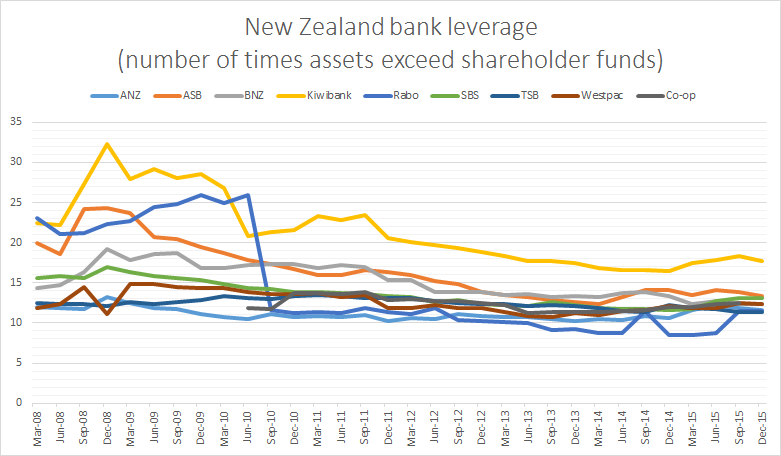
The proposal to use KiwiBank to lower mortgage rates does not add up. KiwiBank does not pay much in the way of dividends to fund such a foray. KiwiBank is already far more leveraged than any other New Zealand major bank.
18 Mar 2016 Leave a comment
in economic growth, economics, Euro crisis, fiscal policy, global financial crisis (GFC), great recession, job search and matching, macroeconomics, monetary economics, Public Choice Tags: Thomas Sargent
17 Mar 2016 Leave a comment
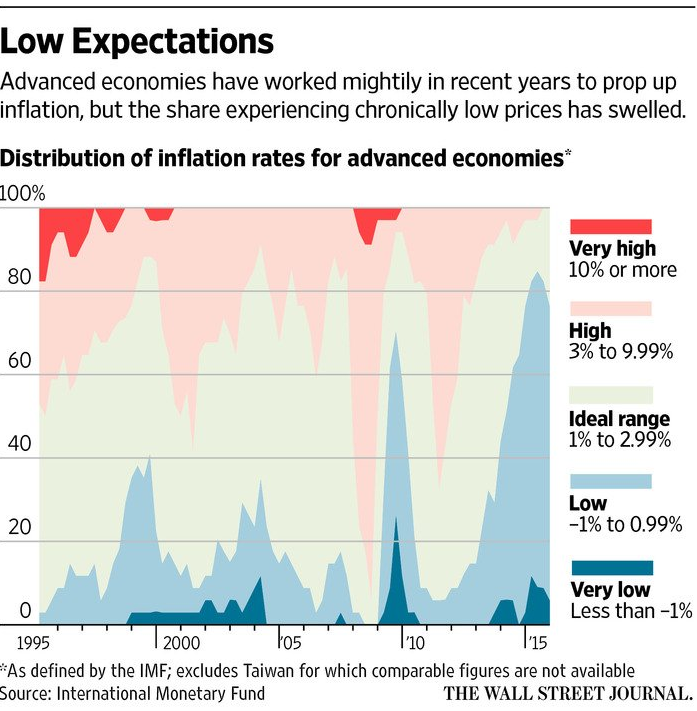
in macroeconomics, monetary economics Tags: deflation, inflation rate, liquidity trap, monetary policy
.
16 Mar 2016 Leave a comment
in economic history, economics of information, economics of regulation, monetary economics, politics - USA Tags: antimarket bias, libertarian paternalism, monetary policy, mortgage interest rates, New Zealand Labour Party, Other people are stupid fallacy, rational irrationality, The fatal conceit, The pretence to knowledge
Despite the best efforts of the libertarian paternalists to sell the other people are stupid fallacy, ordinary New Zealanders are quite nimble at moving between fixed and floating rates depending upon their forecasts of the future of interest rates. Price controls on floating rate mortgages, as suggested by the New Zealand Labour Party, would make this more difficult, not easier.
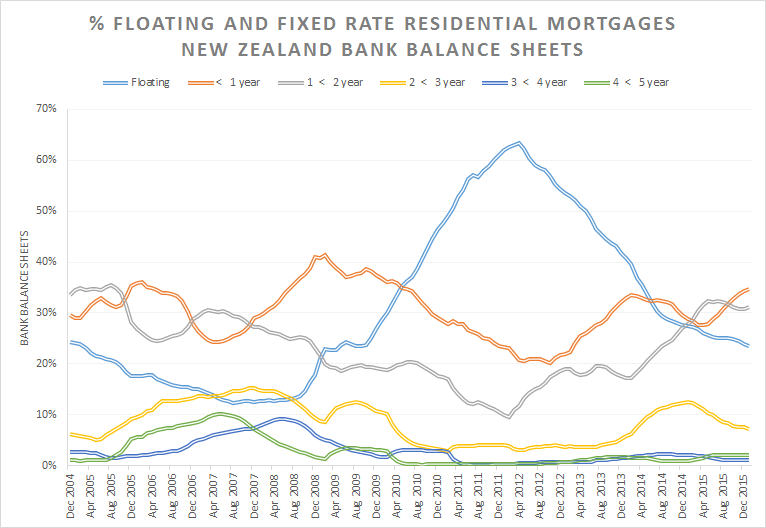
Source: S8 Banks: Mortgage lending ($m) – Reserve Bank of New Zealand.
16 Mar 2016 Leave a comment
in economics of regulation, industrial organisation, monetary economics, politics - New Zealand Tags: antimarket bias, mortgage interest rates, New Zealand Greens, New Zealand Labour Party, price controls, rational irrationality
I did not know so many people were on a fixed rate mortgage. Labour is risking its economic credibility on regulating the rates for a minority of mortgages.

Source: S8 Banks: Mortgage lending ($m) – Reserve Bank of New Zealand.
Capped mortgages cannot be linked to the current official cash rate of the Reserve Bank of New Zealand because they are based on expected future interest rates over an up to 5 year span, not current interest rates.
An important motivation for going onto a floating rate is you can repay faster. Fixed rate mortgages have penalties for early repayment.

Source: Price Controls: Price Floors and Ceilings, Illustrated.
In consequence, price controls linking floating rate mortgages to the official cash rate of the Reserve Bank would benefit better off mortgagees expecting to repay quickly. A typical policy of the modern Labour Party.
15 Mar 2016 Leave a comment
in financial economics, industrial organisation, law and economics, monetary economics, politics - New Zealand Tags: competition law, competition policy, economics of banking, state owned enterprises
15 Mar 2016 Leave a comment
in industrial organisation, monetary economics, politics - USA, public economics Tags: economics of banking, government ownership, KiwiBank, network industries, New Zealand Greens, New Zealand Post, rational irrationality, state owned enterprises
Source: New Zealand Treasury – data released under the Official Information Act.
15 Mar 2016 Leave a comment
in industrial organisation, law and economics, monetary economics, politics - New Zealand, survivor principle Tags: competition law, competition policy, economics of banking, state owned enterprises
11 Mar 2016 Leave a comment
in history of economic thought, macroeconomics, Milton Friedman, monetary economics Tags: monetary rules, rules versus discretion
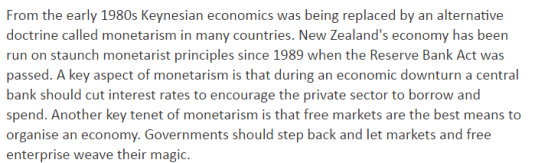
Peter Lyons teaches Economics at St Peter’s College in Epsom and has written several economics texts.
Source: Peter Lyons: Free market doctrine’s bubble about to burst – Economy – NZ Herald News.
Source: Milton Friedman (1984).
06 Feb 2016 Leave a comment
in economics of bureaucracy, macroeconomics, monetary economics
06 Feb 2016 Leave a comment
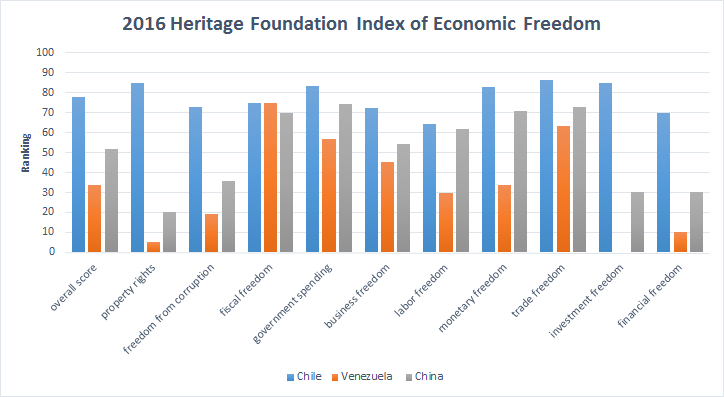
in development economics, economics of regulation, entrepreneurship, fiscal policy, growth disasters, growth miracles, industrial organisation, labour economics, law and economics, macroeconomics, monetary economics, property rights, public economics Tags: capitalism and freedom, Chile, China, The Great Escape, Venezuela
Celebrating humanity's flourishing through the spread of capitalism and the rule of law
Celebrating humanity's flourishing through the spread of capitalism and the rule of law
Celebrating humanity's flourishing through the spread of capitalism and the rule of law
Celebrating humanity's flourishing through the spread of capitalism and the rule of law
Celebrating humanity's flourishing through the spread of capitalism and the rule of law
Celebrating humanity's flourishing through the spread of capitalism and the rule of law
Celebrating humanity's flourishing through the spread of capitalism and the rule of law
Celebrating humanity's flourishing through the spread of capitalism and the rule of law
A History of the Alt-Right
Econ Prof at George Mason University, Economic Historian, Québécois
Celebrating humanity's flourishing through the spread of capitalism and the rule of law
Scholarly commentary on law, economics, and more
Beatrice Cherrier's blog
Celebrating humanity's flourishing through the spread of capitalism and the rule of law
Celebrating humanity's flourishing through the spread of capitalism and the rule of law
Celebrating humanity's flourishing through the spread of capitalism and the rule of law
Why Evolution is True is a blog written by Jerry Coyne, centered on evolution and biology but also dealing with diverse topics like politics, culture, and cats.
Celebrating humanity's flourishing through the spread of capitalism and the rule of law
A rural perspective with a blue tint by Ele Ludemann
DPF's Kiwiblog - Fomenting Happy Mischief since 2003
Celebrating humanity's flourishing through the spread of capitalism and the rule of law
The world's most viewed site on global warming and climate change
Tim Harding's writings on rationality, informal logic and skepticism
A window into Doc Freiberger's library
Let's examine hard decisions!
Commentary on monetary policy in the spirit of R. G. Hawtrey
Thoughts on public policy and the media
Celebrating humanity's flourishing through the spread of capitalism and the rule of law
Politics and the economy
A blog (primarily) on Canadian and Commonwealth political history and institutions
Reading between the lines, and underneath the hype.
Economics, and such stuff as dreams are made on
"The British constitution has always been puzzling, and always will be." --Queen Elizabeth II
Celebrating humanity's flourishing through the spread of capitalism and the rule of law
Celebrating humanity's flourishing through the spread of capitalism and the rule of law
WORLD WAR II, MUSIC, HISTORY, HOLOCAUST
Undisciplined scholar, recovering academic
Celebrating humanity's flourishing through the spread of capitalism and the rule of law
Res ipsa loquitur - The thing itself speaks
In Hume’s spirit, I will attempt to serve as an ambassador from my world of economics, and help in “finding topics of conversation fit for the entertainment of rational creatures.”
Researching the House of Commons, 1832-1868
Articles and research from the History of Parliament Trust
Reflections on books and art
Posts on the History of Law, Crime, and Justice
Celebrating humanity's flourishing through the spread of capitalism and the rule of law
Exploring the Monarchs of Europe



Recent Comments