Unemployment rates and the minimum wage in the European Union
08 Aug 2015 Leave a comment
in Euro crisis, job search and matching, labour economics, macroeconomics, minimum wage, unemployment Tags: employment law, equilibrium unemployment rates, Eurosclerosis, expressive voting, labour market regulation, natural unemployment rate, offsetting behaviour, rational irrationality, unintended consequences
What happened the last time a Labour PM was elected before Blair
08 Aug 2015 Leave a comment
in economic growth, economic history, income redistribution, macroeconomics, Public Choice, rentseeking Tags: British economy, British Labour Party, British politics, Tony Blair Blair
Quarters following general elections tend to see decent growth – especially 1979 http://t.co/bJarqD8Etj—
RBS Economics (@RBS_Economics) July 28, 2015
Greece’s GDP collapse is among the worst advanced economy falls since 1870
07 Aug 2015 Leave a comment
in currency unions, economic growth, economic history, Euro crisis, macroeconomics Tags: Eurosclerosis, Greece, prosperity and depression
Greece's GDP collapse is among the worst advanced economy falls since 1870. And most of those were war-related. http://t.co/QLp6fYN83u—
RBS Economics (@RBS_Economics) July 04, 2015
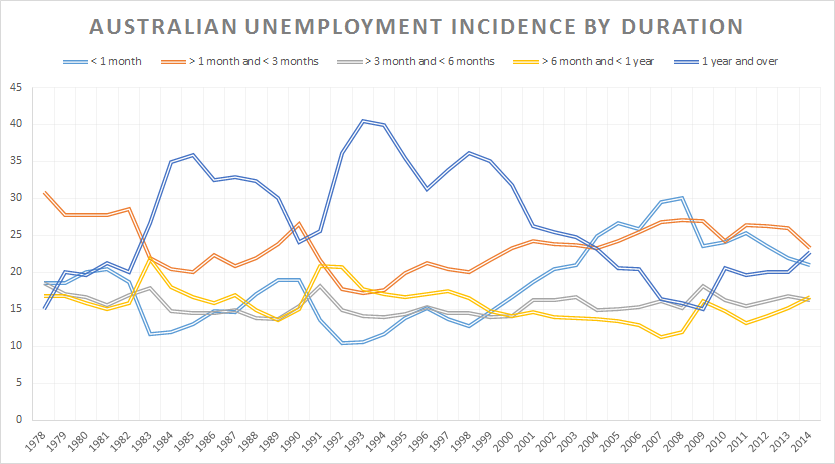
Australian unemployment incidence by duration since 1978
07 Aug 2015 Leave a comment
in economic history, global financial crisis (GFC), job search and matching, labour economics, labour supply, macroeconomics, politics - New Zealand, unemployment Tags: Australia, equilibrium unemployment rate, natural unemployment rate, unemployment duration
As with New Zealand, Australian long-term unemployment seems to go up and down quite a lot with recessions such as those in the early 1980s and early 1990s but not after the global financial crisis.
Source: OECD StatExtract.
The impact of welfare states on life expectancy
07 Aug 2015 Leave a comment
in applied welfare economics, fiscal policy, labour economics, politics - Australia, politics - New Zealand, politics - USA, poverty and inequality, welfare reform Tags: Denmark, Finland, life expectancies, Norway, Sweden, welfare state
New from @iealondon: Scandinavian success is not due to high taxes and welfare spending. iea.org.uk/in-the-media/p… http://t.co/QVH566KNtV—
IEA (@iealondon) July 07, 2015
More evidence of Ricardian equivalence and consumer foresight
05 Aug 2015 Leave a comment
in budget deficits, fiscal policy, public economics Tags: Ricardian equivalence
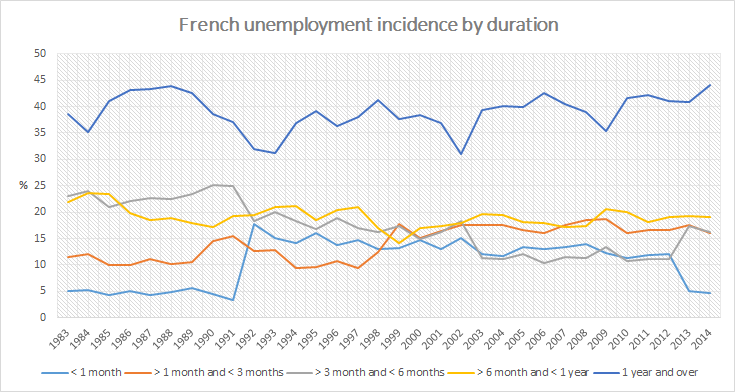
French unemployment incidence by duration since 1983
05 Aug 2015 Leave a comment
in economic history, Euro crisis, job search and matching, labour economics, labour supply, macroeconomics, unemployment Tags: employment law, equilibrium unemployment rate, France, labour market regulation, natural unemployment rate, unemployment duration
Nothing really changes in France recently unemployment duration. Italian labour market is notorious for having very low inflows and outflows from employment and unemployment.
Source: OECD StatExtract.
Swedosclerosis, Eurosclerosis and the British disease compared
05 Aug 2015 2 Comments
in currency unions, economic growth, economic history, economics of regulation, Euro crisis, fiscal policy Tags: British disease, British economy, Eurosclerosis, France, Germany, Italy, sick man of Europe, Sweden, Swedosclerosis
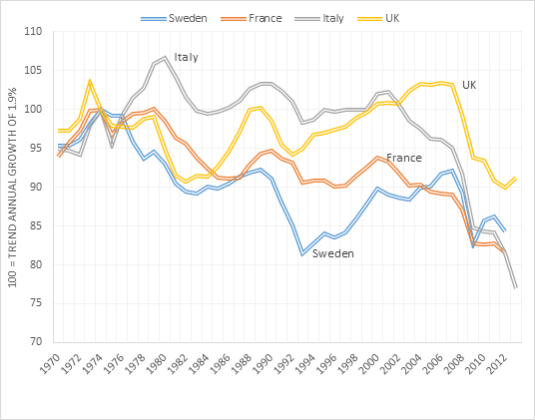
Figure 1 shows stark differences between Sweden, France, Italy and the UK since 1970 in departures from trend growth rates of 1.9% in real GDP per working age person, PPP. Italy did quite OK until 2000 growing at about the trend growth rate of 1.9% after which it fell into a hole so deep that it barely notice the onset of the global financial crisis. Sweden really had been the sick man of Europe until it turned its back on high taxing, welfare state socialism in the early 1990s. France has been in a long decline so much so that the global financial crisis is hard to pick up in the acceleration in its long decline in the mid-1990s. Figure 1 also shows Britain did very well, both under the neoliberal horrors of Thatcherism and the betrayals by Tony Blair of a true Labour Party platform. The UK grew at above the trend annual growth to 1.9% for most of the period from the early 1980s to 2007. The UK has done not so well since the onset of the global financial crisis.
Figure 1: Real GDP per Swede, French, British and Italian aged 15-64, 2014 US$ (converted to 2014 price level with updated 2011 PPPs), 1.9 per cent detrended, 1970-2013
Source: Computed from OECD StatExtract and The Conference Board. 2015. The Conference Board Total Economy Database™, May 2015, http://www.conference-board.org/data/economydatabase/
Note: When the line is flat, the economy is growing at its trend annual growth rate. A falling line means below trend annual growth; a rising line means of above trend annual growth. Detrended with values used by Edward Prescott.
German data was not in figure 1 because German unification threw all of its data into disarray for long-term comparison purposes.
Did fiscal austerity in 2010 have credible academic support?
05 Aug 2015 1 Comment

#Greece austerity gauge. Greek government spending has fallen 20% since 2008. In UK and Italy it's up. #GreekCrisis http://t.co/WMQBxxVFqq—
RBS Economics (@RBS_Economics) July 07, 2015
One measure of the scale of austerity in Greece…and other advanced economies. http://t.co/PxCLagdd3L—
RBS Economics (@RBS_Economics) July 06, 2015
The employment level in #Greece is back to where it was in 1985. It's the equivalent of the UK losing 6 million jobs. http://t.co/AAWHMEFwfK—
RBS Economics (@RBS_Economics) July 06, 2015
Did the GFC catch modern macroeconomists by surprise?
03 Aug 2015 Leave a comment
in budget deficits, business cycles, currency unions, economic growth, Euro crisis, fiscal policy, global financial crisis (GFC), great depression, great recession, history of economic thought, law and economics, macroeconomics, monetary economics Tags: bank panics, bank runs, banking crises, currency crises, Thomas Sargent

Mises and Hayek on the great depression
02 Aug 2015 Leave a comment
in business cycles, F.A. Hayek, great depression, Ludwig von Mises, macroeconomics Tags: Austrian business cycle theory, forecasting errors
@sjwrenlewis The stimulus package ignored what we have learned in the last 60 years of macroeconomic research
02 Aug 2015 Leave a comment
in budget deficits, business cycles, economic growth, fiscal policy, global financial crisis (GFC), great recession, history of economic thought, macroeconomics, monetarism, monetary economics Tags: Brad Delong, fiscal multiplier, fiscal stimulus, Larry Summers, New Keynesian macroeconomics, Thomas Sargent


The exchange rate “needs” to come down?
01 Aug 2015 Leave a comment
in inflation targeting, macroeconomics, monetary economics, politics - New Zealand Tags: central banking, forecasting errors, The fatal conceit, The pretence to knowledge
Anyone who had a good idea about what the the New Zealand dollar should be would be trading on their own account. These super-rich would not be wasting their time giving advice to others. Their time would be too handsomely rewarded for such meagre returns as pontificating to others as to what they should do with their portfolios.
https://twitter.com/JimRose69872629/status/626597273007296514
One of my delights as a bureaucrat was at a meeting between the Reserve Bank of New Zealand and the International Monetary Fund some 15 years or so ago
The Fund asked whether Bank whether it thought the exchange rate was too high, and what their exchange-rate modelling say about this?
- The reply of the Deputy Governor of the Reserve Bank of New Zealand was we don’t have exchange rate model because we don’t think there are any good. Gone are those days.
- The International Monetary Fund team was quite flabbergasted by this response.
At one stage the Fund team tried to draw me into the conversation about the level of New Zealand dollar because I was there representing the New Zealand Treasury. I was only attended as an observer, so naturally my response to their questions was to waffle incoherently. I could have been blunter and simply said the Reserve Bank of New Zealand spoke for New Zealand in this matter, but that would have been impolite.

I’ve been continuing to reflect on Graeme Wheeler’s repeated observation that New Zealand’s exchange rate “needs” to come down. I’m still not entirely sure what he means. The exchange rate is an asset price and presumably should reflect all expected future relevant information, not just spot information about current dairy prices. And the market has no particular reason to focus on stabilising the net international investment position at around current levels. Indeed, although it is a convenient reference point, neither does the Reserve Bank.
“Need” or not, I’d have thought it was likely that the exchange rate would fall further.
The ANZ Commodity Price Index, which lags behind (for example) falling GDT and futures dairy prices, has already had one of the larger falls in the history of the series.
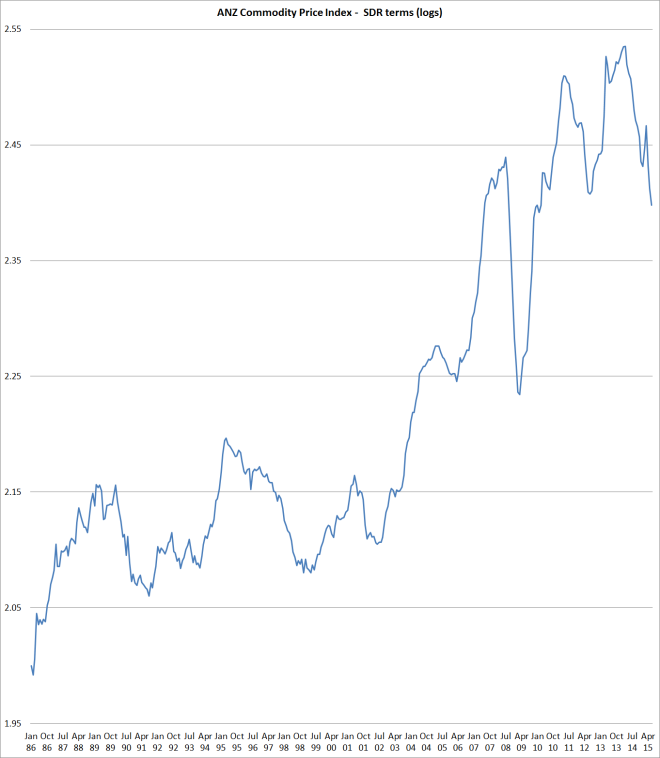
Meanwhile, the fall in the exchange rate, while material, remains pretty small by the standards of past New Zealand adjustments…
View original post 165 more words
Italy compared to Greece – bust without the boom
31 Jul 2015 1 Comment
in business cycles, currency unions, economic growth, economic history, Euro crisis, global financial crisis (GFC), macroeconomics Tags: Eurosclerosis, Greece, Italy, sovereign defaults

Are there net saving from a British pull-out of the EU?
31 Jul 2015 Leave a comment
in currency unions, economic growth, Euro crisis, international economics, macroeconomics Tags: British economy, customs unions, EU, EU membership, free trade areas, international economic integration, preferential trading agreements, regional integration
Ukip claims that there is a net saving from pulling out of EU are highly debatable: http://t.co/TemtNC9gnN—
C4 News FactCheck (@FactCheck) April 02, 2015


Recent Comments