Unemployment rates across the OECD member countries
30 Jul 2015 Leave a comment
in business cycles, currency unions, economic growth, Euro crisis, job search and matching, labour economics, labour supply, macroeconomics, unemployment Tags: employment law, employment regulation, EU, Euro sclerosis, Euroland, Eurosclerosis, Japan, labour market regulation
@ReserveBankofNZ will never be any good at forecasting
30 Jul 2015 Leave a comment
in economics of information, entrepreneurship, financial economics, macroeconomics, monetary economics, politics - New Zealand Tags: entrepreneurial alertness, forecasting errors, The pretence to knowledge
.@ReserveBankofNZ MPS inflation forecasts vs. actual. Via @jamespeshaw: http://t.co/TjPvcoVsbI—
Jayne Ihaka (@Jayniehaka) July 29, 2015
Has there been any labour market deregulation ever in the UK, Australia or New Zealand?
29 Jul 2015 Leave a comment
in economic history, job search and matching, labour economics, labour supply, law and economics, minimum wage, politics - Australia, politics - New Zealand, politics - USA, unions Tags: Australia, British economy, employment law, employment law regulation
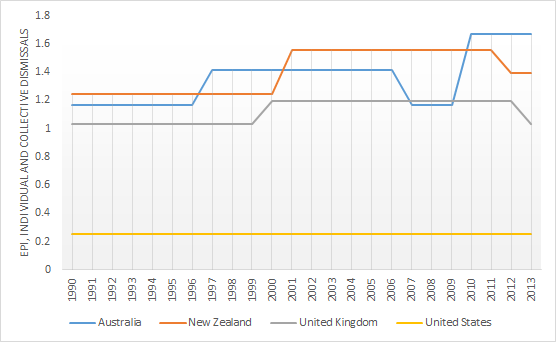
Major deregulations and re-regulations of the labour market in Australia and New Zealand did not move the employment protection inducts around that much in figure 1. All is been quiet on the labour market regulation front of the UK pretty much since the index was started.
Figure 1: OECD employment protection index (EPI), strictness of employment protection – individual and collective dismissals, USA, UK, Australia and New Zealand, 1990 – 2013
Source: OECD StatExtract.
The Work Choices legislation in Australia in 2006 was looked upon by the OECD as a somewhat minor deregulation not much more in scale than the deregulation introduced in 2008 with the election of the National Party led government.

Nobody told the unions that.
A severe commentary
29 Jul 2015 Leave a comment
in macroeconomics, politics - New Zealand Tags: central banks, forecasting errors, monetary policy, The pretence to knowledge
I don’t place much weight on criticisms of forecasting errors. If someone is any good at forecasting the economy, they would be fabulously rich through trading on their own account rather than working in a central bank.
The fact that Reserve Banks can’t forecast with any greater accuracy than anybody else is a bit of an indictment considering they have inside knowledge of the future course of monetary policy.
By the way, I wrote my masters sub thesis on official forecasting errors.

Plenty of commentaries have remarked on the very low inflation numbers out this morning.
None (that I have seen) has highlighted what a severe commentary these numbers are on the Reserve Bank’s conduct of monetary policy over the last few years.
Reciting the history in numbers gets a little repetitive, but:
• December 2009 was the last time the sectoral factor model measure of core inflation was at or above the target midpoint (2 per cent)
• Annual non-tradables inflation has been lower than at present only briefly, in 2001, when the inflation target itself was 0.5 percentage points lower than it is now.
• Non-tradables inflation is only as high as it is because of the large contribution being made by tobacco tax increases (which aren’t “inflation” in any meaningful sense).
• Even with the rebound in petrol prices, CPI inflation ex tobacco was -0.1 over the last year…
View original post 1,600 more words
Strictness of employment protections for individual dismissals – USA, UK, France, Germany and the PIGS
28 Jul 2015 1 Comment
in Euro crisis, job search and matching, labour economics, law and economics, macroeconomics Tags: British economy, employment law, employment law regulation, Eurosclerosis, France, Germany, Greece, Italy, Portugal, Spain
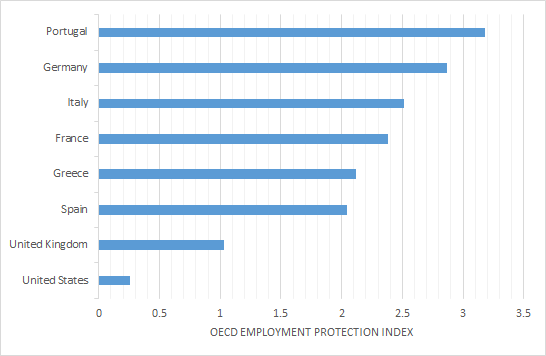
Much easier to fire someone in the USA or UK than on continental Europe. Greece and Spain aren’t that bad by continental European standards for employment law protections against dismissals of individuals.
Figure 1: Strictness of employment protection for individual dismissals, 2013
Source: OECD StatExtract.
Average effective retirement age by gender in the PIGS, 1970 – 2012
27 Jul 2015 Leave a comment
in currency unions, economic history, Euro crisis, fiscal policy, labour economics, labour supply Tags: ageing society, demographics crisis, economics of retirement, female labour force participation, Greece, Italy, male labour force participation, old age pensions, older workers, Portugal, social insurance, Social Security, Spain, taxation and labour supply
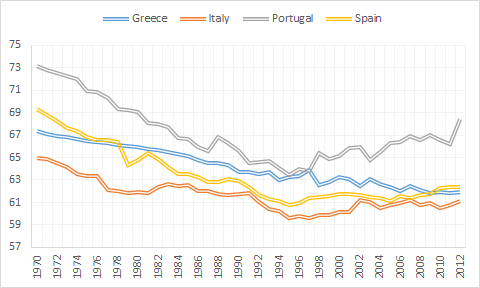
Figure 1 shows a relatively distinct pattern for men in the PIGs. Portugal aside, there has been a long decline retirement ages. This is different to the Anglo-Saxon countries where effective retirement ages have been increasing in recent years for men.
Figure 1: average effective retirement age (5-year averages), men, Portugal, Italy, Greece and Spain, 1970 – 2012
Source: OECD Pensions at a Glance.
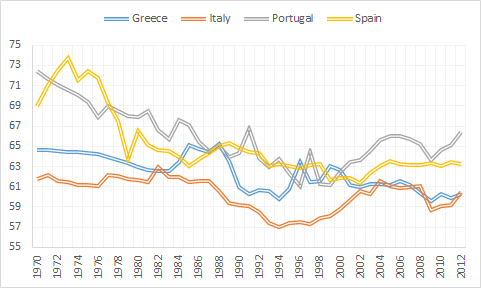
Figure 2 shows that apart from Greece, that after a long decline in female effective retirement ages, there was something the rebound, especially in Italy and Portugal. In Greece, the rebound was in the 80s, followed by a resumption of decline from the mid 90s.
Figure 2: average effective retirement age (5-year averages), women, Portugal, Italy, Greece and Spain, 1970 – 2012
Source: OECD Pensions at a Glance.
EU/OECD averages on R&D spending
27 Jul 2015 Leave a comment
in economic growth, industrial organisation, macroeconomics, survivor principle Tags: creative destruction, endogenous growth theory, entrepreneurial alertness, innovation, R&D
UK below EU/OECD averages on R&D spending: contributes to big productivity problem wef.ch/1dNOgv1 #budget15 http://t.co/OiN0706Tyi—
William Bain (@William_Bain) July 09, 2015

European integration explained in one easy chart
25 Jul 2015 Leave a comment
in currency unions, Euro crisis, international economics, macroeconomics Tags: Common market, customs unions, economics of immigration, EU, Euro, Euroland, European free trade area, European Union, free trade agreements, free trade areas, open borders, preferential trading agreements
AMAZING chart on European integration. One to pin to your office wall. Nice job by @Nic_Koenig delorsinstitut.de/2015/wp-conten… http://t.co/zZbOA29mYP—
Maxime Sbaihi (@MxSba) July 24, 2015
Is the socialist solution to the Greek economic crisis working?
25 Jul 2015 Leave a comment
in budget deficits, business cycles, currency unions, economic growth, Euro crisis, fiscal policy, global financial crisis (GFC), international economics, law and economics, macroeconomics, monetary economics, property rights Tags: capital controls, capital flight, Greece, labour exodus, sovereign defaults
For down and out Greeks, the U.K. is the promised land with jobs aplenty bloom.bg/1Lwcc55 http://t.co/XHHXxdTUiN—
Bloomberg Business (@business) July 24, 2015
@Income_Equality there’s an Internet you know – was there next to no unemployment prior to the mid-1980s in New Zealand?
24 Jul 2015 Leave a comment
in business cycles, econometerics, economic growth, economic history, job search and matching, labour economics, labour supply, macroeconomics, politics - New Zealand, Public Choice, unemployment, unions, welfare reform Tags: antimarket bias, Don Brash, economic reform, expressive voting, Homer Simpson, Leftover Left, lost decades, makework bias, neoliberalism, rational ignorance, rational irrationality, Sir Roger Douglas, Twitter left
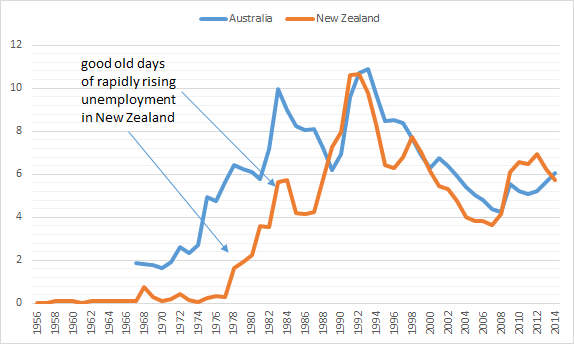
Today, Closing The Gap – The Income Inequality Project boldly claimed today that there was next to no unemployment in New Zealand prior to the onset of the curse of neoliberalism.

There is an Internet on computers now where it is easy to find data showing that the unemployment rate was rising rapidly in New Zealand in the 1970s and in double digits by the end of the 1980s – see figure 1.
Figure 1: harmonised unemployment rates, Australia and New Zealand, 1956-2014
Source: OECD StatExtract.
Figure 1 shows unemployment was rising rapidly in the 1970s and wasn’t much different by the end of the 1970s to the unemployment rates recorded after about 2000 in New Zealand.

One of the reasons that Sir Roger Douglas wrote There’s Got To Be A Better Way was the rapidly rising unemployment in New Zealand and the stagnant economic growth in the late 1970s and early 1980s.

New Zealand was one of the most regulated economies, so much so that Prime Minister David Lange said:
We ended up being run very similarly to a Polish shipyard.
As for those jobs on the railways, the then Reserve Bank Governor Don Brash said in 1996:
Railways cut its freight rates by 50 percent in real terms between 1983 and 1990, reduced its staff by 60 percent, and made an operating profit in 1989/90, the first for six years.
More on unemployment: In 1955 the New Zealand’s prime minister knew all unemployed personally.
– Atkinson’s new book http://t.co/x37Vxya97C—
Max Roser (@MaxCRoser) July 24, 2015
Finland is the poster child for why the euro doesn’t work
24 Jul 2015 Leave a comment
in business cycles, currency unions, economic growth, Euro crisis, global financial crisis (GFC), macroeconomics Tags: Euro land, Finland, recessions and recoveries, Sweden

Herbert Hoover and the onset of the Great Depression
23 Jul 2015 Leave a comment
in business cycles, economic history, economics of regulation, great depression, industrial organisation, labour economics, macroeconomics, unions Tags: Herbert Hoover, Lee Ohanian
Iceland went bankrupt in 2008
23 Jul 2015 Leave a comment
in currency unions, economic growth, Euro crisis, fiscal policy, macroeconomics Tags: Euroland, Eurosclerosis, Finland, Iceland, sovereign default, The Netherlands
Finland and Holland have grown less than Iceland since 2007. Iceland went bankrupt in 2008. washingtonpost.com/blogs/wonkblog… http://t.co/gBEbDUhgYS—
Matt O'Brien (@ObsoleteDogma) July 17, 2015


Recent Comments