Hourly minimum wages before and after taxes, USA, UK, Canada, Australia, New Zealand and Japan
26 Jul 2015 Leave a comment
in labour economics, minimum wage, politics - Australia, politics - New Zealand, politics - USA, population economics, public economics Tags: Australia, British economy, Canada, Japan, social insurance, Social Security taxes, taxation and labour supply
Figure 1: Hourly minimum wage before and after taxes, 2013, US dollars at purchasing power parities, single-person household
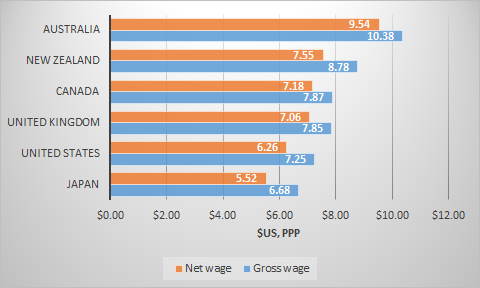
Source: OECD Focus on Minimum Wages after the crisis (2015).
Gary Becker and Kevin Murphy on inequality and growth in living standards
23 Jul 2015 Leave a comment

Fact checking @StaceyKirkNZ & @armchair_critic @Income_Equality: How NZ is one of the worst in the world – updated
23 Jul 2015 1 Comment
in discrimination, gender, labour economics, labour supply, politics - New Zealand, poverty and inequality, public economics, Rawls and Nozick, urban economics Tags: child poverty, difference principle, distributive justice, family poverty, green rent seeking, housing prices, land prices, land supply, Leftover Left, NIMBYs, top 1%
Last May, the Dominion Post had a feature on how New Zealand inequality was amongst the worst in the world:
Rising inequality has been the norm in most developed countries, but few have seen it increase by as much as New Zealand.
Since the 1980s, New Zealand’s inequality – which had been low by OECD standards – drew closer to levels seen in more unequal countries like the United States.
They support this claim with a Gini Coefficient chart that I’ve been unable to source at the OECD. I therefore use another that is freely available in New Zealand and which I have used in the past. My data source on the Gini coefficient has the advantage of been a complete series back to the early 1980s rather than five yearly observations in the OECD data sourced by the Dominion Post.
Figure 1: Inequality in New Zealand and the OECD trend: the Gini coefficient
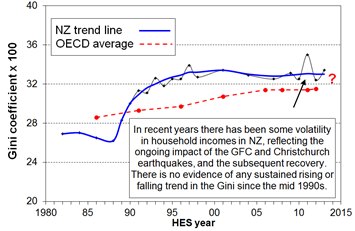
Source: Bryan Perry, Household incomes in New Zealand: Trends in indicators of inequality and hardship 1982 to 2013. Ministry of Social Development (July 2014), Figure J5.
Figure 1 shows there is no evidence of a substantive rise or fall in inequality in New Zealand since the mid 1990s. Nearly all of the increase in inequality was in the late 1980s and early 1990s. Not mentioning that nearly all of the increase was in a short period leads to a poor understanding of the data before their readers. Rising inequality is not an on-going problem in New Zealand. There was a large rise in inequality in the late 1980s and early 1990s.
The next figure that I’ve been able to reproduce is the income shares of the top 10%, top 5%, top 1% on top 0.5% income earners in New Zealand – see figure 2.
Figure 2: Top Income Shares, New Zealand
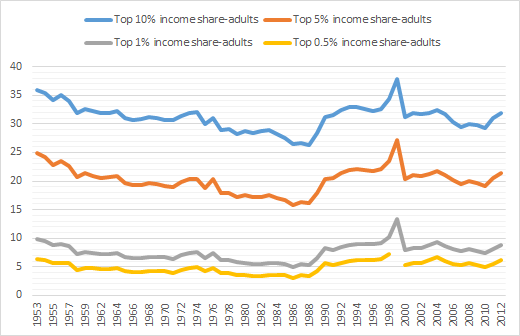
Source: top incomes-parisschoolofeconomics.
Our intrepid reporters in the Dominion Post claim that figure 2 shows that:
In 1986, the top 10 per cent took home 26.5 per cent of New Zealand’s income. In 1999, it was 37.8 per cent and in 2004, it was 33.2 per cent.
Oddly enough, our intrepid reporters decided to stop at 2004 for no particular reason. They also chose to truncate their chart at 1986 for no particular reason other than to lead the coincidence that the top 10% income shares were higher in the 1960s and 1970s that now– see figure 2 . That is, the top 10% in New Zealand earned more in the days before the scourge of neoliberalism came upon the New Zealand then after it – see figure 2. This detail was worth disclosing. Did neoliberalism reduce the income divide in New Zealand between the top 10% and the rest? Figure 2 suggests that it did.
The best that veteran grumbler Max Rashbrooke could spin to make these good old days of higher inequality than now to look like good old days before the scourge of neoliberalism beset New Zealand was to ignore the fortunes of the majority of the population in his dewy eyed view of his childhood:
New Zealand up until the 1980s was fairly egalitarian, apart from Māori and women, our increasing income gap started in the late 1980s and early 1990s
A more worthy analysis of figure 2 is to note that top income shares in New Zealand haven’t changed that much except for a bit of a spike in the late 1980s. This increase in inequality in New Zealand in the late 1980s and early 1990s – see figures 1 and 2 – was quickly followed by a long economic boom – see figure 3.
Figure 3: Real GDP per New Zealander and Australian aged 15-64, 2014 US$ (converted to 2014 price level with updated 2011 PPPs), 1.9 per cent detrended, 1956-2013
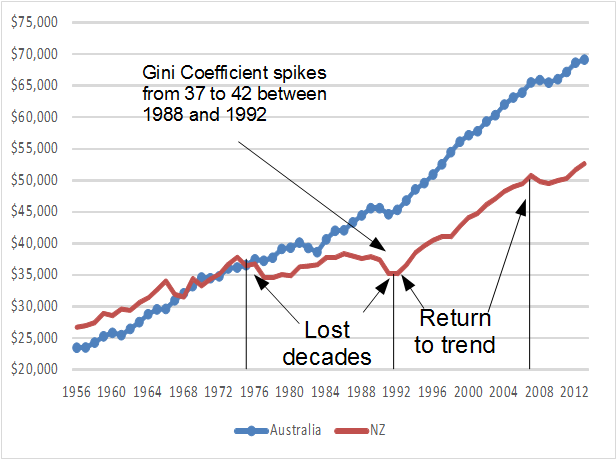
Source: Computed from OECD Stat Extract and The Conference Board. 2015. The Conference Board Total Economy Database™, May 2015, http://www.conference-board.org/data/economydatabase/
This boom after next to two decades of minimal real economic growth per working age New Zealander benefited everyone and, for example, the unemployment rate fell to a record low of 3.5% about 2005. The supposedly more egalitarian 1970s and 1980s were lost decades of growth – see figure 3.
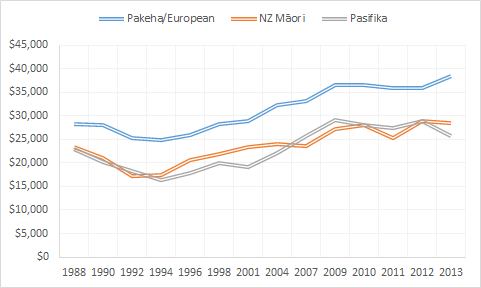
Figure 4: Real equivalised median household income (before housing costs) by ethnicity, 1988 to 2013 ($2013)
Source: Bryan Perry, Household incomes in New Zealand: Trends in indicators of inequality and hardship 1982 to 2013. Ministry of Social Development (July 2014).
As shown in figure 4, between 1994 and 2010, real equivalised median New Zealand Pakeha household income rose by 47%; for Māori, this rise was 68%; for Pasifika, the rise in real equivalised median household income was 77%. These trends pass the difference principle developed by John Rawls.
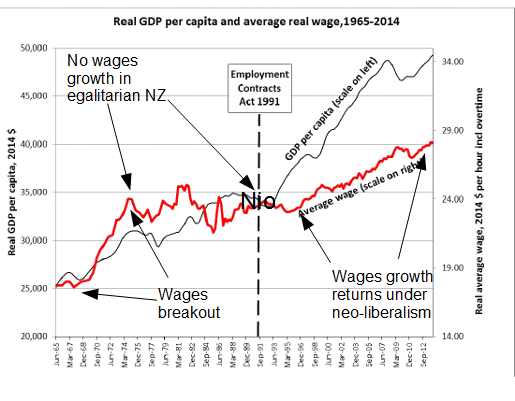
The large improvements in Māori incomes since 1992 were based on rising Māori employment rates, fewer Māori on benefits or zero incomes, more Māori moving into higher paying jobs, and greater Māori educational attainment (Dixon and Maré 2007). Labour force participation rates of Māori increased from 45% in the late 1980s to about 62% in the last few years. Māori unemployment reached a 20-year low of 8 per cent from 2005 to 2008. That and the return of wages growth after years of stagnation as shown in figure 5 is something to celebrate.
Figure 5: real GDP per capita an average real wage, 1965 – 2014, New Zealand
Source: Council of Trade Unions.
The reporters in the Dominion Post also fell for the recent OECD analysis suggesting a connection between economic growth and inequality:
One study by the OECD suggests rising inequality was responsible for wiping a third off New Zealand’s economic growth in the past 30 years
It estimated the rate of New Zealand’s GDP growth was stunted by as much as 15.5 percentage points between 1990 and 2010 – more than any other OECD economy.
The analysis of the OECD depended crucially upon how greater inequality reduces the ability of the lower income families to invest in human capital:
The evidence strongly suggests that high inequality hinders the ability of individuals from low economic background to invest in their human capital, both in terms of the level of education but even more importantly in terms of the quality of education.
The OECD theory of inequality and lower growth is there is a financing constraint because of inequality that reduces economic growth because of less human capital accumulation by lower income families.

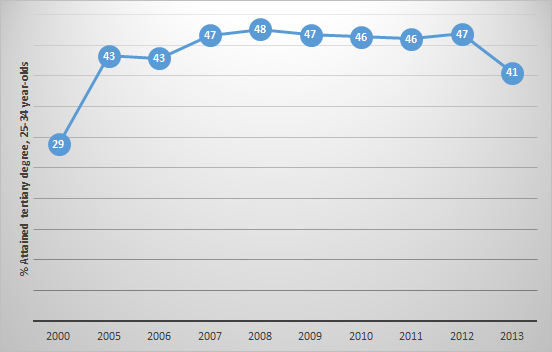
The OECD put a lot of their growth inequality nexus eggs in one basket. The OECD was implying that student loans and other government interventions are not closing credit constraints on financing higher education despite decades of rapidly rising tertiary education attainment, which is partially illustrated in figure 6.
Figure 6: tertiary educational degree attainment (%), New Zealanders aged 25–34, 2000-2013
Source: OECD StatExtract.
This is interesting because in 2002, with Pedro Carneiro, James Heckman showed that lack of credit is not a major constraint on the ability of young Americans to attend college. They found that credit constraints prevent, at most, 4% of the U.S. population from attending. Credit constraints is weakening as a rationale for a lack of an accumulation of human capital, and can be easily solved.
Another difficulty for the OECD is the increase in inequality in New Zealand was, as noted before in figures 1 and 2, in the late 1980s and 1990s. To blame low economic growth to the tune of 15 percentage points on events of some 25 or 30 years ago is a long bow.
Higher education has been free for the low income families for several generations. Student loans are readily available. It is hard to believe that such a readily solvable problem is a major source of inequality and lower growth. Moreover, as Aghion said:
Economists and others have proposed many channels through which education may affect growth–not merely the private returns to individuals’ greater human capital but also a variety of externalities.
For highly developed countries, the most frequently discussed externality is education investments’ fostering technological innovation, thereby making capital and labour more productive, generating income growth.
Despite the enormous interest in the relationship between education and growth, the evidence is fragile at best.
The 15 percentage point reduction in New Zealand economic growth since the late 1980s because of inequality is so large over a 30 year period that this half a percentage point reduction on average per annum qualifies as an independent source of business cycle shocks and an equally implausible driver of real business cycles.
Our intrepid reporters closed by claiming large increases in child poverty:
In December last year, the second annual Child Poverty Monitor showed a slight decrease in the number of Kiwi children living in income poverty, from 27 per cent to 24 per cent. But 30 years ago, it was 14 per cent.
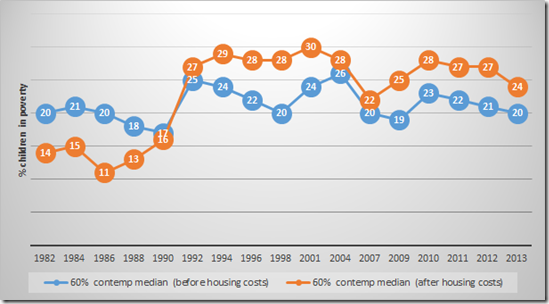
Figure 7 below shows their numbers, which is child poverty in New Zealand for poverty thresholds of 60% relative to a contemporary median measured both before and after housing costs.
Figure 7: % child poverty in New Zealand (before and after housing costs), 60% relative to contemporary median, 1982 – 2013
Source: Bryan Perry, Household incomes in New Zealand: Trends in indicators of inequality and hardship 1982 to 2013. Ministry of Social Development (July 2014), Tables F.6 and F.7.
The first thing to notice in figure 7 is before housing costs child poverty has been pretty stable for 30 years the New Zealand. Few celebrate this.
Figure 7 does show a large increase in after housing costs child poverty in the late 1980s. Since the early 1990s, after housing costs child poverty has slowly tapered down from the high 30% in the mid-1990s to 24% now – see figure 7.
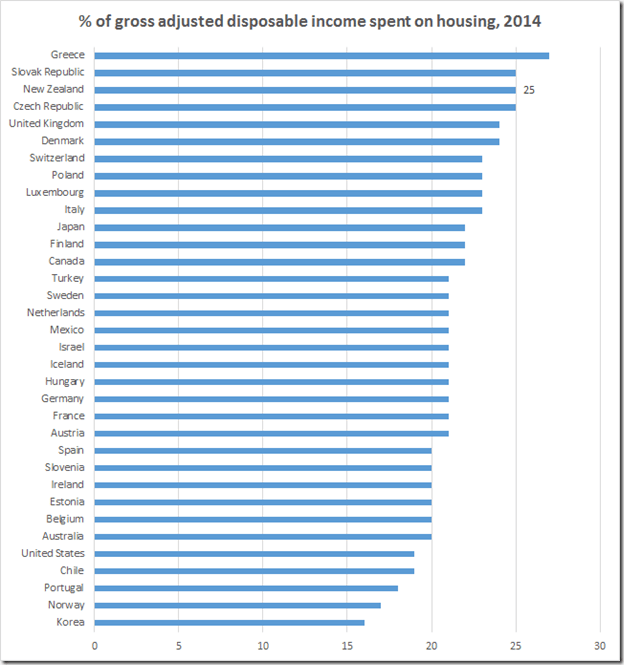
In the longer run after housing costs child poverty rates in 2013 were close to double what they were in the late 1980s mainly because housing costs in 2013 were much higher relative to income than they were in the late 1980s.
– Bryan Perry, 2014 Household Incomes Report – Key Findings. Ministry of Social Development (July 2014).
Before housing costs child poverty in recent years as been the same as it was in 1982 – see figure 7. Although there were large cuts in the social security benefits in the 1991 mother of all budgets in New Zealand, before housing child poverty increased to 25% but was back to 20% by the mid 1990s.
As figure 7 shows, the problem was not income, but the rising costs of housing that had to be paid out of benefits and wages. The Left over Left will not let go of the 1991 benefit cuts even 25 years later despite the fact that the issue was rising housing costs rather than perpetually higher before housing costs child poverty.

The problem is not income, it is rising costs of housing. Increasing wages and benefits will not solve that if more money is simply chasing the same limited stock of land and urban housing.

A proper comparison of the diverging trends in figure 7 between before housing costs child poverty and after housing costs child poverty rates since 1982 gives a much clearer picture of what is increasing child poverty. It is rising housing costs as a result of regulation on the supply of new urban land.
Source: OECD Better Life Index.
The driver of inequality in New Zealand is government regulation of the land supply – policies supported by the middle-class and the left-wing parties. Rising inequality is not inequality between high and low income earners as suggested by the Dominion Post.
The Rahn curve explained
23 Jul 2015 Leave a comment
in comparative institutional analysis, constitutional political economy, income redistribution, politics - Australia, politics - New Zealand, politics - USA, Public Choice, public economics Tags: Director's Law, growth of government, laffer curve, optimal tax theory, Rahn curve, size of government
The average worker doesn’t pay much in income taxes in New Zealand. Then who does?
17 Jul 2015 Leave a comment
in politics - Australia, politics - New Zealand, politics - USA, public economics, taxation Tags: growth of government, size of government, tax burdens, taxation and the labour supply


The left-wing solution to Greek bankruptcy
10 Jul 2015 Leave a comment
in applied price theory, applied welfare economics, comparative institutional analysis, constitutional political economy, currency unions, fiscal policy, global financial crisis (GFC), income redistribution, liberalism, macroeconomics, Marxist economics, Public Choice, public economics, rentseeking Tags: Eurosclerosis, expressive voting, Greece, rational ignorance, rational irrationality, sovereign default
It’s Time to Name a Price on KiwiRail – how much more in losses before committing to shutting it down?
09 Jul 2015 1 Comment
in economics of bureaucracy, politics - New Zealand, Public Choice, public economics, rentseeking, transport economics Tags: corporate welfare, hard budget constraints, KiwiRail, privatisation, public ownership, state owned enterprises, state-owned enterprise welfare
In the finest public service traditions of free and frank advice, the New Zealand Treasury in its budget advice this year advised ministers to contemplate shutting down KiwiRail.
Treasury recommended the Government fund KiwiRail for one more year and undertake a comprehensive public study to look into closing the company. The study is public so that people were informed of the costs of running the rail network compared with any benefits it provided. The Government rejected the idea.
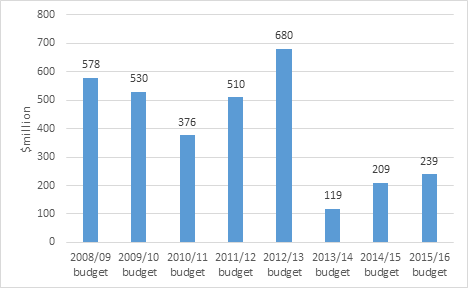
Figure 1: State-owned enterprise welfare, Vote Transport and Vote Finance (KiwiRail), Budgets 08/09 to 15/16
Source: New Zealand budget papers, various years.
KiwiRail has been a constant thorn in the taxpayers’ side. Since this rail business was acquired in 2008 for $665 million as a commercial investment, Crown investments have totalled $3.4 billion – see Figure 1.
Fortunately in the 2015 budget, the Minister of Finance signalled that the government’s patience with the KiwiRail deficits is not unlimited. KiwiRail has a 10-year Turnaround Plan to make its freight business commercially viable. The current network of 4,000 km must be reduced to 2,300 km for the company to even breakeven. The Treasury advised, to no avail, that this massive and painful restructuring was required before KiwiRail was purchased. The purchase went through.
The latest developments where Treasury advised ministers to contemplate shutting the network down is an opportunity for ministers, and the opposition spokesmen on finance and transport both to say how much is too much in accumulated KiwiRail losses.
The Minister of Finance and his Cabinet colleagues must say after the public review that there is only so much more left in the cupboard to bailout KiwiRail losses. After that fiscal cap is reached, KiwiRail is on its own. If that means bankruptcy and network closure, so be it.
In the interim, on the side of every KiwiRail train there should be advertising billboards with the following disclosure statements:
- KiwiRail losses adds one percentage point to the company tax rate each year;
- KiwiRail losses takes deny sick taxpayers X number of elective surgeries per year; and
- X number of doctors, nurses, and teachers could have been hired but for last year’s KiwiRail losses!
The growth of federal taxes in America in the 20th century
09 Jul 2015 Leave a comment
in economic history, politics - USA, public economics Tags: growth of government, size of government
Richer is greener: environmentalists are Environmental Kuznets Curve deniers
07 Jul 2015 Leave a comment
in applied price theory, applied welfare economics, development economics, economic growth, economic history, energy economics, environmental economics, growth disasters, growth miracles, health and safety, industrial organisation, international economics, labour economics, law and economics, liberalism, property rights, public economics Tags: healthier is wealthier, Japan, Kuznets environmental curve, richer is greener, richer is safer
The Kuznets environmental curve describes an empirical regularity between environmental quality and economic growth. Outdoor water, air and other pollution first worse and then improves as a country first experiences economic growth and development.

While many pollutants exhibit this pattern in the Kuznets environmental curve, peak pollution levels occur at different income levels for different pollutants, countries and time periods. John Tierney explains:
In dozens of studies, researchers identified Kuznets curves for a variety of environmental problems.
There are exceptions to the trend, especially in countries with inept governments and poor systems of property rights, but in general, richer is eventually greener.
As incomes go up, people often focus first on cleaning up their drinking water, and then later on air pollutants like sulphur dioxide.
As their wealth grows, people consume more energy, but they move to more efficient and cleaner sources — from wood to coal and oil, and then to natural gas and nuclear power, progressively emitting less carbon per unit of energy.
When I was living in Japan in the mid 1990s, they just completed a period of rapid operation of the Kuznets environmental curve. I was told by my professors at Graduate School that in the 1960s, cities and prefectures welcomed polluting industries because of the better paid jobs they offered. At that time, shipping companies used like to go to Tokyo because the pollution in Tokyo Bay was so bad that it would clean all the barnacles off their ships. That made them sail faster.

Japanese incomes and wages doubled over the course of the 1960s. The Japanese voter was now prepared to support stricter pollution standards and environmental controls.
Life expectancy is at an all time high: buff.ly/1ICraAi http://t.co/jgRqKy8LfQ—
HumanProgress.org (@humanprogress) June 28, 2015
In the early 1970s, the ruling LDP stole the long-standing environmental policies of their opponents in a big crack down on pollution because the country could now afforded them.
Poverty has plummeted in East Asia and the world. buff.ly/1NtIDyY http://t.co/SsY3sf3kyH—
HumanProgress.org (@humanprogress) July 01, 2015
Plenty of developing countries are democracies now. Their people could demand through the ballot box higher environmental standards and clean tap water but they don’t because of its cost to economic development.
These 4 nations are 50% of mankind. That's 3.5 billion people who are living longer. buff.ly/1Kle6mU #health http://t.co/949oqisMsL—
HumanProgress.org (@humanprogress) June 30, 2015
The environmental movement lives in a state of denial regarding the relationship between economic growth and environmental quality.
OECD Better Life Index correlates with GDP
But US lower than poorer countries
& NZL higher than richer countries http://t.co/yrTCnO1B0l—
Max Roser (@MaxCRoser) June 26, 2015
Can NZ double migrant investors and entrepreneurs from $3.5 billion to $7 billion at no cost to taxpayers!?
07 Jul 2015 Leave a comment
in applied price theory, applied welfare economics, comparative institutional analysis, economics of bureaucracy, entrepreneurship, income redistribution, industrial organisation, managerial economics, organisational economics, politics - New Zealand, Public Choice, public economics, rentseeking, survivor principle Tags: corporate welfare, entrepreneurial alertness, industry policy, industry targeting, The fatal conceit, The pretence to knowledge
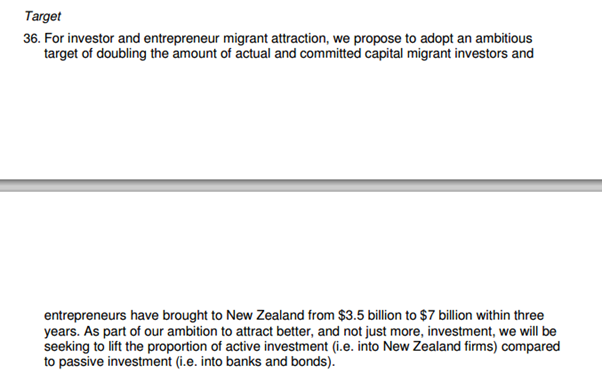

I didn’t notice any discussion in the Cabinet paper of a government doing this before and whether their investment promotion efforts succeeded or not. This latest policy proposal cannot even count as evidence-based policy dreaming, much less a serious contribution to public policy.

Hoping to double incoming foreign investor and entrepreneur migration from $3.5 billion to $7 billion inside three years without spending any extra public money is breathless public policy making. I am sure lots of governments previously tried to get something for nothing.

It will be helpful if ministers pointed to where overseas governments have been successful in doubling foreign investment by simply reprioritising existing investment promotion efforts.

There are at least 2,500 national, provincial and city investment promotion agencies out. Some of them must have been subject to some sort of evaluation as to their success.

This overseas literature review would be in addition to the recent findings of the Ministry of Economic Development about the poor performance and perhaps futility of the foreign direct investment promotion by New Zealand Trade and Enterprise.
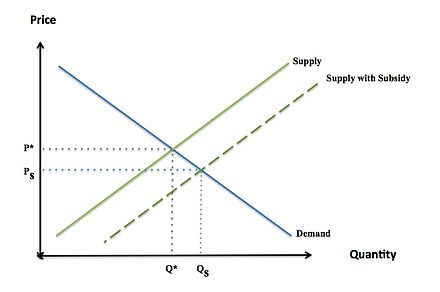
Imagine how much bigger a boost in foreign investor and entrepreneur migration lays before us if actual real new money was put on the table.
via beehive.govt.nz – Strategy targets international investors and Evaluation of NZTE investment support activities [929 KB PDF]
.
A blow to Director’s Law?
03 Jul 2015 Leave a comment
in constitutional political economy, income redistribution, Public Choice, public economics, rentseeking Tags: British economy, British politics, Director's Law, expressive voting, growth of government, median voter theorem, size of government
No, most U.K. homes do not get more in benefits than they pay in tax ow.ly/3y0nEo http://t.co/LaXvGa8ro2—
Bloomberg VisualData (@BBGVisualData) July 02, 2015
…the poorest 30 percent of households receive significantly more in cash benefits than they pay in tax. The next 10 percent receive on average £596 pounds a year more in cash benefits than they pay in tax, and the top 60 percent all pay more in tax than they get back in cash benefits.
New data from the ONS show the huge growth in state dependency under New Labour. Analysis at cps.org.uk/files/factshee… http://t.co/OLjRoxt3eg—
CPS Think Tank (@CPSThinkTank) June 29, 2015
Who pays income tax in New Zealand, and how much?
30 Jun 2015 Leave a comment
Who pays income tax in New Zealand, and how much http://t.co/NpRvzYWbc2—
New Zealand Treasury (@nztreasury) April 12, 2015
 Utopia, you are standing in it!
Recent Comments