Despite all the passions about the TPPA, the correct starting post for an economist on regional trade agreements is lukewarm opposition. That is the position of Paul Krugman. Paul Krugman summarised the TPPA well recently from a standpoint of a professional economist:
I’ve described myself as a lukewarm opponent of the Trans-Pacific Partnership; although I don’t share the intense dislike of many progressives, I’ve seen it as an agreement not really so much about trade as about strengthening intellectual property monopolies and corporate clout in dispute settlement — both arguably bad things, not good, even from an efficiency standpoint….
What I know so far: pharma is mad because the extension of property rights in biologics is much shorter than it wanted, tobacco is mad because it has been carved out of the dispute settlement deal, and Republicans in general are mad because the labour protection stuff is stronger than expected. All of these are good things from my point of view. I’ll need to do much more homework once the details are clearer.
Krugman then reminded that a trade agreement is most politically viable when it is most socially harmful. This is the point that the opponents of the TPPA miss. They will not want to discuss how some trade agreements are good deals but others are bad. That would admit that trade agreements can be welfare enhancing, and sometimes they are but sometimes not.
The correct economic name for free trade agreements is preferential trading agreements. These agreements give tariff and other preferences to some countries over others.
Tariffs are lower for the members of the agreement, creating more trade, but there is also trade division.
CER offers a neat example of trade diversion. Instead of buying cars from the cheapest source and collecting tariff revenue, the hopelessly inefficient Australian car industry did not have to pay tariffs so it made New Zealand into a major export market until tariffs were abolished in 1998.
Less tariff revenue because of CER but we still paid way over the odds for Australian instead of Japanese cars. We were worse off. Less tariff revenue but car prices pretty much as high as before.
New Zealand tariffs are minimal these days. The TPPA reduces the key tariffs on our exports at an excruciatingly slow pace.
There is no discussion of trade diversion in the National Interest Analysis before this committee. For that reason alone, the National Interests Analysis is inadequate and should be returned to the Ministry for further work. Right now, it would not pass a first semester test in a basic international economics course because that most basic risk from trade agreements is not discussed.
Most of the TPPA is not about tariffs. Many of these other chapters are suspicious add-ons to trade talks.
Developing countries rightly regard trade and environment clauses in any trade agreement as a new form of colonialism.
Unions, the Labour Party and Greens happily demand these intrusions into the regulatory sovereignty of developing countries to protect special interests against import competition.
The sovereignty objections to trade agreements are no different to those that can be made to climate change treaties and International Labour Organisation conventions. It is all in the details – what do we get in return?
Consistency would help too. Trade agreements should not include labour or environmental standards as they, for example, limit our right to deregulate our labour market. Be careful for what you wish for when you oppose international agreements on sovereignty grounds.
The intellectual property chapters of the TPPA are truly suspicious. With each new day, the case for patents and copyrights is weakening in the economic literature. Some have made powerful arguments to abolish patents and copyrights altogether.
There are modest extensions of the term limits of drug patents and much more mischief on copyright terms. These should be watched carefully in future trade talks and one day will be a deal breaker.
Good arguments can be made against investor state dispute settlement provisions even after the carve-outs. These provisions have no place in trade agreements between democracies.
Foreigners can take their chances in democratic politics like the rest of us. They might occasionally get a short deal because of left-wing or right-wing populism but these gusts of xenophobia are mostly an occasional irritant in the rich fabric of Western democracies.
Developing countries sign-up to investor state dispute settlement to signal they are open for business. Foreign investors do not have to put up with their corrupt courts and bureaucracies and hopelessly venial politicians.
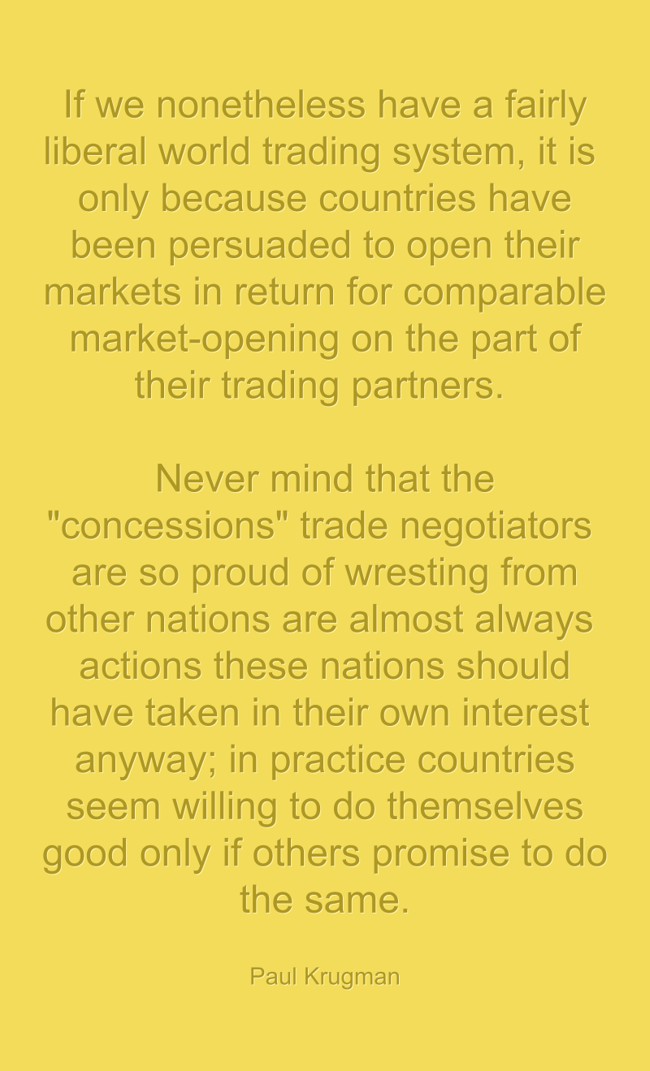
The logic of regional trade negotiations is we cut tariffs we should have cut long ago in return for others cutting their tariffs which they too should have cut long ago.
Much is made of the cost-benefit analysis of the TPPA. All the critics are really saying is cost benefit analysis is really hard and often imprecise.
If the econometric estimates were not in doubt in this or any other public policy field, the academics are simply not trying hard enough to win tenure and promotion. Academics make their careers by being contrarian.
For this lukewarm opponent of regional trade agreements, the TPPA is a so-so deal with small net gains. There is no harm in signing it.
Jane Kelsey makes the following points about the legal implications of the Trans-Pacific Partnership agreement:
The 30 chapter Trans-Pacific Partnership Agreement (TPPA) constrains domestic law and policy at central government level, and in places by local government and SOEs, in diverse areas beyond traditional aspects of international trade.
…The TPP provides cumulative opportunities for foreign states and corporations to influence domestic decisions which may be burdensome and intrusive.
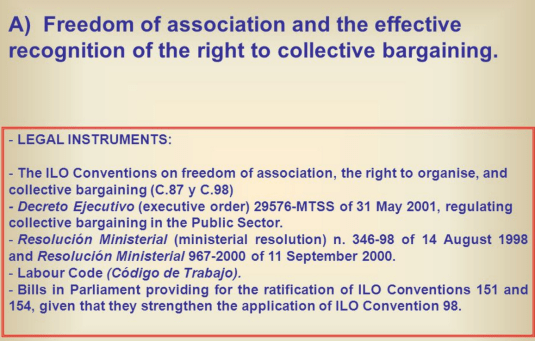
The exact same objections apply to the ILO conventions. The union movement does not hesitate to argue that the democratic process in New Zealand should be overridden because the proposal at hand purportedly conflicts with an ILO convention.
in Parliament on 4 June, the Minister was asked if he agreed with advice from officials that the ability for employers to opt out of multi-employer bargaining may breach our obligations under ILO Convention 98 on the right to organise and collective bargaining.
…There is no point attending such an important UN ILO conference at the time your Government is being advised it is breaching its undertakings to that very organisation…
The paper also points out that these changes open NZ up to international examination by the International Labour Organisation (ILO) for non-compliance with Convention 98 – on the Right to Organise and Collectively Bargain, which New Zealand has signed up to.
Helen Kelly says “at least four of the proposals are deemed to be inconsistent with our international obligations, and two of them are classified as uncertain. Why the Government wants law changes that damage our international obligations is unclear.”
Posner and Goldsmith rightly argue that international law is a product of states pursuing their interests on the international stage. It does not induce states to comply contrary to their interests. The possibilities for what it can achieve are limited.
Government sign-up to various international agreements depending on their political priorities. You cannot complain that governments that you did not vote do what government you voted for also did, which was sign up to international agreements that suited their political agendas. The solution is to work harder to win the next general election.
As for opposing trade agreements on sovereignty grounds, it is rank hypocrisy for the union movement to do so given the number of times it cites international labour agreements when it suits them and seeks their inclusion in trade agreements to raise labour costs in developing countries.
The op-ed by Tim Hazledine today made a poor case against the Trans-Pacific Partnership agreement (TPPA). A much better case could be made but for his still fighting the 1990 election in New Zealand, which was about the future of economic reform.
One of the more gormless of the 1980s “Rogernomics” economic policy experiments was to slash tariffs on imports without seeking equivalent concessions from our trading partners.
That didn’t do us much good then, but means now that matching reductions under the TPP is relatively painless for New Zealand, because our tariffs are already so low.
He wants to put tariffs back up again so that the poor pay well over the odds to import goods that are often not made in New Zealand and when they were they were very expensive.
Henry Simons argued that economics and in particular applied price theory is most useful both to the student and the political leader as a prophylactic against popular fallacies. Paul Krugman explained the twisted logic of trade negotiations well in this tradition when he said:
Anyone who has tried to make sense of international trade negotiations eventually realizes that they can only be understood by realizing that they are a game scored according to mercantilist rules, in which an increase in exports – no matter how expensive to produce in terms of other opportunities foregone – is a victory, and an increase in imports – no matter how many resources it releases for other uses – is a defeat.
The implicit mercantilist theory that underlies trade negotiations does not make sense on any level, indeed is inconsistent with simple adding-up constraints; but it nonetheless governs actual policy.
The economist who wants to influence that policy, as opposed to merely jeering at its foolishness, must not forget that the economic theory underlying trade negotiations is nonsense – but he must also be willing to think as the negotiators think, accepting for the sake of argument their view of the world.
The logic of trade negotiations is they are about cutting tariffs we should have cut long ago in return to others cutting their tariffs which they too should have cut long ago if they had any concern for the welfare of their own country rather than special interests.
Tim Hazledine swallows the logic of trade negotiations hook, line and sinker with all the enthusiasm of a non-economist but he is a professional economist. Professional economists laugh at the mercantilist logic of trade negotiations.
I’ve described myself as a lukewarm opponent of the Trans-Pacific Partnership; although I don’t share the intense dislike of many progressives, I’ve seen it as an agreement not really so much about trade as about strengthening intellectual property monopolies and corporate clout in dispute settlement — both arguably bad things, not good, even from an efficiency standpoint….
What I know so far: pharma is mad because the extension of property rights in biologics is much shorter than it wanted, tobacco is mad because it has been carved out of the dispute settlement deal, and Republicans in general are mad because the labour protection stuff is stronger than expected. All of these are good things from my point of view. I’ll need to do much more homework once the details are clearer.
Krugman then reminded that a trade agreement is most politically viable when it is most socially harmful. This is the point that the opponents of the TPPA miss. They will not want to discuss how some trade agreements are good deals but others are bad. That would admit that trade agreements can be welfare enhancing, and sometimes they are but sometimes not.
Hazledine’s op-ed improves noticeably when he talks about sovereignty but this will backfire on him as I will show shortly:
what perhaps most concerns TPP doubters is possible loss of sovereignty – control by legitimate New Zealand governments over New Zealand policies and institutions: Pharmac, mining, greenhouse gases, fracking, biomedical patents, the Treaty of Waitangi and others have been raised as being at risk. TPP supporters have attempted to soothe such concerns, but I’d say they should come clean. Of course the TPP will weaken New Zealand’s sovereignty. That is what these things are supposed to do!
The fundamental idea or ideology behind the TPP is that national governments cannot be trusted to act independently on many issues, because they will inevitably succumb to local vested interests. Only the cleansing discipline of untrammelled global free-market forces will deliver efficient outcomes.
I fully understand the economic logic of this position, and could easily myself compile a long list of harmful effects of local vested interests, at the top of which would actually be those Canadian etc dairy and other agricultural policies.
But the basic premise is flawed. Most of the sovereignty we are giving up is not ceded to the invisible hand of free, competitive markets. It is not even handed over to larger sovereign states, such as the United States. It is largely to be conceded in the cause of making the world a safer place for huge, stateless multinational corporations to roam. Are we sure this is what we want?
I agree that treaties reduce sovereignty. That is what they are about. I am particularly concerned about treaties that reduce New Zealand’s sovereignty over its greenhouse gas emissions. These sovereignty arguments against trade agreements apply equally to climate treaties.
Likewise, trade agreements should not include trade and environmental standards as they limit the right of New Zealand to deregulate its labour market.
All too often unions point out that this or that International Labor Organisation convention signed decades ago conflicts with labour market deregulation. That undermines the sovereignty of New Zealand regarding the regulation of the economy just as much is the TPPA.
If our friends on the left are to be believed, trade liberalisation is bad unless it involves Cuba, Vietnam, Iraq and other heroes of the anti-west left. The anti-west left is different from the antifascist left and is sometimes known as the renegade left or regressive left.
Access to world markets, and the removal of trade sanctions and travel and investment restrictions are all to the benefit of the Vietnamese, Iraqi and Cuban people in the street and not just their elites in the eyes of the anti-west left. There you have: trade liberalisation is bad because reduced tariffs at home and abroad hurts ordinary people; trade sanctions are bad because they hurt ordinary people by denying them access to import from and exporting into world markets.
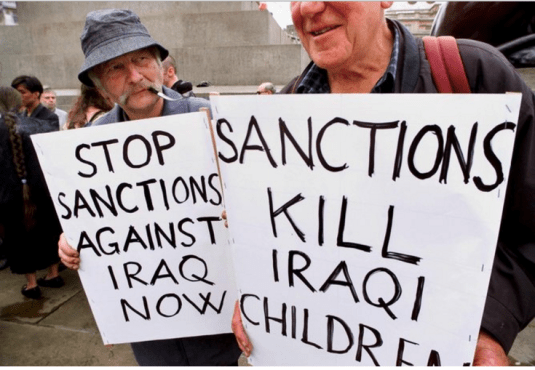
Trade sanctions against Iraq were to terrible for the Iraqi people. Removing those trade sanctions and similar sanctions on Cuba and Vietnam, which expanded their ability to export and import was essential to improving the welfare of Iraqis, Cubans and Vietnamese respectively. Two of these three countries are not a democracy with the guarantees elections have in ensuring broad-based benefits but nonetheless greater trade liberalisation was seen as to the advantage of the ordinary people of those dictatorships by the Left.
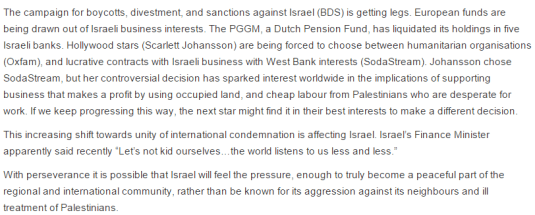
Likewise boycotting, disinvesting and sanctions on Israel will change the Israeli policy because the Israeli people. The logic here is that trade and investment is wealth enhancing, so restricting trade punishes Israelis.
A comprehensive study by Kim Elliott, Jeffrey Schott, and Gary Hufbauer looked at whether sanction works. Do they accomplish the goals identified by U.S. policy-makers such as ending apartheid or undermining Libya’s support of terrorism? The study estimated they have succeeded 23 percent of the time. But of course as Kaempfer and Lowenberg say
Sanctions may be imposed not to bring about maximum economic damage to the target, but for expressive or demonstrative purposes. Moreover, the political effects of sanctions on the target nation are sometimes perverse, generating increased levels of political resistance to the sanctioners’ demands.
It is also that case that Kaempfer, Lowenberg and Mertens (2001) found that sanctions generate rents that can be appropriated by a dictator and his cronies and supporters such as those who were close to Saddam. The losses from the sanctions were borne by those who are opposed to the regime. This weakens their capacity to oppose it, leading to the further entrenchment in power of the dictator and his supporters. As Wintrobe explains:
In the public choice approach, sanctions work through their impact on the relative power of interest groups in the target country. An important implication of this approach is that sanctions only work if there is a relatively well organized interest group whose political effectiveness can be enhanced as a consequence of the sanctions.
What is reasonably clear from the literature on the economics of trade sanctions is at ordinary people in both dictatorships and democracies suffer from trade sanctions the most. The political elite can shift the costs of the trade and investment sanctions onto the disenfranchised within their country. Those with political connections have a better chance of minimising the costs and profiting from any windfall rents:
as Galtung (1967) observes, sanctions can be counterproductive by giving rise to a new elite in the target nation that benefits from international isolation. For example, Selden (1999) notes that, in the long run, sanctions often foster the development of domestic industries in the target country, thus reducing the target’s dependence on the outside world and the ability of sanctioners to influence the target’s behaviour through economic coercion…
Damrosch (1993, p. 299) contends that sanctions will almost inevitably benefit an autocratic regime because the regime will always be in a better position than the civilian population to control external transactions and the internal economy. In Damrosch’s view, the creation and enrichment of a criminal class that profiteers from trading bootleg or scarce goods means that even the most skilfully targeted sanctions will serve only to entrench the power of the ruling elite
One of the hopefully unintended consequences of trade and investment sanctions is disinvestment entrenches the position of capitalists in the sanctioned country and raises the rate of return on the capital in the targeted country as Kaempfer and Lowenberg again found:
…disinvestment sanctions can have the perverse effect of enhancing the target country’s ability to pursue its objectionable behaviour. The existing foreign capital stock – the physical plant and capacity previously owned by foreigners – is purchased by domestic capital owners at reduced prices, causing yields to rise and prompting target-country residents to sell foreign assets and substitute into domestic assets with higher rates of return.
The increase in the rate of return due to the acquisition of productive assets at fire-sale prices translates into a windfall gain to domestic capital owners, which increases the tax base available to the government to finance its policies, including those that attracted the sanctions in the first place
So far so good in terms of international economics of the renegade left until we start considering their attitude to trade agreement such as the Trans-Pacific Partnership. The logic of BDS is swept aside as is the rationale for opposing trade sanctions against Iraq, Cuba and Vietnam. Now enhanced opportunities for trade and investment is not in the interests of ordinary people even if they are Vietnamese – the biggest winner from the Trans-Pacific Partnership.
Now increased opportunities to export are a bad thing. Investor state dispute settlement procedures, which were initially proposed by the governments of poor countries such as in South America, which offer a relief to foreign investors against expropriation and discrimination become a bad thing. Safeguards against corrupt and venial developing country politicians, bureaucrats and courts expropriating foreign investors are a bad thing even if you are talking about Vietnam or Cuba.
The Greens are the first to call for trade sanctions as an alternative to military intervention. Trade sanctions on the grounds of human rights violations as far back apartheid in South Africa make no sense unless the reduced access to world markets imposes a cost on a country. In the case of a democracy like Israel, trade sanctions must hurt the man in the street otherwise the sanctions will not shift electoral fortunes.
The last line of defence of the trade sanctions work but trade liberalisation is bad line of thought is most of the profits and losses of both trade sanctions and trade liberalisations fall on the elite. It is a trickle up argument.
The first flow in that argument is the sanctions against apartheid in South Africa and Rhodesia. They were aimed at ordinary people such as those that play and watch cricket, rugby and other sports. The idea is to encourage people to change their political views and votes if they want access to global sport.
Both Rhodesia and South Africa were democracies for whites. White settler politics in Rhodesia was particularly colourful. It was a brave man to make any statement that put him at the risk of being overtaken on his right in white settler politics.
The bigger problem for the trade sanctions are good, trade liberalisation is bad argument comes from the interest group based explanations of industrialisation in Japan and the East Asian Tigers. Economic development often comes to developing countries through export based industrialisation.
The reason that export based industrialisation is a common path to economic development for poor countries is it does not threaten the existing configuration of special interests. It does not involve deregulating any domestic industry. The export industries do not threaten the business interests and profits of existing rent seekers and ruling elites.
Post-war trade liberalisation and tariff cuts gave Korean and the other East Asian Tigers much greater access to major export markets. This allowed export production to expand without limit. This expansion did not threaten local special interests because they kept their privileges and barriers to entry into the domestic markets.
Incumbent suppliers and workers are less likely to be hurt by the adoption of more efficient technologies because output expands greatly through exporting. If a market is small and limited to one country, and output cannot be increased without price cuts, greater production efficiency from a new technology can lead to less employment and business closures. Industry insiders may oppose this. Exporting reduce the incentives for insiders to block more efficient technologies (Parente and Prescott 2005; Holmes and Schmitz 1995; Olson 1982). Distributional coalitions slow down a society’s capacity to adopt new technologies and to reallocate resources in response to changing conditions and thereby reduce the rate of economic growth.
Many other under-developed nations did not grow because institutional sclerosis locked them into yesterday’s technologies and industries with low growth and major declines in relative incomes (Olson 1982, 1984; Heckelman 2007; Bischoff 2007). A growing accumulation of distributional coalitions – institutional sclerosis – slowed down the capacity of these under-developed countries to adopt new technologies and reallocate resources across firms and industries in response to changing conditions and new opportunities (Olson 1982, 1984; Acemoglu and Robinson 2005).
Mancur Olson argued that over time, stable societies accumulate “distributional coalitions,” narrow special-interest organizations that burden the economy with overregulation and opaque forms of wealth redistribution.
Latin America is a good example of stagnation after initial prosperity because of the accumulation of barriers to efficient production. Latin America has many more international and domestic barriers to competition than do Western and the successful East Asian countries (Cole et al. 2005).
Institutional reforms and imported new technologies increased employment and incomes through this explosion in exporting in Japan and the newly industrialised countries in East Asia. This allowed the losers from the economic changes to be compensated directly or with new opportunities in the export sectors (Parente and Prescott 1999, 2005; Olson 1982, 1984; Acemoglu and Robinson 2005).
The argument that trade sanctions are good while trade liberalisation is bad simply does not stand up against the economic history of trade sanctions, trade liberalisation and export-led industrialisation. If they did, the economic histories of Latin America and East Asia would swap. Latin America took the path of import substitution and crony capitalism while East Asia chose export led industrialisation, low taxes and the market economy.
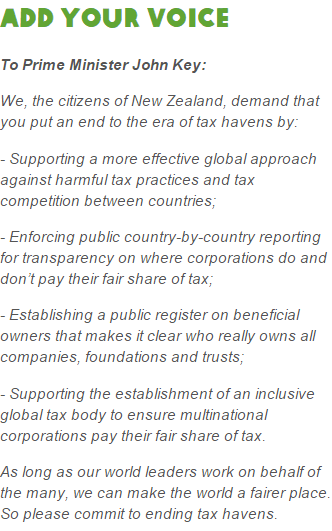
Oxfam New Zealand and fellow travellers at home and abroad are attacking the sovereignty of the Cook Islands and other tax havens by demanding that the developed countries gang up on them because they offer low company tax rates.
All that plucky rhetoric of TPPA no way and how international economic agreements violate the sovereignty of countries and developing countries in particular is forgotten in a flash.
Apparently, the same governments that were at the beck and call of the corporate elites when negotiating international trade agreements, can be trusted to negotiate international tax treaties that take into the account the interests of developing countries, the Pacific Islands and small states.
Oxfam manages to have the blinding hypocrisy of opposing the Transpacific Partnership on national sovereignty grounds and at the same time call for international treaties to bully small countries about their tax policies, which overrides their economic sovereignty.
The sovereign rights of developing countries to find their own way does not extend to undermining the tax bases of the rich countries struggling to finance their welfare states.
The Pacific Islands, the once were heroes of the recent Paris climate talks, turn into pariahs once they start looking out for themselves and setting up offshore financial centres and tax havens.
Developing countries are free to impoverish themselves by embracing socialism, but if they decide to attract investment and jobs through low tax rates and offshore financial centres, a new form of colonialism is embraced by the Twitter Left.
The Cook Islands is one such tax haven. The Cook Islands is self-governing in free association with New Zealand. New Zealand is responsible for its defence and foreign affairs but it has full internal sovereignty.
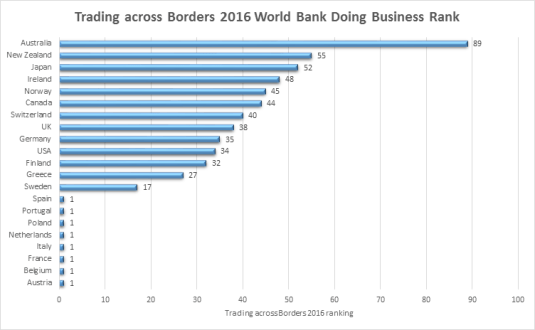
Australia is certainly a dog of a place when it comes to trading across borders and the same pretty much goes for New Zealand. Continental European Union members who are next to each other have a good run when it comes to trading across borders. Germans seem to manage to stuff that up nonetheless.
Australia and New Zealand get a poor rating because of border charges for a processing of customs documents. In Continental Europe, where there are no border controls for land crossings between EU members, these border compliance costs obviously do not apply nor is there any waiting at border checkpoints.
Good grief, the architect of "the pivot to Asia" opposes TPP? In her book she praised the deal! http://t.co/9XDiv0btzM— Ryan Lizza (@RyanLizza) October 07, 2015
One of my policy essays for my Masters of Public Policy Degree in Japan was on the social clauses of the GATT. I described the labour and environmental clauses is a new form of colonialism.
My classmates were government officials from all around Asia, more than 20 countries. As they spoke English as a second language, they were pleased to learn of a new way of describing social clauses in trade agreements in English.
A Filipino friend had a blunter way of referring to social clauses in trade agreements: “the whites are back, telling us what to do”.
Jane Kelsey in a television interview said she opposes the reductions in sovereignty in trade agreements that result from investor-state dispute settlement (ISDS) provisions because they limit the democratic choices of future governments.
If so, she must oppose environmental and labour standards in trade agreements and, more importantly, binding the hands of future governments with climate treaties. All international treaties are about restrictions on sovereignty.
Environmental and labour clauses in trade agreements and climate treaties all limit the powers of governments to legislate on environmental and employment law in accordance with the will of the people as expressed in the most recent election and change of government. Power to the people.
Jane Kelsey would do better focusing on those parts of the TPPA deal that lowers the net value of the deal such as those extending the term of patents over the drugs. All international treaties are about trade-offs.
The next best arguments James Shaw made were xenophobia about foreign investment in land and some vast conspiracy theory regarding endangered dolphins.
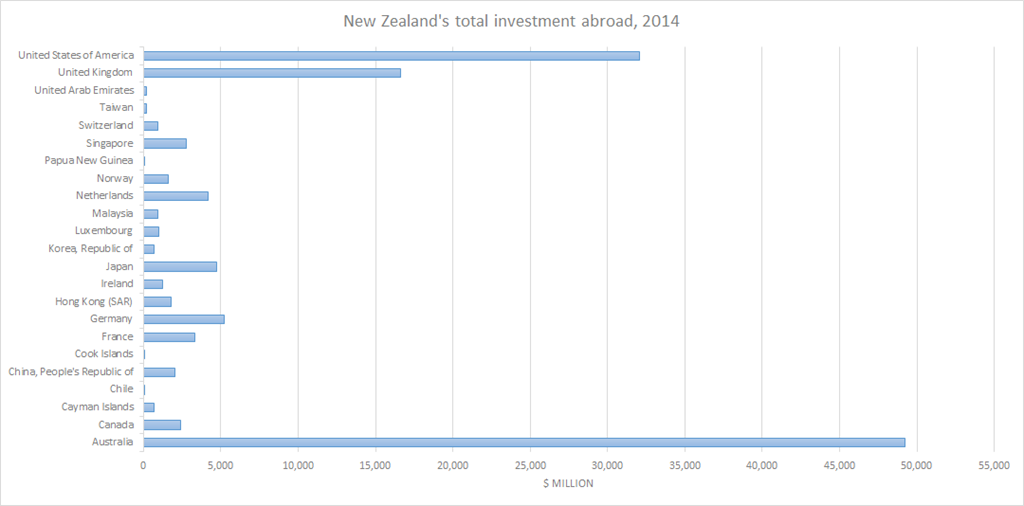
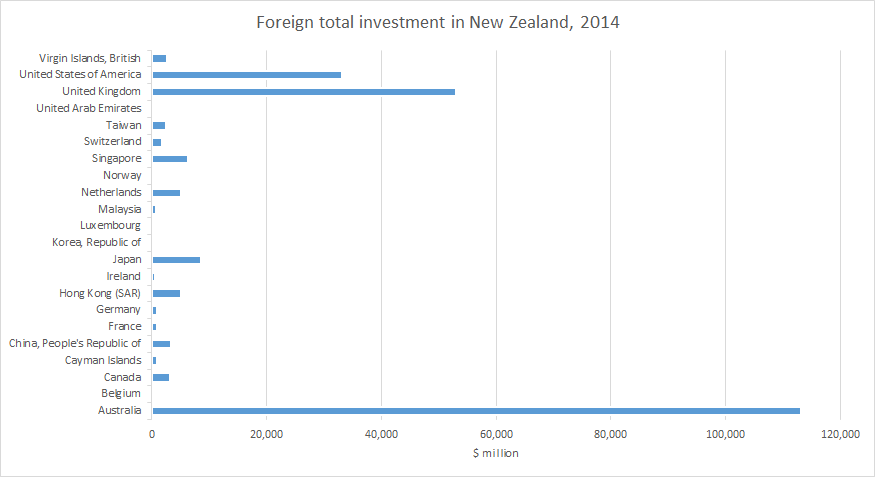
When your next best argument is foreigners are coming to buy up all our land, you are playing from a weak populist hand. About half of million New Zealand born live in other countries.
About 80% of these live in Australia, the great majority as residents rather than as citizens. These New Zealanders living in Australia and elsewhere need protection under international agreements to ensure they are not the victim of populist outbreaks against the sale of land to foreigners.
Source: Statistics New Zealand.
In addition, if a foreigner wants to pay over the odds for my house I am glad to separate a fool from his money.
Source: Statistics New Zealand.
New Zealand has a strong interest in protecting the rights of its own expatriates as well as New Zealand foreign investors to buy land in other countries. As David Friedman explains:
Much more commonly, [economic imperialism] is used by Marxists to describe–and attack–foreign investment in “developing” (i.e., poor) nations. The implication of the term is that such investment is only a subtler equivalent of military imperialism–a way by which capitalists in rich and powerful countries control and exploit the inhabitants of poor and weak countries.
There is one interesting feature of such “economic imperialism” that seems to have escaped the notice of most of those who use the term. Developing countries are generally labour rich and capital poor; developed countries are, relatively, capital rich and labour poor. One result is that in developing countries, the return on labour is low and the return on capital is high–wages are low and profits high. That is why they are attractive to foreign investors.
To the extent that foreign investment occurs, it raises the amount of capital in the country, driving wages up and profits down. The effect is exactly analogous to the effect of free migration. If people move from labour-rich countries to labour-poor ones, they drive wages down and rents and profits up in the countries they go to, while having the opposite effect in the countries they come from.
If capital moves from capital-rich countries to capital-poor ones, it drives profits down and wages up in the countries it goes to and has the opposite effect in the countries it comes from. The people who attack “economic imperialism” generally regard themselves as champions of the poor and oppressed.
To the extent that they succeed in preventing foreign investment in poor countries, they are benefiting the capitalists of those countries by holding up profits and injuring the workers by holding down wages. It would be interesting to know how much of the clamour against foreign investment in such countries is due to Marxist ideologues who do not understand this and how much is financed by local capitalists who do.
The reality is that this is an agreement to manage its members’ trade and investment relations – and to do so on behalf of each country’s most powerful business lobbies.
Make no mistake: It is evident from the main outstanding issues, over which negotiators are still haggling, that the TPP is not about “free” trade.
New Zealand has threatened to walk away from the agreement over the way Canada and the US manage trade in dairy products. Australia is not happy with how the US and Mexico manage trade in sugar.
And the US is not happy with how Japan manages trade in rice. These industries are backed by significant voting blocs in their respective countries. And they represent just the tip of the iceberg in terms of how the TPP would advance an agenda that actually runs counter to free trade.
The case for intellectual property rights over drugs is complicated but no one seems to be suggesting that patents should be lengthened.
Far more can be gained in terms of drug availability through regulatory reforms that streamline the drug safety approval process which is currently costing many people their lives.
Sam Peltzman showed in a famous paper in 1973 that the 1962 amendments to US Federal drug approval laws reduced the introduction of effective new drugs in the USA from an average of forty-three annually in the decade before the 1962 amendments to sixteen annually in the ten years afterwards. No increase in drug safety was identified.
The most bizarre part of drug approval processes is they go beyond the checking whether the new drug is safe. What is even more bizarre in New Zealand is the New Zealand drug safety agency duplicates safety processes already performed overseas. This is instead of automatically approving any drug or medical device approved in the USA, UK, Canada or Australia.
Drug safety regulators in the USA also check to see if the drug works – that the drug has its predicted effects. Drug safety is a health policy concern but whether the investors developed a useful drug is something between them and those interested in buying it. Drugs became available years after they were on the market outside the USA because of drug lags at the FDA. To quote David Friedman:
In 1981… the FDA published a press release confessing to mass murder. That was not, of course, the way in which the release was worded; it was simply an announcement that the FDA had approved the use of timolol, a ß-blocker, to prevent recurrences of heart attacks.
At the time timolol was approved, ß-blockers had been widely used outside the U.S. for over ten years. It was estimated that the use of timolol would save from seven thousand to ten thousand lives a year in the U.S.
So the FDA, by forbidding the use of ß-blockers before 1981, was responsible for something close to a hundred thousand unnecessary deaths.
It is a pity that the far left movement ranted against the TPP focused on conspiratorial theories about investor state dispute settlement rather than the risks of this trade deal to the cost of drugs to the health sector. Only late in the game did the far left start talking about drug availability and the costs of drugs to the health budget of the government if patent lives were extended under the TPPA.
A campaign against the TPPA on the basis of its impact on drug availability because of longer patent terms running up against the limited budgets of pharmaceutical purchasing agencies would have appealed across the entire political spectrum. As Joe Stiglitz explains:
The TPP would manage trade in pharmaceuticals through a variety of seemingly arcane rule changes on issues such as “patent linkage,” “data exclusivity,” and “biologics.”
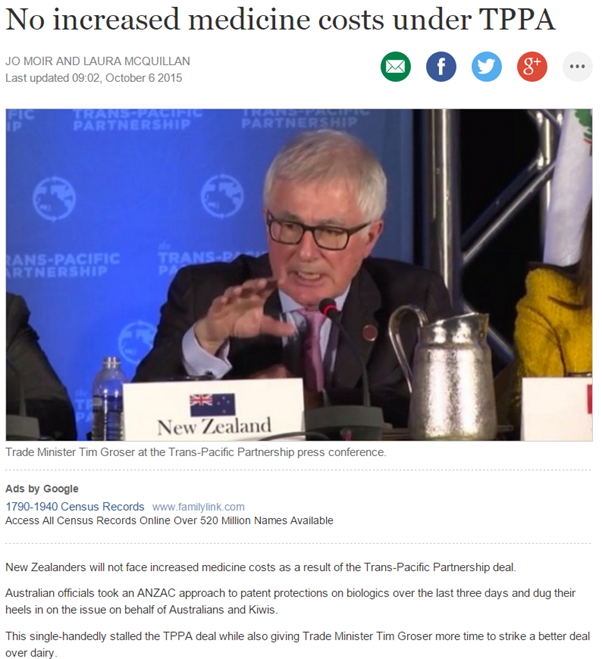
The upshot is that pharmaceutical companies would effectively be allowed to extend – sometimes almost indefinitely – their monopolies on patented medicines, keep cheaper generics off the market, and block “biosimilar” competitors from introducing new medicines for years. That is how the TPP will manage trade for the pharmaceutical industry if the US gets its way.
The health sector can only so much to buy drugs. If drug patents last longer, there is less money to go around because the generics become available later than otherwise.
Why Evolution is True is a blog written by Jerry Coyne, centered on evolution and biology but also dealing with diverse topics like politics, culture, and cats.
“We do not believe any group of men adequate enough or wise enough to operate without scrutiny or without criticism. We know that the only way to avoid error is to detect it, that the only way to detect it is to be free to inquire. We know that in secrecy error undetected will flourish and subvert”. - J Robert Oppenheimer.



 Utopia, you are standing in it!
Recent Comments