
Passports in Europe were abolished between 1861-1914
11 Aug 2015 Leave a comment
in international economic law, international economics, International law Tags: passports
@BrankoMilan Passports in Europe were abolished between 1861-1914 "History of Passports" bit.ly/1N5QSRo http://t.co/P97W2FCKJS—
Old Whig (@aClassicLiberal) August 04, 2015
Income from selling citizenships is now 16% of Malta government’s budget
01 Aug 2015 Leave a comment
in Economics of international refugee law, international economic law, international economics, law and economics Tags: Malta, passports, trading on sovereignty
Income from selling citizenships is now 16% of Malta government's budget bloom.bg/1GFbhJK @dslesperance http://t.co/C5HS8PjOb0—
Old Whig (@aClassicLiberal) March 22, 2015
Jane Kelsey opposes handcuffs on the democratic choices of future governments! Does she oppose labour and environmental standards in trade agreements too?
30 Jul 2015 6 Comments
in applied price theory, applied welfare economics, comparative institutional analysis, constitutional political economy, economics of regulation, environmental economics, health economics, industrial organisation, international economic law, international economics, International law, law and economics, property rights, Public Choice Tags: climate treaties, copyrights, customs unions, environmental standards, free trade agreements, free trade zones, intellectual property law, ISDS, Jane Kelsey, Labour standards, Left-wing hypocrisy, neocolonialism, patents, preferential trading agreeents, regional trade agreements, regulatory harmonisation, TPA, TPPA, WTO
Jane Kelsey in a television interview said she opposes the reductions in sovereignty in trade agreements that result from investor-state dispute settlement (ISDS) provisions because they limit the democratic choices of future governments.
If so, she must oppose environmental and labour standards in trade agreements and, more importantly, binding the hands of future governments with climate treaties. All international treaties are about restrictions on sovereignty.
Environmental and labour clauses in trade agreements and climate treaties all limit the powers of governments to legislate on environmental and employment law in accordance with the will of the people as expressed in the most recent election and change of government. Power to the people.
https://twitter.com/rorymccourt/status/625540621457960960
Jane Kelsey would do better focusing on those parts of the TPPA deal that lowers the net value of the deal such as those extending the term of patents over the drugs. All international treaties are about trade-offs.

The most important reason for focusing on intellectual property law in trade agreements is Kelsey is likely to actually win people over that are not on the far left, including many on the right of politics over to her cause. Kelsey is too busy rounding up the usual suspects.

Ranting about big corporate conspiracies and the investor state dispute settlement clauses puts people off.
As copyright duration's at play in #TPPA, a reminder of the costs when copyright's too long.
offsettingbehaviour.blogspot.co.nz/2014/03/orphan… http://t.co/tOtihpDmSU—
Eric Crampton (@EricCrampton) July 29, 2015
These gusts of paranoia lose support on issues where there is common ground to be suspicious about the growing scope of trade agreements and their reach behind borders.

Regulatory harmonisation is advisable only when there are compelling reasons such as the prevention of hazards or technical compatibility of products – do the plugs fit into each other? As Sykes argues:
as a normative matter, harmonization is inferior to a legal system that tolerates regulatory differences subject to legal constraints, and that relies on mutual recognition where appropriate (the exception to this claim being matters of technical compatibility between products).
Related, as a positive manner, harmonization will often lack any political constituency and thus instances of true harmonization will be rare.
Who has heavily guarded borders?
25 Jul 2015 Leave a comment
in international economic law, international economics, International law, politics - Australia, politics - USA Tags: Australia, British politics, economics of immigration, EU, illegal immigration, Mexico, North Korea, Spain
The walled world
– http://t.co/dXmzCUrjpD—
Amazing Maps (@Amazing_Maps) July 13, 2015
The Puerto Rican sovereign default explained
30 Jun 2015 Leave a comment
in economic growth, fiscal policy, international economic law, politics - USA, population economics Tags: ageing society, economics of immigration, Puerto Rica, sovereign defaults
Puerto Rico's debt is nearly half that of California for a population one-tenth the size on.wsj.com/1Kj5XPZ http://t.co/nM2aM8kWtP—
Nick Timiraos (@NickTimiraos) June 29, 2015
Gambling for Redemption and Self-fulfilling Debt Crises in the Eurozone
29 Jun 2015 Leave a comment
in business cycles, currency unions, economic growth, Euro crisis, fiscal policy, global financial crisis (GFC), international economic law, international economics, macroeconomics Tags: game theory, Greece, Patrick Kehoe, sovereign default
Donald Trump explained
27 Jun 2015 Leave a comment
in international economic law, international economics, politics - USA, Public Choice, rentseeking Tags: 2016 presidential election, antiforeign bias, antimarket bias, crony capitalism, Donald Trump, expressive voting, left-wing populists, populists, right-wing populists
Is investor state dispute settlement a form of overseas development assistance?
24 Jun 2015 Leave a comment
in comparative institutional analysis, constitutional political economy, development economics, growth disasters, growth miracles, international economic law, international economics, law and economics, property rights, Public Choice, rentseeking, Richard Posner Tags: European Court of Justice, free trade agreements, International Court of Justice, international law, investor state dispute settlement, ODA, overseas development assistance, preferential trade agreements, regional trade agreements, WTO
Would objections to the Investor State Dispute Settlement provisions in the proposed Trans-Pacific Partnership wilt away if the adjudicating body was the International Court of Justice? The left-wing opponents of investor state dispute settlement genuflect at the very mention of the International Court of Justice and international law generally (unless it is international economic law).

Disputes over the provisions of European union treaties are adjudicated by the European Court of Justice. The judgements of that court brought by individuals against member states so annoy the British that it is a leading reason for many British wanting to leave the European Union and replace the Human Rights Act 1998 with a British Bill Of Rights policed by British courts rather than by the European Court of Justice and European human rights law.
It is routine for any treaty to have some provision for arbitration of disputes. This includes trade and investment treaties.
The World Trade Organisation treaty includes a dispute settlement provision with arbitrators based in Geneva. Some of the more than 400 cases heard have been motivated by discrimination against imports on the basis of a breached environmental protection policies of the importing country.

A number of countries want to ban imports that are produced in ways that upset them. Others want to include labour and environmental standards in trade agreements to impose developed country standards on developing countries in what is a new form of colonialism.
I have previously said that investor State Dispute Settlement provisions have no place in trade and investment treaties between democracies. I must now admit there are good reasons to have arbitration clauses in treaties between democracies.
The puzzle is why refer these trade and investment disputes to a little-known arbitration body adjunct to the World Bank rather than the far more prestigious International Court of Justice.
Perhaps the reason is both sides want an arbitrator who is not too strong and not too credible. It would look very bad if the International Court of Justice was to rule against you.
William Landes and Richard Posner contended that judicial independence maximises the value of legislative deals with interest groups by enhancing the durability of those deals.
Why no International Court of Commercial Law? When deciding what type in judiciary to enforce international trade bargains, the signatories may prefer a less credible adjudication and enforcement mechanism in case they want to opt out of it or chip around the decision.
The jurisdiction of the International Court of Justice is to settle, in accordance with international law, legal disputes submitted to it by special agreement and matters specifically provided for in treaties and conventions in force.
UN member states are the parties to any litigation but that doesn’t stop them raising cases on behalf of individuals. That said, organizations, private enterprises, and individuals cannot have their cases taken to the International Court, such as to appeal a national supreme court’s ruling. Only the states can bring the cases and become the defendants of the cases.
The International Court of Justice is different from the European Court of Justice because individuals cannot easily bring complaints before it. One of the causes of action before the European Court of Adjusters is under European competition law over member states providing financial aid to industries.
Democratic countries with high levels of economic and social integration, such as the European union, do find it in advantage to set up a European wide Court to adjudicate disputes over rights under European law.
Why then would a democracy sign up to an investment protection treaty with a developing country? One reason is overseas development assistance.
Developing countries with corrupt and incompetent courts, politicians and bureaucracies sign international treaties as a way of assuring foreign investors and trading partners of some degree of security of their property rights and their ability to enforce contracts with suppliers and buyers.
By folding these assurances into trade treaties, the developing country has a stronger incentive to honour its promises. There will be domestic constituencies wanting to retain reciprocal export market access who will lobby for the honouring of the promises of legal protection to investors and businesses in their home country.
New Zealand signing up to the Trans-Pacific Partnership is an example of this form of overseas development assistance. Exporters and investors from the developing country who export and invest in New Zealand have another reason to support more secure property rights and better enforcement of contracts in their home country as a way of securing their treaty rights to export and invest in New Zealand.
The Left of the political spectrum should be keen on this form of overseas development considering their general belief in greatly increasing the amount spent on overseas development assistance. Rather than pay cash to the development country, the payment is in kind as reciprocal legal promises.
Trade treaties that include investor state dispute settlement are forms of governance assistance to developing countries. The reciprocal exchange of promises about investor protection and the enforcement of contracts and property rights improves the quality of governance in the developing country.
The countries most likely to be subject to investor state dispute settlement are those with weaker governance. Even in the European Union, the member states most likely to be sued are former communist countries. The most common course of action was the cancellation of a licence or permit.

Investor state dispute settlement clauses are no different from any other international treaty include environmental and human rights treaties. All these treaties require countries to give up part of their sovereignty.

Democracies give up their sovereignty in investor state dispute settlement in the hope that developing country partners to the treaty will improve the development potential of their country through better governance and more secure property rights.
That is an overseas development aid objective the Left of the political spectrum should support, but it does not. The Left of the political spectrum is happy to use trade agreements to impose developed country labour and environmental standards on poor countries desperate for access to rich country markets, but is not willing to give up anything in return.
Per capita receipt of asylum seekers
19 Jun 2015 Leave a comment
in Economics of international refugee law, international economic law, International law, law and economics, politics - Australia, politics - New Zealand, politics - USA Tags: asylum seekers, economics of immigration
Sweden – the OECD's highest per capita recipient of asylum seekers bit.ly/1vfFEUh http://t.co/y6DmdJjAsE—
Guardian Data (@GuardianData) December 02, 2014
Why America refuses to sign climate treaties that don’t include the BRICs
12 May 2015 Leave a comment
in environmental economics, global warming, international economic law, international economics Tags: climate alarmism, climate treaties, free riding, game theory, global warming
Hypocritical Greens betray NZ sovereignty to US court decision but oppose investor state dispute settlement on sovereignty grounds
10 May 2015 Leave a comment
in defence economics, economics of crime, international economic law, international economics, International law, law and economics, politics - New Zealand, politics - USA Tags: foreign policy, free trade agreements, green hypocrisy, green party, investor state disputes settlement, national security, preferential trading agreements, war against terror
The Greens are happy to betray New Zealand’s sovereignty to a US court where New Zealand’s side of the story was not heard, New Zealand was not a litigant, New Zealand was not named in the proceedings and New Zealand had not agreed to waive its sovereign immunity under US law.
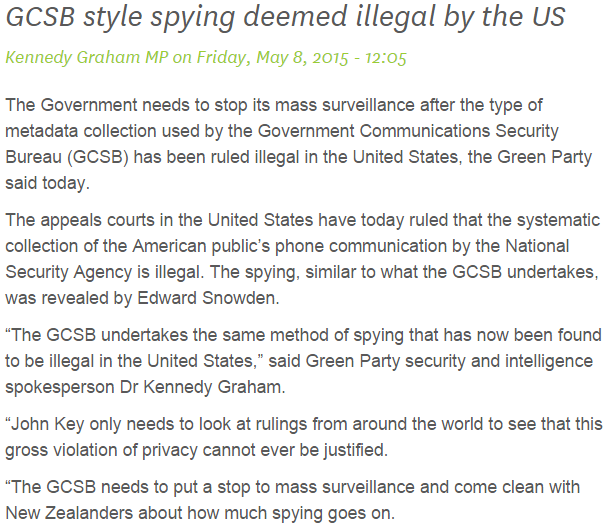
The Greens on the other hand are hysterical about the prospect of New Zealand voluntarily submitting to investor state disputes settlement through an international treaty. International treaties normally are about trading in sovereignty: you give up some form of sovereignty return for something you value more.
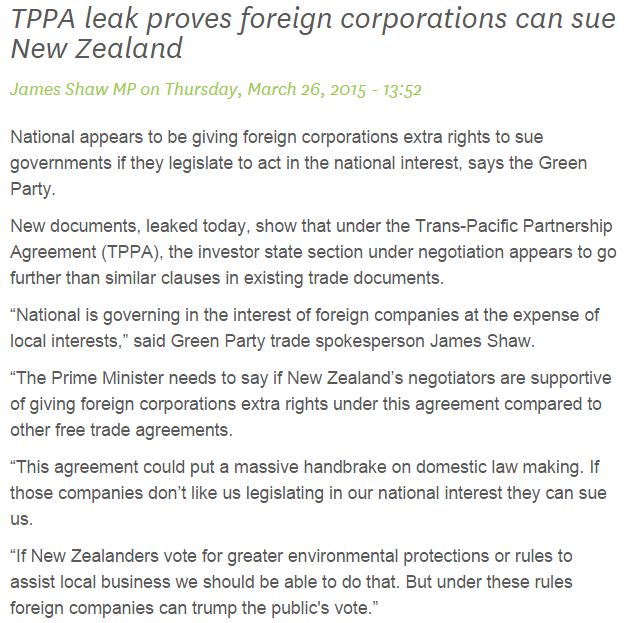
It is thoroughly hypocritical of the Greens to argue the New Zealand should bow down to a foreign court when that court rules in a way that it favours its ideological agenda but refuse to support the principle of international arbitration in circumstances where that may advance New Zealand’s national interests.
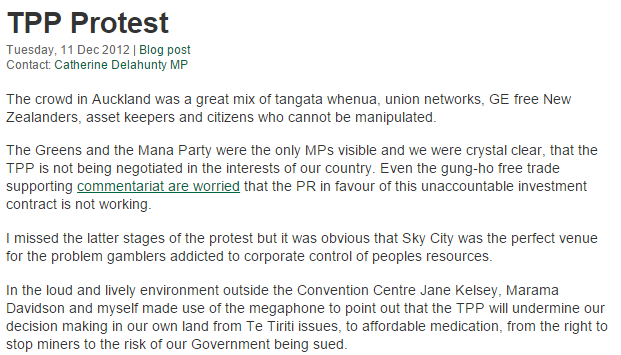
At a minimum, New Zealand itself chose to give up its sovereignty if it agrees to investor state dispute settlement in a trade agreement. The decision was not imposed by a foreign court where it was not heard nor was a party.


Of particular concern to the Greens is international arbitration could "trump the public’s vote vote". New Zealand has repeatedly elected parties that support the alliance with America, and support a robust security and intelligence policy, including electronic surveillance as part of the war on terror.
The last week of the 2014 general election campaign was dominated by the Government Security Communications Bureau and its cooperation with the National Security Agency and the extent to which New Zealand security services engaged in electronic surveillance in New Zealand and abroad.
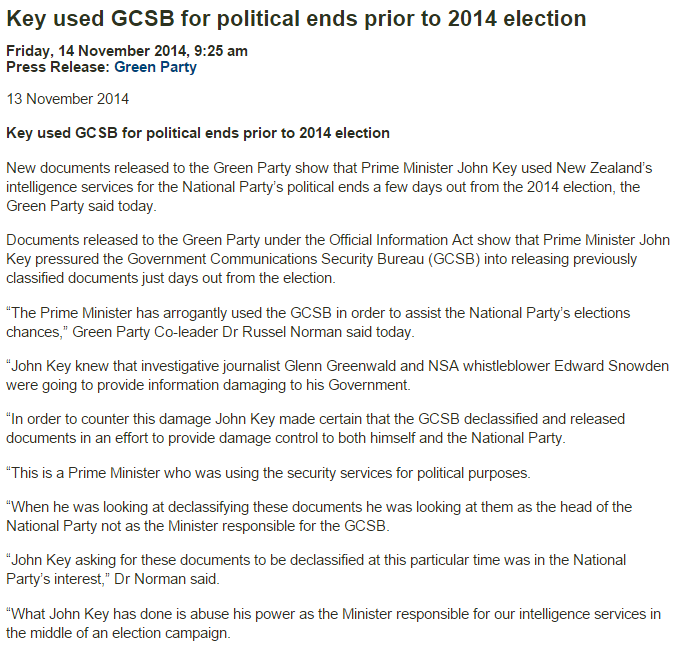
The Greens want to subvert that democratic decision that has been repeated over many New Zealand elections about national security and foreign relations to defer to an American court when New Zealand didn’t even appear as a party.

The US Court of appeal was deciding an issue of statutory interpretation of the Patriot Act. There was no constitutional issues at hand.
The Patriot Act expires in a month unless it is extended. Congress has ample opportunity to amend the renewed law to overturn the appeal court’s decision for the future operation of its security and intelligence laws.
The Greens want a Court of Appeal interpretation of the American Patriot Act to extend to New Zealand without a vote of the New Zealand people or the parliament having any say on whether to give up New Zealand’s sovereignty or waive sovereign immunity in American courts.
.
Senator Warren made a good case against Investor-State Dispute Settlement in the TPP
09 May 2015 Leave a comment
in economic history, economics of regulation, entrepreneurship, industrial organisation, international economic law, international economics, law and economics, politics - Australia, politics - New Zealand, politics - USA, property rights Tags: Australian productivity commission, free trade agreements, investor state disputes settlement, Leftover Left, preferential trade agreements, Senator Elizabeth Warren, Twitter left
In the Washington Post a few months ago, Senator Elizabeth Warren made a balanced case against investor state dispute settlement, not only in the Trans-Pacific Partnership. But in any trade agreement.
Apart from a few rushes of blood in rhetoric to appeal to her base, she made reasoned arguments, good use of history, and put up constructive alternatives to what she was criticising. Furthermore, she put forward arguments that appealed to every point in the political spectrum. The Left over Left critics of investor state disputes settlement clauses in trade agreements in New Zealand never do that.
She echoed arguments I have made the at investor state disputes settlement clauses have no place in trade agreements between liberal democracies.
Liberal democracies have independent courts and honest politics where everyone gets a fair go. That means sometimes you’re on the losing side of politics, but you as free to persuade the majority that they are mistaken. That is democracy in action: sometimes you win, sometimes you lose and there is an election in a few years where you can get another go.
New Zealand has a Closer Economic Relations Agreement with Australia. One provision is a requirement that in most cases New Zealanders are treated the same as Australians under Australian law.
To explain this, some years ago, a New Zealand television production company successfully sued the Australian television regulator to have New Zealand made television shows recognised as Australian content under the 50% Australian content regulations for free-to-air television in Australia.
Note the New Zealand business sued in the Federal Court of Australia and won. They had their day in court.
Senator Warren makes the point that if a business in the USA is unhappy with a regulation, they can challenge by normal democratic and legal means, which investor state disputes settlement undermines:
If a foreign company that makes the toxic chemical opposes the law, it would normally have to challenge it in a U.S. court. But with ISDS, the company could skip the U.S. courts and go before an international panel of arbitrators. If the company won, the ruling couldn’t be challenged in U.S. courts, and the arbitration panel could require American taxpayers to cough up millions — and even billions — of dollars in damages.
Senator Warren also provides a good history of the emergence of investor state disputes settlement and the relevance of that history to contemporary developments:
But after World War II, some investors worried about plunking down their money in developing countries, where the legal systems were not as dependable. They were concerned that a corporation might build a plant one day only to watch a dictator confiscate it the next. To encourage foreign investment in countries with weak legal systems, the United States and other nations began to include ISDS in trade agreements.
Investor state disputes settlement were indeed created to protect businesses that did not have robust democracies and legal systems. Would be international investors in one of these countries were promised international redress if there was a coup, a takeover of their investments or some other unforeseen negative impact because sovereign risk.
She then asked why are these provisions in trade agreements with liberal democracies where they have no relevance:
Those justifications don’t make sense anymore, if they ever did. Countries in the TPP are hardly emerging economies with weak legal systems. Australia and Japan have well-developed, well-respected legal systems, and multinational corporations navigate those systems every day, but ISDS would pre-empt their courts too.
Senator Warren also makes a good point that investor state disputes settlement undermines competition between legal jurisdictions and the rewards for having a sound legal system:
…to the extent there are countries that are riskier politically, market competition can solve the problem. Countries that respect property rights and the rule of law — such as the United States — should be more competitive, and if a company wants to invest in a country with a weak legal system, then it should buy political-risk insurance.
Political risk is is an entrepreneurial opportunity for the insurance market. The World Bank’s Multilateral Investment Guarantee Agency provides insurance to those investing in developing countries against expropriation (including indirect expropriation), as well as acts of war and terrorism. Export Finance schemes of many governments offer political risk Insurance. Anyone who travels in the less safe countries of the world routinely buys travel insurance.
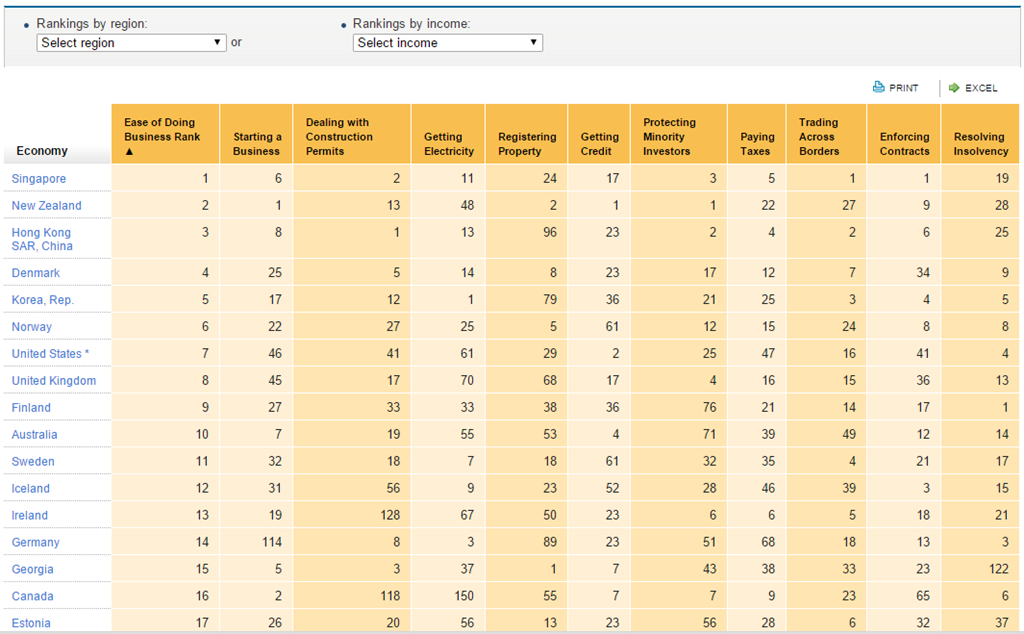
The World Bank puts out an annual index on ease of doing business in every country of the world so foreign investors can’t say they won’t warned of the risks they were taking for the profits they sought.
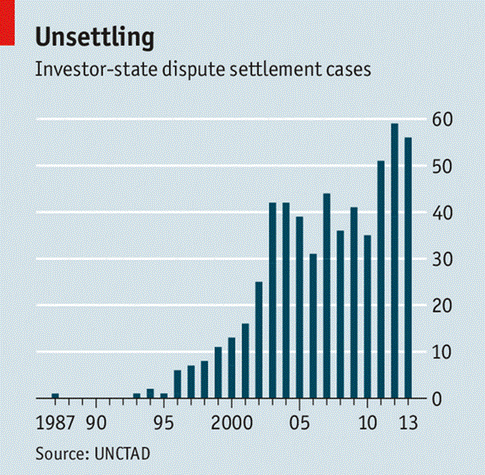
Investor state disputes that were indeed referred to international arbitration used to be rare. Now they are more common as Senator Warren explains:
From 1959 to 2002, there were fewer than 100 ISDS claims worldwide. But in 2012 alone, there were 58 cases.
Recent cases include a French company that sued Egypt because Egypt raised its minimum wage, a Swedish company that sued Germany because Germany decided to phase out nuclear power after Japan’s Fukushima disaster, and a Dutch company that sued the Czech Republic because the Czechs didn’t bail out a bank that the company partially owned. U.S. corporations have also gotten in on the action: Philip Morris is trying to use ISDS to stop Uruguay from implementing new tobacco regulations intended to cut smoking rates.
In a response to Senator Warren’s op-ed, Gary Clyde Hufbauer said:
…only 13 ISDS cases have been brought to judgment against the United States. The United States has not lost a single case.
Why? Because the United States does not expropriate private property without compensation, and the United States does not enact arbitrary or discriminatory laws against foreign firms. Contrary to what the Senator implies, American taxpayers have not had to cough up millions and even billions of dollars in damages. They have not had to cough up anything.
The best part of Senator Warren’s op-ed is when she appeals to all points of the political spectrum based on arguments that do indeed appealed to them:
Conservatives who believe in U.S. sovereignty should be outraged that ISDS would shift power from American courts, whose authority is derived from our Constitution, to unaccountable international tribunals. Libertarians should be offended that ISDS effectively would offer a free taxpayer subsidy to countries with weak legal systems. And progressives should oppose ISDS because it would allow big multinationals to weaken labour and environmental rules.
Senator Warren did make a good case against investor state disputes settlement, particularly between liberal democracies. Foreign investors should take their chances in domestic politics and the courts like the rest of us. They’ve invested in a liberal democracy with independent courts, honest politicians and a commitment to a market economy.

Investor state disputes settlement clauses in trade agreements allow foreign investors to sue the host country for laws, policies, or court decisions they find objectionable. This gives foreign investors more rights than local investors; more influence than local citizens. That is contrary to equality before the law, which is the essence of liberalism.

The point that the Twitter Left rarely makes against investor state disputes settlement, and Senator Warren goes a way towards making is the shield offered by investor state disputes settlement clauses against predatory, corrupt governments in underdeveloped countries, many of which were socialist kleptocracies, has become a sword against regulations that arise in any liberal democracy that were sought and obtained through normal democratic means.
The Australian Productivity Commission held a public inquiry into regional and bilateral trade agreements in 2010. The commission specifically addressed investor state disputes settlement in its subsequent report:
1. There does not appear to be an underlying economic problem that necessitates the inclusion of ISDS provisions within agreements. Available evidence does not suggest that ISDS provisions have a significant impact on investment flows.
2. Experience in other countries demonstrates that there are considerable policy and financial risks arising from ISDS provisions.
The Productivity Commission concluded that investor state dispute settlement provisions are just not worth bargaining coin:
Nor, in the Commission’s assessment, is it advisable in trade negotiations for Australia to expend bargaining coin to seek such rights over foreign governments, as a means of managing investment risks inherent in investing in foreign countries. Other options are available to investors.
The Australian Productivity Commission was quite right to question the advantages of setting up a preferential legal system for anyone:
…a bilateral arrangement with Australia to provide a ‘preferential legal system’ for Australian investors is unlikely to generate the same benefits for that country than if its legal system was developed on a domestic non-preferential basis.
To the extent that secure legal systems facilitate investment in a similar way that customs and port procedures facilitate goods trade, there may be a role for developed nations to assist through legal capacity building to develop stable and transparent legal and judicial frameworks.
When the Left over Left usually argues against investor state disputes settlement provisions they get so carried away with the conspiratorial rhetoric that they overlook a much better argument.
Investor state disputes settlement provisions are bad deal from liberal democracies. Liberal democracies with the rule of law, a market economy and private property rights offer ample protections to any foreign investor.

In trade agreements with less democratic countries, the need for reciprocal promises may not be worth the price when there are other options for investment protection, such as political risk insurance.
The question must be asked as to who lobbies for these agreements considering how much is opposition they provoke, and how useful they are as a mobilisation tool for the Twitter Left in their relentless campaign against lower prices and higher living standards.
More evidence of mass kidnapping of environmental activists
08 Apr 2015 Leave a comment
in environmental economics, environmentalism, international economic law, international economics, International law, law and economics, politics - Australia, politics - New Zealand, politics - USA Tags: green hypocrisy, ozone layer
/cdn0.vox-cdn.com/uploads/chorus_asset/file/3577778/ozone_composite.0.png)
Why aren’t they in the streets celebrating the recovery of the ozone layer, pursuant to an international treaty negotiated by the Reagan administration that banned CFCs as soon as they were not required any longer in developed countries:
International efforts to control the gases, particularly among developed countries, began to occur in the mid-1980s as new information appeared that strengthened the link between CFCs and the deterioration of stratospheric ozone. This increased the expected benefits of international action.
At the same time, domestic political opposition began to diminish when Du Pont announced they would no longer make CFCs. A reason for Du Pont’s attitude change was that European firms had increased their share of the CFC market, and in response Du Pont had developed CFC substitutes.
Accordingly, since international controls on CFCs provided them a competitive advantage, Du Pont announced that they would no longer make CFCs and the company lobbied the U.S. Congress for international regulation.
Under the 1987 Montreal Protocol, world leaders agreed to phase out CFCs, and eventually the hole in the ozone layer stopped expanding. In 2014, a UN assessment found that the ozone layer is just now starting to heal — and should be back to its 1980 levels by 2050 or so.
 Utopia, you are standing in it!
Recent Comments