10 Aug 2015
by Jim Rose
in applied price theory, applied welfare economics, comparative institutional analysis, currency unions, economic growth, economic history, economics of regulation, entrepreneurship, Euro crisis, fiscal policy, global financial crisis (GFC), income redistribution, labour economics, labour supply, macroeconomics, Marxist economics, poverty and inequality, Public Choice, public economics, rentseeking
Tags: British disease, entrepreneurial alertness, Eurosclerosis, France, German unification, Germany, growth of government, sick man of Europe, social insurance, Sweden, taxation and entrepreneurship, taxation and investment, taxation and labour supply, welfare state
The Washington Centre for Equitable Growth recently tweeted that inequality harms growth in the USA as compared to Sweden, France, Germany and the UK. It was relying on some dodgy OECD research.
The Washington Centre for Equitable Growth did not check their inequality ratios they tweeted against trends in economic growth and economic policy since 1970, which I have reproduced in figure 1. Germany is not included in figure 1 because German data on growth is thrown askew by German unification.
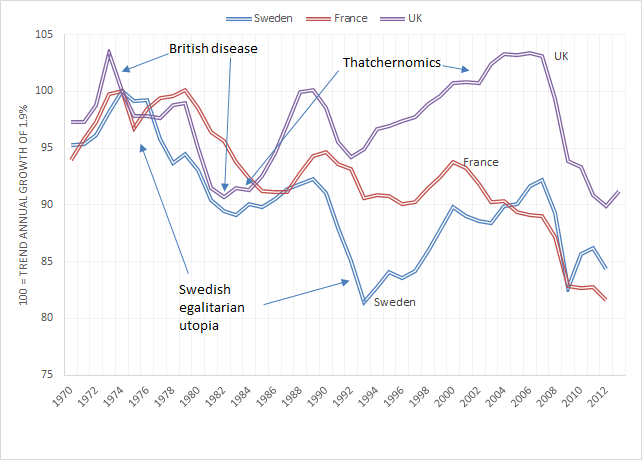
Figure 1: Real GDP per British, French and Swede aged 15-64, 2014 US$ (converted to 2014 price level with updated 2011 PPPs), 1.9 per cent detrended, 1970-2013
Source: Computed from OECD Stat Extract and The Conference Board. 2015. The Conference Board Total Economy Database™, May 2015, http://www.conference-board.org/data/economydatabase/
Figure 1 shows that France has been in a long-term decline since the late 1970s despite the blessings of a more equal society than the USA as championed by the Washington Centre for Equitable Growth. In figure 1, a flat line is growth in real GDP per working age person, PPP, at the same rate as the USA for the 20th century, which was 1.9% per year. A falling line in figure 1 indicates growth of less than 1.9% while a rising line indicates growth in real GDP per working age person, PPP, in excess of 1.9%. In figure 1, France hardly ever grew at the trend rate of growth for the USA of 1.9% per year and was frequently well below that rate.

Sweden tells a slightly different story in figure 1 because of regime change in the early 1990s when Sweden adopted more liberal economic policies where taxes and government spending were reduced:
The rapid growth of the state in the late 1960s and 1970s led to a large decline in Sweden’s relative economic performance. In 1975, Sweden was the 4th richest industrialised country in terms of GDP per head. By 1993, it had fallen to 14th.
That regime change reversed a long economic decline since 1970 under the egalitarian policies of the Swedish Social Democratic Party. Under the Swedish Social Democratic Party, Sweden was almost always growing at less than the trend rate of growth of the USA, which was 1.9%. That position reversed only when there was a turn away from big government and high taxes.

Figure 1 tells a similar story for the British economy: a long economic decline in the 1970s when Britain was the sick man of Europe. Under Thatchernomics, Europe had a long economic boom for 20 years or more – see figure 1.
In the 1970s, under the high taxes of the Heath, Callaghan and Wilson administrations, as figure 1 shows, Britain was the sick man of Europe. With the election of the Thatcher Government, Britain soon grew at better than the US trend growth rate for nearly 20 years through few exceptions.
05 Aug 2015
by Jim Rose
in discrimination, economic history, gender, labour economics, law and economics
Tags: France, gender wage gap, Germany, Leftover Left, Norway, Sweden, Twitter left
Our friends on the Left go on about how wonderful place Sweden is despite its gender gap being stuck for 35 years. Not much better in Norway and in Germany and France for that matter.
Figure 1: gender wage, % of median male wage, full-time employees, France, Germany, Sweden and Norway, 1980 – 2012

Source: Earnings and wages – Gender wage gap – OECD Data.
The gender wage gap in figure 1 is unadjusted and defined as the difference between median earnings of men and women relative to median earnings of men. Data refer to full-time employees.
05 Aug 2015
by Jim Rose
in currency unions, economic growth, economic history, economics of regulation, Euro crisis, fiscal policy
Tags: British disease, British economy, Eurosclerosis, France, Germany, Italy, sick man of Europe, Sweden, Swedosclerosis
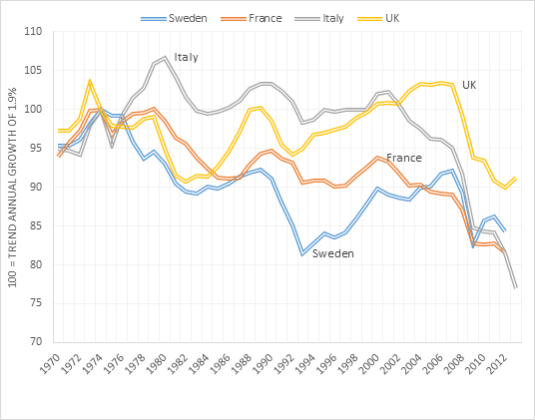
Figure 1 shows stark differences between Sweden, France, Italy and the UK since 1970 in departures from trend growth rates of 1.9% in real GDP per working age person, PPP. Italy did quite OK until 2000 growing at about the trend growth rate of 1.9% after which it fell into a hole so deep that it barely notice the onset of the global financial crisis. Sweden really had been the sick man of Europe until it turned its back on high taxing, welfare state socialism in the early 1990s. France has been in a long decline so much so that the global financial crisis is hard to pick up in the acceleration in its long decline in the mid-1990s. Figure 1 also shows Britain did very well, both under the neoliberal horrors of Thatcherism and the betrayals by Tony Blair of a true Labour Party platform. The UK grew at above the trend annual growth to 1.9% for most of the period from the early 1980s to 2007. The UK has done not so well since the onset of the global financial crisis.
Figure 1: Real GDP per Swede, French, British and Italian aged 15-64, 2014 US$ (converted to 2014 price level with updated 2011 PPPs), 1.9 per cent detrended, 1970-2013

Source: Computed from OECD StatExtract and The Conference Board. 2015. The Conference Board Total Economy Database™, May 2015, http://www.conference-board.org/data/economydatabase/
Note: When the line is flat, the economy is growing at its trend annual growth rate. A falling line means below trend annual growth; a rising line means of above trend annual growth. Detrended with values used by Edward Prescott.
German data was not in figure 1 because German unification threw all of its data into disarray for long-term comparison purposes.
02 Aug 2015
by Jim Rose
in labour economics, labour supply, politics - Australia, politics - New Zealand, politics - USA, public economics
Tags: Australia, British economy, Canada, France, Germany, taxation and labour supply
28 Jul 2015
by Jim Rose
in Euro crisis, job search and matching, labour economics, law and economics, macroeconomics
Tags: British economy, employment law, employment law regulation, Eurosclerosis, France, Germany, Greece, Italy, Portugal, Spain
Much easier to fire someone in the USA or UK than on continental Europe. Greece and Spain aren’t that bad by continental European standards for employment law protections against dismissals of individuals.
Figure 1: Strictness of employment protection for individual dismissals, 2013

Source: OECD StatExtract.
25 Jul 2015
by Jim Rose
in economic history, gender, labour economics, labour supply, politics - USA
Tags: ageing society, British economy, demographic crisis, economics of retirement, effective retirement ages, female labour force participation, female labour supply, France, Germany, male labour force participation, male labour supply, old age pensions, older workers, retirement ages, social insurance, Social Security, welfare state
Figure 1 shows a divergence from a common starting point in 1974 effective retirement ages. The French in particular were the first to put their feet up and start retiring by the age of 60 by the early 1990. There was also a sharp increase in the average effective retirement age for men in the UK over a short decade. After that, British retirement ages for men started to climb again in the late 1990s. Figure 1 also shows that the gentle taper in the effective retirement age for American men stopped at the 1980s and started to climb again in the 2000s. The German data is too short to be of much use because of German unification. France only recently stopped seeing its effective retirement age fall and it is slightly increased recently – see figure 1
Figure 1: average effective retirement age for men, USA, UK, France and Germany, 1970 – 2012, (five-year average)

Source: OECD Pensions at a Glance.
Figure 2 shows similar results for British and American women as for men in the same country shown in figure 1 . That is, falling effective retirement ages for both British and American women in the 1970s and 1980s followed by a slow climb again towards the end of 1990s. French effective retirement ages for women followed the same pattern as for French retirement ages for men – a long fall to below the age of 60 with a slight increase recently. The German retirement data suggest that effective retirement ages for German women is increasing.
Figure 2: average effective retirement age for women, USA, UK, France and Germany 1970 – 2012, (five-year average)

Source: OECD Pensions at a Glance.
22 Jul 2015
by Jim Rose
in energy economics, environmental economics, environmentalism, global warming
Tags: carbon emissions, Euroland, expressive voting, Germany, global warming, investor state dispute settlement, nuclear energy, tradeoffs
21 Jul 2015
by Jim Rose
in economic history, economics of regulation, global financial crisis (GFC), job search and matching, labour economics, labour supply, law and economics, minimum wage, politics - USA, unions
Tags: British economy, employment law, employment regulation, Eurosclerosis, France, Germany, Index of Economic Freedom
The writers of the Index of Economic Freedom at the Heritage foundation really loves the USA and didn’t think much of the Conservative Party – Liberal Democratic Party coalition government because labour market freedom actually fell in the UK during their administration. Bring back Tony Blair, all is forgiven. The information on their website throws no insight into why this reduction in labour market freedom in Britain happened.
Figure 1: Index of Economic Freedom, Argentina, Brazil, Chile and Venezuela, 95 – 2015 
Source: Index of Economic Freedom 2015.
Fortunately for Germany, labour market freedom increased over the course of the global financial crisis and its aftermath. This helps explains low unemployment in Germany during that period. Nothing much happened in France in regard to labour market freedom.
19 Jul 2015
by Jim Rose
in business cycles, economic growth, economic history, fiscal policy, job search and matching, labour economics, macroeconomics, unemployment
Tags: Celtic Tiger, equilibrium unemployment rate, Eurosclerosis, Germany, Ireland, Italy, natural unemployment rate, Rance, Spain
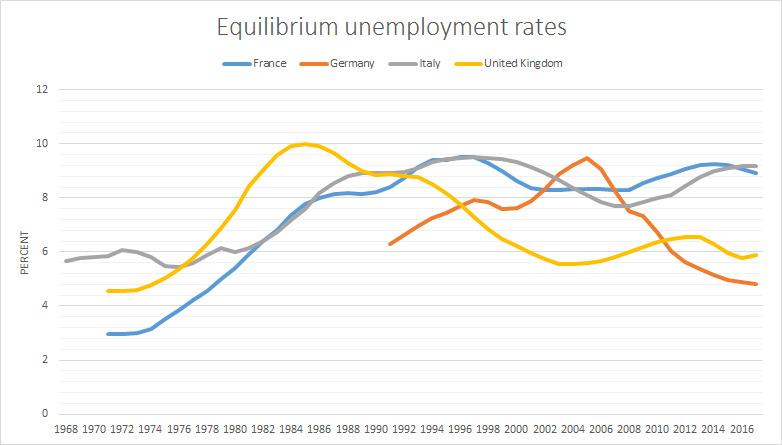
Figure 1 shows large contrasts in time path of equilibrium unemployment rates. For example, French and Italian equilibrium unemployment rates haven’t changed much since about 1986.
Figure 1: equilibrium unemployment rates, France, Germany, Italy, Ireland and Spain, 1968 – 2016

Source: OECD Economic Outlook June 2015 via OECD StatExtract..
Figure 1 also shows some fortuitous ups and downs in the German equilibrium unemployment rate. This estimate was available only from after German unification.
The equilibrium German unemployment rate rose from 6% to above 8% on the eve of the global financial crisis. Fortunately for Germany, major labour market reforms brought the equilibrium unemployment rate down as Germany moved into the global financial crisis.
The Spanish equilibrium unemployment rate had been terrible since about 1980, started to fall in the 1990s, then skyrocketed even before the onset of the global financial crisis – see figure 1.
There have been ups and downs in the Irish equilibrium unemployment rate – see figure 1. It was as high as 14% at the end of the Irish great depression of the 1970s and 1980s. The equilibrium Irish unemployment rate was 8% at the heyday of the Celtic tiger then slowly rose in the lead up to the global financial crisis.
17 Jul 2015
by Jim Rose
in economics of regulation, industrial organisation, international economics, politics - USA
Tags: border costs, British economy, Canada, Common market, Common markets, customs unions, EU, France, free trade areas, Germany, Italy, NAFTA, trade costs
Figure 1: World Bank Doing Business rankings and sub rankings for trading across the French, German, Italian, British, Canadian and US borders, 2014

Source: World Bank Doing Business database; note: cost of importing and exporting not included.
Figure 2: World Bank Doing Business rankings – cost of importing and exporting across the French, German, Italian, British, Canadian and US borders, 2014

Source: World Bank Doing Business database; note: cost of importing and exporting not included.
13 Jul 2015
by Jim Rose
in applied price theory, applied welfare economics, economics of religion, law and economics, politics - USA, property rights
Tags: British economy, doing business, France, Germany
Figure 1: registering property rankings, USA, UK, Germany and France – World Bank Doing Business rankings, 2014

Source: Doing Business – Measuring Business Regulations – World Bank Group.
11 Jul 2015
by Jim Rose
in applied price theory, applied welfare economics, comparative institutional analysis, economics of regulation, industrial organisation, law and economics, politics - USA, property rights
Tags: British economy Doing Business, France, Germany, World Bank
Figure 1: Starting a business rankings, USA, UK, Germany and France – World Bank Doing Business rankings, 2014

Source: Doing Business – Measuring Business Regulations – World Bank Group.
I have no idea why you have to pledge one third of German per capita income to start a business in Germany. It takes about a week and a half a dozen procedures to start a business in the other countries.
In New Zealand, you can start a business within the hour by registering for GST and registering your company online.
10 Jul 2015
by Jim Rose
in economic history, economics of media and culture
Tags: Berlin wall, Cold War, collapse of communism, East Germany, fall of the Berlin wall, German unification, Germany, Greece, public intellectuals, West Germany
Previous Older Entries Next Newer Entries
Recent Comments