July 20, 1969: One Giant Leap For Mankind – Apollo 11 lands on the moon.
NASA Apollo Archive. http://t.co/WFWbeorBqN—
History (@HistoryTime_) July 20, 2015
Apollo 11 landed on the moon this day 1969
20 Jul 2015 Leave a comment
in economic history Tags: moon, moon landing
More and more people are able to travel by air
20 Jul 2015 Leave a comment
More and more people are able to travel by air. buff.ly/1G4fMMT #progress http://t.co/Dgseo3FCJL—
HumanProgress.org (@humanprogress) June 18, 2015
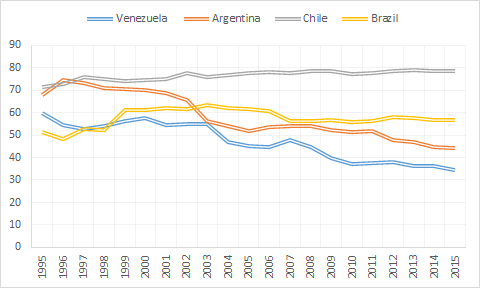
The impact of neoliberalism on economic freedom in Argentina, Brazil, Chile and Venezuela since 1995
20 Jul 2015 Leave a comment
in applied price theory, applied welfare economics, comparative institutional analysis, development economics, economic history, economics of regulation, growth disasters, growth miracles Tags: Argentina, Brazil, Chile, conspiracy theories, Index of Economic Freedom, Leftover Left, Mont Pelerin Society, neoliberalism, Twitter left, Venezuela
All was quiet on the neoliberalism front in Latin America for the last 20 years. In yet another defeat for the Mont Pelerin Society led transnational conspiracy, economic freedom has been pretty stable in Chile for 20 years and in the serious decline in Venezuela and Argentina – see figure 1. Not much happening in Brazil either on the neoliberalism front – see figure 1. I’ve always had my doubts about the ability of a transnational conspiracy to be led by a society with such a crappy website.
Figure 1: Index of Economic Freedom, Argentina, Brazil, Chile and Venezuela, 95 – 2015
Source: Index of Economic Freedom 2015.

Creative destruction in 1GB hard drives
20 Jul 2015 Leave a comment
in economic history, entrepreneurship, technological progress Tags: creative destruction, entrepreneurial alertness
From 10 Million Dollar to 9 cents!
The price of 1GB Hard Drive since 1950(Source: bit.ly/1E4xzDD) http://t.co/TIAZG8OPof—
Max Roser (@MaxCRoser) June 05, 2015
Thomas Macaulay (1830) on the green movement
19 Jul 2015 Leave a comment
in development economics, economic history, economics of media and culture, environmental economics, environmentalism, growth disasters, growth miracles Tags: doomsday prophecies, doomsday prophets, Leftover Left, Thomas Macaulay
“…we see nothing but improvement behind us [yet] expect nothing but deterioration before us” buff.ly/1HscRBL http://t.co/cKILhkKWvr—
HumanProgress.org (@humanprogress) June 30, 2015
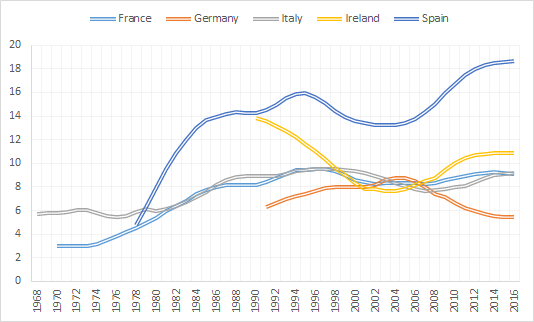
French, German, Italian, Irish and Spanish equilibrium unemployment rates, 1968 – 2016
19 Jul 2015 Leave a comment
in business cycles, economic growth, economic history, fiscal policy, job search and matching, labour economics, macroeconomics, unemployment Tags: Celtic Tiger, equilibrium unemployment rate, Eurosclerosis, Germany, Ireland, Italy, natural unemployment rate, Rance, Spain
Figure 1 shows large contrasts in time path of equilibrium unemployment rates. For example, French and Italian equilibrium unemployment rates haven’t changed much since about 1986.
Figure 1: equilibrium unemployment rates, France, Germany, Italy, Ireland and Spain, 1968 – 2016
Source: OECD Economic Outlook June 2015 via OECD StatExtract..
Figure 1 also shows some fortuitous ups and downs in the German equilibrium unemployment rate. This estimate was available only from after German unification.
The equilibrium German unemployment rate rose from 6% to above 8% on the eve of the global financial crisis. Fortunately for Germany, major labour market reforms brought the equilibrium unemployment rate down as Germany moved into the global financial crisis.
The Spanish equilibrium unemployment rate had been terrible since about 1980, started to fall in the 1990s, then skyrocketed even before the onset of the global financial crisis – see figure 1.
There have been ups and downs in the Irish equilibrium unemployment rate – see figure 1. It was as high as 14% at the end of the Irish great depression of the 1970s and 1980s. The equilibrium Irish unemployment rate was 8% at the heyday of the Celtic tiger then slowly rose in the lead up to the global financial crisis.
Creative destruction in portable Macintosh computers
19 Jul 2015 Leave a comment
in economic history, entrepreneurship, technological progress Tags: creative destruction, laptops, PCs
The 16 Mhz Mac Portable, Apple's first portable Macintosh computer. 1989. http://t.co/nAudOktDBd—
History Pics (@HistoryPixs) February 23, 2014
1st cellphone
18 Jul 2015 Leave a comment
in economic history, economics of media and culture, entrepreneurship, technological progress Tags: cell phones, creative destruction, entrepreneurial alertness
This is the first cellphone.
It went on sale 30 years ago today for $4,000 http://t.co/6zFIf3cxDV—
History Pics (@HistoryPixs) March 14, 2014
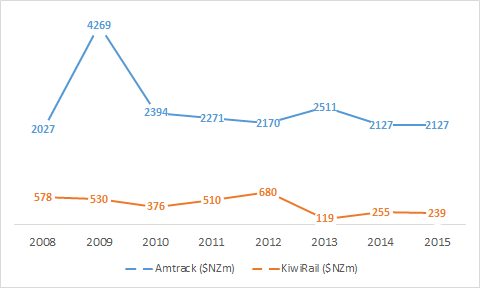
The Amtrak and KiwiRail bailouts compared
18 Jul 2015 1 Comment
in economic history, economics of bureaucracy, politics - New Zealand, politics - USA, Public Choice, rentseeking, transport economics Tags: Amtrak, corporate welfare, expressive voting, industry policy, KiwiRail, privatisation, rational ignorance, rational irrationality, state owned enterprises
Figure 1: Amtrak and KiwiRail bailouts, (exchange rate US$1:NZ$1.53), 2008 – 2015
Sources: Federal Funding Received by Amtrak | Mercatus and New report: Corporate welfare in the 2015 budget – Taxpayers’ Union.
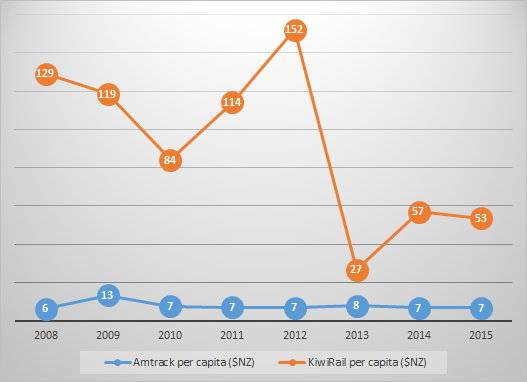
New Zealand with its KiwiRail does a good job of keeping up with the Amtrak bailout especially when you look at figure 2, which computes the bailouts on a per capita basis.
Figure 2: Amtrak and KiwiRail bailouts per capita (2014 populations), (exchange rate US$1:NZ$1.53), 2008 – 2015
Sources: Federal Funding Received by Amtrak | Mercatus and New report: Corporate welfare in the 2015 budget – Taxpayers’ Union.
Measurement error in the computer age
18 Jul 2015 1 Comment
in applied welfare economics, econometerics, economic history, entrepreneurship, technological progress Tags: age of the computer, capitalism and freedom, measurement error, Robert Solow

Maggie Thatcher on the Greek crisis
17 Jul 2015 Leave a comment
in applied welfare economics, budget deficits, comparative institutional analysis, constitutional political economy, currency unions, economic growth, economic history, economics of regulation, Euro crisis, fiscal policy, income redistribution, macroeconomics, Marxist economics, Public Choice, rentseeking Tags: Greece, growth of government, Margaret Thatcher, size of government
Equality lacks relevance if the poor are growing richer
17 Jul 2015 Leave a comment
in development economics, economic history, growth disasters, growth miracles, liberalism Tags: capitalism and freedom, Deirdre McCloskey, life expectancies, The Great Enrichment, The Great Escape, The Great Fact, top 1%

Capitalism and The Great Fact in China
17 Jul 2015 Leave a comment
in applied price theory, applied welfare economics, comparative institutional analysis, development economics, economic history, economics of education, economics of regulation, entrepreneurship, environmental economics, growth disasters, growth miracles, history of economic thought, industrial organisation, Marxist economics, Public Choice Tags: capitalism and freedom, China, fall of communism, Leftover Left, transitional economies
As China grew freer economically, its poverty rate fell. buff.ly/1KohOxS http://t.co/OpaxOzNdNs—
HumanProgress.org (@humanprogress) June 29, 2015
How to argue for inequality and neoliberalism when arguing dead set against it
17 Jul 2015 Leave a comment
in economic growth, economic history, human capital, income redistribution, labour economics, labour supply, politics - New Zealand, poverty and inequality, Public Choice, rentseeking Tags: Leftover Left, neoliberalism, top 1%
On 12 August last, Closer Together New Zealand posted a chart showing average hourly wages had been stagnant for 20 years and then started growing again in 1993. Closer Together New Zealand then rounded up the usual suspects of the Left over Left.
Later that month in a comment on that post, a chart was posted showing that inequality had been increasing quite rapidly in the late 1980s and early 1990s in New Zealand. There were a range of economic reforms Closer Together New Zealand didn’t like in the late 1980s and early 1990s.
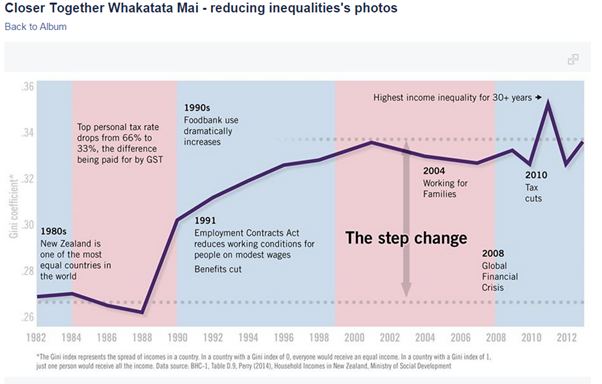
Closer Together New Zealand did not notice their second chart showed there had been a large increase in inequality, and their first chart showed that this was followed by the return of regular average hourly wages after 20 years of stagnation.
I am not so vulgar as to suggest correlation is causation, but it is amusing to watch that one day a chart is posted showing a resumption of wages growth after 20 years of wage stagnation and the next day a chart is posted showing that the major economic developments in the preceding years were a large increase in inequality and substantial economic liberalisation.
To add to my amusement, a companion site Inequality A New Zealand Conversation posted a chart showing the top 1% had not had much at all in income growth for the last 20 years while most everyone else had. This spike in the incomes of the top 1% prior to about 1994 was followed by the resumption in average wages growth after 1994.
Why Greenland is called Greenland?
16 Jul 2015 Leave a comment
in economic history, environmental economics, global warming Tags: climate alarmism, global cooling, global warming, Greenland, Little ice age
https://twitter.com/SteveSGoddard/status/598905503238991872/photo/1
Your SUV made the Arctic ice cap disappear 1,000 years ago.
news.google.com/newspapers?nid… http://t.co/6EP7PWEPOA—
Steve Goddard (@SteveSGoddard) May 14, 2015


Recent Comments