
via WHAT SHOULD TRADE NEGOTIATORS NEGOTIATE ABOUT? A REVIEW ESSAY.
Celebrating humanity's flourishing through the spread of capitalism and the rule of law
29 Jul 2015 2 Comments
25 Jul 2015 Leave a comment
in currency unions, Euro crisis, international economics, macroeconomics Tags: Common market, customs unions, economics of immigration, EU, Euro, Euroland, European free trade area, European Union, free trade agreements, free trade areas, open borders, preferential trading agreements
AMAZING chart on European integration. One to pin to your office wall. Nice job by @Nic_Koenig delorsinstitut.de/2015/wp-conten… http://t.co/zZbOA29mYP—
Maxime Sbaihi (@MxSba) July 24, 2015
25 Jul 2015 Leave a comment
in international economic law, international economics, International law, politics - Australia, politics - USA Tags: Australia, British politics, economics of immigration, EU, illegal immigration, Mexico, North Korea, Spain
The walled world
– http://t.co/dXmzCUrjpD—
Amazing Maps (@Amazing_Maps) July 13, 2015
25 Jul 2015 Leave a comment
in applied price theory, applied welfare economics, comparative institutional analysis, constitutional political economy, economic history, economics of bureaucracy, economics of education, economics of regulation, economics of religion, energy economics, environmental economics, income redistribution, industrial organisation, international economics, Murray Rothbard, politics - Australia, politics - New Zealand, politics - USA, Public Choice, rentseeking, survivor principle Tags: antiforeign bias, antimarket bias, Catholic social thought, climate alarmism, expressive voting, global warming, makework bias, Pope Francis, rational ignorance, rational irrationality, voter demographics


25 Jul 2015 Leave a comment
in budget deficits, business cycles, currency unions, economic growth, Euro crisis, fiscal policy, global financial crisis (GFC), international economics, law and economics, macroeconomics, monetary economics, property rights Tags: capital controls, capital flight, Greece, labour exodus, sovereign defaults
For down and out Greeks, the U.K. is the promised land with jobs aplenty bloom.bg/1Lwcc55 http://t.co/XHHXxdTUiN—
Bloomberg Business (@business) July 24, 2015
18 Jul 2015 Leave a comment
in economic growth, Euro crisis, fiscal policy, global financial crisis (GFC), great recession, international economics, law and economics Tags: Greece, sovereign defaults
17 Jul 2015 Leave a comment
in economics of regulation, industrial organisation, international economics, politics - USA Tags: border costs, British economy, Canada, Common market, Common markets, customs unions, EU, France, free trade areas, Germany, Italy, NAFTA, trade costs
Figure 1: World Bank Doing Business rankings and sub rankings for trading across the French, German, Italian, British, Canadian and US borders, 2014
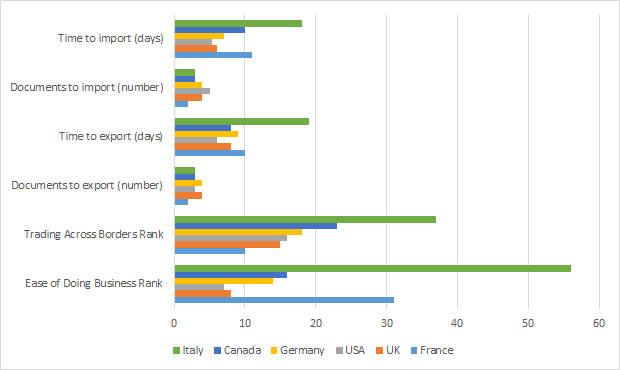
Source: World Bank Doing Business database; note: cost of importing and exporting not included.
Figure 2: World Bank Doing Business rankings – cost of importing and exporting across the French, German, Italian, British, Canadian and US borders, 2014
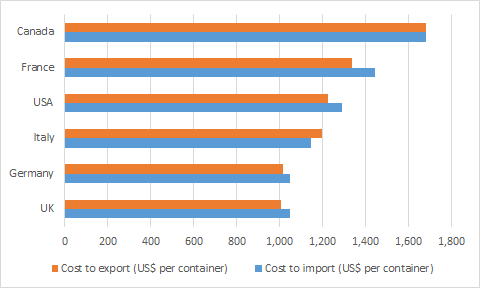
Source: World Bank Doing Business database; note: cost of importing and exporting not included.
16 Jul 2015 Leave a comment
in applied price theory, applied welfare economics, Austrian economics, comparative institutional analysis, constitutional political economy, development economics, economic history, economics of bureaucracy, economics of education, economics of regulation, economics of religion, energy economics, entrepreneurship, environmental economics, financial economics, growth disasters, growth miracles, income redistribution, industrial organisation, international economics, labour economics, labour supply, liberalism, poverty and inequality, Public Choice, rentseeking, survivor principle, transport economics, urban economics Tags: Deirdre McCloskey, entrepreneurial alertness, The Great Enrichment, The Great Escape, The Great Fact, top 1%
"The rich got richer, true. But…" —@DeirdreMcClosk buff.ly/1Imdv4o http://t.co/M3ERx3JTIn—
HumanProgress.org (@humanprogress) June 28, 2015
15 Jul 2015 Leave a comment
in discrimination, economics of education, gender, human capital, international economics Tags: gender gap, reversing gender gap
14 Jul 2015 Leave a comment
in international economics, labour supply, minimum wage, politics - Australia, politics - New Zealand, politics - USA, poverty and inequality, welfare reform Tags: Australia, British economy, Canada, low pay, New Zealand, social insurance, welfare state, working poor
Figure 1: working poor – proportion of employed persons with income below the poverty line (50% of median disposable income) living in households with a working age head and at least one worker in USA, UK, Canada, Australia and New Zealand, 2013
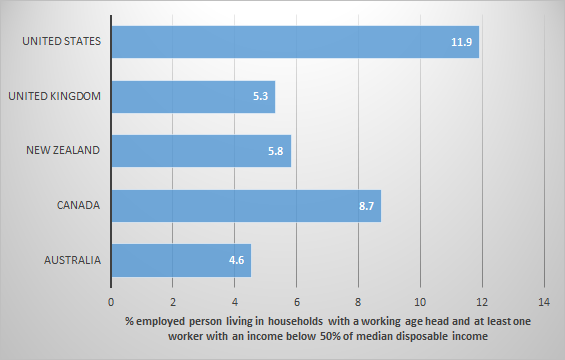
Source: In It Together – Why Less Inequality Benefits All – © OECD 2015, OECD Income Distribution Database (IDD), www.oecd.org/social/income-distribution-database.htm, Table 1.A1.1. Key indicators on the distribution of household disposable income and poverty, 2007, 2011 and 2013 or most recent year.
11 Jul 2015 Leave a comment
in constitutional political economy, international economics, law and economics, politics - New Zealand, property rights, Public Choice, rentseeking Tags: antiforeign bias, antimarket bias, left-wing populists, New Zealand First, New Zealand Labour Party, political opportunism, racism, rational ignorance, rational irrationality, right-wing populists, traditional labour voter, working class Tory
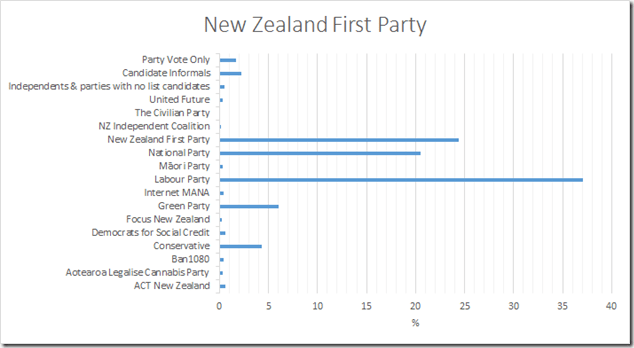
Figure 1: who won the electorate vote of New Zealand First party voters, 2014 New Zealand election
Source: Electoral Commission.
New Zealand First vote splitting data in Figure 1 suggests many more Labour voters vote New Zealand First than for the National Party with their electorate votes.
1/3rd of voters who gave their party vote to New Zealand First voted Labour with their electorate vote. This compares to one in five New Zealand First voters who gave their electorate vote to the National Party.
The Labour Party can win back some traditional Labour voters by borrowing populist policies from New Zealand First and its ageing leader such as prohibiting foreigners from buying New Zealand land.
Who mentioned Shane Jones?
In politics we don't pull our punches, unless you've got one of the world's best in town! http://t.co/Xiz2l36btg—
Winston Peters (@winstonpeters) August 08, 2013
11 Jul 2015 Leave a comment
in currency unions, economic history, Euro crisis, international economics, law and economics, macroeconomics Tags: Argentina, Greece, Russia, sovereign defaults

via Defaulting Debtors.
09 Jul 2015 Leave a comment
in economic history, financial economics, fiscal policy, international economics, macroeconomics, monetarism, monetary economics Tags: Anna Schwartz, bank runs, banking panics, China, contagion, evidence-based policy, financial crises, financial stability, inflation targeting, international systemic risk, Michael Bordo, monetary history, pseudo financial crises, pseudo international systemic risk
If we could take time out from the breathless journalism about the Chinese stock market, which some people may have heard of before this week, it’s crash should be seen through the lens that Anna Schwartz developed in 1987 of a pseudo financial crisis and a financial crisis.
This is why so many Chinese companies are suspended bloom.bg/1UA7TbA http://t.co/5awEt6B23u—
Bloomberg Business (@business) July 08, 2015
Her paper is written at the same time as the 1987 stock market crash. On financial crises, Anna Schwartz said:
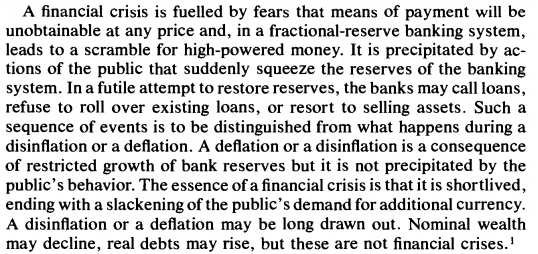
As for those pseudo financial crises, she said:
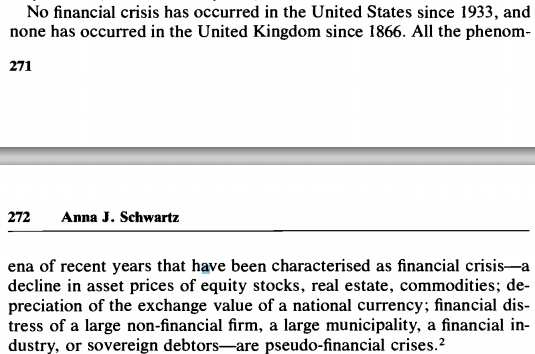
Schwartz’s principal concern with regard to pseudo financial crisis was:
proposals to deal with pseudo-financial crises is the perpetuation of policies that promote inflation and waste of economic resources
As we are talking about the Chinese stock market, Anna Schwartz also wrote about the concepts of real systemic international risk and and pseudo international systemic risk.
Once again, and as with pseudo financial crises and real financial crises, what distinguishes real systemic international risk and pseudo international systemic risk is a threat to the payment system. The threat of bank runs, which can easily be eliminated through lender of last resort facilities:
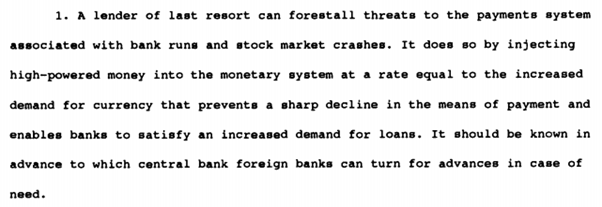
As always it is about the security of the payments system – of avoiding bank runs, not private losses:
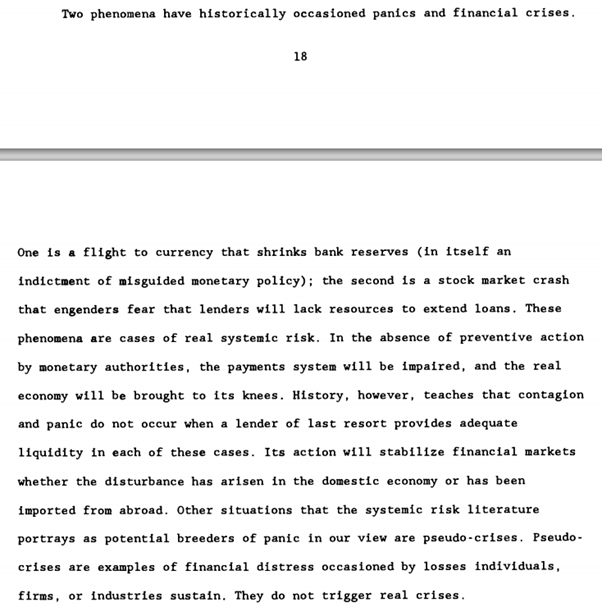
The lesson for the day is that when people start panicking about the economy or the stock market or international markets, don’t go to a macroeconomist for advice, go to a monetary historian. They have seen it all before.

09 Jul 2015 Leave a comment
in industrial organisation, international economics, politics - Australia, politics - New Zealand, politics - USA Tags: antiforeign bias, antimarket bias, expressive voting, free trade, rational ignorance, rational irrationality, voter demographics
Who favors free trade?
(The affluent.)
nytimes.com/2015/05/28/ups… @BrendanNyhan http://t.co/kojmUWUtH0—
Justin Wolfers (@JustinWolfers) May 27, 2015
Celebrating humanity's flourishing through the spread of capitalism and the rule of law
Celebrating humanity's flourishing through the spread of capitalism and the rule of law
Celebrating humanity's flourishing through the spread of capitalism and the rule of law
Celebrating humanity's flourishing through the spread of capitalism and the rule of law
Celebrating humanity's flourishing through the spread of capitalism and the rule of law
Celebrating humanity's flourishing through the spread of capitalism and the rule of law
Celebrating humanity's flourishing through the spread of capitalism and the rule of law
A History of the Alt-Right
Econ Prof at George Mason University, Economic Historian, Québécois
Celebrating humanity's flourishing through the spread of capitalism and the rule of law
Scholarly commentary on law, economics, and more
Beatrice Cherrier's blog
Celebrating humanity's flourishing through the spread of capitalism and the rule of law
Celebrating humanity's flourishing through the spread of capitalism and the rule of law
Celebrating humanity's flourishing through the spread of capitalism and the rule of law
Why Evolution is True is a blog written by Jerry Coyne, centered on evolution and biology but also dealing with diverse topics like politics, culture, and cats.
Celebrating humanity's flourishing through the spread of capitalism and the rule of law
A rural perspective with a blue tint by Ele Ludemann
DPF's Kiwiblog - Fomenting Happy Mischief since 2003
Celebrating humanity's flourishing through the spread of capitalism and the rule of law
The world's most viewed site on global warming and climate change
Tim Harding's writings on rationality, informal logic and skepticism
A window into Doc Freiberger's library
Let's examine hard decisions!
Commentary on monetary policy in the spirit of R. G. Hawtrey
Thoughts on public policy and the media
Celebrating humanity's flourishing through the spread of capitalism and the rule of law
Politics and the economy
A blog (primarily) on Canadian and Commonwealth political history and institutions
Reading between the lines, and underneath the hype.
Economics, and such stuff as dreams are made on
"The British constitution has always been puzzling, and always will be." --Queen Elizabeth II
Celebrating humanity's flourishing through the spread of capitalism and the rule of law
Celebrating humanity's flourishing through the spread of capitalism and the rule of law
WORLD WAR II, MUSIC, HISTORY, HOLOCAUST
Undisciplined scholar, recovering academic
Celebrating humanity's flourishing through the spread of capitalism and the rule of law
Res ipsa loquitur - The thing itself speaks
In Hume’s spirit, I will attempt to serve as an ambassador from my world of economics, and help in “finding topics of conversation fit for the entertainment of rational creatures.”
Researching the House of Commons, 1832-1868
Articles and research from the History of Parliament Trust
Reflections on books and art
Posts on the History of Law, Crime, and Justice
Celebrating humanity's flourishing through the spread of capitalism and the rule of law
Exploring the Monarchs of Europe
Cutting edge science you can dice with


Recent Comments