Charles Shultz on the social sciences… thesocietypages.org/socimages/2015… http://t.co/xVTf7kJ6KP—
(@SocImages) July 19, 2015
Incidence of long-term unemployment in the PIGS since 1983
17 Aug 2015 Leave a comment
in business cycles, currency unions, economic growth, economic history, Euro crisis, job search and matching, labour economics, labour supply, macroeconomics, occupational choice, unemployment, unions, welfare reform Tags: employment law, equilibrium unemployment, Greece, Italy, labour market regulation, natural unemployment rate, Portugal, Spain, unemployment duration
The boom that preceded the bust in the Greek economy did nothing for the rate of long-term unemployment among Greeks. Long-term unemployment had been pretty stable prior to the economic boom after joining the euro currency union.
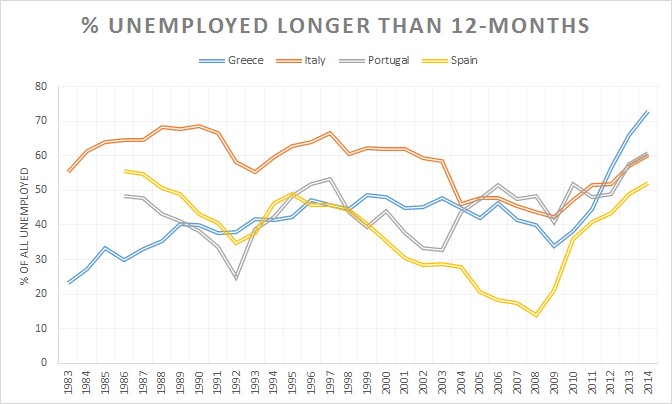
Source: OECD StatExtract.
Nothing much happened to long-term unemployment in Italy or Portugal in recent decades. Spanish long-term unemployment fell in line with the economic boom in Spain over the 1980s and 1990s up until the global financial crisis.
The man-cession illustrated
13 Aug 2015 Leave a comment
in business cycles, discrimination, gender, human capital, job search and matching, labour economics, labour supply, macroeconomics, occupational choice Tags: female labour force participation, male labour force participation, recessions and recoveries
CHART: The Great Recession Had a Disproportionately Negative Effect on Men That Continues Today @CHSommers @AsheSchow http://t.co/wnfdUOUn0a—
Mark J. Perry (@Mark_J_Perry) August 08, 2015
The education explosion in the 20th century
06 Aug 2015 Leave a comment
in economic history, economics of education, human capital, labour economics, occupational choice Tags: age of human capital, educational attainment
Dramatic increase in education across all demographic groups over the past 100 years bit.ly/16XYZun http://t.co/0Ew0OxDzlx—
Catherine Mulbrandon (@VisualEcon) August 27, 2013
The workplace payoff of Myers Briggs personality types
03 Aug 2015 Leave a comment
in human capital, labour economics, managerial economics, occupational choice, organisational economics, personnel economics Tags: compensating differentials, economics of personality traits, occupational choice
https://twitter.com/businessinsider/status/626968055046926336/photo/1
Human Resources will assign you a personality…. #HRhumour HT @ssmoir_1973 http://t.co/Vz6vs5ODLw—
Gem Reucroft (@HR_Gem) July 30, 2015
Being an airline pilot or engineer is much more dangerous than I thought it was
02 Aug 2015 2 Comments
in discrimination, gender, health and safety, labour economics, occupational choice, transport economics Tags: aviation, gender fatalities gaps, occupational deaths and injuries, reverse gender gap
Dear "lumbersexuals": real loggers are 30x more likely to die on the job than the avg worker priceonomics.com/how-the-lumber… http://t.co/1BLTBI37da—
Zachary Crockett (@zzcrockett) June 12, 2015
If bureaucrats were any good at picking winners, they would be hedge funds managers
30 Jul 2015 Leave a comment
in applied price theory, comparative institutional analysis, economics of bureaucracy, entrepreneurship, financial economics, human capital, industrial organisation, labour economics, managerial economics, occupational choice, organisational economics, rentseeking, survivor principle Tags: active investing, corporate welfare, efficient markets hypothesis, entrepreneurial alertness, hedge funds, industry policy, passive investing, picking winners, The fatal conceit, The pretence to knowledge
Page 32 of "An Illustrated Guide to Income" more economic #dataviz at: bit.ly/12SEI9p http://t.co/HYm0II2UNI—
Catherine Mulbrandon (@VisualEcon) May 08, 2013
Page 33 of "An Illustrated Guide to Income" more economic #dataviz at: bit.ly/10M7lqR http://t.co/FcmaqZWB32—
Catherine Mulbrandon (@VisualEcon) May 09, 2013
The hedge fund industry held $2.9 trillion of assets in June. Exchange-traded funds did better econ.st/1DdXgWS http://t.co/CK2foqMOpw—
The Economist (@EconEconomics) August 01, 2015
Maternity leave compared
30 Jul 2015 Leave a comment
in discrimination, gender, labour economics, labour supply, occupational choice Tags: gender gap, maternal labour supply, maternity leave, paternity leave
Why no ethnic wage gap for New Zealanders aged 15 to 24?
29 Jul 2015 Leave a comment
in discrimination, gender, human capital, labour economics, labour supply, occupational choice, politics - New Zealand Tags: employer discrimination, ethnic wage gap, gender wage gap, racial discrimination, racial wage gap
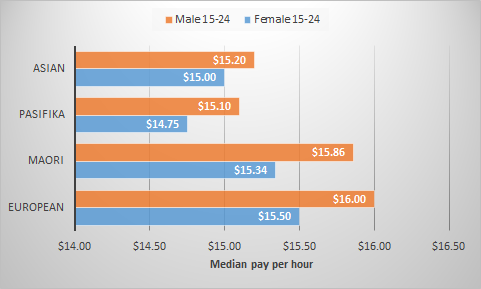
via New Zealand Income Survey 2014 via Human Rights Commission: Tracking Equality at Work
The occupations of the top 1% and the top 0.1%
29 Jul 2015 Leave a comment
in applied price theory, applied welfare economics, entrepreneurship, financial economics, human capital, labour economics, occupational choice Tags: CEO pay, compensating differentials, entrepreneurial alertness, top 0.1%, top 1%, top income earners, top wage earners
Page 41 from "An Illustrated Guide to Income" more economic #dataviz at: bit.ly/11v2e9k http://t.co/7Hlgk4AjZn—
Catherine Mulbrandon (@VisualEcon) May 22, 2013
Why next to no gender wage gap for under 45s in New Zealand?
28 Jul 2015 Leave a comment
in discrimination, economics of education, gender, human capital, labour economics, labour supply, occupational choice, politics - New Zealand Tags: gender wage gap
Figure 1: unadjusted median pay per hour by gender and age group, New Zealand, 2014

Source: New Zealand Income Survey 2014 via Human Rights Commission: Tracking Equality at Work.
More evidence on the rise and rise of the working super rich – the top income earners are top wage earners now
28 Jul 2015 Leave a comment
in economic history, economics of education, entrepreneurship, financial economics, human capital, labour supply, occupational choice, politics - USA Tags: creative destruction, entrepreneurial alertness, top 1%, top income earners, top wage earners
Page 47 from "An Illustrated Guide to Income" more economic #dataviz at: bit.ly/10QWgyR http://t.co/d1dhSYKWDC—
Catherine Mulbrandon (@VisualEcon) June 03, 2013
The gender wage gap by educational attainment
28 Jul 2015 Leave a comment
in discrimination, economics of education, gender, human capital, labour economics, occupational choice Tags: College premium, education premium, gender wage gap
Men's and Women's Earnings by Education (Ph'Ds are the most equal) bit.ly/153m9jZ http://t.co/IPfT15Qwiz—
Catherine Mulbrandon (@VisualEcon) September 03, 2013
 Utopia, you are standing in it!
Recent Comments