Is this the beginning of the rule of law in China? The right to say no to local bureaucrats?
24 Mar 2015 Leave a comment
in development economics, growth miracles, law and economics, property rights Tags: China, compulsory acquisition, rule of law, takings
The North–South theory of product life cycles
23 Mar 2015 Leave a comment
in comparative institutional analysis, entrepreneurship, industrial organisation, law and economics, managerial economics, organisational economics, property rights, survivor principle, theory of the firm Tags: entrepreneurial alertness, foreign direct investment, incomplete contracts, incomplete property rights, North-South product life cycle, product life cycles
Forecasts of the offshoring of service jobs, as an example, can be constituted into a theory of North-South product cycles. The North-South theory of the life cycle of products starts with their research and development and refinement by entrepreneurs in the advanced countries (the North) with some exporting (Grossman and Helpmann 1991a, 1991b). These innovations require resources to be invested with uncertain prospects of success. Entrepreneurs in the North compete to discover new technology-intensive products using the ample supply of R&D workers and human capital-rich workers in the industrialised countries (Grossman and Helpmann 1991a, 1991b).

As a new product matures and its production becomes more standardised, the bulk of its production can migrate to the less developed countries (the South) to take advantage of lower production costs, and these countries will become net exporters. In the South, entrepreneurs focus more on imitation. They invest resources in importing and learning the production processes developed and proven to be a success in the North (Grossman and Helpmann 1991a, 1991b).
The shifting of production of standardised products to lower-wage foreign locations will frequently be within the originating company via a foreign affiliate, because of uncertainties about property rights and contract enforcement institutions in the host countries, and only later to independent foreign firms (Antràs 2005). Within corporate hierarchies, the high-skilled managers in the developed countries will specialise in problem-solving and non-routine tasks. They will interact with middle managers and production workers in developing countries who perform the routine tasks (Antràs et al. 2006, 2008).
Contracts are typically incomplete either because they are difficult to write and/or because the court cannot enforce them. The World Trade Organization (2005, 2008) concluded that, for example, the location of offshored services depends on:
- labour costs,
- trade costs,
- the quality of institutions, particularly the legal framework,
- the tax and investment regime,
- the quality of infrastructure, particularly telecommunications, and
- skills, particularly language and computer skills.
Risks in contract negotiation and enforcement will influence which types of production is outsourced. Roughly one-third of world trade is infra-firm, and this intra-firm trade is concentrated in the capital-intensive industries because of the costs and risks of investing in contracting with arm’s-length suppliers (Antràs 2003). Considerations about R&D incentives, the availability of human capital and the quality of contract enforcement institutions weigh heavily on the development of new products and their initial and later locations of different stages of production.
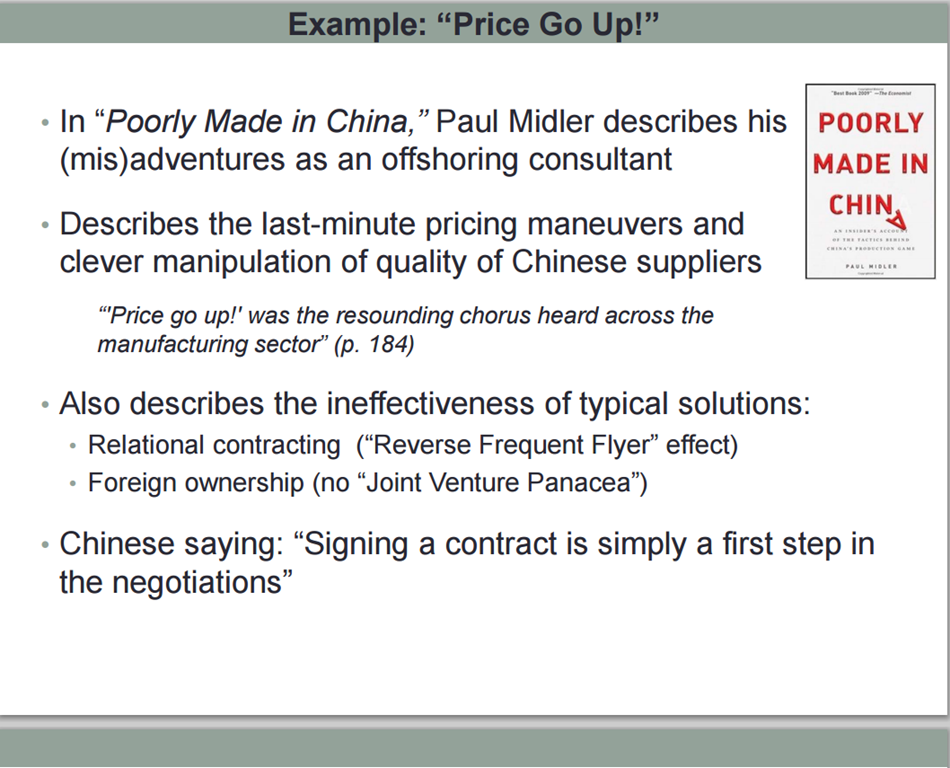
Products are initially developed in the highly industrialised countries because their sophisticated legal systems allow contracts to be enforced. Even then, in industrialised countries, the difficulties of writing and enforcing complicated contracts over the quality of new products early in the product life cycle encourages firms to make those products internally within the firm. Early in the product life cycle, if sub-contractors were used for key imports, there would have to be continual renegotiation of contracts contracts to incorporate new innovations and learning by doing. As Antras says:
Global production networks necessarily entail intensive contracting between parties located in different countries and thus subject to distinct legal systems0
As the new product standardises, and product quality in consequence becomes easier to measure and contract over, initially the innovating firm will sub-contract within the industrialised country but in time will import from developing countries. In the first instance, these imports may be from affiliates established in the developing country to ensure greater control of product quality through direct ownership of the factory. As Antras says:
Firms contemplating doing business in a country with weak contracting institutions might decide to do so within firm boundaries to have more control.
The size and shape of the firm is a direct response to mitigate the costs of contracting over quality that is hard to measure and which is constantly changing early in the product cycle. By assigning ownership rights to the party undertaking the more important investment in quality early in the product life cycle, entrepreneurs and innovators can minimise the losses caused by lack of enforceable contracts over quality when quality is changing rapidly as the firm moves through the product life cycle.

Boeing blamed the delays on the delivery of the Dreamliner on an unwillingness of sub-contractors to stand by their contractual obligations. In response, Boeing acquired some of the key sub-contractors to ensure that they delivered as promised. This is a classic operation of the theory of the firm where the entrepreneur brings within the firm what is too expensive to transact on the market because of difficulties in measuring quality and defining and enforcing property rights over what has been contracted.
Sales to locations with weak contractual enforcement are more likely to be cash in advance
22 Mar 2015 Leave a comment
in comparative institutional analysis, development economics, law and economics, property rights
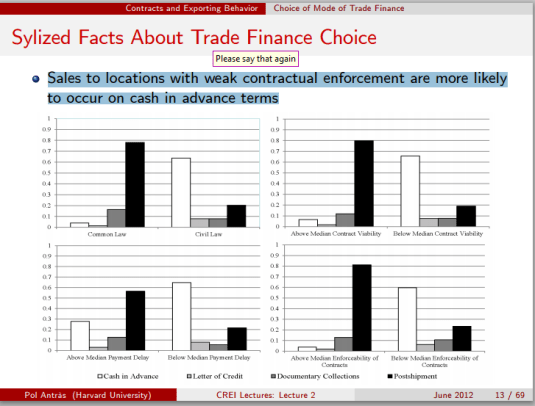
In another triumphant British Justice, trade credit is much more likely in common law countries and in countries with honest courts.
David Friedman on global warming, population and problems with the externality argument
02 Mar 2015 Leave a comment
in applied price theory, applied welfare economics, comparative institutional analysis, constitutional political economy, David Friedman, economic history, economics of information, economics of regulation, environmental economics, environmentalism, global warming, law and economics, population economics, property rights Tags: climate alarmism, competition as a discovery procedure, David Friedman, externalities, global warming, population bomb, The fatal conceit, The pretence to knowledge


Buzz Aldrin punches Moon landing conspiracy theorist stalker after being harassed by him
15 Feb 2015 1 Comment
in economics of crime, economics of media and culture, health economics, law and economics, property rights Tags: Buzz Aldrin, conspiracy theorists, moon landing hoax, privacy, self-defence, stalking
HT: Liar_tuck
An alternative to the no fault Accident Compensation Scheme in New Zealand
13 Feb 2015 Leave a comment
in health and safety, labour economics, law and economics, politics - Australia, politics - New Zealand, property rights Tags: ACC, accident compensation, right to sue, workers' compenstaion, workplace fatalities
New Zealand has a unique government monopoly since 1974 which provides compensation for personal injuries from accidents wherever they may occur in New Zealand.
The right to sue in court under tort law was abolished. Instead, there is a lower but more certain right to be compensated for loss of income and medical expenses and various other losses. The scheme is funded by a levy of about 1.4% on incomes earned, insurance premiums paid by employers and levies on motor car registrations.
The scheme essentially folds no fault workers compensation and no fault car accident insurance into a scheme that covers you for all other accidents.
What is peculiar is the abolition of the right to sue in court for ordinary damages. I never liked this taking away of the right of vindication in court.

In Australia, they have a much simpler system in some states. You can sue for personal injury under the common-law, but any damages you might win for loss of income, medical expenses and other losses is deducted dollar for dollar from any of damages you might be awarded under the compulsory insurance scheme for either workplace or car accidents. This system allows everyone to be compensated to some degree and protected against judgement proof employers, car owners and other wrongdoers. It also saves on legal costs.
The Australian dual system both gives people the right of vindication and allows those who are poorly compensated by the government monopoly to continue to be compensated for losses. For example, the compensation for lost income under the government monopoly is based on your last 12 months income rather than prospective income. This seriously disadvantages young people and students in particular at the start of their working lives and mothers who are out of the workforce.
Another thing I like about the Australian system and deeply dislike about the New Zealand system is you do not have the right to sue cowboy employers to bankrupt them.
The system of funding in New Zealand is simply a flat rate premium applies the different occupations. Premiums do not increase for high risk employers or employers who repeatedly have accidents because they are careless or negligent. This increases the number of accidents and deaths. The penalties for workplace accidents and deaths under New Zealand workplace safety regulation are rather weak. Reckless employers are fined, no one is bankrupted nor goes to prison.
The government monopoly insurer of personal accidents in New Zealand also doesn’t pay for pain and suffering. Initially it did, but that right of compensation was taken away as a cost-cutting measure about 20 years ago. Prior to that pain and suffering compensation was initially limited to $10,000, then increased to $17,000 before it was abolished.
This lack of a legal remedy for the pain and suffering from a personal injury is a grave injustice. The courts were pretty stingy on pain and suffering, so the government monopoly has taking away what was a pretty limited right anyway, but a very important right nonetheless. That common-law right was to be made whole again after being injured wrongfully.


Posner and Easterbrook opine upon the law and economics of rent control
20 Jan 2015 1 Comment
in applied price theory, applied welfare economics, law and economics, property rights, Public Choice, rentseeking, Richard Posner Tags: Frank Easterbrook, rent control, Richard Posner
POSNER, Circuit Judge, with whom EASTERBROOK, Circuit Judge, joins in 819 F. 2d 732 – Chicago Board of Realtors Inc v. City of Chicago:
The stated purpose of the ordinance is to promote public health, safety, and welfare and the quality of housing in Chicago. It is unlikely that this is the real purpose, and it is not the likely effect.
Forbidding landlords to charge interest at market rates on late payment of rent could hardly be thought calculated to improve the health, safety, and welfare of Chicagoans or to improve the quality of the housing stock.
But it may have the opposite effect. The initial consequence of the rule will be to reduce the resources that landlords devote to improving the quality of housing, by making the provision of rental housing more costly. Landlords will try to offset the higher cost (in time value of money, less predictable cash flow, and, probably, higher rate of default) by raising rents. To the extent they succeed, tenants will be worse off, or at least no better off.
Landlords will also screen applicants more carefully, because the cost of renting to a deadbeat will now be higher; so marginal tenants will find it harder to persuade landlords to rent to them. Those who do find apartments but then are slow to pay will be subsidized by responsible tenants (some of them marginal too), who will be paying higher rents, assuming the landlord cannot determine in advance who is likely to pay rent on time. Insofar as these efforts to offset the ordinance fail, the cost of rental housing will be higher to landlords and therefore less will be supplied–more of the existing stock than would otherwise be the case will be converted to condominia and cooperatives and less rental housing will be built…
The provisions that authorize rent withholding, whether directly or by subtracting repair costs, may seem more closely related to the stated objectives of the ordinance; but the relation is tenuous. The right to withhold rent is not limited to cases of hazardous or unhealthy conditions. And any benefits in safer or healthier housing from exercise of the right are likely to be offset by the higher costs to landlords, resulting in higher rents and less rental housing.
The ordinance is not in the interest of poor people. As is frequently the case with legislation ostensibly designed to promote the welfare of the poor, the principal beneficiaries will be middle-class people.
They will be people who buy rather than rent housing (the conversion of rental to owner housing will reduce the price of the latter by increasing its supply); people willing to pay a higher rental for better-quality housing; and (a largely overlapping group) more affluent tenants, who will become more attractive to landlords because such tenants are less likely to be late with the rent or to abuse the right of withholding rent–a right that is more attractive, the poorer the tenant. The losers from the ordinance will be some landlords, some out-of-state banks, the poorest class of tenants, and future tenants.
The landlords are few in number (once owner-occupied rental housing is excluded–and the ordinance excludes it). Out-of-staters can’t vote in Chicago elections. Poor people in our society don’t vote as often as the affluent. See Filer, An Economic Theory of Voter Turnout 81 (Ph.D. thesis, Dept. of Econ., Univ. of Chi., Dec. 1977); Statistical Abstract of the U.S., 1982-83, at pp. 492-93 (tabs. 805, 806). And future tenants are a diffuse and largely unknown class.
In contrast, the beneficiaries of the ordinance are the most influential group in the city’s population. So the politics of the ordinance are plain enough, cf. DeCanio, Rent Control Voting Patterns,Popular Views, and Group Interests, in Resolving the Housing Crisis 301, 311-12 (Johnson ed. 1982), and they have nothing to do with either improving the allocation of resources to housing or bringing about a more equal distribution of income and wealth.
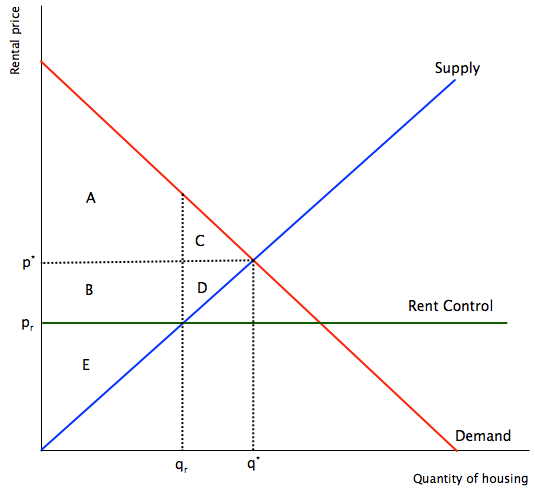
A growing body of empirical literature deals with the effects of governmental regulation of the market for rental housing. The regulations that have been studied, such as rent control in New York City and Los Angeles, are not identical to the new Chicago ordinance, though some–regulations which require that rental housing be "habitable"–are close. The significance of this literature is not in proving that the Chicago ordinance is unsound, but in showing that the market for rental housing behaves as economic theory predicts: if price is artificially depressed, or the costs of landlords artificially increased, supply falls and many tenants, usually the poorer and the newer tenants, are hurt…


Recent Comments