Edward C Prescott on the EU, business cycles and European economic research
07 May 2017 Leave a comment
in budget deficits, business cycles, economic growth, Edward Prescott, macroeconomics Tags: real business cycle theory
Monetary policy versus fiscal policy | Finn E. Kydland
21 Nov 2016 Leave a comment
in budget deficits, business cycles, economic growth, fiscal policy, macroeconomics, monetary economics Tags: Finn Kydland
The Broken Window Fallacy
26 Oct 2016 1 Comment
in budget deficits, business cycles, economic growth, economics, fiscal policy, macroeconomics Tags: crowding out

General government net financial liabilities as % Portuguese, Italian, Greek, Spanish and Irish GDPs
03 Jun 2016 Leave a comment
in budget deficits, business cycles, economic growth, economic history, Euro crisis, financial economics, fiscal policy, global financial crisis (GFC), macroeconomics Tags: Greece, Ireland, Italy, Portugal, public debt management, sovereign debt crises, sovereign defaults, Spain
I had borrowed a lot of money from scratch after 2007. Greece borrowed a lot of money of its own accord from 2010. Italy always owed a lot of money. Spanish do not know all that much money considering their dire financial circumstances.
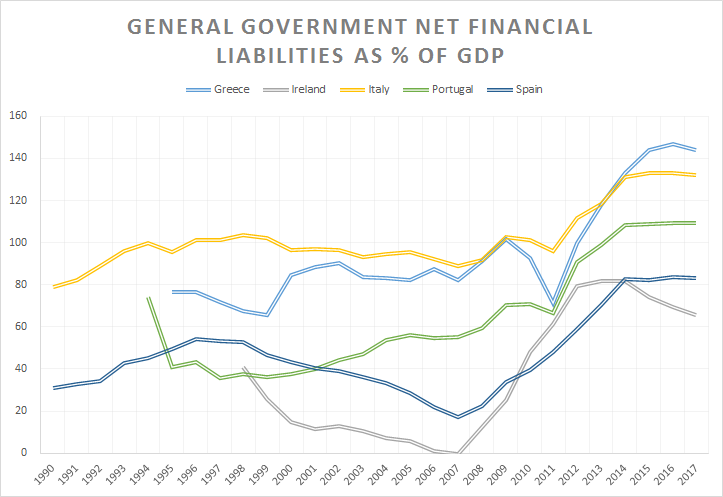
Source: OECD Economic Outlook June 2016 Data extracted on 01 Jun 2016 12:57 UTC (GMT) from OECD.Stat
General government expenditure and general government revenue as a % of Australian and New Zealand GDP since 1970
13 Mar 2016 Leave a comment
in budget deficits, economic history, fiscal policy, macroeconomics, politics - New Zealand, politics - USA, public economics Tags: Australia, growth of government, size of government
I do not trust the numbers for New Zealand prior to the early 1990s released by the OECD. New Zealand simply did not have a tax structure including a GST in the double digits back then to support estate of that size. Nonetheless, the size of government in New Zealand is systematically larger than in Australia, a richer country which can afford a large government and generous welfare state.
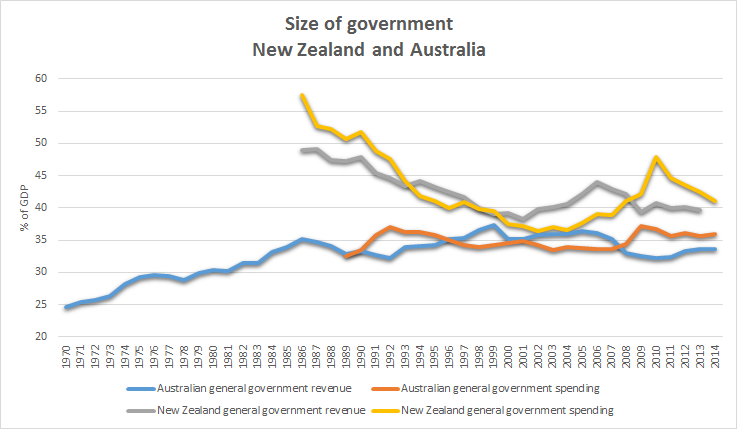
Source: General government – General government revenue – OECD Data and Data extracted on 12 Feb 2016 08:45 UTC (GMT) from OECD.Stat from OECD Economic Outlook November 2015.
General government spending and general government revenue as % of US GDP since 1970
12 Mar 2016 Leave a comment
in budget deficits, economic history, fiscal policy, politics - USA, public economics Tags: growth of government, size of government
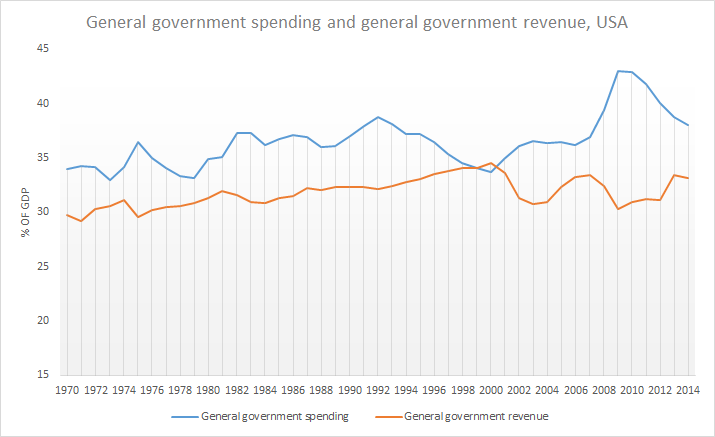
Source: General government – General government spending – OECD Data and Source: General government – General government revenue – OECD Data.
The modern macroeconomics of the Global Financial Crisis
02 Dec 2015 Leave a comment
in applied price theory, budget deficits, business cycles, economic growth, economic history, economics of regulation, Euro crisis, fiscal policy, global financial crisis (GFC), great depression, great recession, macroeconomics, monetary economics Tags: adverse selection, bank panics, bank runs, banking crises, deposit insurance, economics central banks, financial crises, moral hazard, sovereign defaults
Where are British taxes spent?
26 Nov 2015 1 Comment
in budget deficits, defence economics, economics of education, fiscal policy, health economics, labour supply Tags: ageing society, British economy, British politics, demographic crisis
The dangerous left-wing bias of economists strikes again
21 Sep 2015 2 Comments
in applied price theory, budget deficits, business cycles, economics of regulation, history of economic thought, occupational choice, politics - USA
The left-wing bias of economists must be taken into account in public policy-making. Any suggestions to regulate the economy, spend our way out of a recession, increase the top tax rate and so on must be discounted for that well-known but little publicised political bias.
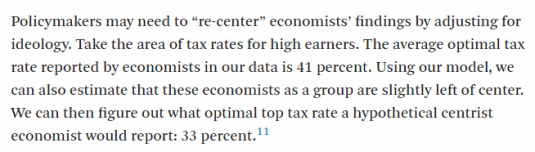
Source: Economists Aren’t As Nonpartisan As We Think | FiveThirtyEight
As is not well-known enough, Cardiff and Klein (2005) used voter registration data to rank disciplines at Californian Ivy League universities by Democrat to Republican ratios. Economics is the most conservative social science, with a Democrat to Republican ratio of a mere 2.8 to 1. This can be contrasted with sociology (44 to 1), political science (6.5 to 1) and anthropology (10.5 to 1). 40% of Americans are Democrats, 32% are independents with the balance Republicans.

Zubin Jelveh, Bruce Kogut, and Suresh Naidu confirmed that bias: that the typical economist is a moderate Democrat. They found a 60–40 liberal conservative bias

Jelveh, Kogut, and Naidu also reminded, as many have before them that economics is the most politically diverse of academic professions. Sociology is a notorious left-wing echo chamber as an example. Their most likely view of Jeremy Corbyn is he is a bit of a Tory. Oddly enough, sociologists are the first to point the finger at economists for political bias.

Jelveh, Kogut, and Naidu correlated political donations of more than $200 in the Federal Elections Commission database with the language used in 18,000 journal articles back to the 1970s.

More interestingly, they correlated political bias with the estimates of quantitative effects such as the top tax rate and its impact on labour supply and investment:
We found a (significant) correlation when we compared the ideologies of authors with the numerical results in their papers. That means that a left-leaning economist is more likely to report numerical results aligned with liberal ideology (and the same is true for right-leaning economists and conservative ideology)… liberals think the fiscal multiplier is high, meaning the government can improve economic growth by increasing spending, while conservatives believe the multiplier is close to zero or negative.
They are not suggesting a rigging of the results. Economists tend to sort into the fields that suit their ideologies:
It’s more likely that these correlations are driven by research areas and the methodologies employed by economists of differing political stripe. Economics involves both methodological and normative judgments, and it is difficult to imagine that any social science could completely erase correlations between these two… macroeconomists and financial economists are more right-leaning on average while labour economists tend to be left-leaning. Economists at business schools, no matter their specialty, lean conservative. Apparently, there is “political sorting” in the academic labour market.
Before you start writing out the indictment that economic policy and the global financial crisis is the product of a vast left-wing conspiracy within the economics profession you should remember the wise words of George Stigler.
Stigler argued that ideas about economic reform needed to wait for a market. He contended that economists exert a minor and scarcely detectable independent influence on the societies in which they live. As is well known, Stigler in the 1970s toasted Milton Friedman at a dinner in his honour by saying:
Milton, if you hadn’t been born, it wouldn’t have made any difference.
Stigler said that if Richard Cobden had spoken only Yiddish, and with a stammer, and Robert Peel had been a narrow, stupid man, England would have still have repealed the Corn Laws in the 1840s. England would still have moved towards free trade in grain as its agricultural classes declined and its manufacturing and commercial classes grew in the 1840s onwards because of the industrial revolution.
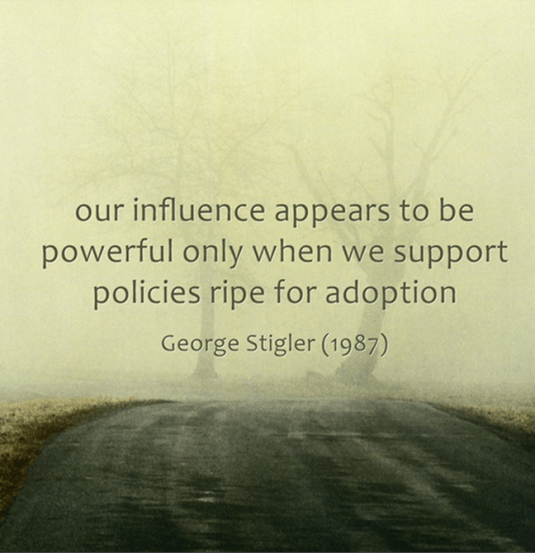
As Stigler noted, when their day comes, economists seem to be the leaders of public opinion. But when the views of economists are not so congenial to the current requirements of special interest groups, these economists are left to be the writers of letters to the editor in provincial newspapers. These days, they would run an angry blog.


Recent Comments